
Microsoft
Developer Blogs
Get the latest information, insights, and news from Microsoft.
Highlights
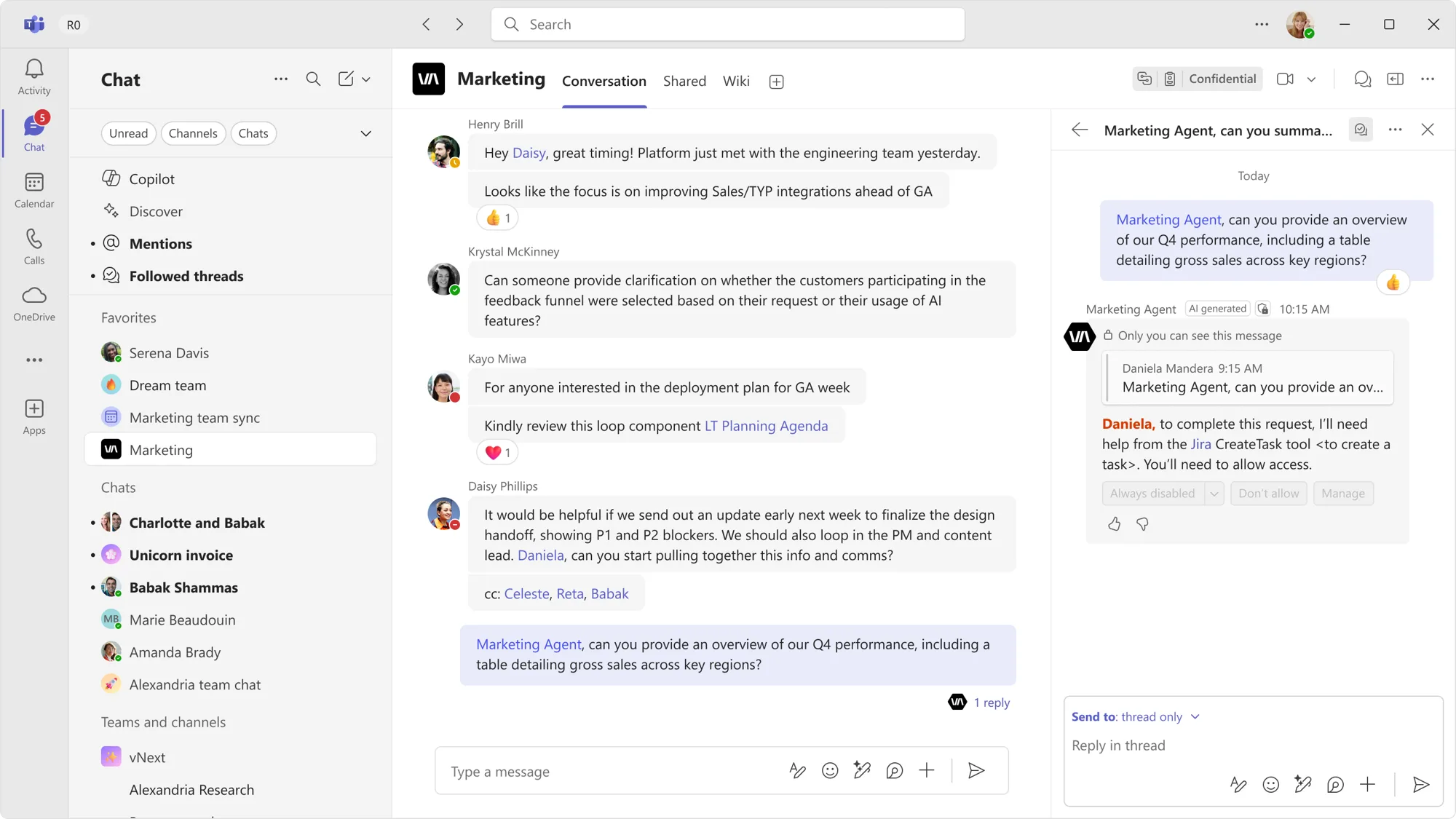
Building Agents for Teams: Turning conversations into outcomes
How to test agent skills without hitting real APIs
Latest posts
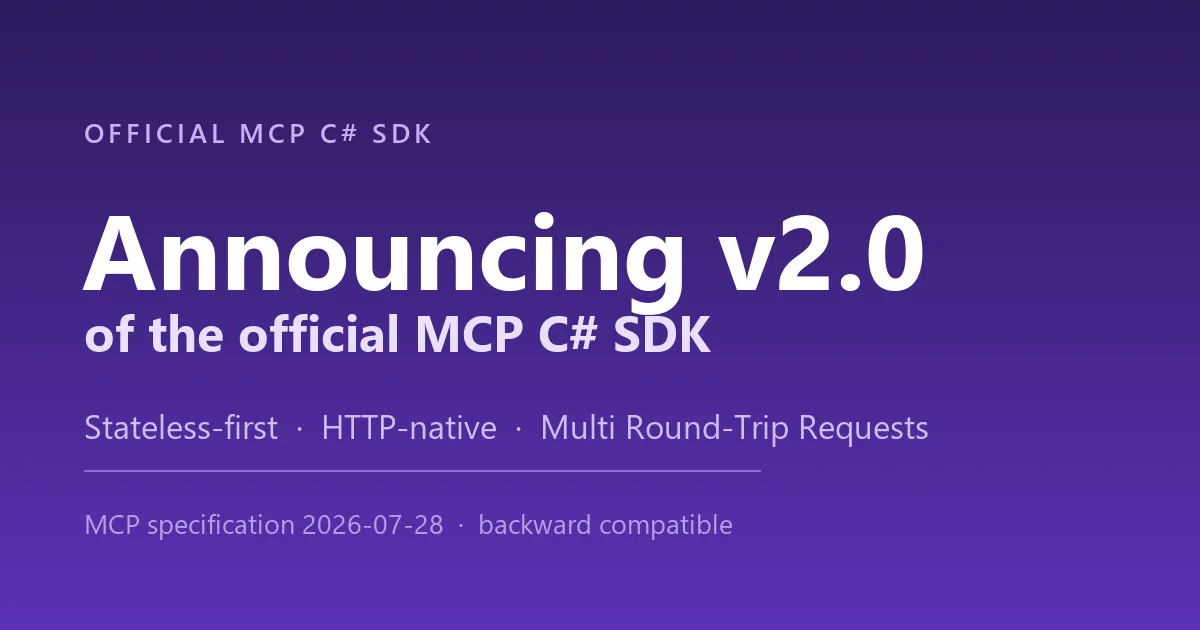
Announcing v2.0 of the official MCP C# SDK

MCP C# SDK v2.0 implements the 2026-07-28 specification with a stateless-first protocol, standardized HTTP headers, and Multi Round-Trip Requests for interactive tools, all while staying backward compatible.

Package Integrity and Enforcement

A recent conversation started (as many interesting conversations do) with a simple question: "Why is MSIX secure?" MSIX includes multiple layers of protection designed to defend against both accidental damage and malicious tampering. But as with all good security solutions, it's not the individual elements so much as their interlocking design that makes the whole stronger than the sum of its parts. MSIX was designed around several core facets, integrated in sometimes novel ways. A packaged process can be trusted to a higher degree than most applications because Windows maintains a verifiable chain of trust fr...
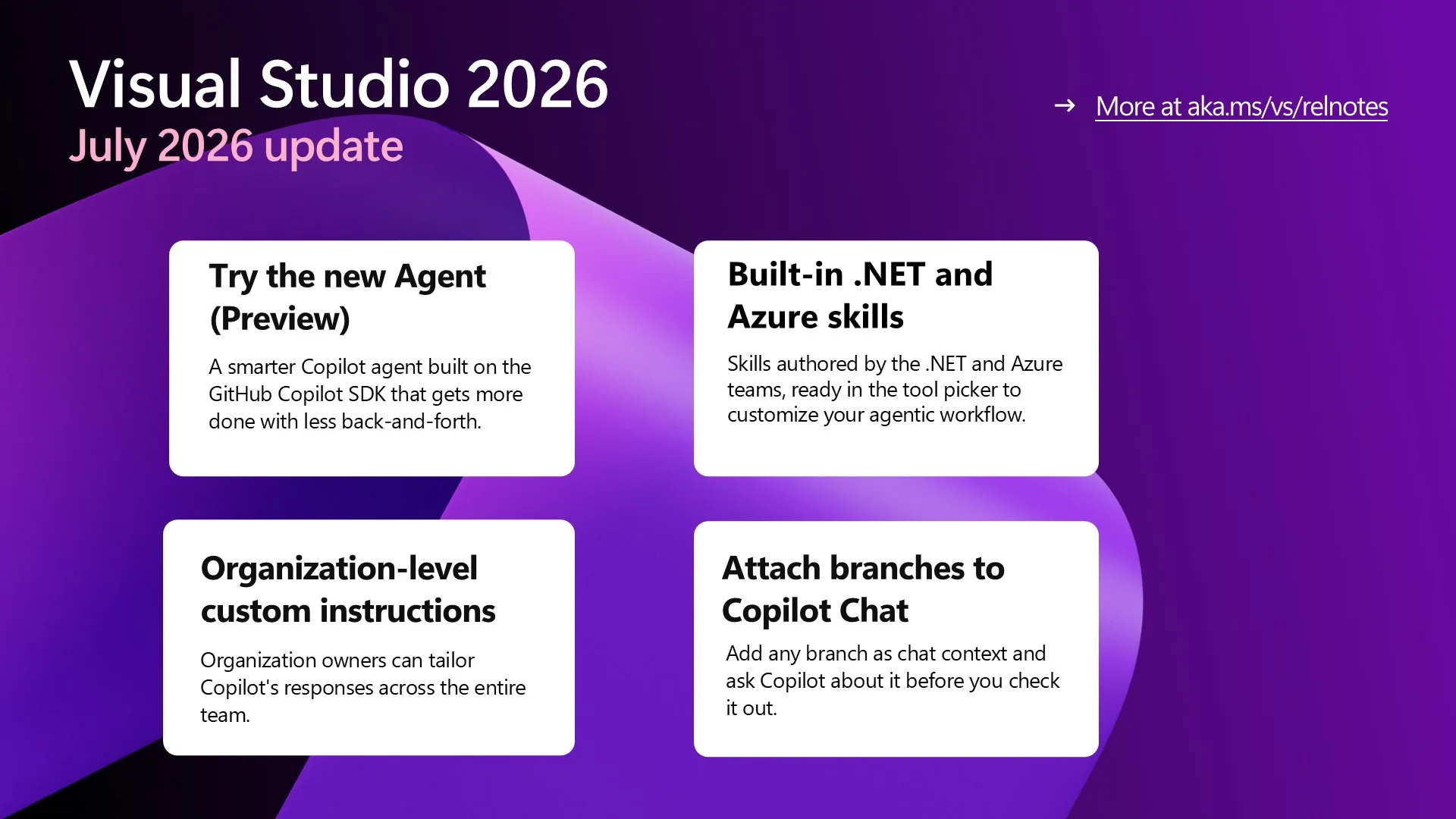
Visual Studio July Update — Meet the New Agent, Powered by the GitHub Copilot SDK

There's a new Agent (Preview) in Copilot Chat, built on the same GitHub Copilot SDK that powers the GitHub Copilot CLI, that gets more done with less back-and-forth.
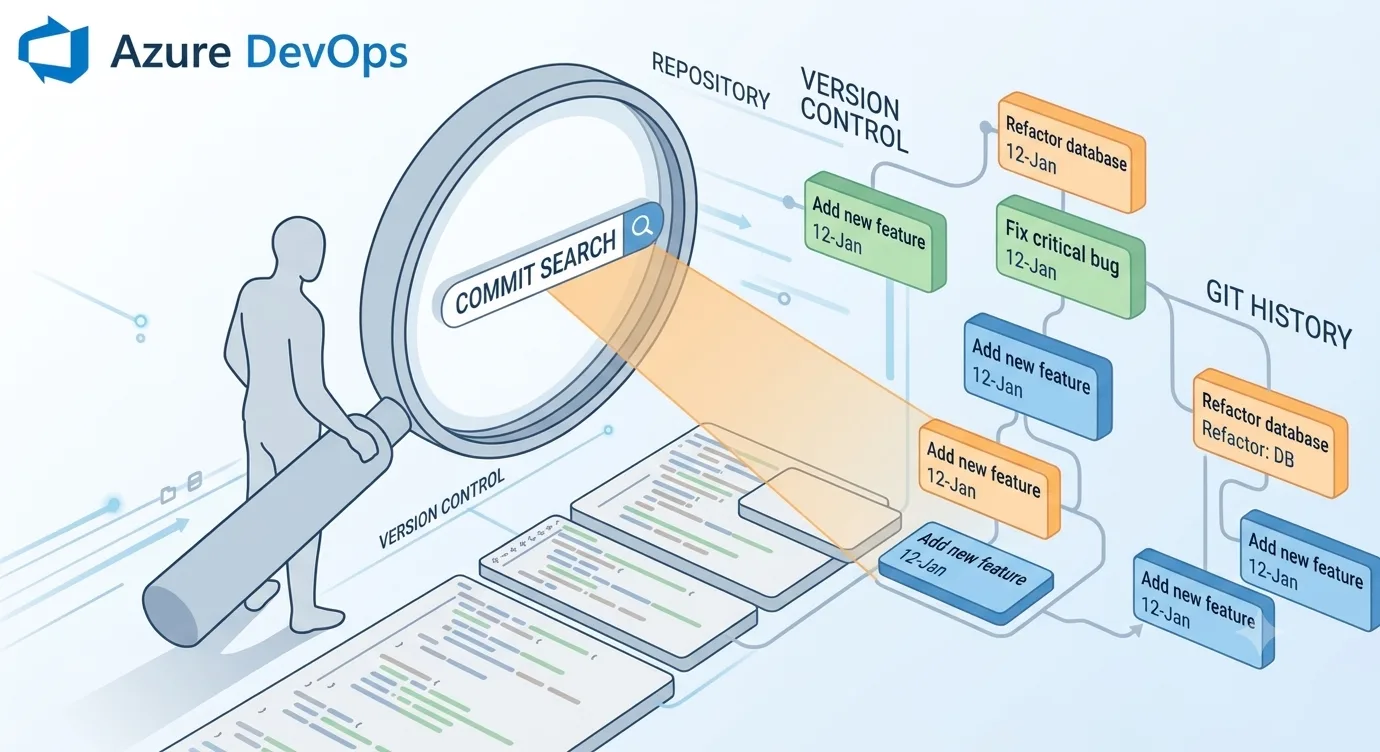
Find any commit in seconds: Commit Search comes to Azure DevOps

Great code has a long memory. The fix you shipped last quarter, the refactor that touched a dozen files, the one-line change that explained why something works the way it does — it's all there in your commit history. The hard part has always been finding it. Today, we're excited to announce that Commit Search is entering general availability (GA) in Azure DevOps. This is a capability our team has been building and refining for quite some time — through design, a private preview with early customers, and a careful, staged rollout — and we couldn't be happier to bring it to everyone. Why we built Commit Search C...

Making an agile version of a Windows Runtime delegate in C++/WinRT, part 7

Further explorations into exception safety.
Refactor your database with SQL projects in VS Code

SQL database projects are a fundamental tool for keeping your database in source control, tracking changes and collaborating on quickly evolving database needs. Not to be forgotten, their superpower is being able to dynamically generate deployment scripts that match the declared state and the exact environment you're deploying to. SQL project development becomes more challenging when a database needs serious changes, where the requirements of the system have evolved to the point of having to rename tables and move objects between schemas. In plain T-SQL, we can rename a table or column without having to co...
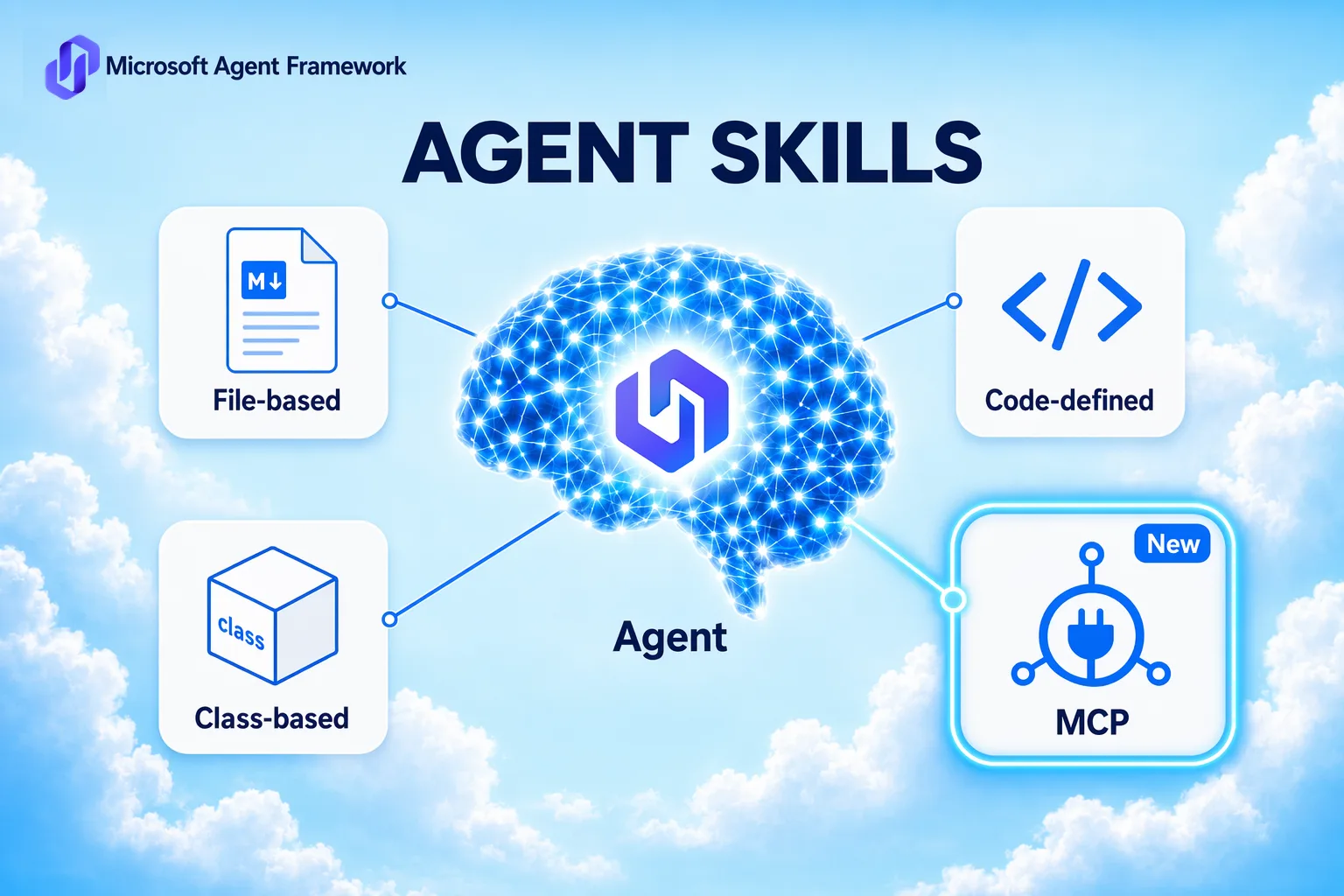
Discover Agent Skills from MCP servers in .NET

Your agents can now discover and load Agent Skills directly from a Model Context Protocol (MCP) server. Instead of shipping every skill inside your application or copying skill folders into each deployment, you point an agent at an MCP server and it pulls the skills it needs on demand. A central team can publish skills once, and every agent across your organization picks them up without a redeploy. This is available today in .NET through the package. For makers, this removes a distribution problem: you author a skill in one place and serve it to many agents. For enterprise leaders, it means domain expertise –...
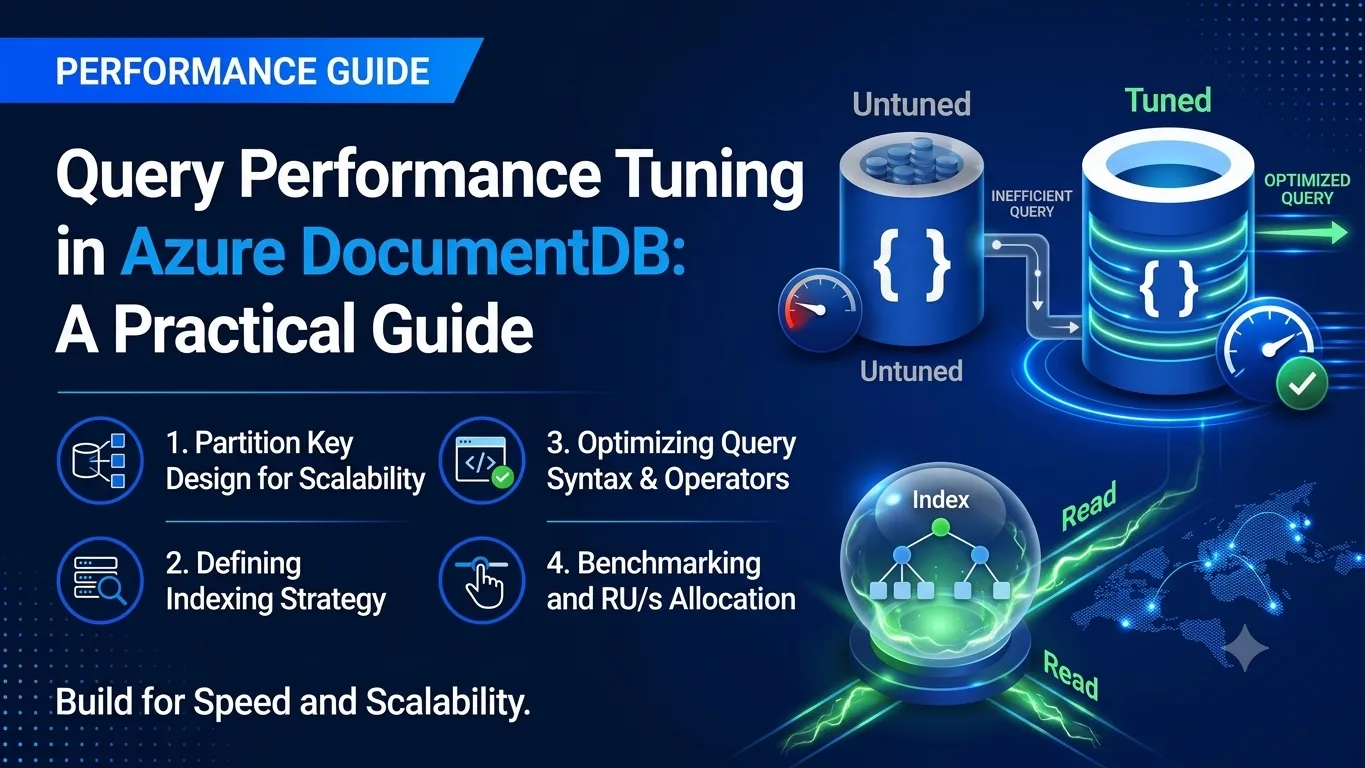
Query Performance Tuning in Azure DocumentDB: A Practical Guide


Writing a query that works is easy. Writing a query that scales is a different story. As collections grow to millions of documents, queries that returned results in milliseconds during development start taking seconds or timing out entirely. The root cause is almost always the same: the database is doing far more work than it needs to. In this post, we’ll take a single, realistic query and walk through the full optimization process: running explain() to understand what’s happening under the hood, building indexes step by step, and applying the ESR rule to design a compound index that eliminates wasted scans and...
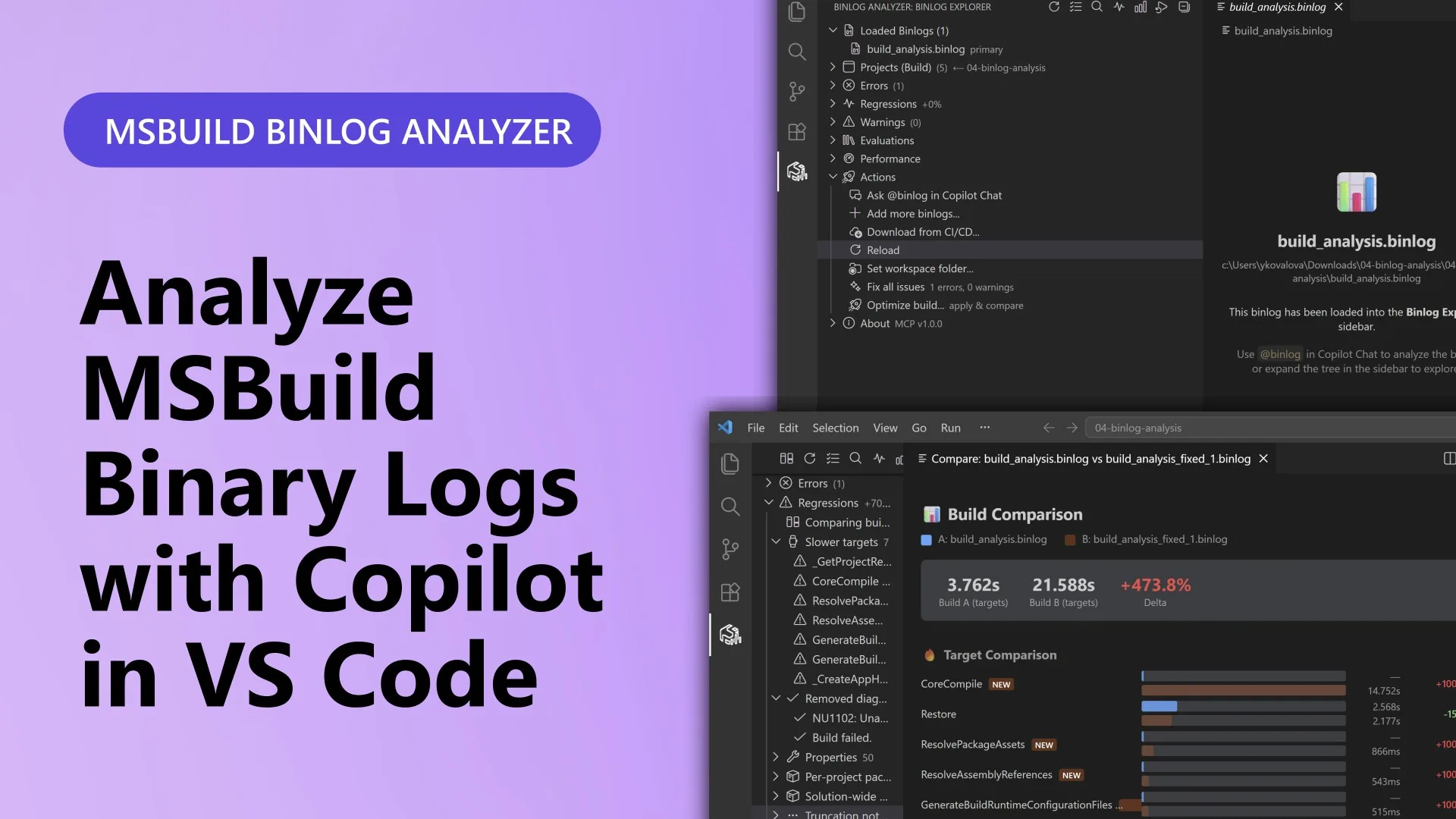
Analyze MSBuild Binary Logs with Copilot in VS Code


Meet the MSBuild Binlog Analyzer for VS Code - a Copilot-powered way to read MSBuild binary logs, explain and fix build failures with one click, compare builds, and catch regressions, backed by the Microsoft.AITools.BinlogMcp MCP server.
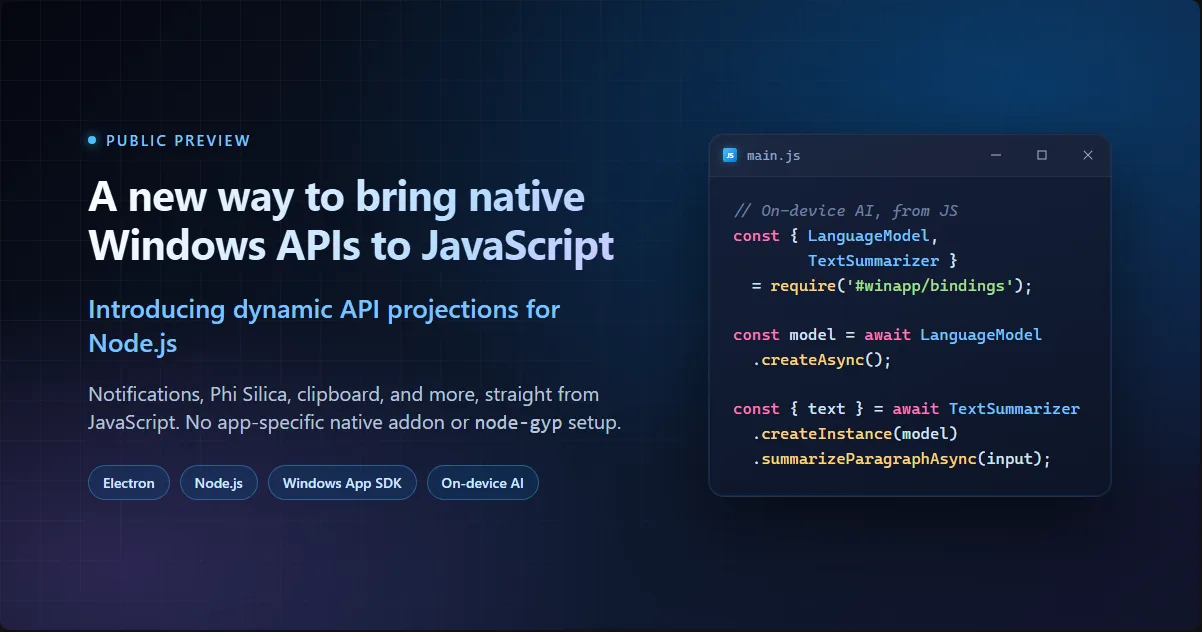
A new way to bring native Windows APIs to JavaScript – introducing dynamic API projections for Node.js

Electron and Node.js make it straightforward to build Windows desktop apps in JavaScript. Calling Windows Runtime APIs has been less straightforward: features such as on-device AI often required a C++ or C# bridge, manual translation of WinRT types and asynchronous behavior, and wrapper code for every exposed API. That meant another language and toolchain to build, test, and keep compatible with Electron. We're making a dynamic Windows Runtime API (WinRT) projection for Node.js available in public preview. It lets an Electron app or plain Node.js process call supported Windows Runtime APIs directly fro...
Making an agile version of a Windows Runtime delegate in C++/WinRT, part 6
Exception-safety, the invisible bug.

Java OpenJDK July 2026 Patch & Security Update

Hello Java customers! We are happy to announce the latest July 2026 patch & security update release for the Microsoft Build of OpenJDK. Check our release notes page for details on fixes and enhancements or download and install the binaries today. The source code of our builds are now available on GitHub for further inspection: Microsoft Build of OpenJDK specific updates OpenJDK 25 OpenJDK 21 OpenJDK 17 OpenJDK 11 Summary of Upstream Updates OpenJDK Vulnerability Advisory July 2026 OpenJDK 25 OpenJDK 21 ...
Making an agile version of a Windows Runtime delegate in C++/WinRT, part 5
Making sure to use the non-agile delegate non-agile-ly.
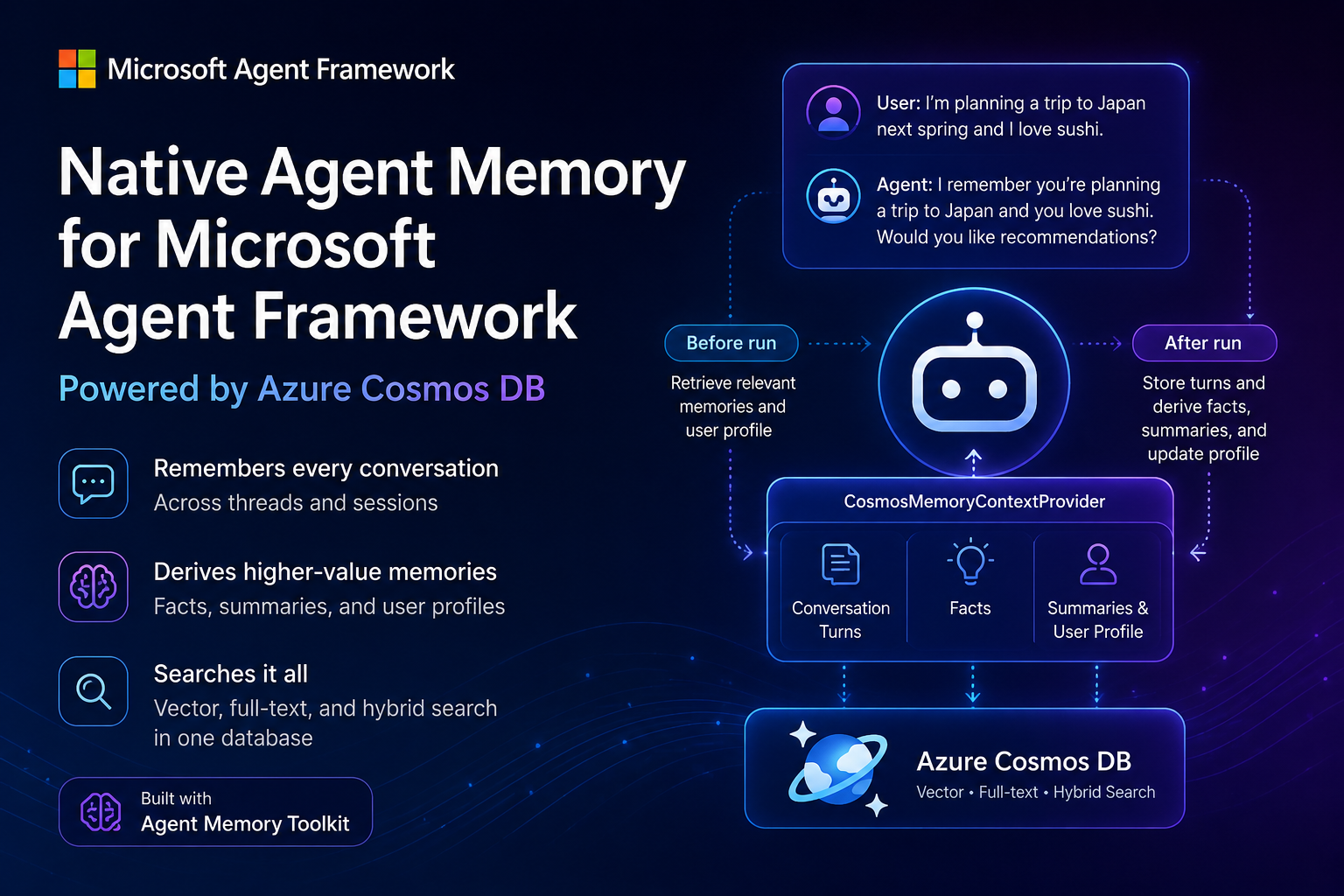
Native Agent Memory for Microsoft Agent Framework, Powered by Azure Cosmos DB

Recently we introduced the Agent Memory Toolkit and the Agentic Retrieval Toolkit for Azure Cosmos DB. The Agent Memory Toolkit gives your agents durable, Cosmos-backed memory: it stores raw conversation turns and then distills them into higher-value derived memories (thread summaries, extracted facts, and cross-thread user profiles), all searchable with vector, full-text, and hybrid search in the one database you already use. Today we're taking the next step. With the latest release of Microsoft Agent Framework, you can now drop that memory into an agent with a single object: the , shipped in the new package f...

The Microsoft 365 Copilot Agent’s Playbook: A Practical Livestream Series for Building Better Agents

Building on Microsoft 365 Copilot? Here's your playbook. Declarative agents are quickly becoming one of the most exciting ways to extend Microsoft 365 Copilot and bring organizational knowledge, workflows, and tools directly into the flow of work. But as agent capabilities grow, so does the need for practical guidance: How do you build agents that are useful, grounded, extensible, and measurable? That’s why we’re launching The Microsoft 365 Copilot Agent’s Playbook, a four-part livestream series designed to help developers, makers, and technical teams understand how modern Microsoft 365 Copilot de...

Move Agent Orchestration/Workflows out of Code with Agent Framework Declarative Workflows 1.0

Most multi-agent apps wire every flow in application code: the sequence of steps, branching, and handoffs between agents all live inside the program, making the orchestration harder to review, version, and change. Declarative workflows make that orchestration explicit. In YAML, you define how agents coordinate, how state changes, where execution branches, and when people step in. Agent Framework loads the definition into a standard workflow you can run, stream, and compose with code. Today, declarative workflows reach 1.0 across both Agent Framework SDKs. Python's package is now 1.0.0, joining th...
Build locally, ship to Azure: meet Azure SQL Developer


Big news: Azure SQL Developer is here, in private preview. It's the Azure SQL Database engine, on your laptop, in a container. Build against the exact engine you run in the cloud. Ship the same code to Azure. Change one line, the connection string, and you're in production. Free for local dev and CI. No subscription. No credit card. No catch. Run it yourself, or hand it to an AI agent and watch it go. The inner-loop problem If you build apps on a cloud database, you know the friction. To develop and test locally, you either point your app at a shared cloud instance, with slow round trips, noisy neighbors, and ...
Making an agile version of a Windows Runtime delegate in C++/WinRT, part 4
Optimizing the context check.
Smarter Spring Development in Eclipse with GitHub Copilot


How the Spring Tools MCP Server and GitHub Copilot together make Spring Development more efficient. Introduction If you write Spring Boot applications in Eclipse, you already know that Spring Tools for Eclipse brings best-in-class tooling right into your IDE, including quick navigation and visualization of core Spring elements in your projects, live information from running Spring Boot applications, Spring specific auto completion, validations and quick fixes, request mapping overviews, and much more. In addition to that, if you have the GitHub Copilot plugin for Eclipse installed, you have a powerful AI codi...
Pure Virtual C++ 2026 Is a Wrap

Pure Virtual C++ 2026 is a wrap. Every featured and on-demand session is now available on YouTube — catch up on C++/Rust interop, AI-driven tooling, build performance, and more.
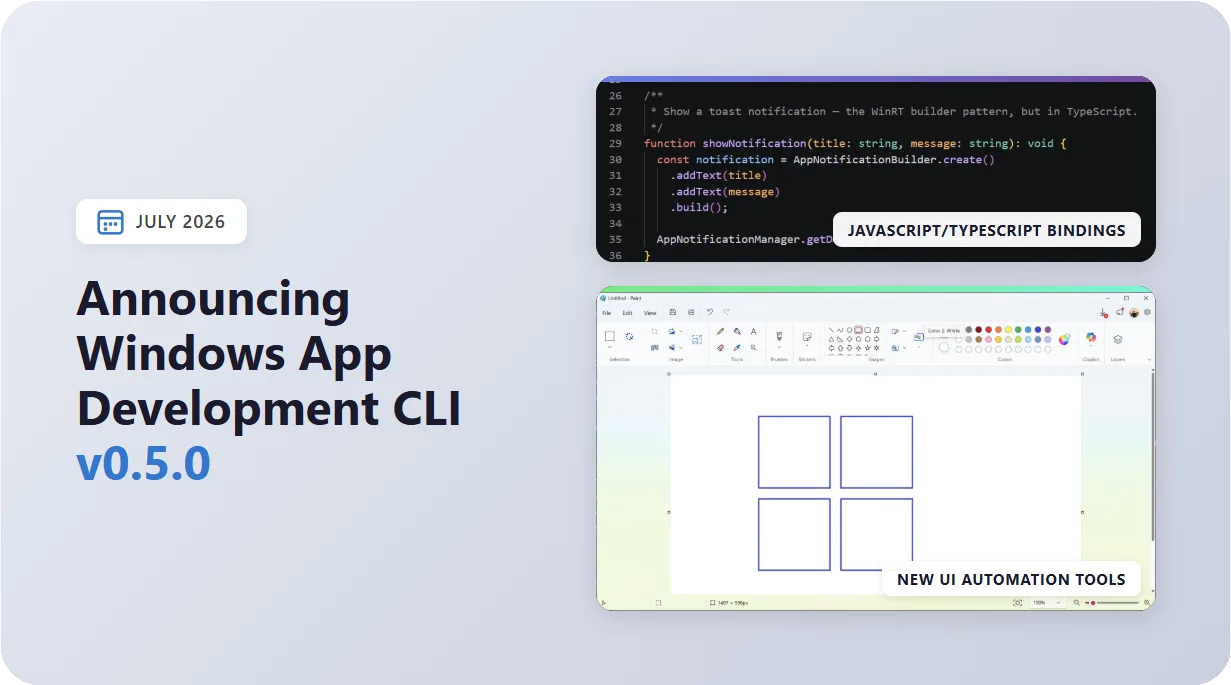
Windows App Development CLI v0.5.0 – expanded UI automation, JS/TS bindings, and more

WinApp CLI v0.5.0 greatly expands the UI automation toolkit (recording, touch, pen, and keyboard injection), lets you call Windows Runtime APIs straight from JavaScript and TypeScript with zero native addons, and makes WinUI crashes far easier to diagnose. Get the update by running winget install Microsoft.WinAppCLI or check the repo for other install options. Here's what the new version has to offer in depth: 🕹️ An expanded UI automation toolkit The winapp ui command family grew from inspection into a complete automation toolkit. On top of the existing inspect/click/screenshot verbs, these relea...

Building Agents that Act on Your Behalf with Toolboxes in Foundry


How Toolboxes in Foundry simplify user delegation At some point, many agents move from answering questions to taking action. And when it does, the question becomes: whose identity is it acting with? Imagine you are building an internal employee agent. It needs to call a private, Entra-protected MCP server for orders, and it also needs to use Microsoft’s managed Work IQ MCP server to reason over the employee’s Microsoft 365 context. In both cases, the agent can’t run as a managed identity or service account. It has to act as the real signed-in user — with that user’s permissions, access boundaries, and data pr...
Making an agile version of a Windows Runtime delegate in C++/WinRT, part 3
The object that actively refuses to be marshaled.
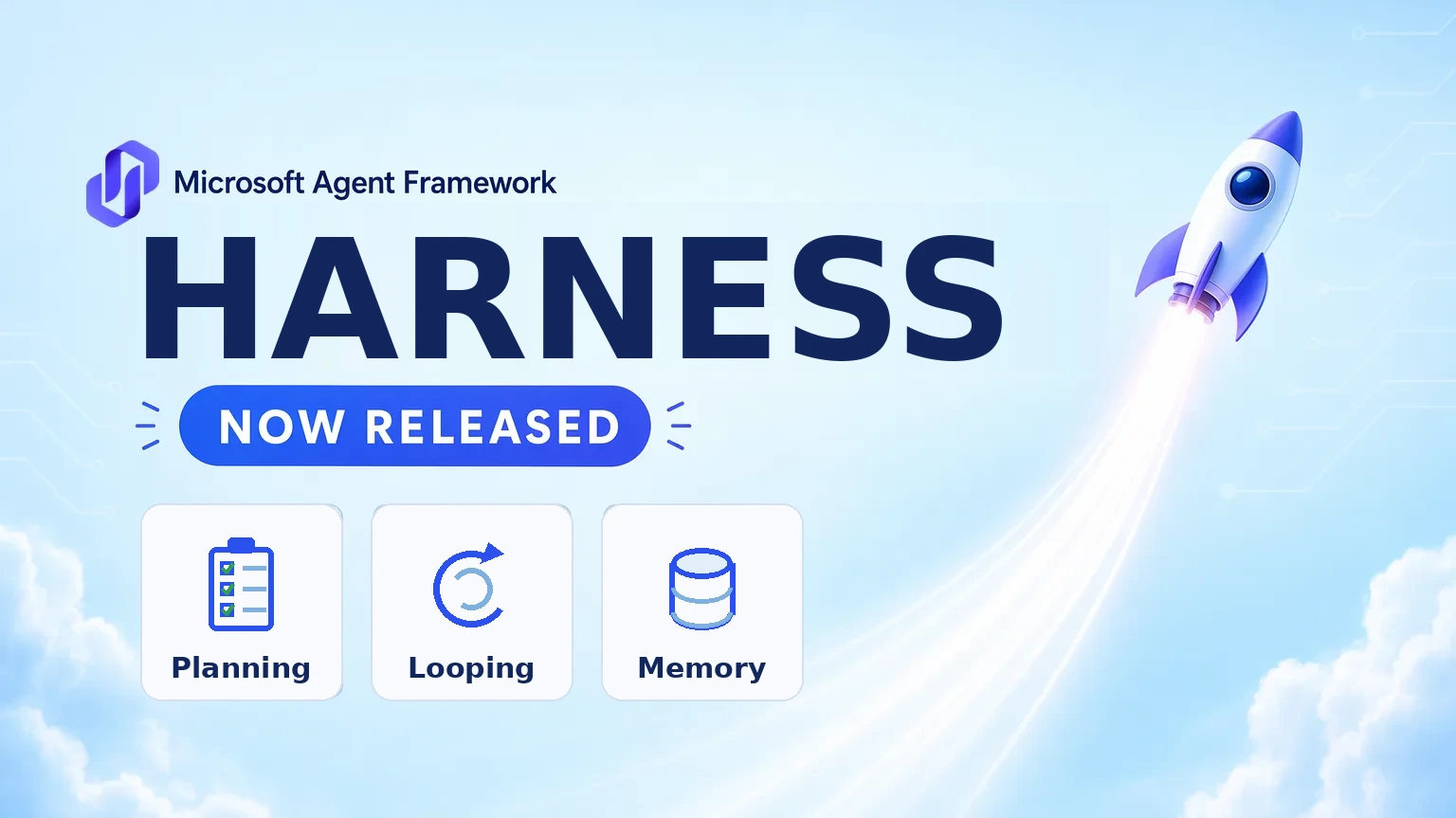
The Microsoft Agent Framework Harness is now released

Your agents can now be built on a stable, batteries-included harness - the loop, planning, memory, context management, approvals, and telemetry that turn a model into an agent that actually does things - in both Python and .NET. What is an agent harness? An agent harness is the scaffolding that turns a language model into an agent. A model on its own can only generate text. To have it call tools, work through multi-step tasks, remember what it has done, and keep going until the job is finished, you need a runtime wrapped around the model - and that runtime is the harness. Agent Framework ships a ready-made o...
Pure Virtual C++ 2026 Is Now Live!
Pure Virtual C++ 2026 is streaming now — watch five featured sessions live with Q&A, plus a full on-demand playlist, all free.
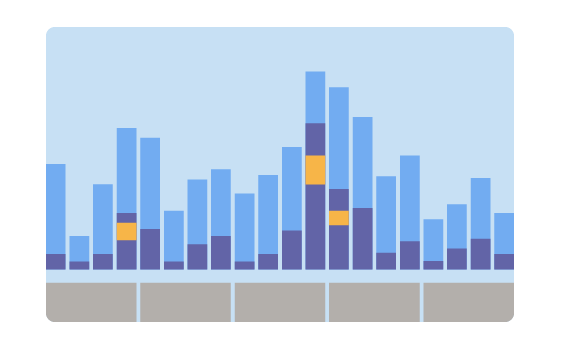
Introducing the ETW MCP: AI-assisted ETL trace analysis, headless and in your terminal

If you’ve ever opened an ETL trace with hundreds of data tables and wondered “where do I even start?” This post is for you. We’re releasing an early preview of the ETW MCP, a Model Context Protocol server that lets GitHub Copilot, or any MCP-aware AI assistant, read, query, and reason over Event Tracing for Windows (ETW) traces the same way an experienced engineer would. No UI required. This is a companion to the WPA MCP (coming soon), which brings the same AI-assisted experience inside Windows Performance Analyzer. The ETW MCP server is the headless sibling, same data layer, no WPA needed, works anywhere you ...
July Patches for Azure DevOps Server

We are releasing new patches for our self‑hosted product, Azure DevOps Server. We strongly recommend that all customers stay up to date with the latest, most secure version of Azure DevOps Server. The most recent release, Azure DevOps Server, is available on the download page. The following versions have been patched. For more details on these updates, see the release notes: ⬇️Azure DevOps Server Patch Download ✅Verifying Installation To verify that the patch is installed, run the following command on the Azure DevOps Server machine using the patch installer you downloaded: Replace with the name of the...

Display Name is for Humans
Package identity exists for one primary purpose: This is a considerable improvement over the historical tendency to assign UUIDs and GUIDs to nearly everything - including things that humans were expected to discuss in meetings. Identity Is for Systems A package's Name, Package Full Name, and other identity-derived values are intended for developer and system use. These identifiers prioritize correctness, uniqueness, and programmatic consumption - not clarity or friendliness from an end-user's perspective. Identity must remain stable across servicing operations and dependency resolution. If it changes, the...
Making an agile version of a Windows Runtime delegate in C++/WinRT, part 2
Short-circuiting the easiest case.
How to test agent experience changes without shipping them


Most changes you think will improve AI agent behavior won't. We tested a dozen hypotheses on a real project upgrade scenario and the majority failed. Learn how to emulate documentation, API, and MCP server changes locally so you can validate what works before shipping anything to production.

C++ Dependencies Without the Headache: vcpkg + Copilot CLI

At Pure Virtual C++ 2026, we build a C++ console app from an empty folder using CMake, MSVC, and GitHub Copilot CLI. This walkthrough shows a practical prompt sequence for dependency selection, reproducible builds, and controlled updates.
Pure Virtual C++ 2026 Is Tomorrow and On-Demand Sessions Are Now Available
The on-demand sessions for Pure Virtual C++ 2026 are available now on YouTube. Watch seven talks on SPGO, vcpkg + Copilot CLI, CMake Tools, PackageReference, MSVC upgrades, and C++23/26 status — then join us live tomorrow.
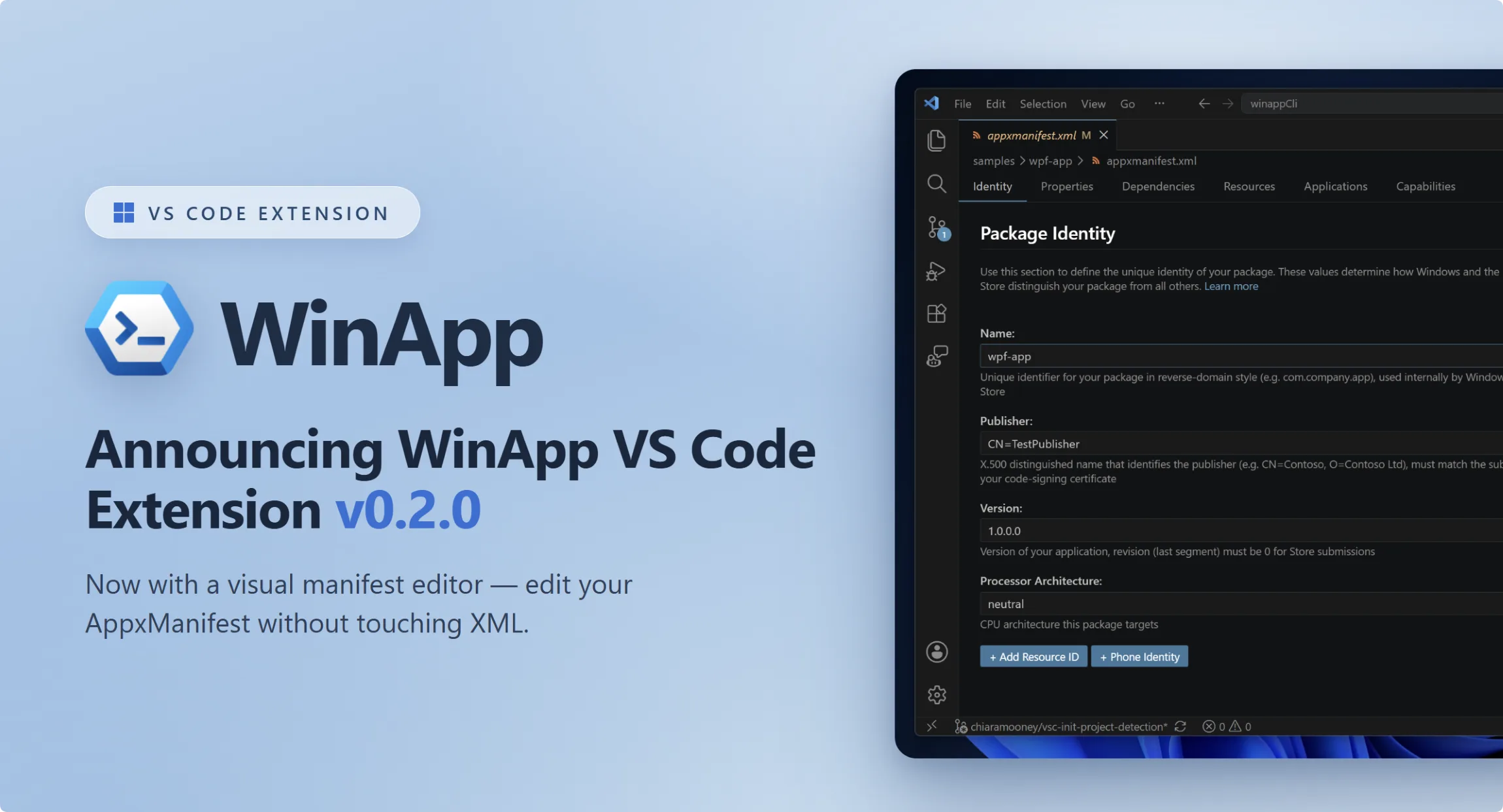
Announcing a New Visual Manifest Editor in the WinApp VS Code Extension

The WinApp VS Code extension exists to make Windows app development feel at home in VS Code. It brings the Windows App Development CLI right into the editor, so you can initialize, run, debug, package, and sign Windows apps built with .NET, WPF, WinUI, C++, Electron, Rust, Tauri, or Flutter, all without switching tools. Get it now: Install the WinApp extension from the VS Code Marketplace. We're excited to announce the release of v0.2. This release includes a new editor that supports editing a manifest file without touching raw XML and support for running WinApp commands in multi-app workspaces. A Visu...
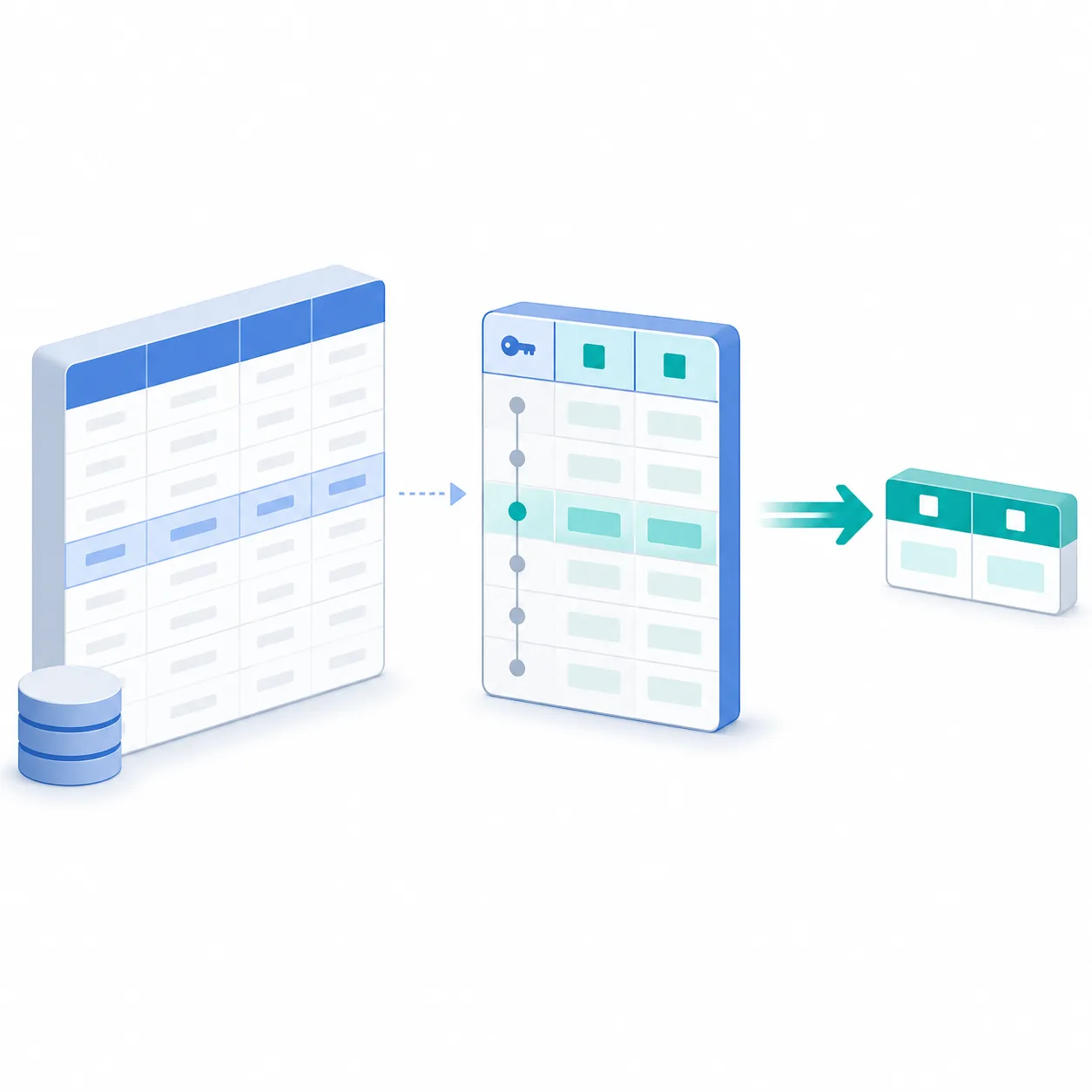
T-SQL Hygiene: Introducing the Covering Index

Often in applications, we write database queries. And often, the same query is executed again and again. To make queries against large tables faster, we can add an index. This is a general improvement for anyone accessing the table. However, there is a specially designed index called a covering index that can make queries against large tables particularly faster for one specific query. We call it covering because it covers all the projections and predicates in that query. Which query? That is up to you, the developer, to identify. Look for queries that are either 1) very important to run fast or 2) extreme...
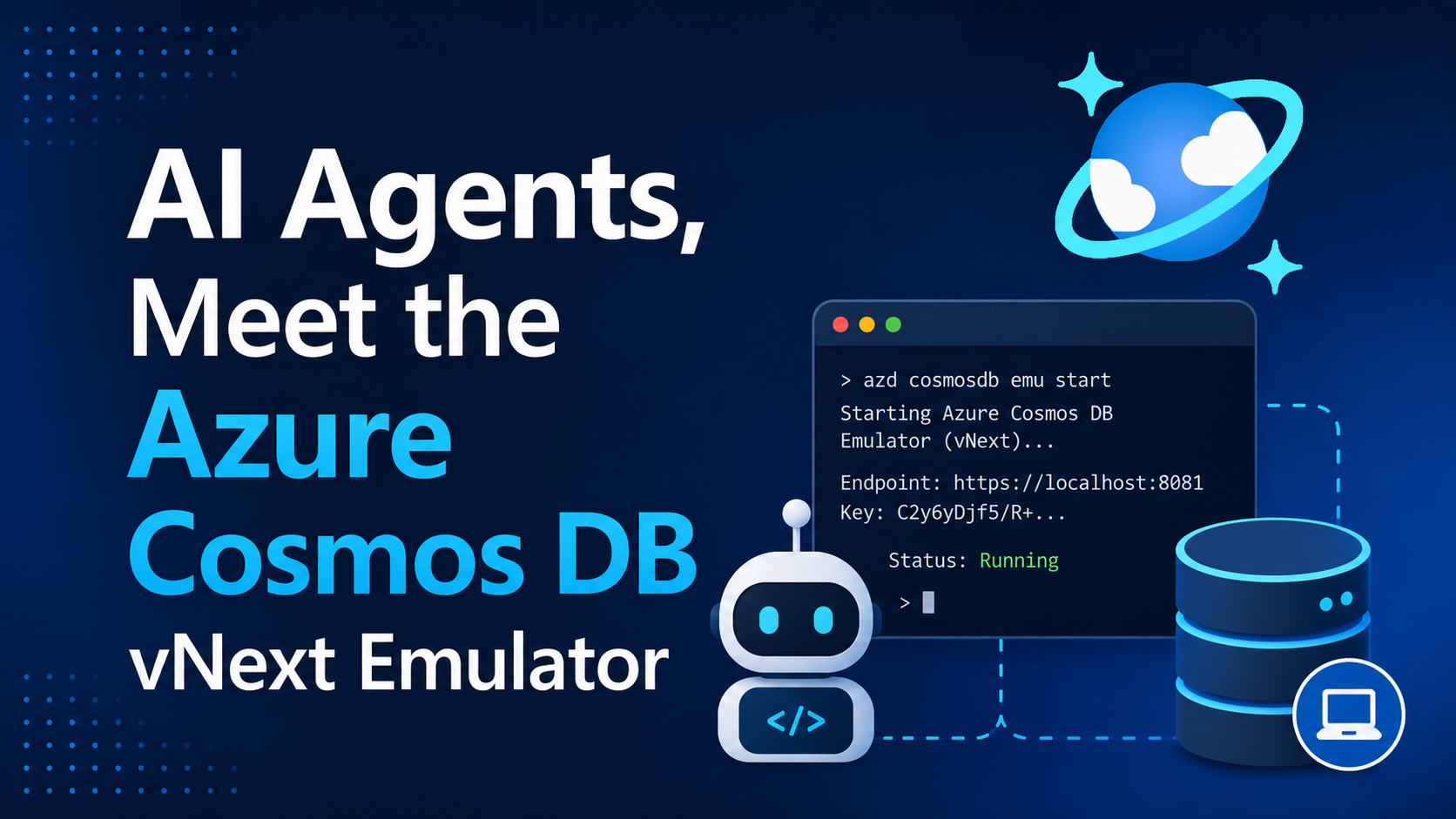
AI agents, meet the Azure Cosmos DB vNext emulator

If you use the Azure Cosmos DB vNext emulator, you probably know the local development loop: start the emulator, connect to it, create some resources, load test data, run queries, and inspect the results. Each step is straightforward, but together they add setup work before you can test the application you are actually building. How agents work with the emulator The emulator includes the Azure Cosmos DB Shell, an open-source CLI for working with databases, containers, and items. It runs inside the emulator container and handles the local endpoint and well-known key, giving developers a direct, scr...
Making an agile version of a Windows Runtime delegate in C++/WinRT, part 1
The easy case is easy.
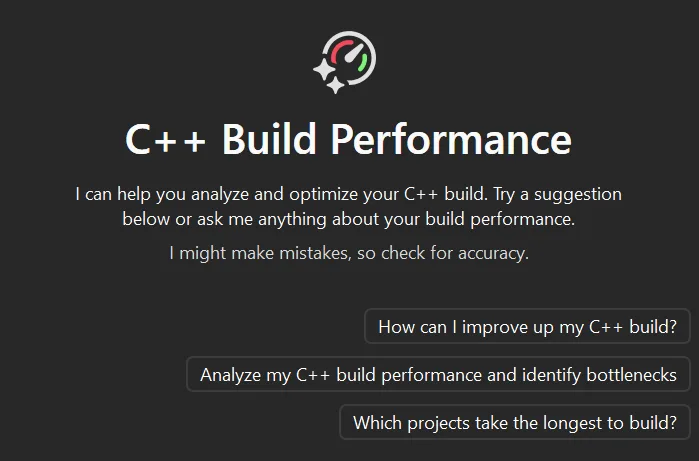
Faster C++ iterative builds with GitHub Copilot

Slow builds are a consistent theme of feedback from C++ developers. We built GitHub Copilot build performance for Windows so you can leverage Copilot to optimize your project’s build times. This workflow will find optimizations that bring your build times down. At first, we only measured the impact of build optimizations on full clean builds. While that number is valuable, we know that you are not rebuilding from scratch on most days. You edit a file and build, then repeat the process as part of your iterative loop. Working with customers after the public preview, we noticed that every now and then, the age...
Why has the display control panel pointer truncation bug gone unfixed for so long?
It's fixed, but the fix isn't getting there.
How to test agent skills without hitting real APIs
Your agent skill calls an API. The moment you start evaluating it, every run either costs money or mutates production data. Learn how to mock APIs transparently so you can run evals without changing your skill or hitting real endpoints.
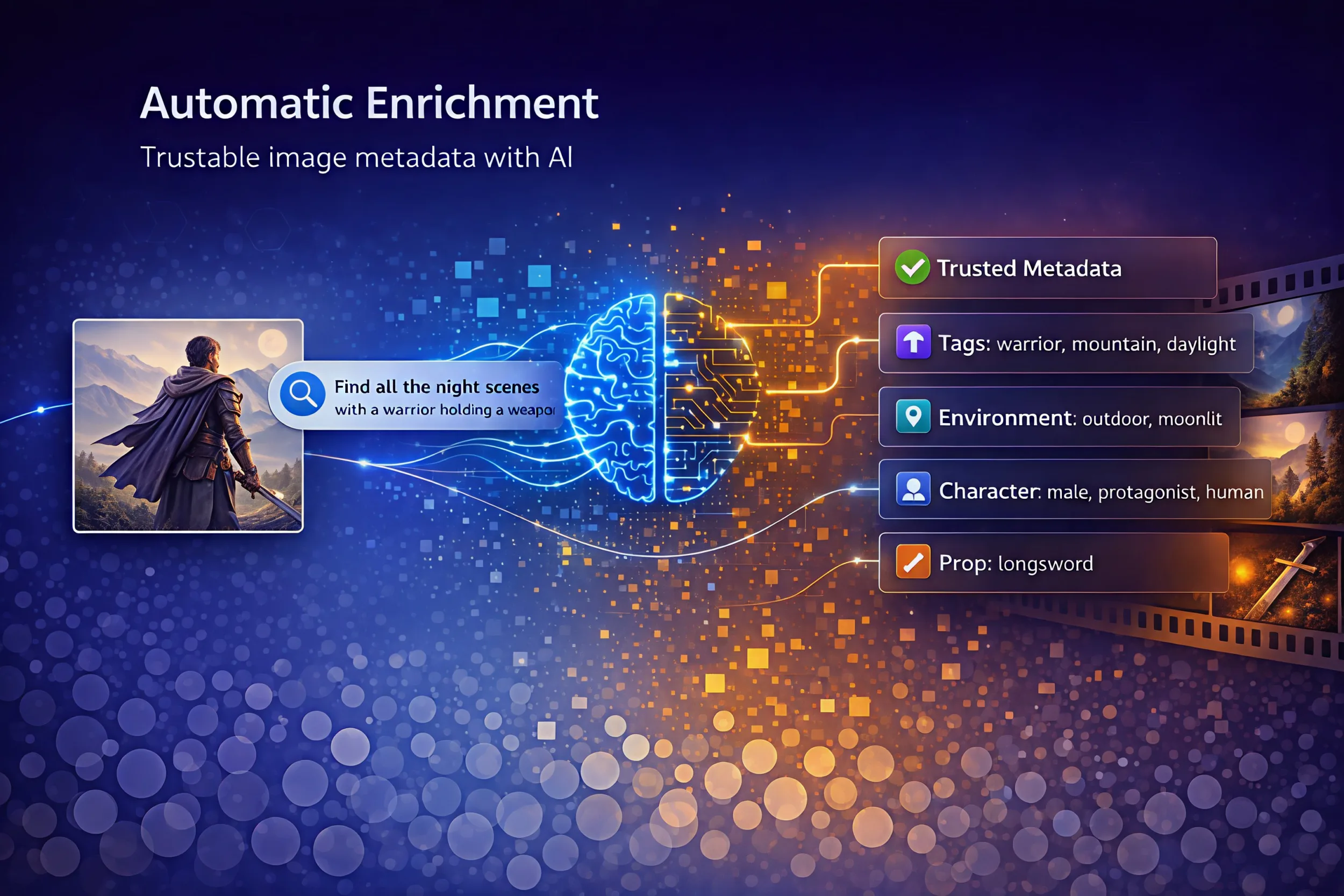
Teaching a Vision Model to See Like a Human Annotator—and Catching It When It Lies


A multimodal LLM enrichment pipeline that extracts structured metadata from visual assets, constrains output to predefined values to minimize hallucinations, and uses a ground truth evaluation template to measure quality—all as a plug-and-play module.
Pure Virtual C++ 2026 [Meet the Speakers, Part 3]: Modernizing C++
Meet the speakers behind Pure Virtual C++ 2026. In the final part, Victor Ciura maps the real challenges and promising directions for C++/Rust interop.
Build Once, Run Everywhere: Unified Manifest for Office Add-Ins now Generally Available

Unified manifest support for Word, Excel, PowerPoint, and Outlook makes it possible for developers to build a single app that works across Microsoft 365 apps, creating a more consistent experience for users and a simpler deployment model for IT admins.
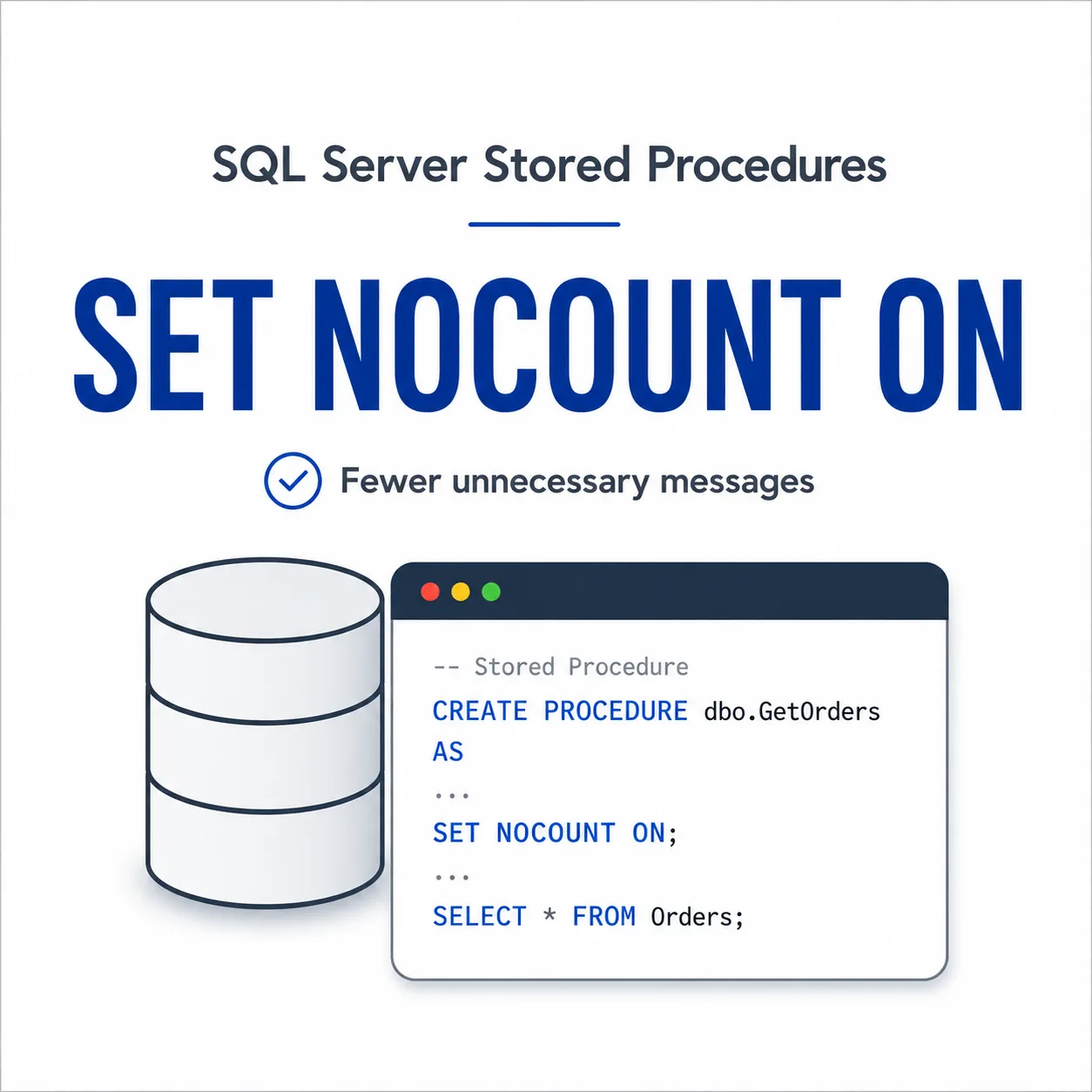
T-SQL Hygiene: What’s the Big Deal with SET NOCOUNT ON?
Learn why SET NOCOUNT ON improves stored procedure efficiency, reduces unnecessary messages, and matters to .NET developers.
Announcing .NET Modernization for Beginners

A free, open-source, hands-on course that walks you through modernizing a real legacy ASP.NET application all the way to .NET 10 using the GitHub Copilot modernization agent, step by step.
How to build long-running MCP tools on Azure Functions

Learn how to build long-running MCP tools on Azure Functions using Durable Functions. This post explains why synchronous tool calls break down for long-running work, introduces the MCP Tasks extension, and walks through a sample pattern that works with existing request/response clients today.
Visual Studio Administrator? Join our Private Marketplace Preview!

Organizations are increasingly looking for greater control over extensions within development environments. Driven by security, compliance, and internal governance requirements, teams want more visibility into how developers discover and acquire extensions. To address these needs, we're excited to begin previewing Private Marketplace support in Visual Studio. Private Marketplace for Visual Studio For organizations familiar with Private Marketplace in VS Code, Private Marketplace in Visual Studio provides a similar curated extension acquisition experience while preserving the familiar Visual Studio workfl...
Speculating on how the buggy control panel extension truncated a value that it had right in front of it
Inferring the code's history.
MSVC Build Tools Preview updates – July 2026

Try the latest updates to MSVC Build Tools Preview
MSSQL Extension for VS Code: Shortcuts Configuration, Enhanced Results Grid Experience, and More

The MSSQL extension for VS Code v1.44 continues to improve the SQL development experience with features that help you work faster and customize your workflow. In this release, we're introducing the Public Preview of Shortcuts Configuration and an Enhanced Results Grid experience. Together, these updates make it easier to personalize how you work with SQL and improve the performance and usability of query results directly inside Visual Studio Code. What's new in MSSQL extension for VS Code v1.44 Here's a summary of the key features in this release: Shortcuts Configuration (Preview) The new Shor...
Agent Skills for Python Is Now Released

Your Python agents can now pick up reusable bundles of domain expertise (instructions, reference material, and scripts that load only when a task calls for them) through a stable, production-ready API. Agent Skills for Python in Microsoft Agent Framework is stable and shipping: the core skills API has no experimental gate, so you can rely on it in production without the churn of a preview surface. Teams can author skills, release them on their own schedule, and drop them into any agent, backed by the governance controls enterprises expect before agents reach production. If you've been following our earlier...
Pick, manage, and get the most from your models

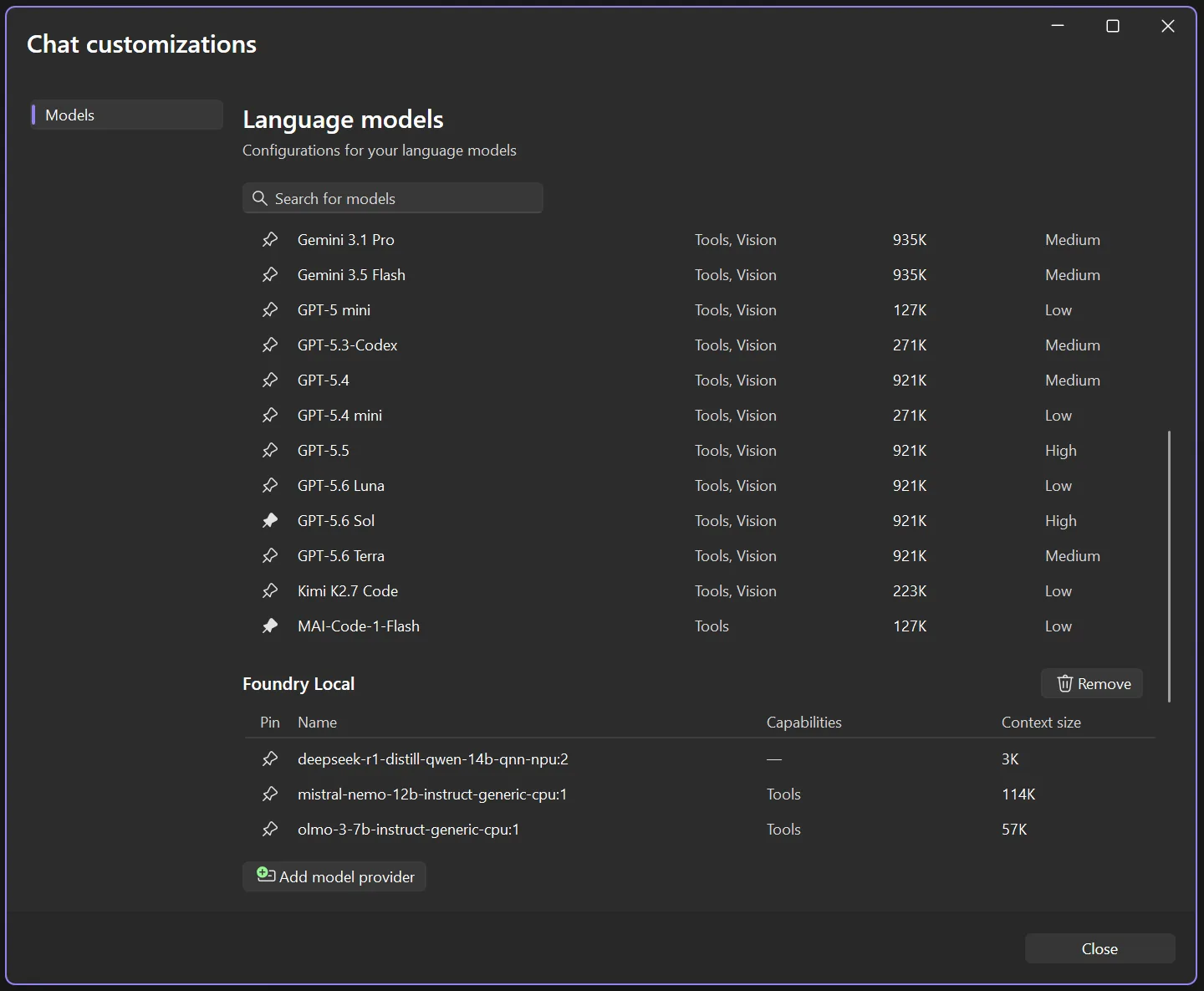
You open the model picker, scroll past a dozen options, and pause. How are these models different? Which one should you actually use? And once you're a few hundred messages deep, how much capacity is even left before things start dropping off? We've all been there. These are the kinds of questions Visual Studio now makes a little easier to answer. Here's a closer look at how you can see, compare, and get more from the models you already have. A model picker that works the way you do The model picker presents a long list of models you’ve needed to scroll through every single time. Starting in 18.9 Insider...
The case of the invalid function pointer when shutting down the display control panel
Watching the bits disappear.
Building AX evals that actually work
This is the eighth and final article in a series about Agent Experience (AX): the practice of making AI coding agents work correctly with your technology. The series covers what you can and can't control in the agent stack, how to measure whether your extensions are helping or hurting, and how to iterate toward better outcomes. You've read seven articles about what to measure, why benchmarks don't transfer, and what hidden variables can do to your results. Now you actually have to build the thing. Most teams build an eval, run it, get scores, and feel good about the numbers. The trouble is that these evals produ...
Rethinking C++ Performance: Faster Code Navigation and GitHub Copilot Tools with Whole Codebase Indexing


In large C++ codebases, your code understanding and navigation depend on quickly determining how symbols, declarations, definitions, and references are connected across your project. In Visual Studio Insiders 18.9, the new whole codebase indexing (WCI) enhances the existing browse database via a deeper, more comprehensive indexing approach. This preview feature allows Visual Studio to access richer symbol information more efficiently in your C++ project, with faster lookups for core IntelliSense scenarios like Find All References and semantic file colorization. It also enables new experiences like CodeLens ref...
.NET and .NET Framework July 2026 servicing releases updates


A recap of the latest servicing updates for .NET and .NET Framework for July 2026.
CoreCLR Progress and the Mono Timeline for .NET MAUI

CoreCLR is now the only runtime for .NET MAUI mobile apps in .NET 11 Preview 6. Here is where we are, and why we need you to test today.
.NET 11 Preview 6 is now available!

Find out about the new features in .NET 11 Preview 6 across runtime, SDK, libraries, ASP.NET Core, .NET MAUI, C#, Entity Framework Core, F#, and container images.
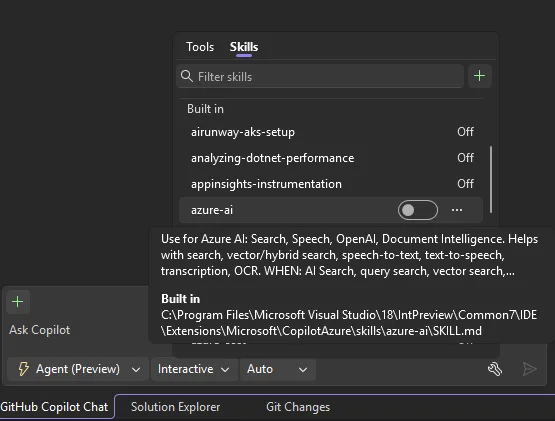
Built-in Agent Skills Bring .NET and Azure Expertise into Visual Studio


Visual Studio now includes built-in Agent Skills, created by experts from the .NET and Azure teams, to help you better customize your agentic workflow and complete development tasks more efficiently, starting with the 18.8 Release. Agent Skills are reusable capabilities that enable your agent to perform structured tasks more reliably (to learn more about what are Agent Skills, see this previous post). We’ve heard that getting started with skills can feel unclear, especially when deciding which ones to use and how to apply them. To simplify this experience, we’ve introduced a set of built-in skills for common ....

Package Status
Every package has a set of status flags describing its current health and availability. These can be queried via the Package.Status property. A package may report more than one status value at a time if multiple conditions apply. Package Status Groups The various states fall into three groups: NeedsRemediation Status values in the NeedsRemediation group indicate that the package is in a bad or broken state and must be repaired before it can be used. NotAvailable Status values in the NotAvailable group indicate that Windows has the package installed, but it cannot be used at this time. ...
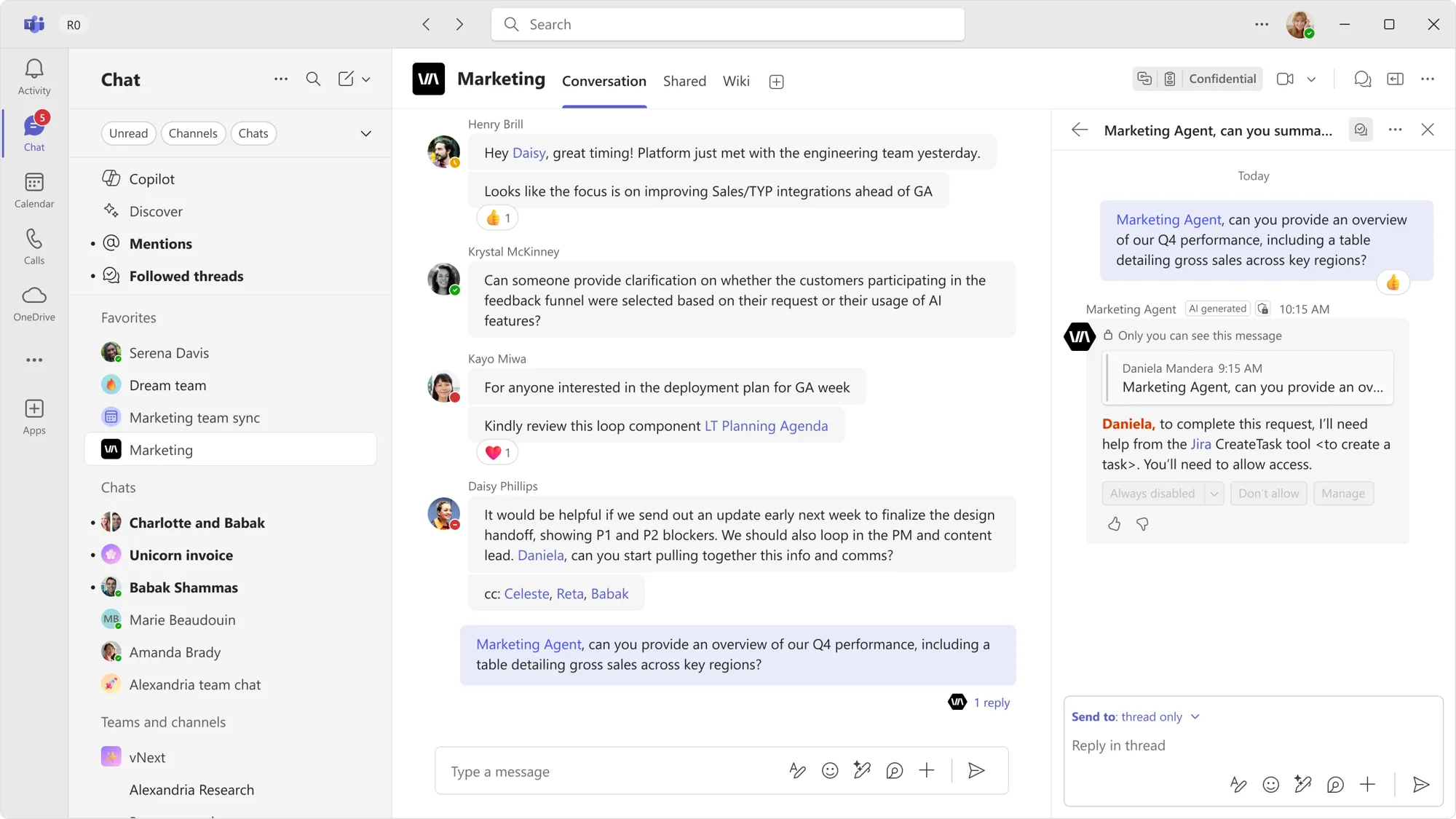
Building Agents for Teams: Turning conversations into outcomes

The Microsoft Teams platform mission is to build the best collaborative platform in the world. We want to make it easy for developers to build agents that participate seamlessly in chats, channels, and meetings, helping teams turn ideas into action in real time. By bringing agents directly into the places where collaboration happens, we can help ensure work is completed in the moment rather than getting lost in a stream of conversation. Everything we build is designed to help developers create collaborative experiences that empower people and agents to work together more effectively. Today we're launching ...
Microspeak: Double-click and drill down
Please, tell me more.
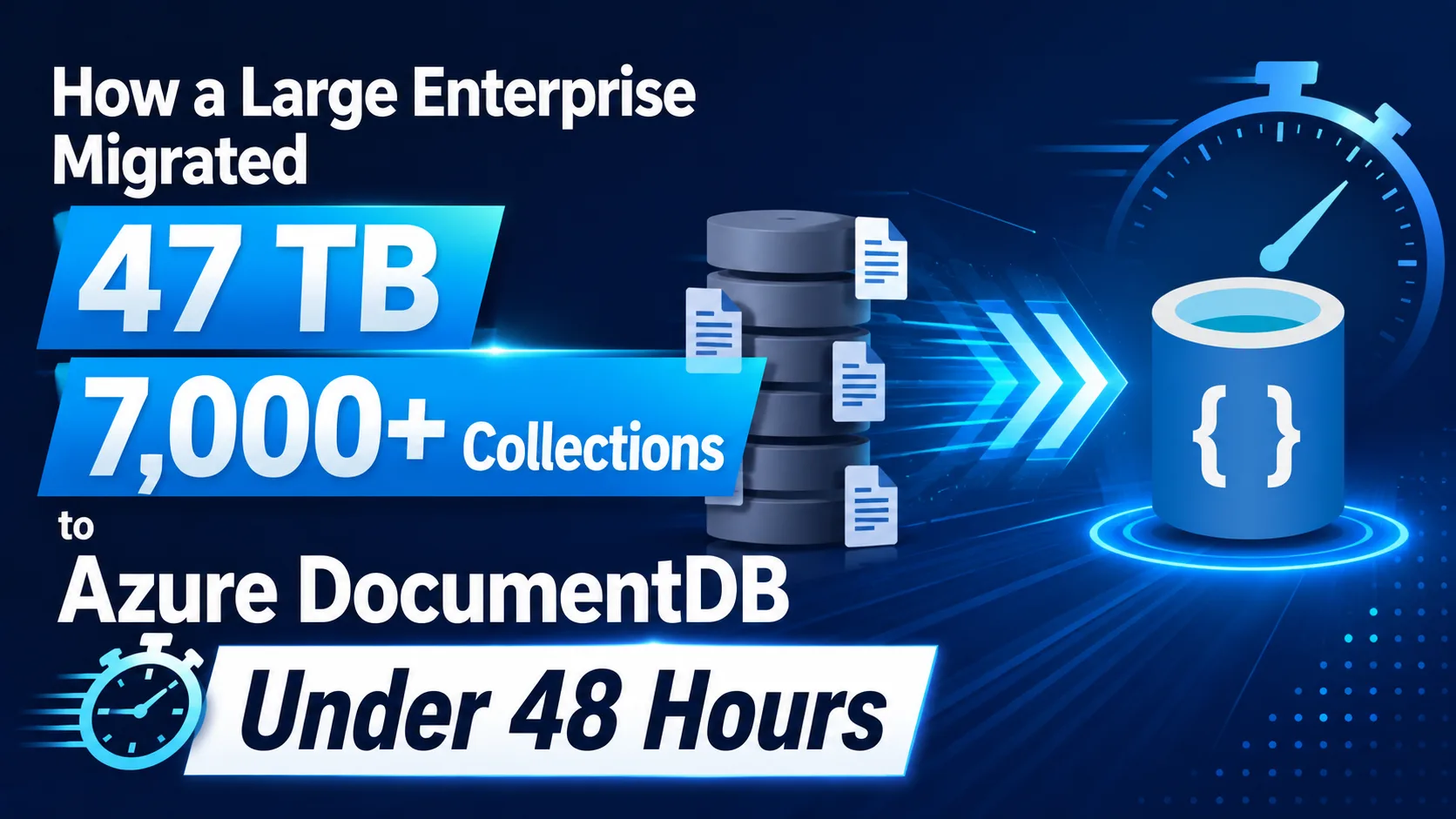
How a Large Enterprise Migrated 47 TB and 7,000+ Collections to Azure DocumentDB in Under 48 Hours

Large database migrations are where good planning either pays off or falls apart. In a MongoDB-compatible estate with thousands of collections, the hard part is not only moving data. It is deciding what to move, what to defer, how to sequence the work, and how to keep the system stable while ingestion is running at full speed. That is exactly what we saw in a recent large enterprise migration to Azure DocumentDB: 47 TB of data, 7,000+ collections, a 27-node source footprint, and a production cutover window of less than 48 hours. The target was intentionally smaller and simpler: a 3-node, 16 TB Azure DocumentDB...
Pure Virtual C++ 2026 [Meet the Speakers, Part 2]: The AI-Native C++ Developer Workflow
Pure Virtual C++ 2026 streams Tuesday, July 21, 2026 at 9:00 AM PT, a free, one-day virtual conference for the whole C++ community, live on YouTube (Microsoft Reactor) and Twitch, with on-demand recordings on the Visual Studio YouTube channel afterward. Register now → Welcome to part two of our Meet the Speakers series. In part one we looked at building and running faster. Today we turn to the theme shaping the future of development: the AI-native C++ developer workflow. Why this theme matters C++ development is evolving into an AI-native, agent-driven experience and it's happening everywhere you work, f...
The Visual Studio Dev/Test Benefit: Freedom to Build, Test, and Experiment in Azure

One of the best parts of a Visual Studio Subscription is discovering benefits that can make your day-to-day development work easier and more cost effective. One benefit that deserves more attention is Azure Dev/Test pricing. In fact, it's one of the most valuable benefits included with a Visual Studio Subscription. If you're building cloud applications, testing new ideas, or maintaining multiple development environments, cloud costs can sometimes influence how often you experiment or how closely your development environment matches production. Azure Dev/Test pricing helps remove that barrier by giving eli...
Why don’t we just make the entire stack out of guard pages?
Guard pages all the way down?

Go 1.26.5-2 Microsoft build now available

A new release of the Microsoft build of Go is now available for download.
The case of the mysterious changes to integers when there shouldn’t have been any code generation effect
Decoding where those integer came from.
Shrinking Azure Pipeline task extensions using esbuild

TL;DR We bundled an internal Azure Pipelines task extension into a single bundled JavaScript file using esbuild. The task package dropped from tens of megabytes and thousands of files to three files per task ( , , and ). The change took about 20 lines of build tooling. We measured the payoff across our production pipelines: Spending less time downloading and extracting tasks means we can make more efficient use of our build infrastructure. If you publish a node-based Azure DevOps task extension that ships a large folder or thousands of small files, you can almost certainly benefit from this same chan...
Microsoft Agent Framework for Go public preview

Microsoft Agent Framework for Go is entering public preview, bringing Agent Framework concepts to Go developers building agents and multi-agent workflows.
Pure Virtual C++ 2026 [Meet the Speakers, Part 1]: Build Faster, Run Faster
Meet the speakers behind Pure Virtual C++ 2026. In part one, Ryan Shepherd and David Li show how to build faster and smaller with C++20 modules and GitHub Copilot build performance.
Modernize .NET applications in the GitHub Copilot app

Modernize .NET applications in the GitHub Copilot app. Follow your upgrade from assessment through execution in an interactive upgrade canvas.
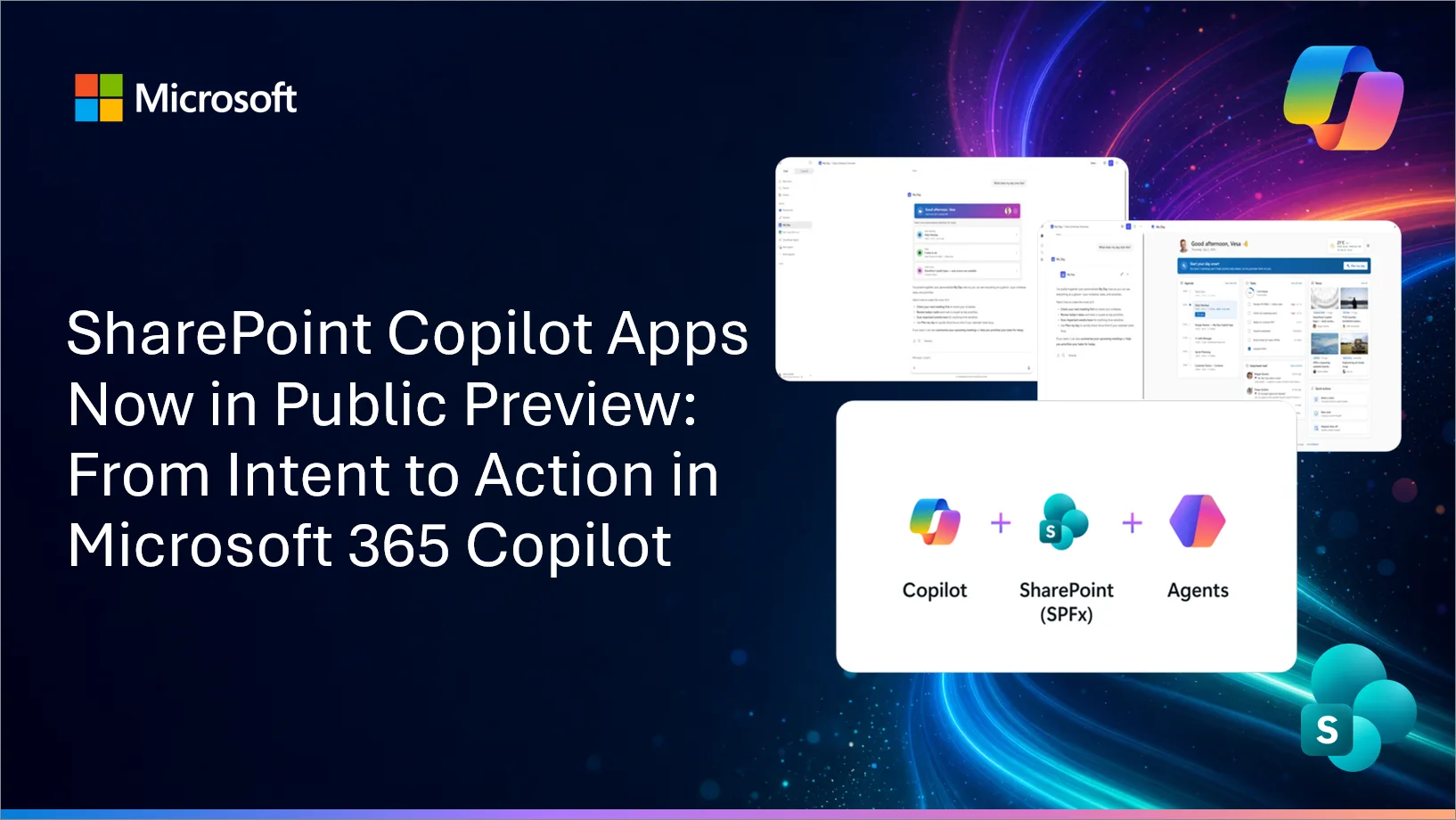
SharePoint Copilot Apps Now in Public Preview: From Intent to Action in Microsoft 365 Copilot

SharePoint Copilot Apps are now in public preview, introducing a new way to bring guided, action-oriented business experiences into Microsoft 365 Copilot. By combining natural language reasoning with structured UX, validation, permissions, and deterministic operations, organizations can help users move from intent to trusted outcomes directly in the Copilot flow.
I’ve decoded a #pragma detect_mismatch error and fixed the mismatch, but I still get the error
You need to rebuild everything that was dependent on the change.
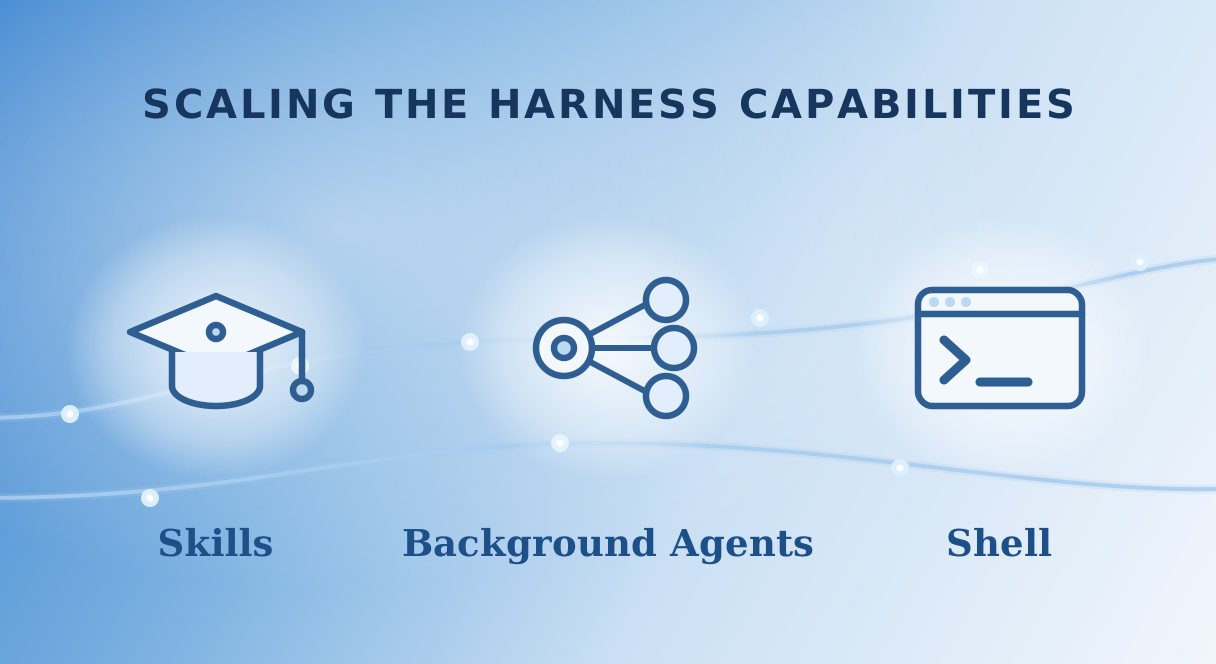
Agent Harness: Scaling the claw or harness capabilities
Part 3 of Build your own claw and harness with Microsoft Agent Framework. In Part 2 our personal finance assistant learned to work with your data safely: it reads your portfolio, asks before it trades, and remembers what matters across sessions. It's useful - but everything it knows is baked into one prompt, it does its work one step at a time, and it can't reach past the file-access tools to actually reorganize anything. This part makes the claw more capable along four axes: As before, we only supply what makes our agent ours; the harness provides the machinery. Let's take them in turn...
What’s New in vcpkg (June 2026)
These June updates add a vcpkg-tool switch to skip installation when packages are already cached, OpenHarmony (OHOS) platform support, and major library updates including curl 8.21, CGAL 6.2, and Graphviz 15.
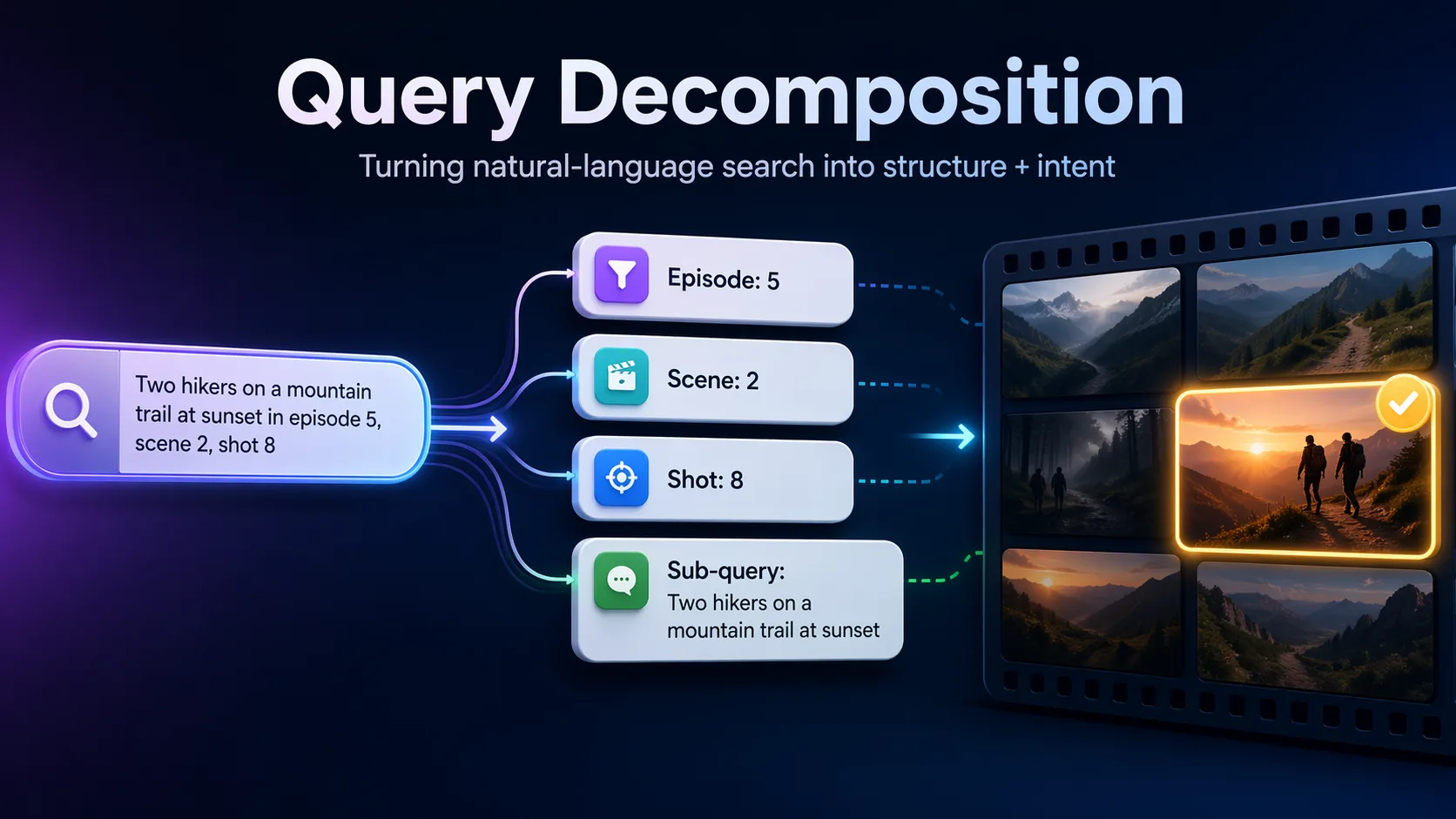
From Noisy Queries to Precise Frames: Query Decomposition for Media Asset Search
How query decomposition separates metadata filters from visual intent to significantly improve media asset retrieval quality.
Go 1.26.5-1 and 1.25.12-1 Microsoft builds now available
A new release of the Microsoft build of Go including security fixes is now available for download.
Let’s Learn GitHub Copilot App – Free Virtual Training Event

Join us for a free online event series kicking off July 16 to learn how to get started with the GitHub Copilot App!
Announcing TypeScript 7.0

Today we are proud to announce the availability of TypeScript 7, a 10x faster native port of TypeScript! Since its early days, TypeScript has promised to deliver on JavaScript that scales. By bringing strong type-checking and rich tooling to the world of JavaScript, TypeScript made it possible to build non-trivial high-quality apps across platforms. Last year, our team unveiled TypeScript's next step in scaling: making every part of the toolset an order of magnitude faster. The mission was a native port of TypeScript built in Go that could make the most of modern hardware. This port was done as faithfull...
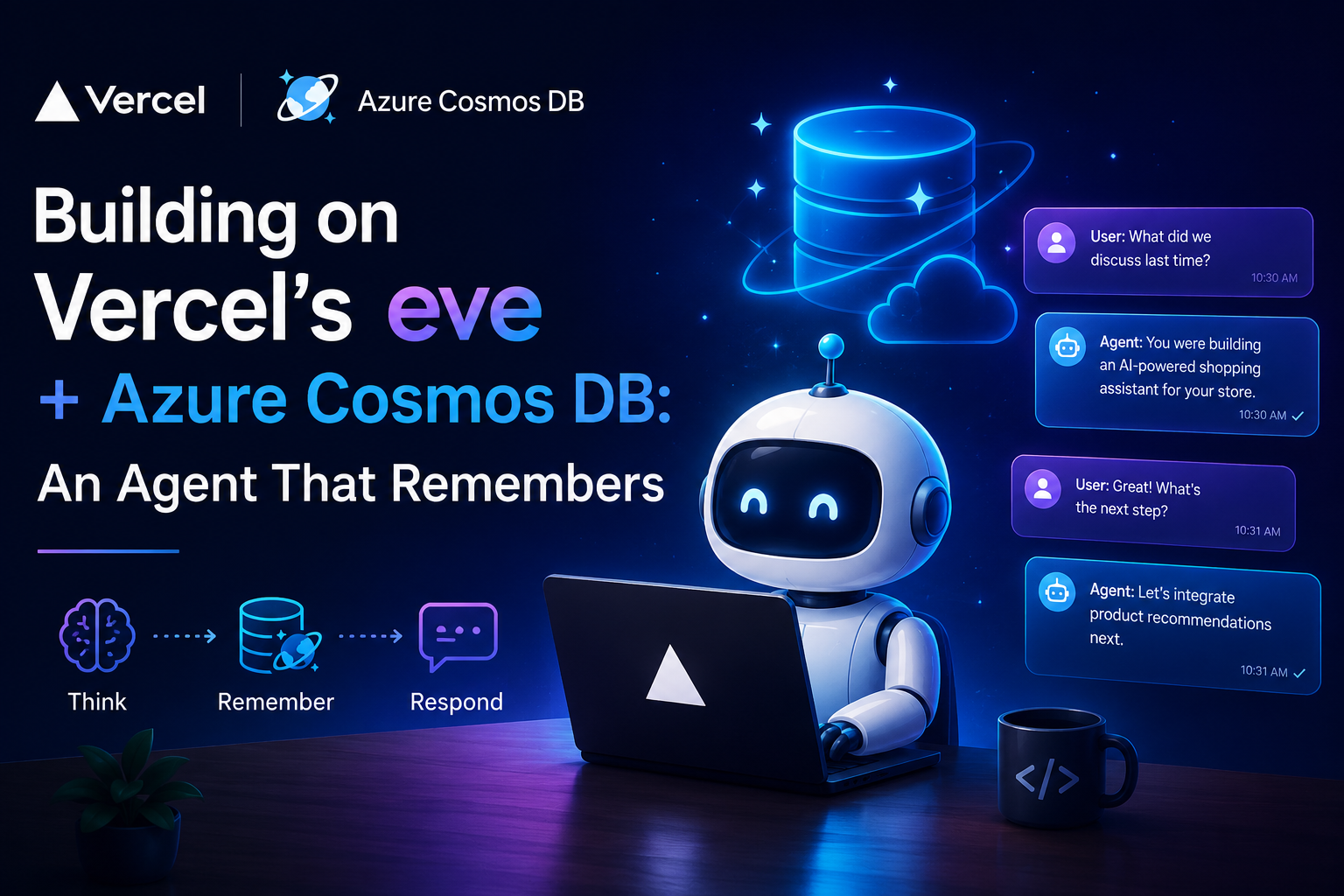
Building on Vercel’s eve + Azure Cosmos DB: An Agent That Remembers

Most "AI agent" demos forget everything the moment the process exits. That's fine for a toy project, but useless for anything real. An agent that helps you write, triage, or support needs two things a language model alone can't give it: durable state and the ability to recall the right context by meaning. This post shows how to build exactly that by integrating two pieces that fit together surprisingly well: Eve — Vercel's filesystem-first agent platform. Drop a file in agent/tools/, and it becomes a tool the model can call. Azure Cosmos DB JavaScript SDK — the official, promise-based client for Cosmos DB N...
The other kind of control flow guard check: The combined validate and call
A two-in-one package.
The hidden variables in your agent eval
This is the seventh article in a series about Agent Experience (AX): the practice of making AI coding agents work correctly with your technology. The series covers what you can and can't control in the agent stack, how to measure whether your extensions are helping or hurting, and how to iterate toward better outcomes. You build an eval. You run it on your machine. You get a score. Your colleague runs the same eval on their machine and gets a different score. Same scenario, same setup. What changed? In the previous article, we covered why public benchmarks can't tell you which model works best for your stack. T...
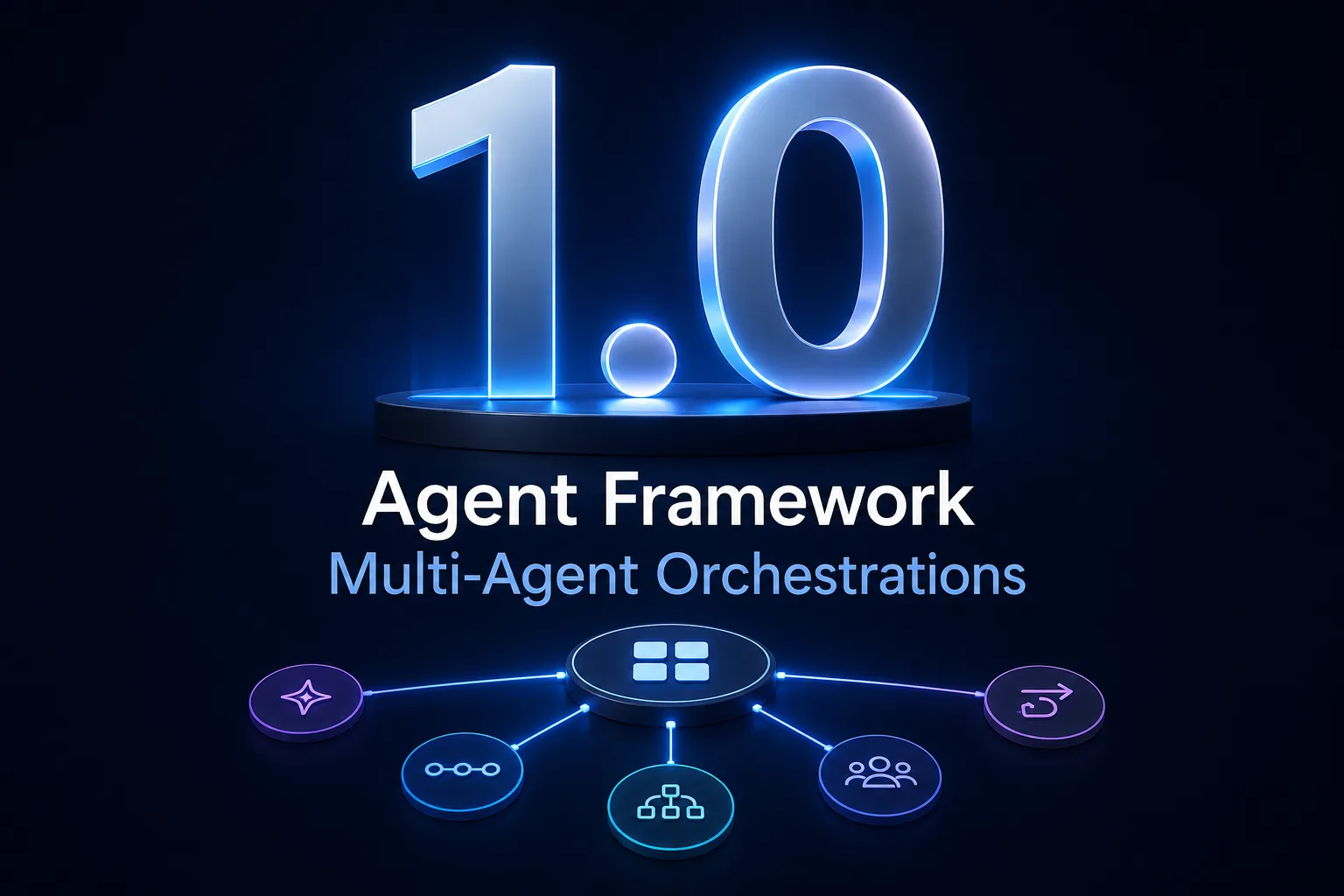
Agent Framework’s Orchestration Patterns Reach 1.0

Python's package is now 1.0.0. That puts Microsoft Agent Framework's orchestration layer at 1.0 across Python and .NET. Sequential, concurrent, group chat, handoff, and magentic orchestration are now stable in both SDKs. You can pick the coordination pattern that fits your problem instead of choosing around SDK maturity. Magentic is the best example of why that matters. It is the least hand-wired pattern: you give it a goal, a manager, and a set of specialists, then the manager decides how the team should work. At the workflow layer, Agent Framework lets you build the graph yourself. Executors do the wo...
Applications Are Not Packages
Applications are not packages. Let me repeat. Applications are not packages. This is a common misconception due to the (too) often blurring of concepts and terminology. Packages and applications are different and distinct things, so it's important to understand what those words mean (to MSIX). Packages and Applications Are Different Things An application is distributed via a package. That's not the same as being the package. A package is a unit of distribution and deployment. You can install a package, or update a package, or remove a package. You can't install half a package, or remove part of a package. A...
How did Windows 95 decide that a setup program ran?
It used some heuristics.
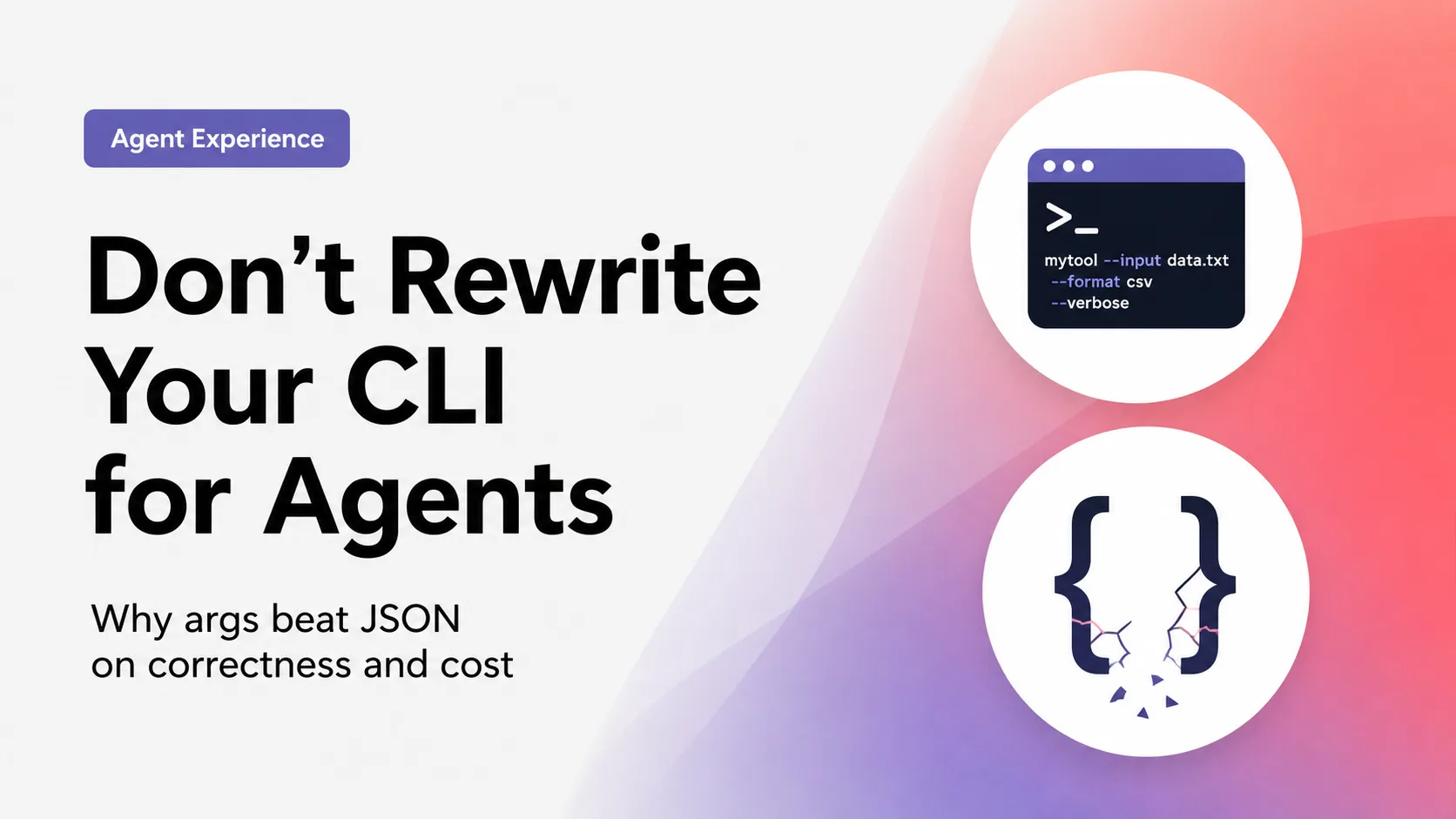
Don’t rewrite your CLI for agents
There's advice making the rounds: replace your CLI args with a single payload so agents can use your tool more effectively. The thinking being, that agents already think in structured formats, and nested data maps cleanly to JSON. Flat args on the other hand, force awkward conventions like repeating to delimit multi-value groups, which is inherently ambiguous. Not to mention, that the agent needs to get the types of all values right. It's a reasonable hypothesis, and we wanted to know if it holds up under measurement. The data we collected, showed something interesting. What we tested We built a synthetic CL...
Agent Skills for .NET Is Now Released
You can now give your .NET agents reusable packages of domain expertise - instructions, reference documents, and scripts they load only when a task needs them - through a stable, production-ready API. Agent Skills for .NET in Microsoft Agent Framework has moved out of experimental preview - the attribute is removed and the API is stable. Teams can build skills, ship them independently, and combine them in any agent, with the governance controls enterprises need before putting agents into production. If you've been following our earlier posts on file-based skills and authoring modes with script execution, ever...
What’s New in Microsoft Foundry | June 2026

Claude is now generally available in Microsoft Foundry. Here's everything else that shipped between Build 2026 and the end of June — autopilot agents, expanded Toolboxes and Routines, Agent Optimizer's private preview, and more.
See our new Azure Cosmos DB Design Patterns

Design patterns are where good data modeling lives or dies. In a NoSQL database like Azure Cosmos DB, the difference between a schema that scales to millions of operations per second and one that fights you at every turn usually comes down to a handful of well‑understood patterns: how you partition, how you version, how you fan out work, how you keep concurrent writers from stepping on each other. That's exactly what the Azure Cosmos DB Design Patterns repo is for. It's a growing, hands‑on collection of small, focused samples — each one isolates a single pattern, explains why it matters, and lets you run it your...
I opened a file with FILE_FLAG_DELETE_ON_CLOSE , but now I changed my mind
You can't change your mind, but you can do it a different way.
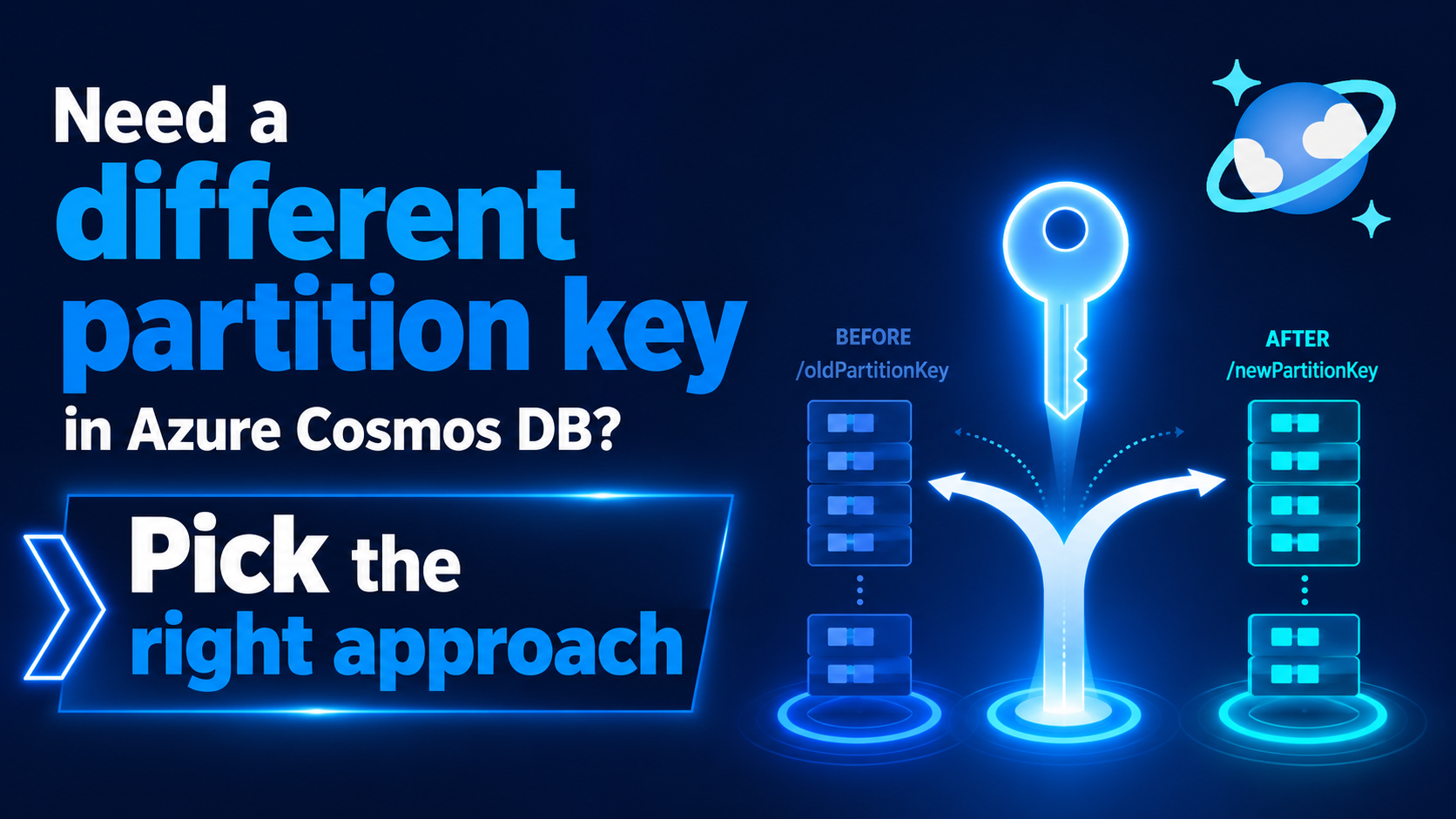
Need a different partition key in Azure Cosmos DB? Pick the right approach
Once you create a container, its partition key is fixed at creation, and you can’t change it in place. However, if your original key starts causing problems like cross-partition queries or hot partitions, you need to consider your options for changing it. This post explains the mechanics of changing a partition key, and the tradeoffs between the options. First, think about the intent of your change: Note that every “change the partition key” option is actually a move: get your data into a new container that has the new key, then point your app at it. The exception is a Global Secondary Index, whic...
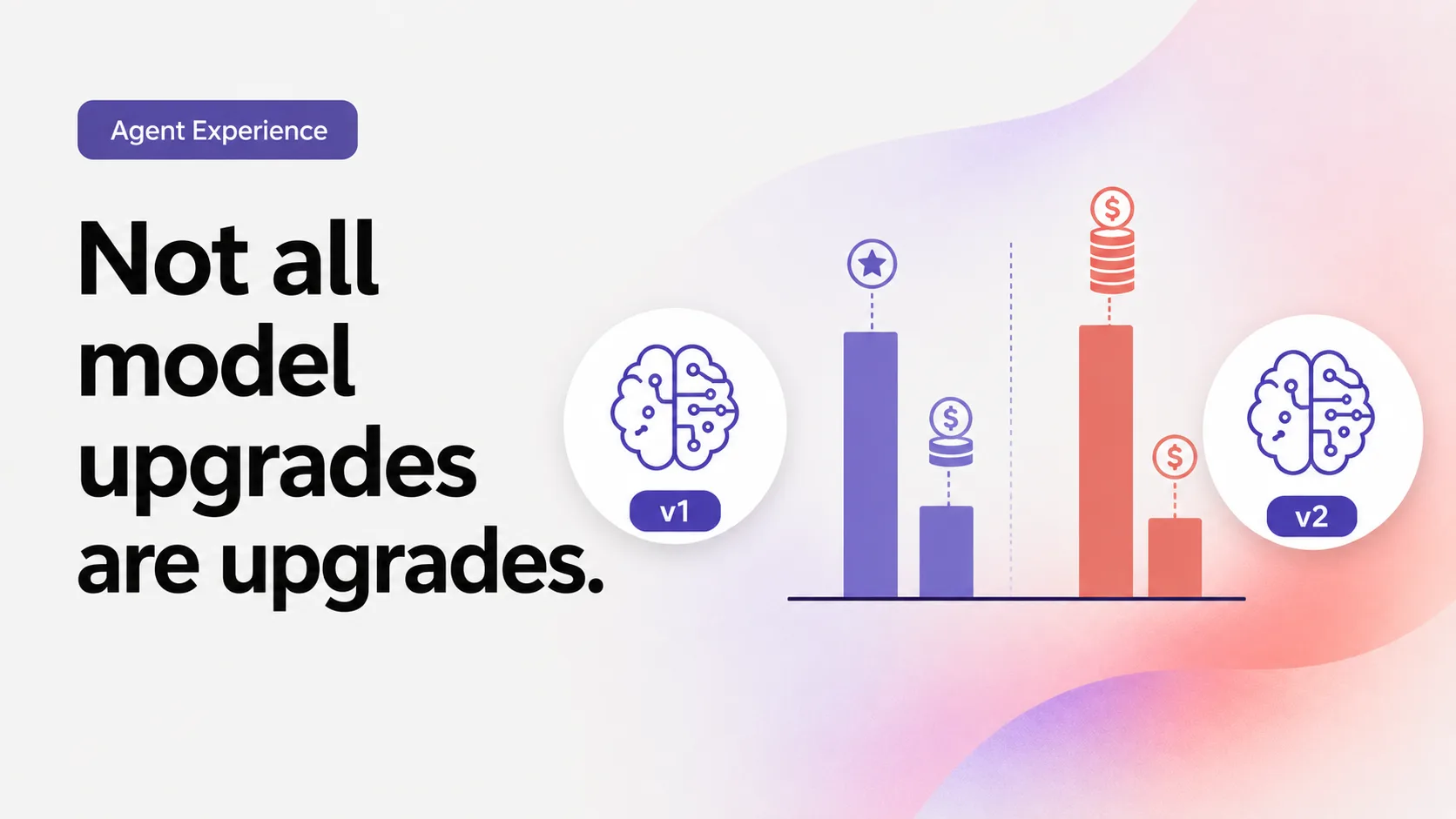
Not all model upgrades are upgrades
A new model drops with lower per-token pricing and better benchmarks. You switch. A week later someone asks why the agent is burning 12x more tokens on the same task while producing worse output. We ran 150 agent tasks across 15 scenarios on two models, Claude Sonnet 4.6 and Claude Sonnet 5, using GitHub Copilot Chat in VS Code on Windows. The scenarios covered two types of work: architecture and design tasks grounded in Microsoft Learn documentation, and SharePoint Framework project upgrades. Sonnet 5 is the newer model with 33% lower per-token pricing across every token category. The assumption we wanted to te...
Azure SDK Release (June 2026)

Azure SDK releases every month. In this post, you'll find this month's highlights and release notes.
How did we conclude that CcNamespace.dll was the ringleader of a group of DLLs that unloaded prematurely?
Contextual clues.
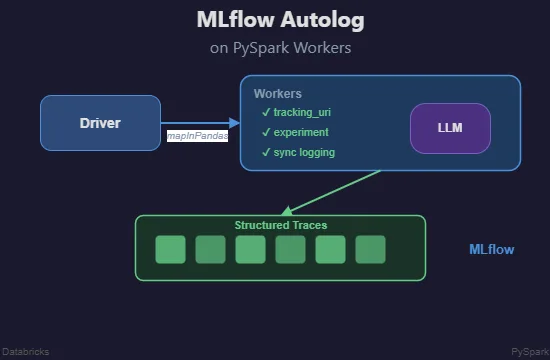
Enabling MLflow OpenAI Autolog on PySpark Workers

When distributing LLM calls across PySpark workers via mapInPandas, MLflow autolog silently fails. Here is how to fix it.
Pure Virtual C++ 2026 Talks Announced
The featured talks for Pure Virtual C++ 2026 are here! Join us on July 21 for a free, one-day virtual conference for the whole C++ community.
The case of the thread executing from an unloaded third-party DLL
Oops, I didn't realize that I was still doing that.
Fundamentals of Azure DevOps with SQL projects
Building automated pipelines with your SQL database projects enables you to build a rich CI/CD ecosystem to ensure that your application is being deployed with good quality code and at high confidence of success. SQL Database Projects are compatible with just about every automation environment because fundamentally they're built on top of the .NET SDK, a free and cross-platform development platform. You can develop the Microsoft.Build.Sql projects in VS Code and SQL Server Management Studio (SSMS). In this post, we'll take a look at the things you need to know to get started with building and deploying SQL projec...
Upcoming Change: NTLM Removal in Git (libcurl) – Impact to Azure DevOps Server Customers
Overview In September 2026, NTLM support will be removed from libcurl, which is used by Git for HTTP(S) operations. As a result, Git operations over HTTPS against Azure DevOps Server (on-premises) will stop working for customers who rely on NTLM authentication. This change is part of a broader industry move toward more secure authentication mechanisms. Many environments may be affected even if they believe they are using Kerberos. This is because Negotiate (SPNEGO) authentication can silently fall back to NTLM when Kerberos is not properly configured, leading to unintentional dependency on NTLM. If your enviro...

Audit Frontier AI Agents with SQL MCP Server
With On-Behalf-Of authentication, SQL MCP Server lets agents access Microsoft SQL without losing the user identity behind the request. Azure SQL can audit the signed-in user who invoked the operation, not just the agent, app, or MCP server that carried it out.
What AI benchmarks are not telling you
This is the sixth article in a series about Agent Experience (AX): the practice of making AI coding agents work correctly with your technology. The series covers what you can and can't control in the agent stack, how to measure whether your extensions are helping or hurting, and how to iterate toward better outcomes. We love benchmarks. A new model drops, the leaderboard says 92% on SWE-bench, and your timeline declares it "the best coding model." You switch to it, run your agent on your codebase, and outcomes are... the same. Maybe worse. The leaderboard said 92%, so what happened? In the previous article, we ...
It rather involved being on the other side of this airtight hatchway: Changing administrative settings
Unlocking the door from the inside.
What’s new across Microsoft SQL in 2026 so far (SQL Server, Azure SQL, and SQL database in Fabric)

We’re halfway through 2026, and Microsoft SQL has not slowed down. Since SQLCon/FabCon in March (where we released a ton of things, and those updates can be found in this updates video), we shipped a wave of updates across SQL Server, Azure SQL, and SQL database in Fabric, with Microsoft Build 2026 as the centerpiece. If you want the details on Build, start with my recap blog, The Era of the Agentic Database Developer. This post collects everything new from mid-March through today, organized by service so you can find what matters to you. Every item is tagged Preview or Generally Available with a link. You can...
Access GitHub Copilot in JetBrains – GitHub Copilot Is Now a Native Agent in JetBrains AI Assistant


GitHub Copilot is now a first-class, native option in JetBrains AI Assistant agent picker(read more). You can select it directly from the chat interface, no extra configuration needed, and immediately put Copilot to work on real coding tasks without ever leaving AI Assistant. Millions of developers already rely on the GitHub Copilot plugin as their AI pair programmer inside JetBrains IDEs. Copilot has long been reachable through JetBrains AI Assistant via the Agent Client Protocol (ACP), but today we are taking that integration a significant step further. This is not a separate window or a plugin ...
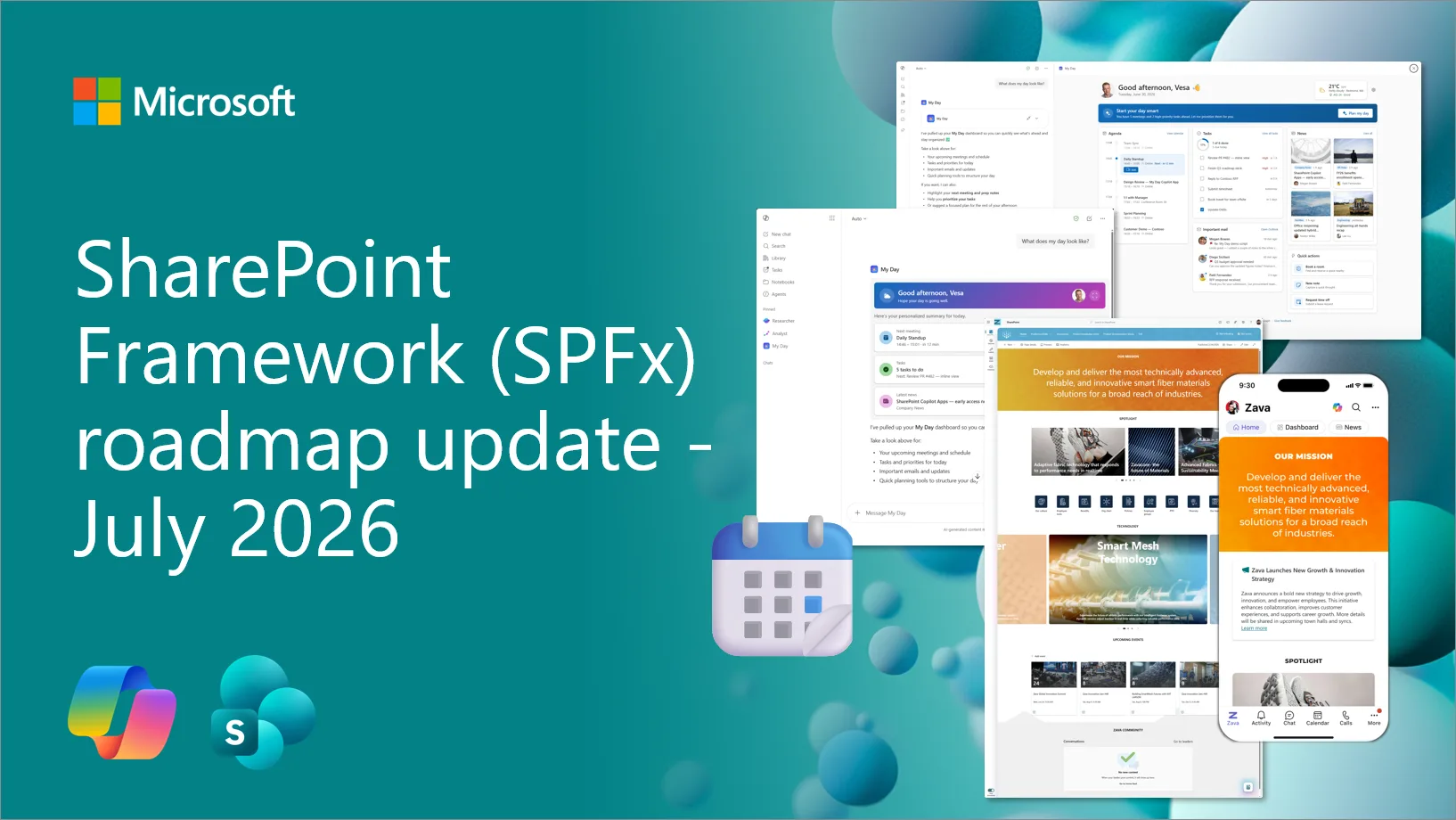
SharePoint Framework (SPFx) roadmap update – July 2026
June celebrates the announcement of upcoming SharePoint Copilot Apps, ships the quality-focused SPFx 1.23.2 release, and shares the roadmap for the AI era - shaped by your feedback.

Compose your API surface with Data API builder custom paths
Data API builder (DAB) 2.0 adds compound paths for REST endpoints, giving developers more control over how their API surface is organized. Instead of mirroring database topology, endpoints can now reflect simple names, business areas, or schema ownership.
MCP Beyond the Chat Window: Build Diagnostics in CI
A practical tour of the Model Context Protocol tools for .NET build diagnostics - the full Binlog MCP toolset, how those tools run inside a GitHub Actions workflow, and what the evaluation data says about the efficiency gains.

Visual Studio June Update – Track Your Usage, Trust Your Tools
The June update includes a Copilot Usage window refresh with proactive alerts as you approach your limits, MCP servers now get a trust check before they run anything new.
MSIX Per-User vs All Users: Install, Provision, and Uninstall Packages
MSIX supports making a package available to all users; the formal term is provisioning. Provisioning a package family makes it available to all users, whereas registration makes a package available to a single user. Per-User vs All Users Traditional installers often provide a "per-machine" installation mode to make software available to all users. In MSIX, the equivalent user experience is achieved through provisioning. To install a package for all users, first stage the package on the machine and then register it for each user. To facilitate this, Deployment manages a 'list of provisioned package families' an...
Mailbox requirement set 1.16 now available for Outlook add-ins
Mailbox requirement set 1.16 is now generally available for Outlook add-ins. This release reflects our continued investment in closing the gap between COM/VSTO and web add-ins, with a focus on message and information security. Mailbox 1.16 introduces APIs and platform updates that enable your add-in to: Handle message decryption with ease Mailbox requirement set 1.16 introduces the OnMessageDecrypt event, which enables Outlook add-ins to automatically decrypt protected messages when a user opens them. The event-based workflow identifies encrypted messages, decrypts messages, displays ...
2026 mid-year link clearance
Made it to another midpoint.
A compatibility note on the abuse of Windows window class extra bytes
Finding an illicit place to hide data.

🚀React Native Windows v0.84 is here!!


We're excited to release React Native Windows 0.84.0, aligned with React Native 0.84.1. React Native Windows v0.84 delivers input-handling improvements such as standard click events and imperative focus, theme-aware defaults and robust hit-testing semantics. 🔥 What's New in RNW v0.84? Visual Studio 2026 is required for 0.84 version of RNW. onClick and Events for Fabric Components Fabric components now fire standard and events, bringing RNW's click-handling model in line with the W3C specification. Windows developers can now handle primary and auxiliary (middle-click) interactions using the same patte...
.NET 8 and .NET 9 will reach End of Support on November 10, 2026
.NET 8 and .NET 9 will both reach end of support on November 10, 2026. Learn what this means and how to upgrade to .NET 10 (LTS).
SkiaSharp 4.0 is here: announcing the first stable release

SkiaSharp 4.148.0 is the first stable release of SkiaSharp v4. Learn what is new, why you should be excited, and join the SkiaSharp live event on June 30.
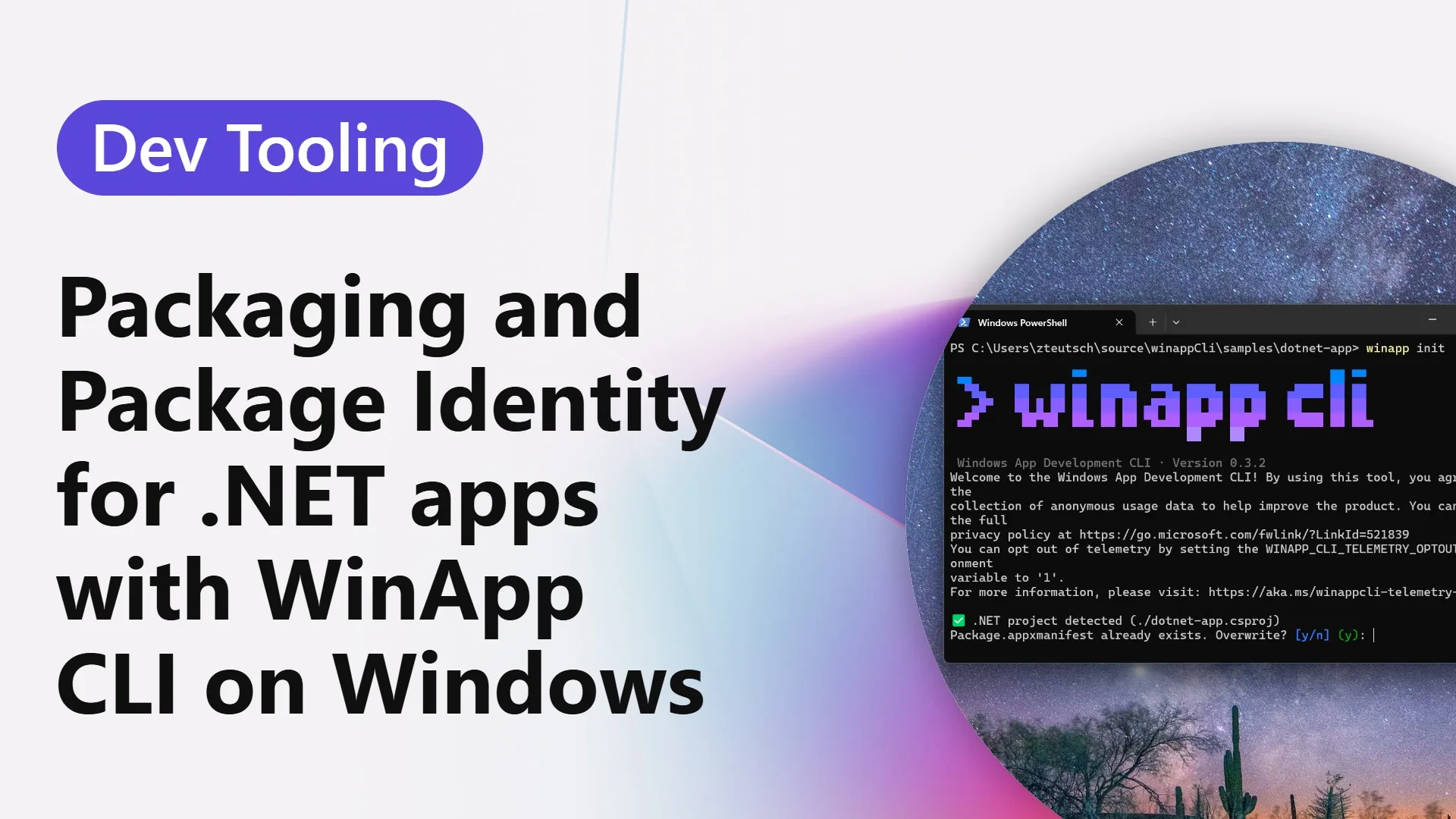
Packaging and Package Identity for .NET apps with WinApp CLI on Windows

Use the WinApp CLI to add identity to and package .NET desktop applications, enabling deeper integration to Windows and easier distribution.
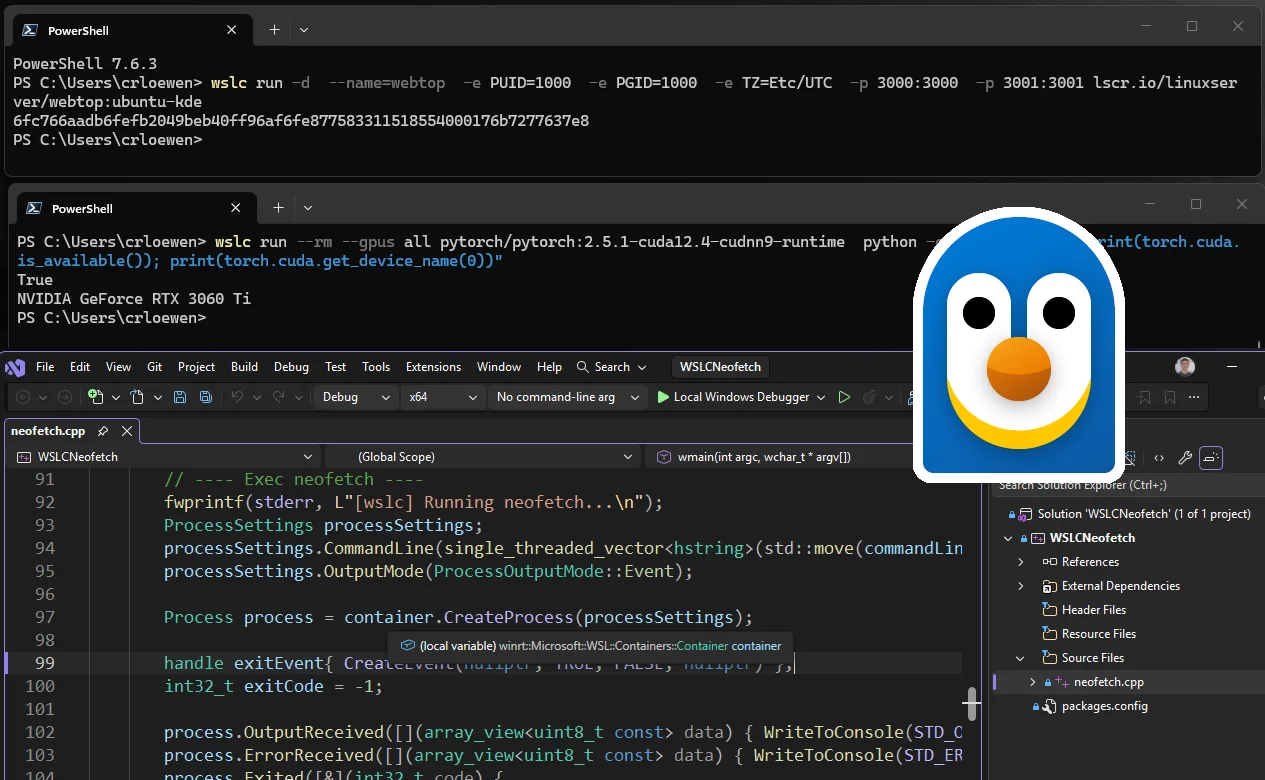
WSL container is now available for public preview

At Microsoft Build 2026, we introduced WSL containers, bringing Linux container development directly into Windows through the Windows Subsystem for Linux (WSL). Containers have become a foundational part of modern development - from cloud-native applications and AI workloads to testing and deployment pipelines and WSL containers simplify this experience by providing a built-in, enterprise-ready way to create, run, and manage Linux containers on Windows, without requiring additional third-party tooling. With a new container CLI for end-to-end container workflows and an API that enables Windows applications to pro...
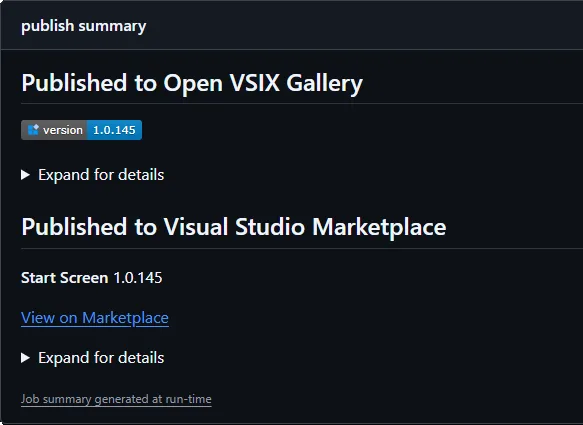
Automating your Visual Studio extension builds with GitHub Actions

If you’re building and maintaining Visual Studio extensions, you’ve probably ended up with some sort of build and publishing workflow - whether it’s manual, scripted, or stitched together over time. This post is for extension authors who want a simple, repeatable way to build, version, and publish their VSIX files using GitHub Actions. I’m going to show how I do this across my own extensions. I’ve been using this approach for a long time, and over time I pulled the most repetitive pieces into a few small reusable actions, so I don’t have to keep rewriting the same logic in every repo. Those are: ...
The evolution of window and class extra bytes in Windows
The intended usage is encoded in the prefix.
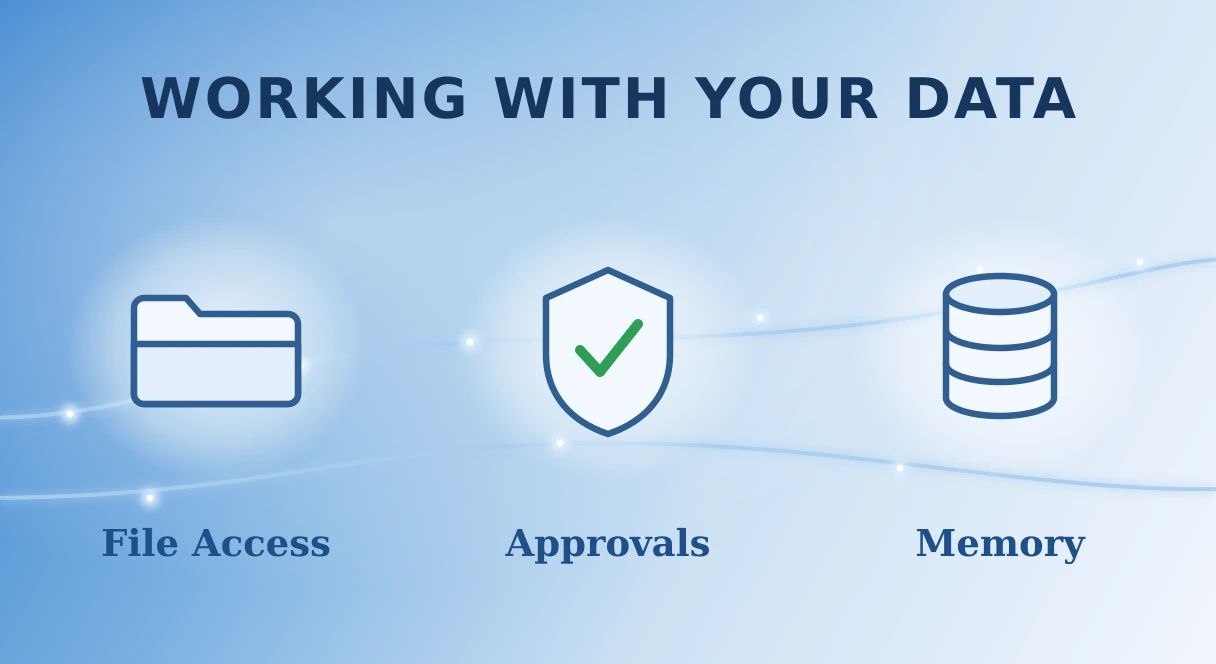
Agent Harness: Working with your data, safely
Part 2 of Build your own claw and agent harness with Microsoft Agent Framework. In Part 1 we stood up a harness and gave our personal finance assistant its first abilities: a custom tool, web search, and planning. It can talk about the markets - but it can't yet touch your data, and nothing stops it from taking a sensitive action on a whim. This part fixes both, using three abilities that are all included in the harness: As before, we only supply what makes our agent ours; the harness provides the machinery. Let's take the three in turn. Give it your data: file access Our assistant should...

Remote Event Receivers are retiring: move to SharePoint webhooks before July 1, 2027

Remote Event Receivers in SharePoint Online are retiring. Starting July 1, 2027, all remote event receivers will stop firing events, including those registered using Microsoft Entra applications.
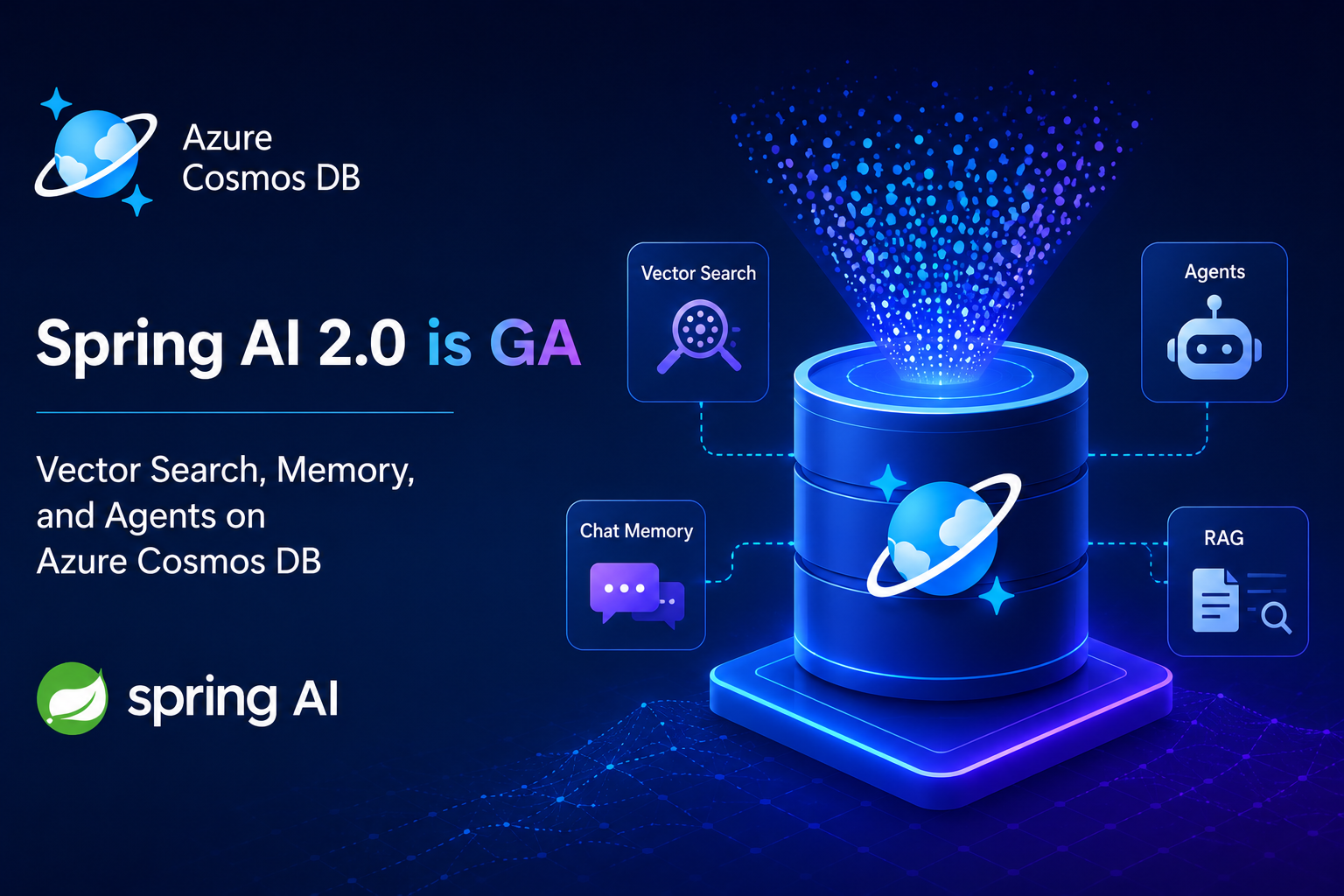
Spring AI 2.0 is GA: Vector Search, Memory, and Agents on Azure Cosmos DB
The wait is over. Spring AI 2.0 is generally available, and Azure Cosmos DB is right there with it. With this release, Spring AI graduates into a mature, production-ready framework for building AI applications in Java, and Azure Cosmos DB ships dedicated, vendor-maintained integrations that plug straight into the Spring AI ecosystem. The Spring AI 2.0 GA announcement names Azure Cosmos DB among its vendor-maintained modules, maintained directly by Microsoft rather than the core Spring AI team. This means the integration is built and supported by the engineers who work on Cosmos DB itself, bringing deep, first-ha...

Azure Developer CLI (azd) – May and June 2026

A combined May and June recap. A new azd tool command group, the cross-platform azd exec runner, safer multi-layer provisioning, an interactive Ctrl+C cancel prompt, Go support for Azure Functions, self-contained extension bundles, per-tenant subscription filters, and a long list of correctness fixes for parallel Container Apps deploys and authentication.
The case of the DLL that was not present in memory despite not being formally unloaded, part 2
Tying two bugs together.

Passing Context Between Agents in Multi-Agent A2A Systems


How we solved the challenge of passing conversational context between independently deployed agents using the A2A protocol's embedded context pattern, keeping domain agents stateless and secure.
Save the Date: Pure Virtual C++ 2026
Pure Virtual C++ is back for its 7th year! Join us on July 21 for a free, one-day virtual conference for the whole C++ community.
Your agent already has a plan
If an agent isn't doing the right thing, the obvious move is to make the docs clearer. Add a tip, spell out the correct command, describe the right approach more prominently. You do all of that, and the agent still ignores it. It does what it had already decided to do. The tip wasn't ignored because it was unclear, it was ignored because the agent had already made its plan before it read the page. The agent plans before it reads An AI coding agent doesn't arrive at your documentation as a blank slate. The moment you give it a task, it forms a plan based on what it learned during training, before it goes and...
Learn from Microsoft: Transform software development through an agentic platform

See how Microsoft is transforming software development with agentic workflows, AI-powered automation, and specialized agents across the engineering lifecycle.
The case of the DLL that was not present in memory despite not being formally unloaded, part 1
Figuring out how it went missing.
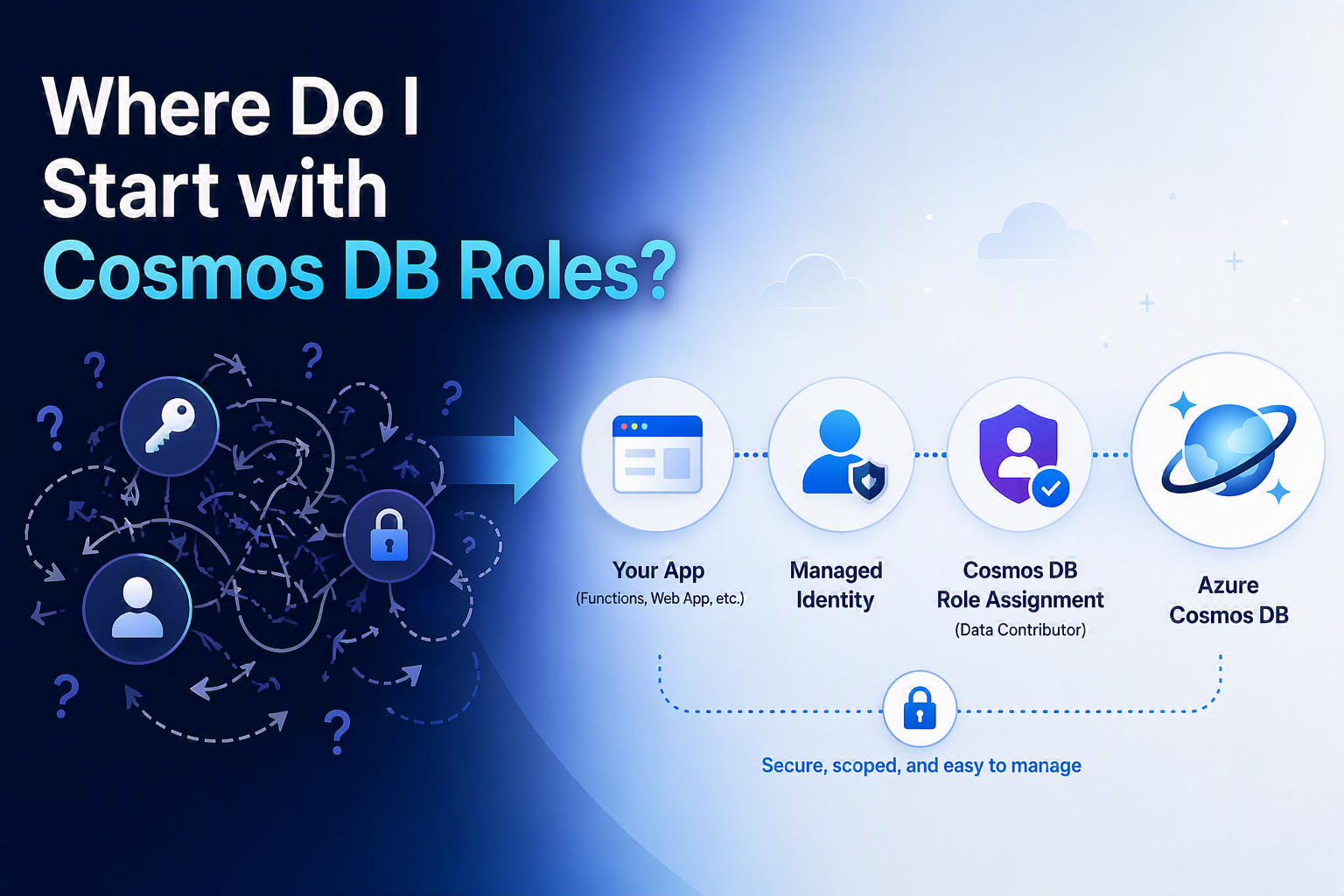
Which Azure Cosmos DB Role Does My App Need?


In the previous post in the series, we covered the security decisions you make on day one. In this part, we will talk about how to give your app access to Cosmos DB data, using roles and a managed identity instead of keys. The situation You’ve built your app. It works locally. Now you’re ready to connect it to Azure Cosmos DB, and you hit the question: how does my app get access? There are really only three questions you need to answer: First, the one distinction that trips everyone up Cosmos DB has two completely separate permission systems. If you remember nothing else from this ...
Azure Functions MCP Extension: What’s New at Build 2026
A roundup of what shipped in the Azure Functions MCP extension since preview: resource and prompt triggers, MCP Apps, built-in MCP authentication, structured and rich content, fluent .NET configuration APIs, and what is coming next.
When the model has never seen your code
This is the fifth article in a series about Agent Experience (AX): the practice of making AI coding agents work correctly with your technology. The series covers what you can and can't control in the agent stack, how to measure whether your extensions are helping or hurting, and how to iterate toward better outcomes. Everything we've covered so far assumed the model has some training data about your technology. Maybe it's outdated, maybe it's biased toward a competitor, but there's something in the weights to work with. For proprietary code, internal SDKs, and custom frameworks, there's nothing. In the previous...
Cancellation of Windows Runtime activities is asynchronous
You're asking for it to cancel, but it doesn't wait for confirmation.
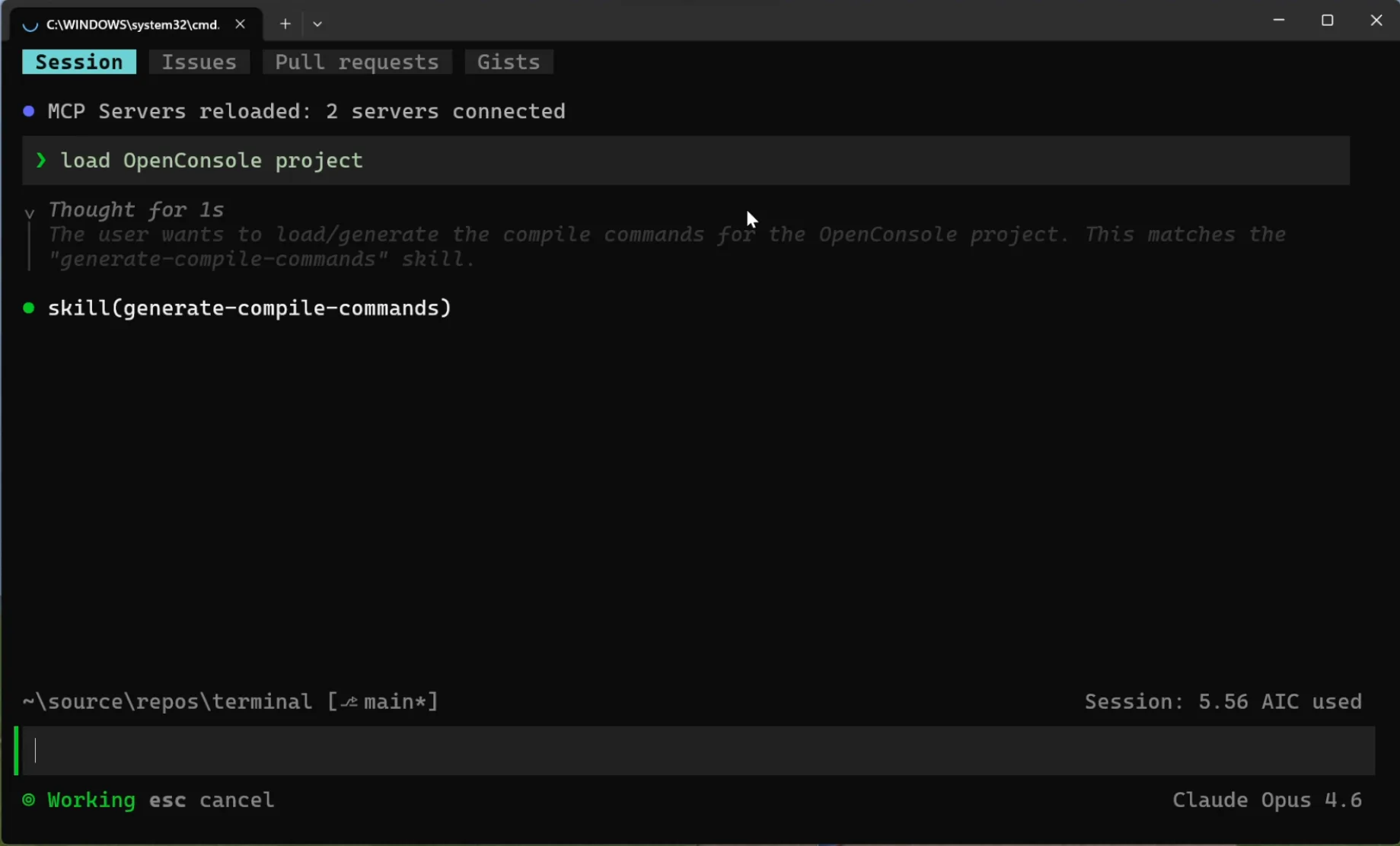
Streamline C++ Code Intelligence Setup in Copilot CLI
C++ developers can now bring IDE-style semantic intelligence into Copilot CLI with less setup. The C++ language server plugin supports richer code navigation, diagnostics, symbol understanding, and code changes by using the same build context your compiler does. That build context usually comes from a file, which tells the language server how each source file is compiled. Instead of manually wiring that file together, the C++ language server plugin now provides a setup LSP skill that can help generate or refresh compile commands for common project types, including CMake and MSBuild. For custom build systems, ...
Add vs Stage and Register
As previously mentioned to 'install' a package, as people think of the term, Windows actually performs two separate operations: staging and registration. To oversimplify: One way to 'install' a package for a user is to explicitly stage it, then register the package: But this scenario is common enough that deployment handles it more efficiently as a single deployment operation: stage the package and register it in one request. That's what the 'Add Package' operation does: ensures the package is staged if necessary, then registers it for the user. Why not always Add? Because staging and registratio...
Microspeak elaborated: Isn’t escrow just a release candidate by another name?
Yes, but the name is a psychological trick.

Going beyond text in Microsoft 365 Copilot – Introducing SharePoint Copilot Apps
Microsoft 365 Copilot is brilliant with words - but work isn't only words. Introducing SharePoint Copilot Apps: bring rich, interactive UX components straight into the Copilot canvas, built with any JavaScript stack your team already knows. Reuse your existing SPFx investments across Copilot, SharePoint, and Teams - no new platform, no infrastructure, no lock-in.

Azure SDK Release (May 2026)
Azure SDK releases every month. In this post, you'll find this month's highlights and release notes.

Meet your agent harness and claw
Part 1 of Build your own claw and agent harness with Microsoft Agent Framework. In the overview we said a "claw" is really just an agent harness: a loop around a model, wired up with tools, planning, memory, and more. In this first post we stand up that loop and give our personal finance assistant its first three abilities: plan. The remarkable part: we get almost all of this for free. Agent Framework's harness bundles function invocation, history persistence, planning, and web search into a single call. We only supply what makes our agent ours - its instructions and its custom tool. Let...
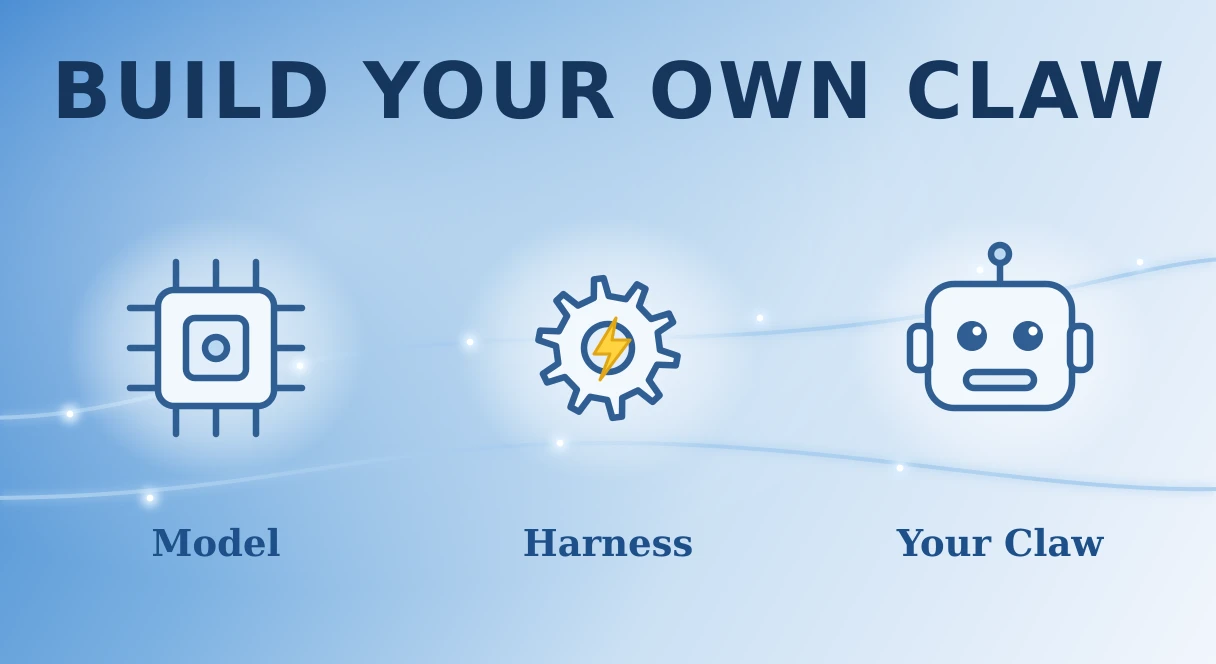
Build your own claw and agent harness with Microsoft Agent Framework
What does it take to build your own "claw" - a capable, CLI-style agent that can plan, use tools, remember things, and safely act on your behalf? Coding agents and assistants like these can feel like magic, but underneath they are an agent harness: a loop around a language model wired up with tools, planning, memory, approvals, and observability. In this series we build one from scratch using Microsoft Agent Framework and its batteries-included harness, demonstrating both .NET and Python, side by side. The series Everything is grounded in runnable samples that live in the repository, so you can follow alon...
Models don’t have preferences, they have context
You open a fresh chat, type "What framework should I use for a web app?", and the model says "React." You screenshot it, share it, and write "Claude prefers React." It gets engagement. People nod along. A few reply with their own results. And now we have a consensus: Claude prefers React. Except it doesn't. The model doesn't prefer anything. You're reading the room, not the mind. The genre There's a whole genre of this. Run N prompts in a bare chat window, tabulate the answers, maybe build a heatmap, publish it as a blog post or a thread. "Which frameworks do LLMs prefer?" "What languages do models recommend mo...
In memory of the man who put red and green squiggles under words
Starting in Word and expanding to nearly every other word processor, and even things that aren't word processors.
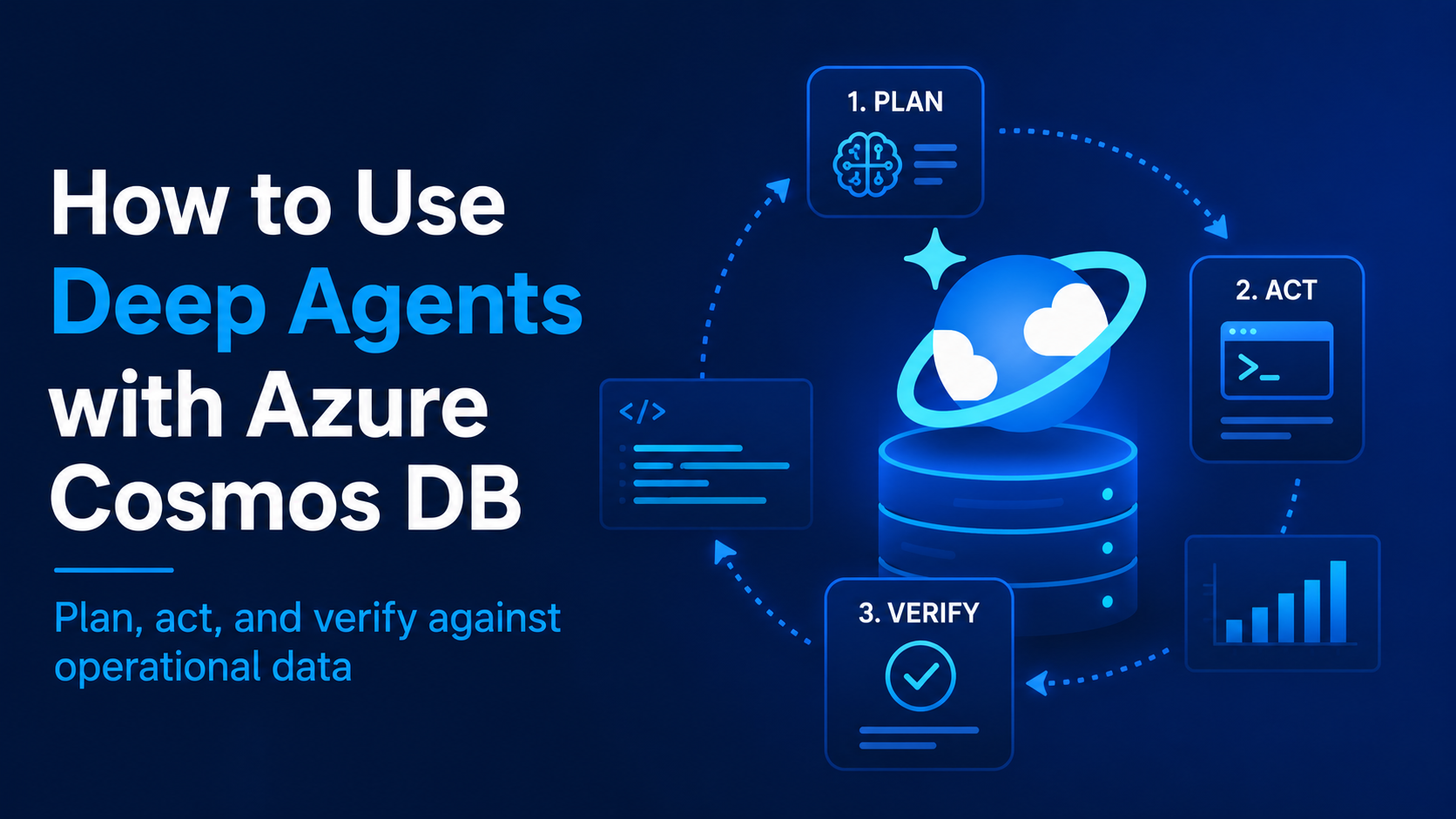
How to Use Deep Agents with Azure Cosmos DB – Plan, act, and verify against operational data
Deep Agents is an agent harness built on LangGraph, for agents that need to work through a task over many steps instead of a single LLM call. The agent runs tools, looks at the results, and uses that to pick the next one, keeping a todo list as it goes. On top of that loop the harness brings what a longer-running agent needs. It can load instructions on demand instead of holding everything in the prompt (skills), offload large tool outputs so they don’t fill the context window, and pause for human approval in apps that need an approval gate before data changes. Support Ops Agent is a sample app that puts this ...
Retirement of Azure DevOps issuer in Workload identity federation service connections

We are announcing the deprecation of the Azure DevOps issuer in workload identity federation (WIF) service connections, with planned retirement on July 1, 2027. The Azure DevOps issuer uses the prefix in federated credentials. This change is part of Microsoft's broader initiative to standardize on the Microsoft Entra issuer across Azure services that implement workload identity federation. Important This deprecation only applies to service connections in Azure public cloud that use single-tenant Microsoft Entra applications or managed identities. Service connections targeting non-public clouds (for example, ...
Copilot 在 JetBrains IDE:功能更新与 Claude 作为 Agent 提供方预览

本次更新为 GitHub Copilot for JetBrains IDEs 带来了对来自 GitHub 的组织和企业级 agent 的支持,让你可以在 Copilot CLI 会话中排队和引导消息,引入了全新的 agent 调试日志摘要视图,并将 Claude 作为 agent 提供方带入公开预览。 此外,本次更新还包含模型选择器增强、按轮次显示的 AI Credits 指示器,以及一系列用户体验和可靠性方面的改进。Cloud agent 现已正式可用(GA)。 新功能 支持来自 GitHub 的组织和企业级 agent 现在你可以直接在 JetBrains IDE 中使用在 GitHub 组织和企业级别定义的自定义 agent。管理员可以发布一组精选的 agent,并自动提供给组织或企业中的每个人。这让在团队中共享、标准化和治理 agent 工作流变得更加容易。 使用方法: 了解更多详情,请参阅在组织中准备使用自定义 agent和在企业中准备使用自定义 agent。 在请求运行时发送消息(CLI) 在 Copilot CLI 会话中处理较长的任务时,以前你必须等待响应完成或取消它。现在,你可以在请求仍在运行时发送后续消息。 当请求正在进行时,发送按钮会变为一个带有三个选项的下拉菜单: ...
What does it mean when the bottom bit of my HMODULE is set?
A special kind of <CODE>HMODULE</CODE>.

Separating Deterministic Extraction from AI Inference in Industrial Summarization

When 100% of our prototype outputs were valid JSON but 0% met the data contract, we discovered the LLM was doing work that software should own. A field classification exercise and 4-pass pipeline brought schema compliance from 0% to 100%.

Meet the Agent Academy Hackathon Winners

From May 12 to June 2, 2026, builders from around the world put their Agent Academy learning to the test by designing, building, and shipping real, working AI agents with Copilot Studio. After two weeks of judging, we’re thrilled to announce the Agent Academy Hackathon winners. 🏆 The Winners Recruit Track The Recruit track is geared toward exploring the fundamentals of agent building and is optimized for first-time agent builders. 🥇 First place: Performance Development Assistant Built by @Ateina What they built After a performance review, employees often know what to improve but have no clear path forward ...

Outcome-driven learning systems: Enterprise RL with OpenEnv and Foundry

We shipped a lot at Build 2026: hosted agents, Toolboxes, Foundry IQ, Memory, Managed Compute, fine‑tuning, Frontier Tuning, and a new evaluation and optimization stack. Read as a feature list, it is a lot to hold in your head. So here is a simpler way to see it: these are the parts you need to build a learning system, with agents that get measurably better at your work over time, not a chatbot that answers once and forgets. This post is about assembling those parts into one loop you own, and the science that makes a small, owned model worth training. It builds on two pieces worth reading first. Jay Pari...
DirectX Dump Files Preview Now Available!

At this year’s GDC, we shared our vision for bringing console‑level GPU developer tools to Windows. As part of that announcement, we introduced DirectX Dump Files as a major step forward in GPU crash debugging on Windows. Today, we’re excited to make our DirectX Dump Files public preview available to developers! If you missed our GDC announcement, it’s now available in the GDC Vault: Bringing Console-Level GPU Tooling to Windows You can also read our announcement blog: DirectX: Bringing Console‑Level Developer Tools to Windows For instructions on how to get started today, see our Getting Started secti...

PIX 2606.18-preview: DirectX Dump Files and more

Today we released PIX 2606.18-preview, available here. This PIX release coincides with the preview availability of DirectX Dump Files (.dxdmp). The PIX UI can open DirectX Dump Files directly for analysis, and the PIX API can be used to analyze them programmatically. Please visit the DirectX blog for more information about the DirectX Dump Files preview and PIX support for them. PIX 2606.18-preview also includes everything in the previous PIX preview build, PIX 2605.28-preview, and additional new functionality. The full list is: As a preview release, this build provides early access to ...
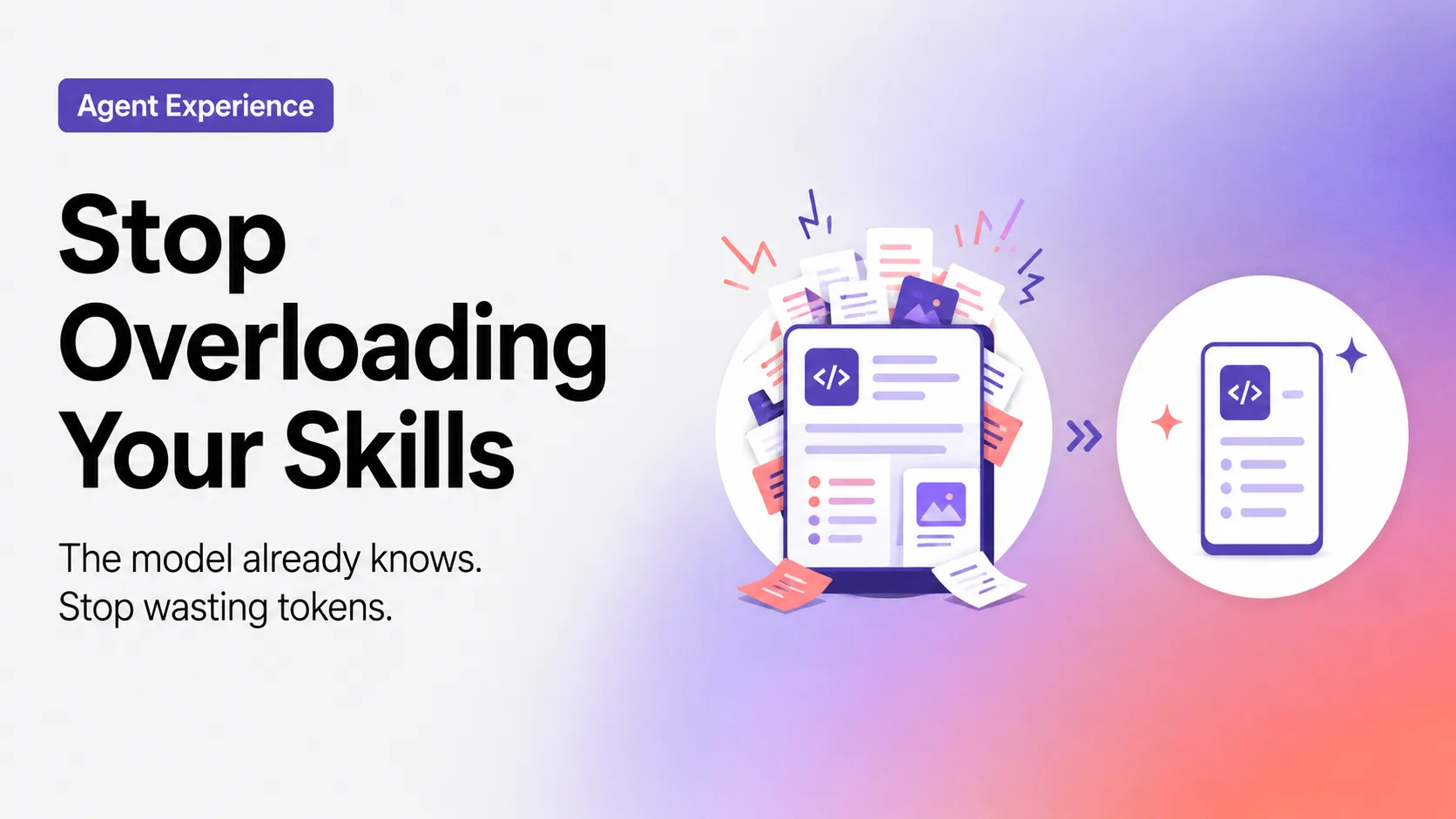
Stop overloading your skills
You built a skill for your technology. API references, authentication flows, SDK patterns, error handling, version info, all packed into one skill. The agent calls it, gets all that context, and generates code. The kicker? You've just wasted a lot of tokens. It already knows Models have ingested your documentation, your Stack Overflow answers, your GitHub repos, your blog posts. The default imports, the standard auth flow, the common CRUD operations: the model already has all of that baked in. When your skill repeats what the model already knows, you're not helping, you're adding weight. Every token your skill...
Why doesn’t GetLastInputInfo() return info for the user I’m impersonating?
It doesn't care about impersonation, says so on the tin.
Announcing TypeScript 7.0 RC
Today we are excited to announce the Release Candidate of TypeScript 7.0! If you haven't been following TypeScript 7.0's development, this release is significant in that it is built on a completely new foundation. Over the past year, we have been porting the existing TypeScript codebase from TypeScript (as a bootstrapped codebase that compiles to JavaScript) over to Go. With a combination of native code speed and shared memory parallelism, TypeScript 7.0 is often about 10 times faster than TypeScript 6.0. To get the new compiler, you can just install it from the package on npm, just like with any other r...

Intelligent Terminal 0.1.1 is here: bash support, new slash commands, and more customization

We're back with the first servicing release of Intelligent Terminal! This update brings auto error detection to Bash and WSL, a new command for on-demand help, an on-the-fly picker, a customizable agent pane, and Windows 10 support, along with a round of bug fixes and reliability improvements. You can grab the update from the Microsoft Store, via , or by heading to the release page on GitHub. Let's dive in! Auto error detection and fix support comes to Bash and WSL In 0.1, automatic error detection and fix/command suggestions were limited to PowerShell. With this release, that same experience now works in Ba...
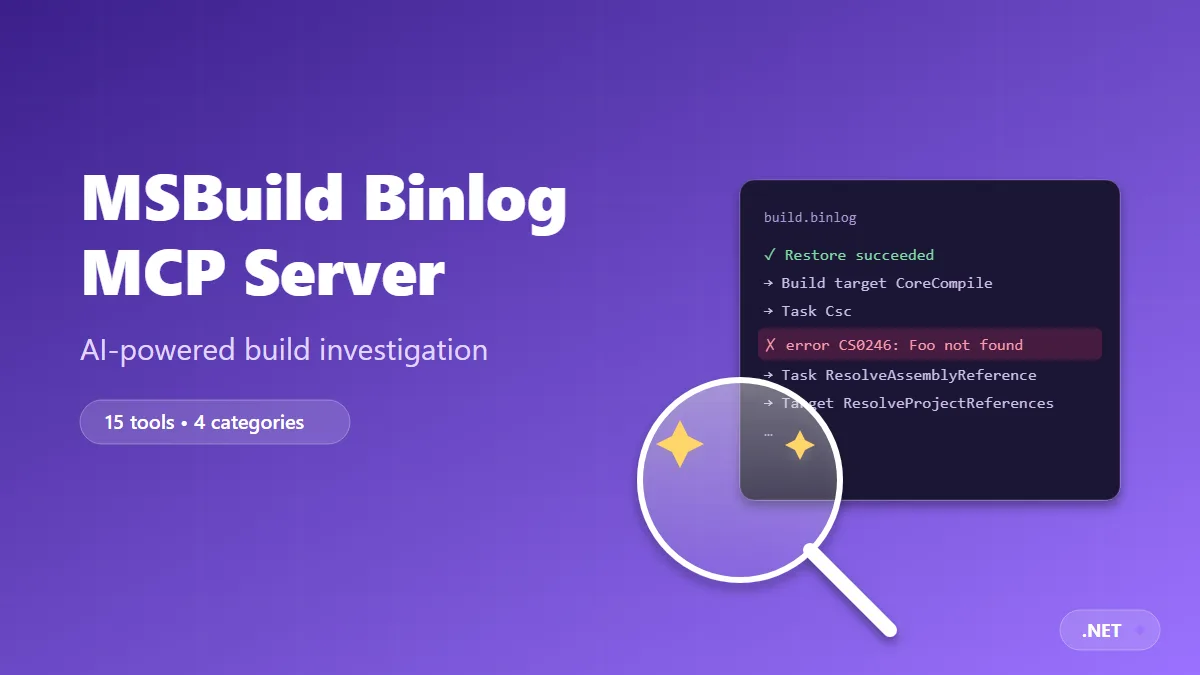
AI-Powered MSBuild Investigation with the Microsoft Binlog MCP Server
Diagnose MSBuild build failures and performance issues with AI using the new Microsoft Binlog MCP Server - 15 specialized tools that let your AI assistant investigate binary logs.

How to diagnose conflicts between AI agent extensions
Your extension works in isolation. You measured it, confirmed it creates lift. Then a developer installs it alongside 14 other extensions, and outcomes get worse. The symptoms look like a bug in your code, but the problem is elsewhere: extensions fighting each other for the same context window and model attention.
Windows stack limit checking retrospective, follow-up
Choosing the register to use to pass the desired stack allocation size.
Azure Backup for Azure Cosmos DB Public Preview Adds Immutable Backups and Long-Term Retention


Azure Backup for Azure Cosmos DB Public Preview Adds Immutable Backups and Long-Term Retention Picture the first few hours after a serious data incident. A production application is down. Security teams are still trying to understand what happened. Application owners need to know which recovery points are usable, which ones are protected from tampering, and whether they can restore somewhere outside the environment under investigation. For teams running regulated or business-critical workloads on Azure Cosmos DB, that moment is exactly where backup design stops being a checkbox. It becomes part of opera...
Boosting Adobe Photoshop’s Performance with MSVC and SPGO
Boosting Adobe Photoshop’s Performance with MSVC and SPGO Adobe and Microsoft worked together to improve Photoshop performance and responsiveness on Windows by combining MSVC’s peak-performance build settings with Sample-based Profile-Guided Optimization (SPGO). The collaboration focused on real customer scenarios where latency matters most, including brush and stroke responsiveness, file open times, and other CPU-intensive operations that directly affect creative flow. Adobe’s combined benchmarking showed improvements of 20% on x64 and 13% on ARM64, demonstrating how modern compiler technology can translate int...
Aspire in VS Code: the 13.4 developer loop

Aspire 13.4 brings more of the local development loop into VS Code: AppHost CodeLens actions, live resource state, dashboard shortcuts, typed resource command prompts, TypeScript AppHost support, and multi-language debugging.
Third Rule of MSIX
MSIX has several core principles underlying its design and implementation. Engineers half-jokingly call these The Rules of MSIX. The Third Rule of MSIX is arguably the most important and certainly the most foundational: Package identity is unique across space and time Packageidentity is a unique identifier corresponding to a specific set of bits. Change even a single bit in the package and the package identity must change as well. The deployment engine relies on this rule when deciding if a package needs to be staged. If an existing package already has the same identity, deployment skips staging work. This...
Why AI coding agents keep using deprecated CLIs and SDKs
You deprecated the old CLI and shipped something better. Developers are migrating, but AI coding agents aren't. They keep reaching for the deprecated tool, confidently scaffolding projects with something you sunset months ago. The agent isn't broken, your docs aren't wrong. The model is doing exactly what ten years of training data told it to do, and once you understand why, you can fix it. Training data gravity Models learn from the internet. If your technology has been around for a decade, there are thousands of blog posts, Stack Overflow answers, tutorials, and GitHub repos that document the old way of doi...
Retrofitting the WM_COPYDATA message onto Windows 3.1
It was carefully designed to be trivial.

Announcing General Availability of the Azure Cosmos DB Built-in Connector for Logic Apps Standard
Today, we're excited to announce the general availability of the Azure Cosmos DB built-in connector for Azure Logic Apps Standard. This connector gives you a native, high-performance way to integrate Azure Cosmos DB into your Standard logic app workflows, with better throughput, lower latency, and richer functionality than the managed connector. That includes real-time change feed processing, bulk operations, and Microsoft Entra ID authentication. If you've been building integration workflows that read, write, or react to data in Azure Cosmos DB, this GA release means you can do all of that with production-grade...
GitHub Copilot for JetBrains is moving to Copilot CLI as the default agent harness

Copilot CLI is becoming the default agent harness in GitHub Copilot for JetBrains, and our local harness will be deprecated. This change provides greater consistency across all GitHub Copilot surfaces and is an important step toward faster feature parity and higher-quality results in GitHub Copilot for JetBrains. Copilot CLI sessions run independently in the background on your machine and use the Copilot CLI agent harness, while the IDE starts, monitors, and steers them. This is the same architecture used across GitHub Copilot today and adopting it in JetBrains lets us ship the same capabilities to JetBrain...

Make Visual Studio look the way you want
Themes are personal. Some of us live in dark mode, some swear by high contrast, and some of us have very strong opinions about that one shade of blue from years ago. The new themes in Visual Studio 2026 are built on Fluent, which gives us a much more consistent and accessible foundation, but we have heard from plenty of you who want more control over specific colors. Accent colors, hover states, the line between the shell and the tab headers… the small things that make an IDE feel like yours. So, we did something about it. Visual Studio now has a new Theme colors options page that lets you customize any...
The time the x86 emulator team found code so bad that they fixed it during emulation
Offensive content in the eyes of a software engineer.

GitHub Copilot modernization for C++ is out of preview

GitHub Copilot modernization for C++ is out of preview as of Visual Studio 2026, helping you upgrade your MSVC Build Tools with an AI-guided workflow.
How can I schedule work on a thread pool with low latency?
The thread pool is designed for throughput, not latency.

Orchestration Patterns for Multi-Agent Systems: Performance and Trade-offs

Real-world lessons from evolving a production chatbot into a coordinator-based multi-agent architecture, including performance trade-offs for enterprise-scale agent reuse.
MSVC Build Tools Preview updates – June 2026
Try the latest updates to MSVC Build Tools Preview
June Patches for Azure DevOps Server
We are releasing new patches for our self‑hosted product, Azure DevOps Server. We strongly recommend that all customers stay up to date with the latest, most secure version of Azure DevOps Server. The most recent release, Azure DevOps Server, is available on the download page. The following versions have been patched. For more details on these updates, see the release notes: ⬇️Azure DevOps Server Patch Download ✅Verifying Installation To verify that the patch is installed, run the following command on the Azure DevOps Server machine using the patch installer you downloaded: Replace with the name of the...

Migrating EWS notifications to Microsoft Graph

Migrating from the Exchange Web Services (EWS) notification framework, which supports push, pull, and streaming notification types — to the Microsoft Graph subscription model represents a fundamental transition toward a unified, stateless, and event-driven framework.
Your agent just scaffolded a project from 2020
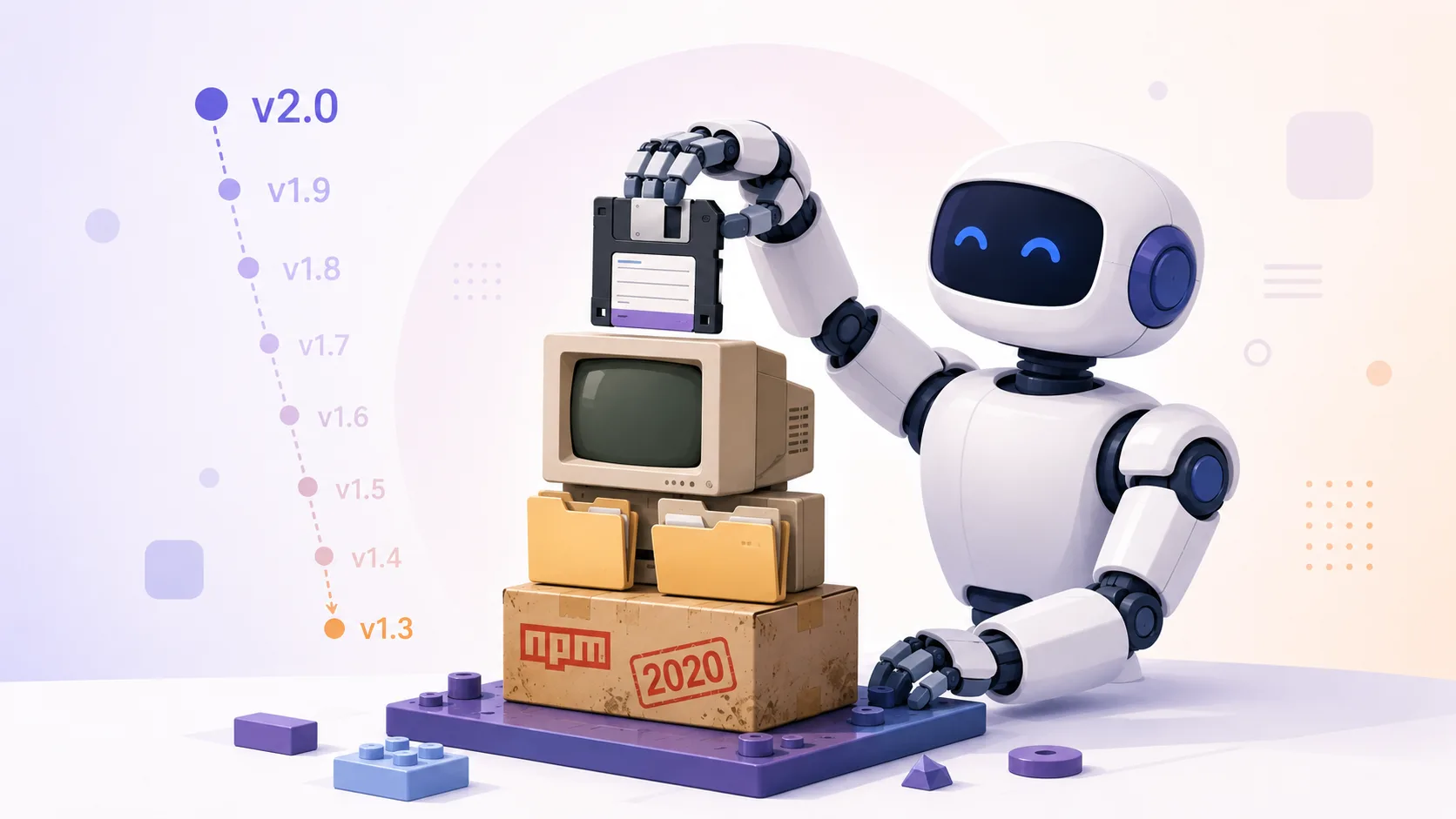
Your agent ran a scaffold command. Project generated, dependencies resolved, no errors. Everything looks fine. Except it's based on the project structure from 2020, and neither you nor the agent noticed. How npx picks the right-but-wrong version When an agent scaffolds a project or runs a CLI tool, it often reaches for without specifying a version. Something like: Notice, that there's no version pinned anywhere. The agent typed the package name and assumed it'd get the latest. That's where things break. When you run without a version, npm resolves the latest version that's compatible with your current Nod...
Windows App Development CLI v0.3.2 — bundling support, smarter initialization, and more
Windows App Development CLI v0.3.2 is here! This release brings MSIX bundle support for multi-architecture packaging, a smarter winapp init experience that auto-detects your projects, higher quality UI screenshots, and a handful of reliability fixes across the board. Get the update by running winget install Microsoft.WinAppCLI or check the repo for other install options. Let's take a look at what's new. 📦 MSIX Bundle Support The pack command now supports creating MSIX bundles — multi-architecture packages that combine x64 and ARM64 builds into a single .msixbundle file. This is the format the Mic...
Review pull requests without leaving Visual Studio

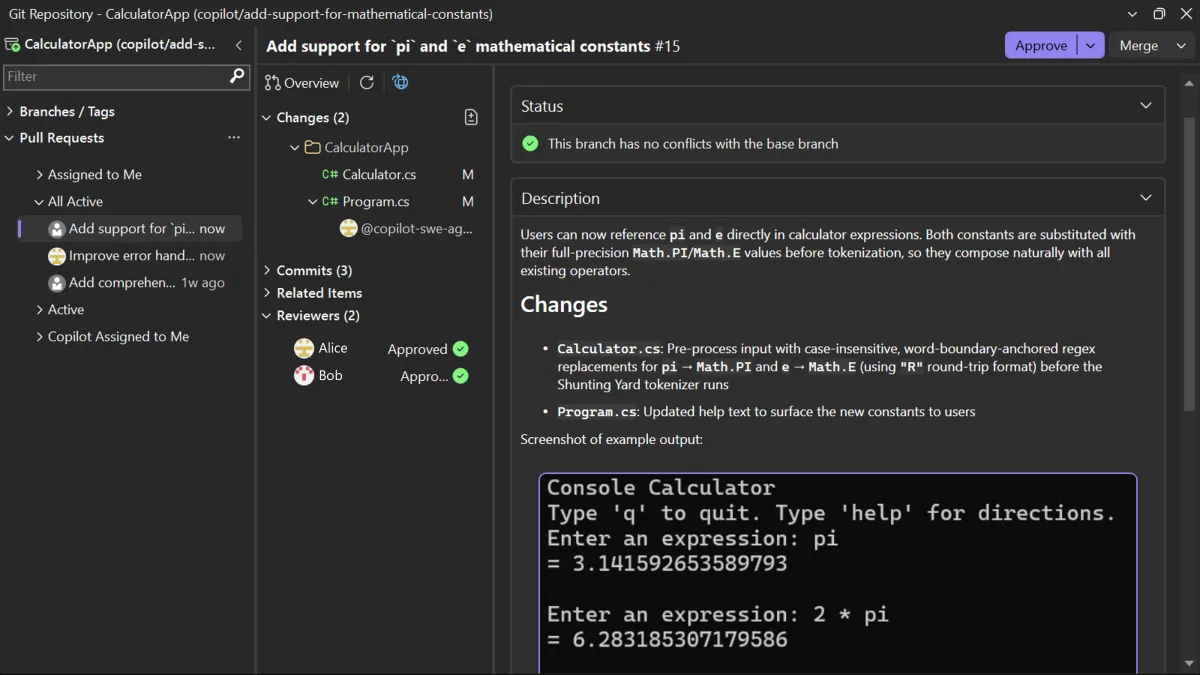
Pull request integration in Visual Studio has been one of the most requested Git features. Developers have been asking for a way to open a PR, inspect the changes, discuss feedback, and finish the review without switching to the browser. The feedback on that request has played a big role in shaping this experience over time. You’ve been able to create pull requests in Visual Studio since 2024. Now you can also review, comment on, and approve pull requests from both GitHub and Azure DevOps, all without leaving the IDE. Find and open pull requests You can view the list of pull requests for the open rep...

Copilot Autofix for GitHub Advanced Security for Azure DevOps

Over the last few years, we've encouraged customers to move their repositories from Azure Repos to GitHub, where the newest AI-powered and agentic development experiences land first. Migrating isn't equally simple for everyone. A move to GitHub can range from straightforward to a multi-year program, depending on an organization's size, customizations, compliance requirements, tooling, and industry constraints. While many customers are actively planning or running migrations today, others aren't ready yet. They continue to rely on Azure Repos for day-to-day development. For teams still building on Azure Repos, h...
Understanding the rationale behind a rule when trying to circumvent it
I mean, technically <I>I</I> didn't do it.

Agents League Hackathon 2026 – Enterprise Agents

From declarative agents for Microsoft 365 Copilot to fully autonomous multi-agent systems orchestrating complex workflows, developers now have the power to redefine how work gets done. If you're ready to push those boundaries, Agents League Hackathon 2026 is your stage. What is Agents League? Agents League is not just another hackathon—it's a global playground for developers, makers, and architects to experiment with: Whether you're building with pro-code tools (C#, TypeScript, SDKs) or leveraging low-code platforms like Copilot Studio, this is where innovation meets real-world im...

How to measure AI agent extension effectiveness
You shipped your skill. Everything looks like it's working. But is the generated code actually better because of your extension? You can't tell without measuring, and measuring agent extension impact is harder than it looks.
Stop skillmaxxing, save your tokens
You built a dozen skills for your technology: authentication, CRUD, error handling, deployment, testing, monitoring. Then you installed a cloud platform bundle with 15 more covering diagnostics, storage, compliance, and cost optimization. A design suite. A marketing pack. Document converters for Word, Excel, PowerPoint, PDF. Fifty skills, all sitting in your workspace. Here is why that's a problem. The tax you pay before typing a single prompt Every skill has metadata: a name, a description, trigger phrases, sometimes parameter schemas. When you start a session, the agent discovers all of them and injects their...
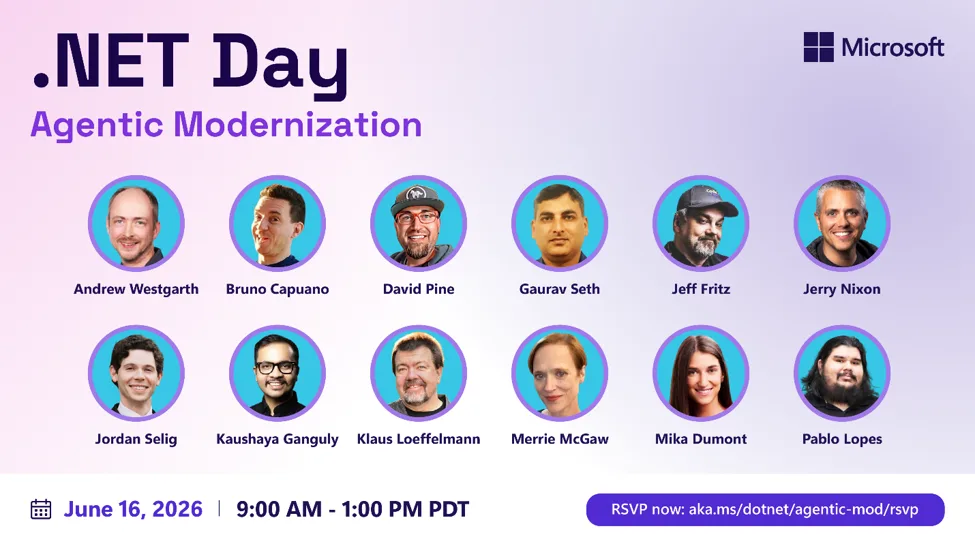
Join us for .NET Day on Agentic Modernization Livestream

Announcing the .NET Day of Agentic Modernization Livestream
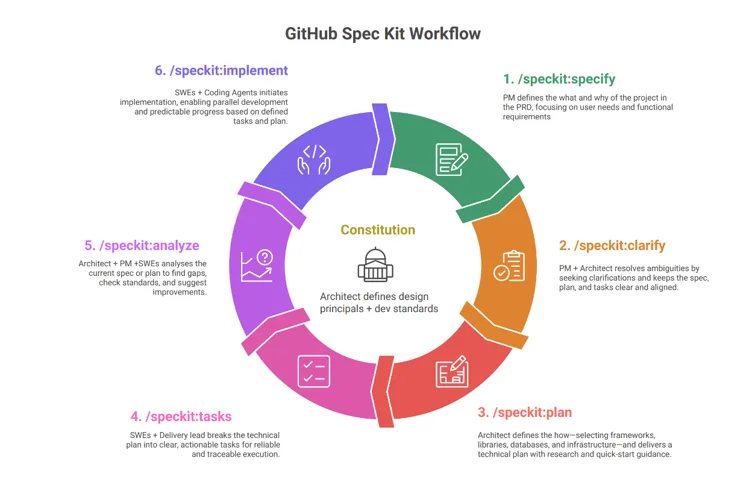
Spec-Driven Development: A Spec-First Approach to AI-Native Engineering

AI has made software delivery faster, but speed alone does not guarantee better outcomes. As teams adopt AI-native development, the real challenge is keeping requirements, design, implementation, and validation aligned so the final result still reflects the original intent. Spec-Driven Development (SDD) addresses this by making structured specs the shared source of truth for both humans and AI. Instead of prompting first and aligning later, teams align first and let AI accelerate execution from a clear spec. Why AI-assisted development still breaks down Teams often ship software that works but still misses the ...
What’s the opposite of ClipCursor that lets me exclude the cursor from a region?
There is no such feature, but you can just exclude it virtually.

PowerToys 0.100 is here: new Shortcut Guide, Command Palette improvements and much more!

We're back with a fresh PowerToys release! This month introduces the brand-new Shortcut Guide, a major Command Palette update with the new Extension Gallery and multi-monitor Dock support, and a wave of improvements to Power Display. We've also upgraded PowerToys to .NET 10, improved auto-update reliability, reduced installer size, and continued modernizing the app experience across the suite. Grab the update by checking for updates in PowerToys or by heading to heading to the release page. Let's dive in! ⌨️ Introducing the new Shortcut Guide The new Shortcut Guide has been designed and built from the groun...
.NET 11 Preview 5 is now available!
Find out about the new features in .NET 11 Preview 5 across the .NET runtime, SDK, libraries, ASP.NET Core, .NET MAUI, C#, Entity Framework Core, and more!
.NET and .NET Framework June 2026 servicing releases updates
A recap of the latest servicing updates for .NET and .NET Framework for June 2026.
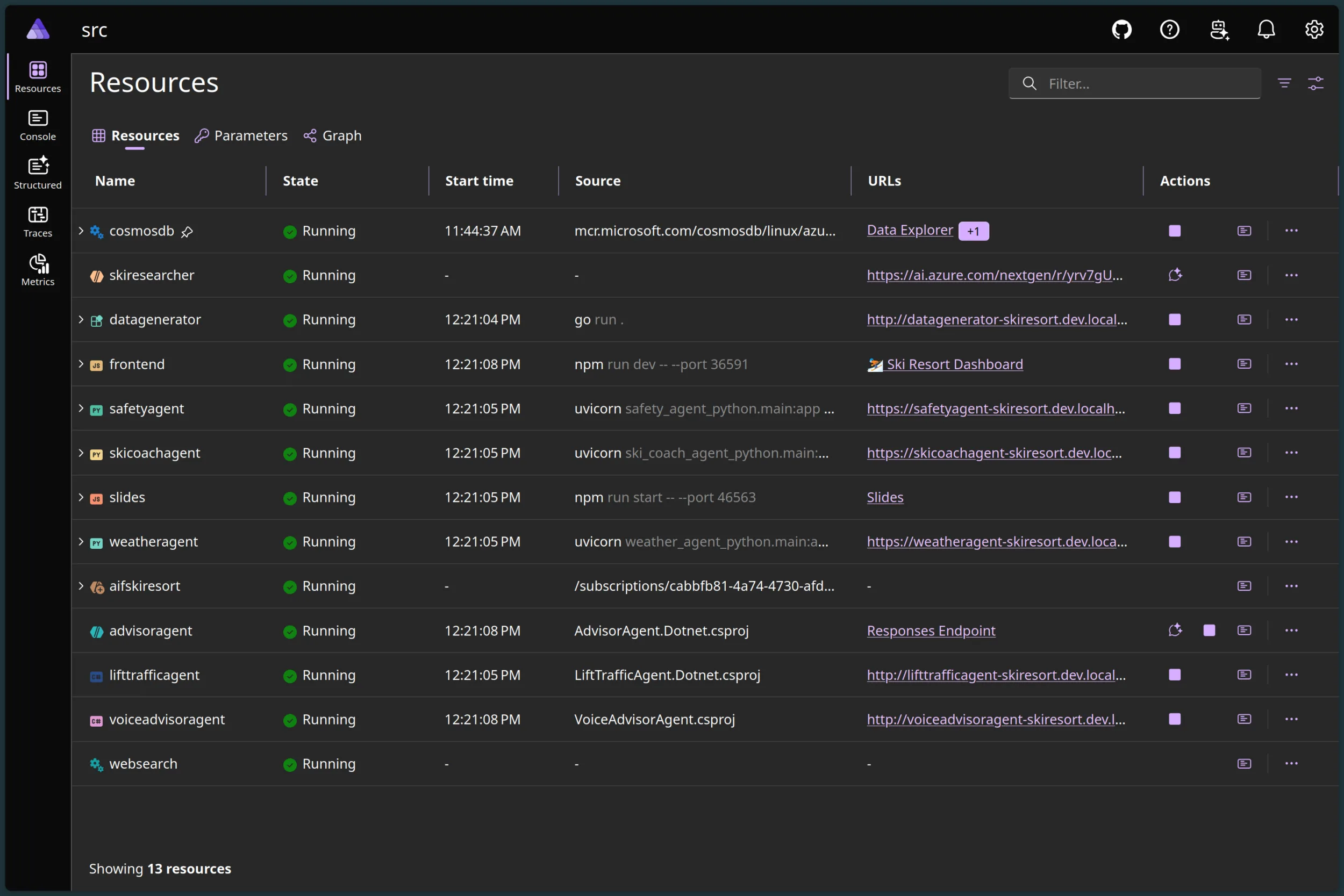
Distributed multi-agent systems with Aspire and Microsoft Agent Framework

Learn how Aspire, Microsoft Agent Framework, and Microsoft Foundry model, run, observe, and publish a distributed multi-agent AlpineAI ski resort demo.
ICYMI: Inside the Microsoft Agent Framework: How we designed a layered SDK

In case you missed it, the Command Line blog was launched last week and has a great article (by yours truly) about our SDK design philosophy with Microsoft Agent Framework. Check it out: Inside the Microsoft Agent Framework: How we designed a layered SDK Developers are moving quickly from simple chat-based AI experiences to applications that can reason, use tools, coordinate across systems, and complete multi-step and long-running tasks. The first wave of AI apps proved that large language models could understand intent and generate content through patterns like completions, retrieval-augmented g...
Staging Part 2 – Disk Space Optimization
"Disk space optimizations" is one of the key features of MSIX: Disk space optimizations. With MSIX there is no duplication of files across apps and Windows manages the shared files across apps. The apps are still independent of each other so updates will not impact other apps that share the file. But how does MSIX accomplish this? Every package includes an , which lists all files in the package along with their corresponding hashes. In Windows 8 - when MSIX was first introduced1 - staging would extract every file from the package directly into a file within the package's install location (also known as t...
Copilot Code Reviews for Azure Repos


Over the last several years, we have encouraged customers to move their repositories from Azure Repos to GitHub to take advantage of the latest AI powered and agentic development experiences that GitHub is delivering. At the same time, we recognize that migrating repositories to GitHub can vary significantly in complexity depending on an organization’s size, customizations, compliance requirements, tooling, and industry constraints. While many customers are actively planning and executing migrations to GitHub, many others are not yet ready to move and continue to rely on Azure Repos for day-to-day development....
Microsoft Build 2026 recap: vision, launches, and top sessions

Catch up on Microsoft Build 2026 with the vision lead-off, top developer announcements, and must-watch sessions across the Microsoft developer ecosystem.
.NET at Microsoft Build 2026: Must watch sessions

Catch up on all the .NET sessions from Microsoft Build 2026 covering .NET 11, union types in C#, AI building blocks, the agentic web, .NET MAUI, and more!

Enterprise Live Migrations: Moving from Azure DevOps Repo to GitHub with minimal disruption


Over the last several years, we’ve encouraged customers to move their repositories from Azure Repos to GitHub to take advantage of the latest AI-powered and agentic development experiences. For many enterprise teams, however, migrating at scale comes with real constraints. Traditional approaches can require extended downtime - sometimes days - which isn’t acceptable for teams running critical workloads. To address this, we’re introducing Enterprise Live Migrations (ELM), in limited public preview. Migrations begin without locking the Azure DevOps repository, with changes continuously synchronized to GitHub whi...
Rotation revisited: Shuffling more than three blocks, and other small notes
Generalizing the shuffle to arbitrary numbers of blocks.
Rotation revisited: Avoiding having to calculate the gcd when doing cycle decomposition
Math is hard. Let's go counting!
What’s New in vcpkg (May 2026)
This release includes major library updates for Boost 1.91, Qt 6.11, and OpenCASCADE 8.0, along with 27 new ports and over 500 port updates.

Frameworks only matter when they force decisions


Frameworks mean nothing, until they change what gets built! In this article we discuss how Git-Ape turns architecture and governance into delivery controls on Azure because, if frameworks do not shape delivery decisions, they are just decoration. Cloud teams do not have a framework problem. They have an execution problem. The industry is full of architecture guidance, governance models, and security baselines, yet far too many deployments still reach production with obvious weaknesses because the frameworks are treated like reference material instead of delivery controls. That is the real issue, not a ...
Aspire Multi-repo Rollout at Scale with Agentic AI

This is part 2 blog of the windows 365 integration journey with Aspire. This blog focus to show how Windows 365 scaled Aspire adoption with reliability patterns and an agentic AI rollout system across 50+ repos.
Rotation revisited: Cycle decomposition in clang’s libcxx
Rotating in the minimum number of steps by performing cycle decomposition.

Accelerate Edge AI Development with Foundry Local


Why edge AI development is still hard AI is no longer confined to cloud experiments. Developers are increasingly expected to deliver AI inside apps, devices, and edge systems where responsiveness, privacy, resilience, and local control are essential. But building those experiences for production is still difficult. Teams often have to solve model packaging, runtime fragmentation, hardware differences, and deployment complexity before they can ship a single reliable feature. That slows iteration and makes it harder to move from prototype to product. At Microsoft Build 2026, we’re announcing updates acros...
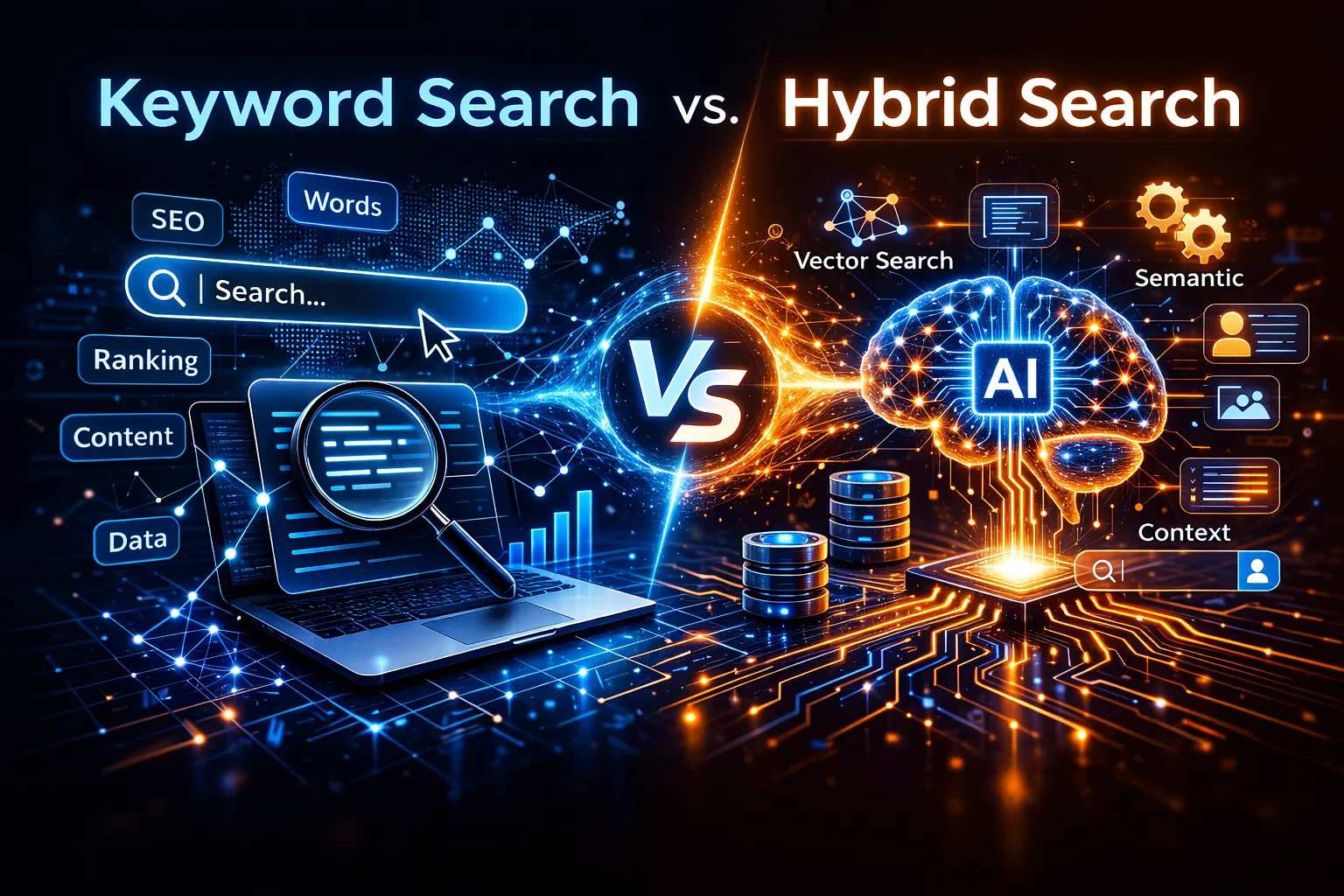
How we Decide Between Keyword and Hybrid Search: 5 Enterprise Evaluation Criteria

A data-driven framework we use in enterprise deployments to decide between vector-only keyword and hybrid search, based on five measurable evaluation criteria.

Build 2026: From observability to ROI for AI agents on any framework

9 min read · June 3, 2026 · Sebastian Kohlmeier Shipping an AI agent is the easy part. Keeping it accurate, safe, and accountable in production is where teams get stuck. Agents are non-deterministic. Their behavior shifts as models update, tools change, and traffic patterns evolve and most of that drift happens silently, long after the demo. End-to-end observability covering the full development lifecycle is how you close that gap: See every step an agent takes, evaluate quality and safety against criteria you define, optimize what isn’t working, and prove the business value of what is. This spring w...
Go 1.26.4-1 and 1.25.11-1 Microsoft builds now available
A new release of the Microsoft build of Go including security fixes is now available for download.

How Microsoft is migrating repositories to GitHub

For the past decade, Azure DevOps has powered software development at Microsoft, supporting some of our largest repositories and most complex engineering workflows across Azure Repos, Boards, and Pipelines. Software development is being reshaped by AI, and where code lives now have a direct impact on how much value organizations can capture. For teams that want to take full advantage of AI-native development, repository location is becoming a strategic decision. Azure DevOps and GitHub product teams have spent the past few years building the integration, migration, and enterprise-readiness capabilities needed t...
Expanding the Reach of Document Translation – New Capabilities Announced at Microsoft Build

Learn how new Document Translation capabilities in Azure Translator, available in Foundry Tools, help developers translate images, PDFs, Office files, DITA, XLIFF, and future LLM-powered document workflows.
Microsoft Agent Framework at BUILD 2026: Agent Harness, Hosted Agents, CodeAct, and more
Microsoft Agent Framework at BUILD 2026: Agent Harness, Hosted Agents, CodeAct, and more BUILD 2026 is underway, and the Microsoft Agent Framework team have a round-up of exciting announcements! Microsoft Agent Framework (MAF) is our open-source SDK and runtime for building AI agents and multi-agent workflows, with the same concepts and APIs across .NET and Python. It gives you a clean programming model - chat clients, tools, MCP integrations, context providers, middleware, and multi-step workflows - so you can focus on agent logic instead of plumbing. MAF reached 1.0 GA on April 2, 2026, bringing the conver...
Announcing Foundry Managed Compute: Run open models in Microsoft Foundry

Microsoft Foundry Managed Compute is a new GPU platform-as-a-service for hosting open-source and custom AI models behind the same endpoint, SDKs, and bill as frontier models.

Introducing Agent Optimizer in Foundry Agent Service


With hosted agents, we made it straightforward to build and deploy agents on Foundry. You write your logic, run azd deploy, and your agent is live. But “live” and “production-ready” aren’t the same thing. The gap shows up quickly. Your customer support agent handles requests, but it forgets to ask for an order number before looking up status. It answers warranty questions without checking the purchase date. It gives electrical wiring advice when it should decline and recommends a professional. Each fix means rewriting your system prompt, testing by hand, and hoping you didn’t break something else in the proces...
Making agent memory more reliable, transparent, and production-ready

Memory has always mattered for personalization and continuity. But as customers move agents from demos into production, another requirement becomes just as important: reliability. Enterprise teams need agents that not only remember facts, but also apply what they have learned to follow procedures consistently, recover from repeated failure modes, and complete tasks with greater confidence over time. Memory in Foundry Agent Service is built for this shift, with new procedural memory capability, management experiences, and a set of new features such as time-to-live that give developers more visibility and cont...

Discovery to Execution: Scaling Agents with Toolboxes and Routines in Microsoft Foundry
Tooling doesn’t break at a small scale—it breaks when teams move to production. AI adoption accelerates, so does the number of tools available to them. Discovering, managing and securing the right tools has quickly become one of the biggest challenges in building production-grade agents. Today, we are announcing new capabilities in Toolboxes in Foundry: Most of the capabilities in this post are delivered through Toolboxes in Foundry—the layer where agents discover, access, and use tools at runtime. Routines (preview) is the exception: it’s part of Foundry Agent Service and handles agent run c...

From Building Agents to Working with Them: Enterprise Agent Distribution in Microsoft Foundry

The past year was about building agents. The next year is about putting them to work. Organizations have moved quickly from experimenting with AI agents to building ones that perform complex business processes and execute long-running tasks. But the bottleneck has shifted. The challenge is no longer building agents — it's getting them into the hands of employees in the tools they already use and governing them at scale. Today we're announcing three things that close that last mile: Publish to Microsoft 365 Copilot and Teams In Foundry, you can publish any agent directly into M...
Rotation revisited: A shocking discovery about gcc’s unidirectional rotation algorithm
We've seen this before.
Build smarter document workflows: What’s new in Azure Content Understanding at Build 2026


Azure Content Understanding (CU) in Foundry Tools is Microsoft's comprehensive content AI service. It ingests diverse data types — documents, audio, images, and video — and extracts the most critical information to power well-grounded, reliable generative AI and agentic solutions. Azure Content Understanding brings together Azure Document Intelligence's proven traditional AI with advanced LLM-based content reasoning, enabling both structured and unstructured content extraction, as well as multimodal understanding to address your full spectrum of processing needs. Accelerating customer momentum Leading organizat...
Build, scale, and monetize apps and agents with Microsoft Marketplace

At Microsoft Build, we are sharing how Microsoft Marketplace brings development, distribution, and monetization together— so apps and agents move beyond prototyping into real-world usage at scale. Microsoft Marketplace connects tens of thousands of cloud and AI solutions built by software development companies to millions of commercial customers. For developers, Marketplace turns code into results. As you build, scale, and monetize your apps and agents, Marketplace connects them to customer demand. Today, Microsoft Marketplace is launching intelligent discovery (in preview). Instead of rel...

Introducing azure-functions-skills: An AI-Era Workspace for Azure Functions (Preview)

azure-functions-skills gives GitHub Copilot CLI, Claude Code, Codex CLI, and VS Code the skills, MCP configuration, hooks, and instructions needed to create, diagnose, deploy, and validate Azure Functions projects end-to-end.
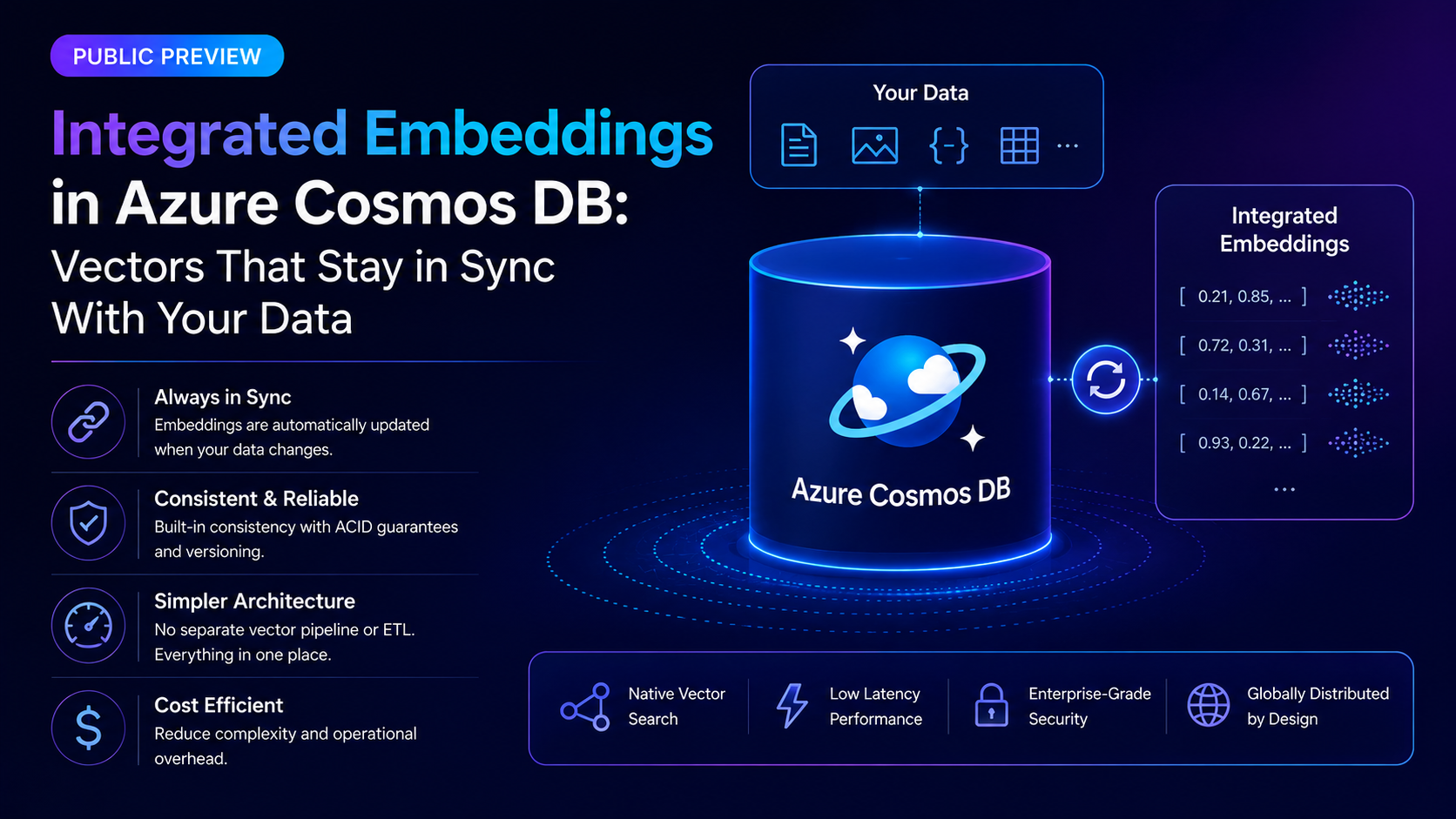
Announcing the Public Preview of Integrated Embeddings in Azure Cosmos DB: Build AI Apps With Embeddings That Stay in Sync
AI applications built on Azure Cosmos DB depend on embeddings for grounded results. Keeping them in sync with your data is the hard part: it means building and operating a separate data pipeline to track changes, call an embedding model, and write the results back to Azure Cosmos DB. In practice, that pipeline also has to handle failures and retries, throttling, scaling, and monitoring as your data and traffic grow. Integrated Embeddings in Azure Cosmos DB, now in Public Preview, removes that heavy lifting. Azure Cosmos DB automatically generates and maintains the embeddings for you as items are written and upda...
Introducing OmniVec: An Open-Source Embedding Platform for AI Apps on Azure
Today we are open-sourcing OmniVec, a platform for building and operating the embedding pipelines that keep the vector representation of your operational data in sync as it changes. You register data sources, embedding model(s), vector stores (destination), and OmniVec does the rest: initial backfill, change tracking, model invocation to geenrate, and writing them back to your vector store. We are shipping this with support for Azure Cosmos DB, PostgreSQL, SQL Server (source and destination), and Azure Blob Storage (destination). You deploy OmniVec in your own Azure subscription, and use the web UI, CLI, or the ...

Azure DocumentDB – General Availability of Service-Managed Failovers

We are excited to announce the general availability of service-managed failovers in Azure DocumentDB, eliminating the need for human intervention to recover from a regional outage. Running a production database means planning for the unlikely. Regional outages are rare, but when they happen, every second lost can have significant business impact. Previously, protecting against a region-wide failure in Azure DocumentDB required user-initiated actions - starting with monitoring availability and then making a judgment call based on the criticality of the application. Eventually culminating in manually promoting a...

Instant Free Tier Clusters in Azure DocumentDB
Feedback from developers using Azure DocumentDB consistently pointed to one small but still impactful item on their wish list: provisioning a free tier cluster took a few minutes. For a developer just getting started, or an agentic workflow spinning up ephemeral clusters to validate a solution, those minutes are vital. Today, that wait is effectively gone. Free tier cluster provisioning on Azure DocumentDB is now a near-instant operation. What Changed We've made optimizations to the free tier provisioning path. What previously took a few minutes now completes in seconds, with no changes to feature com...
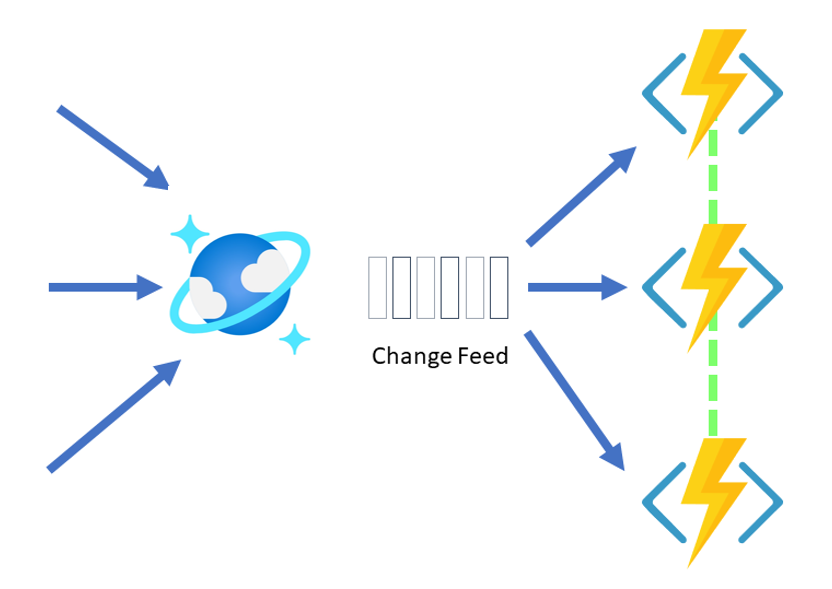
Azure Cosmos DB All Versions and Deletes Change Feed Mode is Now Generally Available

Modern applications don't just write data and move on. They react to it. A new order triggers an inventory update. A profile change syncs to a search index. A deleted record kicks off a compliance workflow. Azure Cosmos DB's change feed makes this possible by giving you a real-time stream of every change happening in your container, and it's one of the most powerful capabilities of the platform. Today, we're excited to announce that all versions and deletes change feed mode is generally available in Azure Cosmos DB for NoSQL! This mode gives you the full picture of what's changing in your data, including deletes ...

Change Partition Keys in Azure Cosmos DB is Now Generally Available

We're excited to announce the general availability of Change Partition Key in Azure Cosmos DB for NoSQL, now with online copy support. You can repartition containers directly in the Azure portal with near-zero downtime and without stopping writes to the source container. Why Partition Key Choice Matters In Azure Cosmos DB, the partition key is one of the most important design choices you make. It affects how data is distributed across physical partitions, how queries are routed, and how well your application performs at scale. But applications change over time. A partition key that worked well at launch can ...

Change Streams in Azure DocumentDB: Richer Events, Historical Replay, and Multi-Node Change Streams (Public Preview)

Real-time, event-driven applications are now the expectation, not the exception. Teams want dashboards that update the instant something happens, microservices that react the moment data lands, and pipelines that move changes downstream without polling a database on a timer. Since Change Streams reached General Availability in Azure DocumentDB, that pattern has been production-ready and the feature has kept getting better. Here’s a quick tour of what’s new since GA, with the headline being three of the most requested capabilities: richer change events, historical replay, and Multi-Node Change Streams, now in Pub...
Graceful Failovers in Azure DocumentDB – Now Generally Available
We are excited to announce the general availability of graceful failovers in Azure DocumentDB. Not every region switch is because of availability loss. Whether you're migrating your primary workload to a different Azure region or proactively moving ahead of a forecasted application-level upgrade, you need a failover mechanism that prioritizes data integrity over speed. One that lets you move deliberately, not reactively. With Graceful Failover, you initiate a controlled promotion of your replica cluster to read-write and the service guarantees that every write committed on the primary is replicated before t...

Announcing the General Availability of Per Partition Automatic Failover for Azure Cosmos DB NoSQL

Today, we are excited to announce the General Availability of Per Partition Automatic Failover (PPAF) for Azure Cosmos DB NoSQL API. PPAF is a significant advancement in how Azure Cosmos DB delivers availability and resilience for mission-critical workloads running on single-write-region accounts. If you rely on Azure Cosmos DB to be always on for your mission-critical applications — PPAF is built for you. With PPAF, Azure Cosmos DB can automatically recover affected partitions by failing over writes to a secondary region within 3 minutes at P99, without requiring application changes. A smarter, more granu...
Public Preview: AI-powered Azure Cosmos DB Migration Assistant for RDBMS to NoSQL


Today, we are excited to announce the public preview of the Azure Cosmos DB Migration Assistant for RDBMS to NoSQL, now available in the Azure Cosmos DB extension for Visual Studio Code. 📈 Modernize with confidence Why migrate from RDBMS to Azure Cosmos DB? Modernizing relational workloads has traditionally been complex, time-consuming, and risky. This new AI-assisted, phase-based workflow replaces manual analysis with structured recommendations and helps you navigate key design choices such as denormalization, partitioning, and NoSQL data modeling. It helps you move from relational databases (SQL Se...
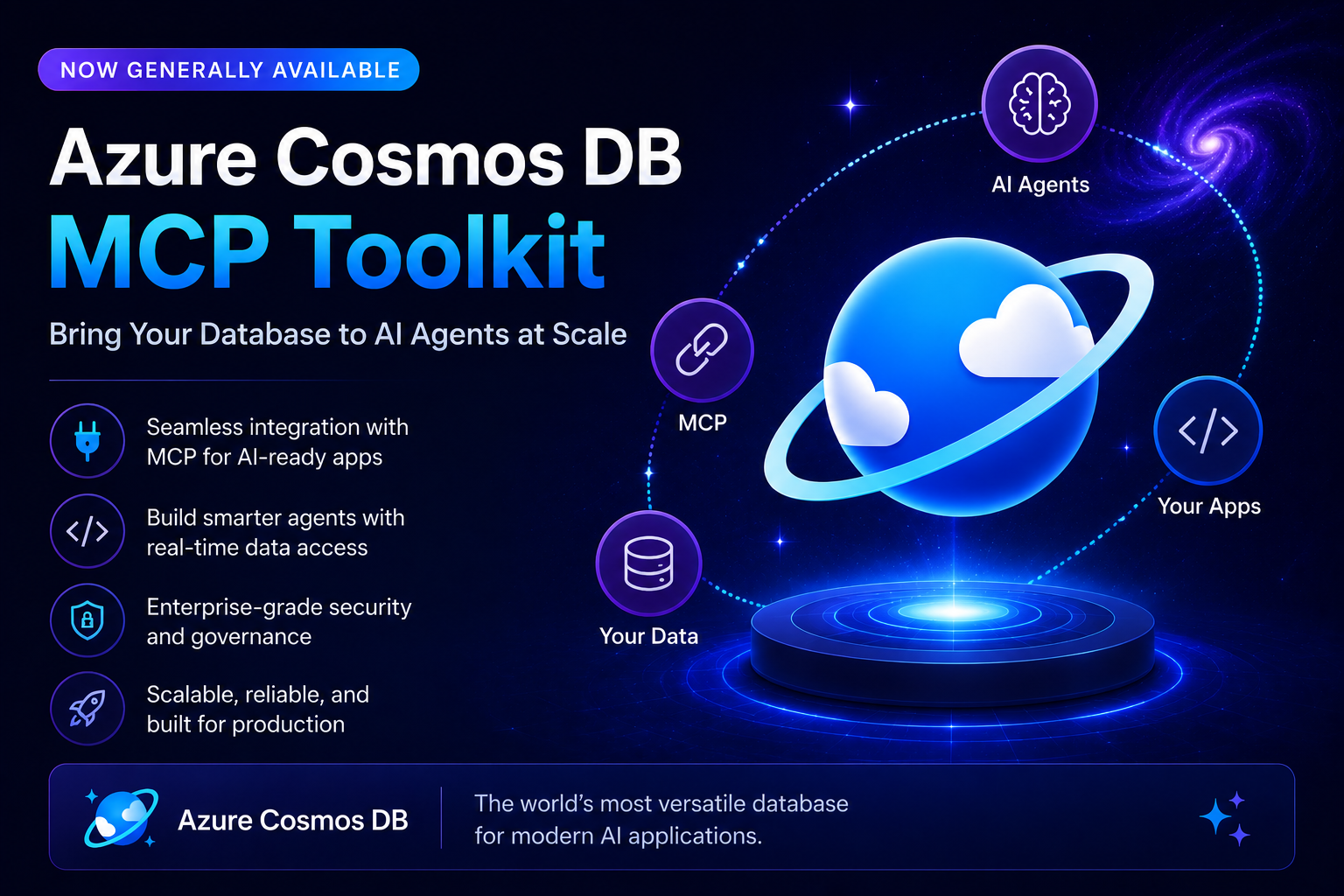
Azure Cosmos DB MCP Toolkit Is Now Generally Available — Bringing Your Database to AI Agents at Scale
Since we introduced the Azure Cosmos DB MCP Toolkit at Ignite 2025 in preview, the response has been clear: developers want a straightforward way to connect AI agents to their production databases. Customers asked for stability, broader embedding provider support, and a smoother path from experimentation to production. Today, we're announcing the general availability of the Azure Cosmos DB MCP Toolkit (v1.1.2), now with deeper Microsoft Foundry integration, multi-provider embedding support, and the reliability improvements you asked for. The Problem: Getting AI Agents to Talk to Your Data Is Harder Than I...

Announcing General availability of the Azure Cosmos DB vNext emulator
The Azure Cosmos DB vNext emulator is generally available today. It ships as a Docker image that runs on Linux, macOS, and Windows, on both x64 and ARM64 architectures, giving you a local Cosmos DB instance you can develop and test against. Use it for inner-loop development on your laptop, in CI integration tests, and anywhere else you’d rather not use a live account. You can get started right away with a couple of simple commands: A lot has shipped since the preview announcement: broader feature and API coverage, an embedded shell, vector search, and OpenTelemetry support. The rest of this post walks throu...

Announcing General Availability of Azure Cosmos DB Global Secondary Indexes
Have you ever needed to evolve your read patterns without losing efficiency? Maybe your app started with one access pattern, but now you need three, and the queries that don't hit your partition key are getting slower and more expensive every month. We built global secondary indexes (GSIs) for exactly this, and today we're thrilled to announce they're generally available in Azure Cosmos DB! A GSI is an automatically synced copy of your data with a different partition key, so you can query it efficiently for more read patterns. The problem GSI solves Azure Cosmos DB scales by distributing data across physical ...
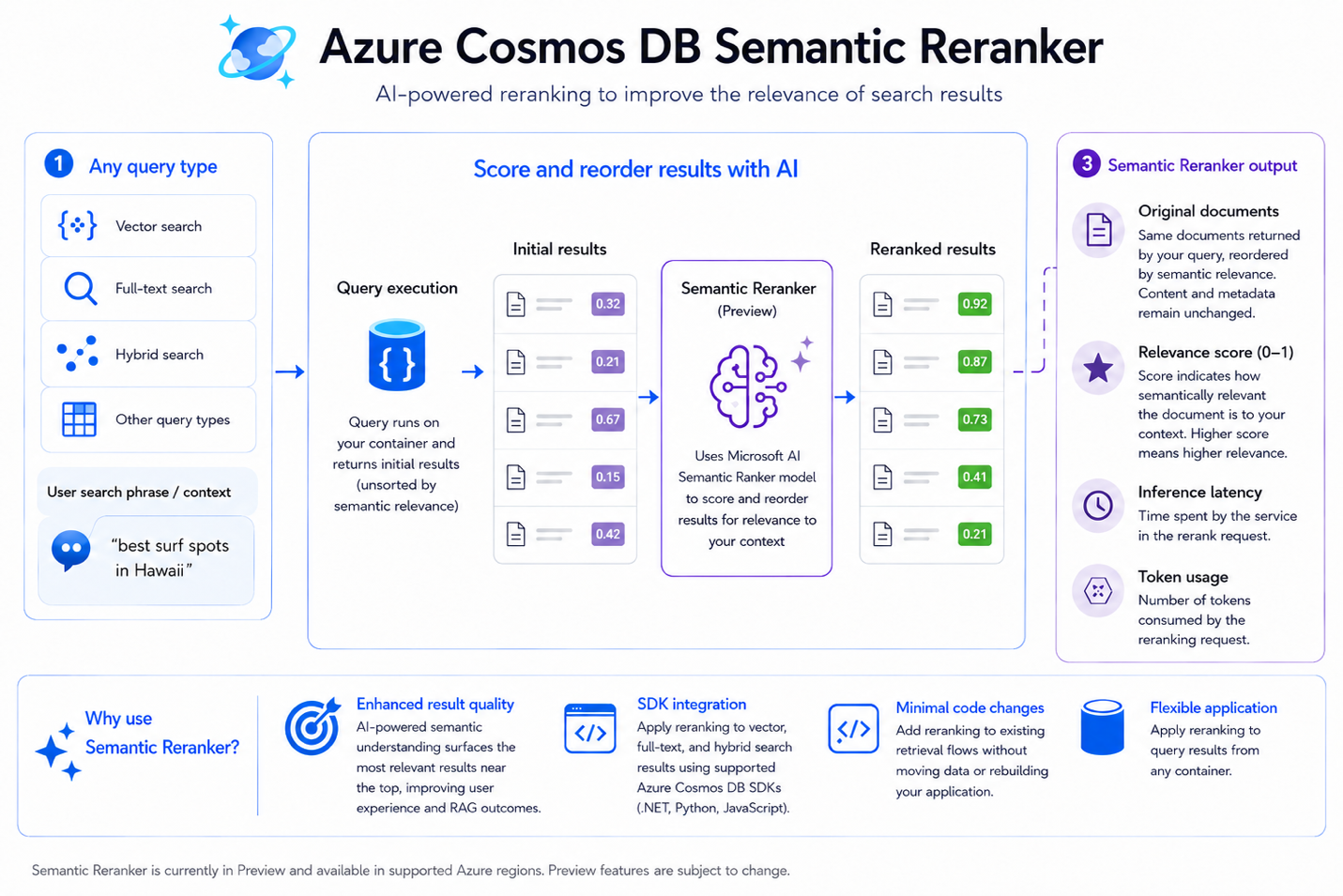
Announcing the Public Preview of Semantic Reranker in Azure Cosmos DB for NoSQL

Today we’re thrilled to announce the public preview of Semantic Reranker in Azure Cosmos DB for NoSQL, a new AI-powered capability that improves the relevancy of your search results with just a few lines of code. If you’ve ever run a vector, full-text, or hybrid search and wished the most relevant documents bubbled to the very top, this one’s for you. Semantic Reranker uses an AI model to score and reorder the results of any query based on how well each document matches the user’s intent. It’s built right into the Azure Cosmos DB SDKs (Python, .NET, and Java), so you can reorder results from any container with...
Azure DocumentDB MCP Toolkit: Agentic AI for MongoDB-Compatible Workloads

Developers are moving quickly to build AI-powered experiences, but there is a gap between what an agent can say and what it can actually do. To be useful, an agent needs secure access to live systems, real data, and the same operational context developers already rely on. That is why we are pleased to announce the Azure DocumentDB MCP Toolkit in public preview. It is an open-source implementation of the Model Context Protocol (MCP) that gives AI agents and LLMs direct, secure access to Azure DocumentDB, the fully managed Azure service built on the open-source DocumentDB project. Instead of guessing from training ...
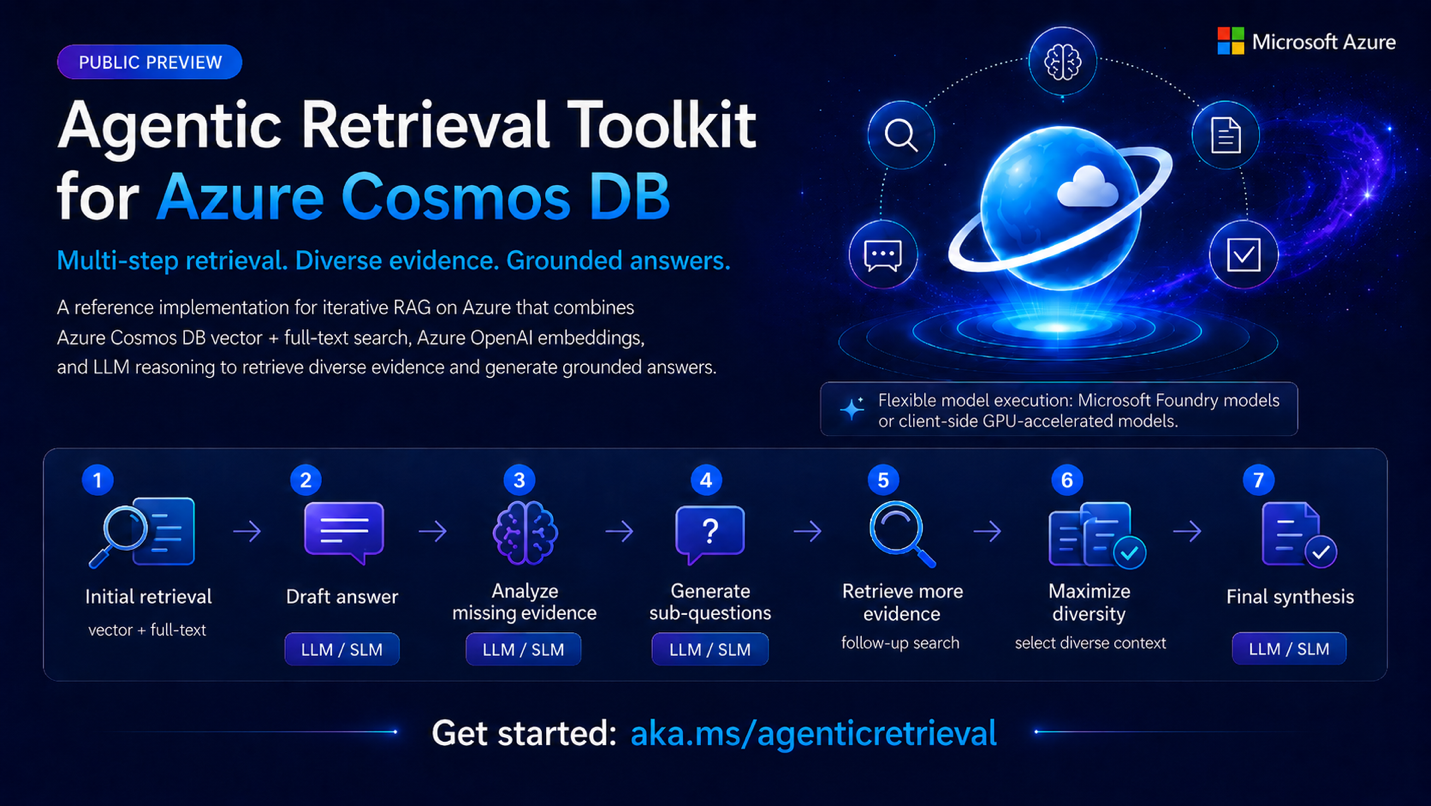
New Toolkits for Agent Memories and Agentic Retrieval in Azure Cosmos DB
Today we’re thrilled to announce the public preview of two new toolkits for Azure Cosmos DB: the Agent Memory Toolkit and the Agentic Retrieval Toolkit. If you’re building AI agents and retrieval-augmented generation (RAG) apps, these toolkits are designed to take you from prototype to production faster, giving your agents durable memory and your RAG pipelines the ability to reason over evidence in multiple passes, all backed by the database you already know and love. Both toolkits build on the same foundation: Azure Cosmos DB for NoSQL as a unified store for documents, vectors, and full-text data, with vector...

Announcing Public Preview of Safe Key Rotation in Azure Cosmos DB
In our previous post, we introduced the private preview of Safe Key Rotation, a feature that helps Azure Cosmos DB customers avoid service disruptions during key rotations. By showing when each account key was last used, it helps teams make informed decisions before rotating keys or moving to Entra ID. This capability addresses a common challenge: keys that appear unused may still support critical applications, which can lead to unexpected outages if they are rotated too soon. What is new? With public preview, we are expanding this capability to give you even more control and confidence when managing you...

Announcing the Public Preview of the Azure Cosmos DB Cost Estimator for NoSQL

Today, we're thrilled to announce the public preview of the Azure Cosmos DB Cost Estimator, a new sizing and pricing experience that takes developers from a blank page to a defensible monthly cost estimate in minutes. Sizing an Azure Cosmos DB workload has always been one of the first questions a team has to answer, and historically one of the hardest. Every one of those decisions changes the number, and most teams need that number before they've written a single line of code. AI workloads have made this harder, not easier. RAG pipelines, AI chat sessions, vector embeddi...
Announcing Public Preview of Distributed Transactions in Azure Cosmos DB for NoSQL
In modern cloud-native applications, correctness is often hardest to maintain at the exact moment a workflow crosses boundaries. A checkout flow writes an order in one place; decrements inventory in another and emits an audit event somewhere else. A money movement workflow debits one account, credits another, and records the transfer for compliance. An AI workflow updates state across multiple services while coordinating retries, handoffs, and downstream actions. Each step is individually straightforward. Keeping the entire workflow correct under partial failures, concurrent updates, retries, and regional events ...
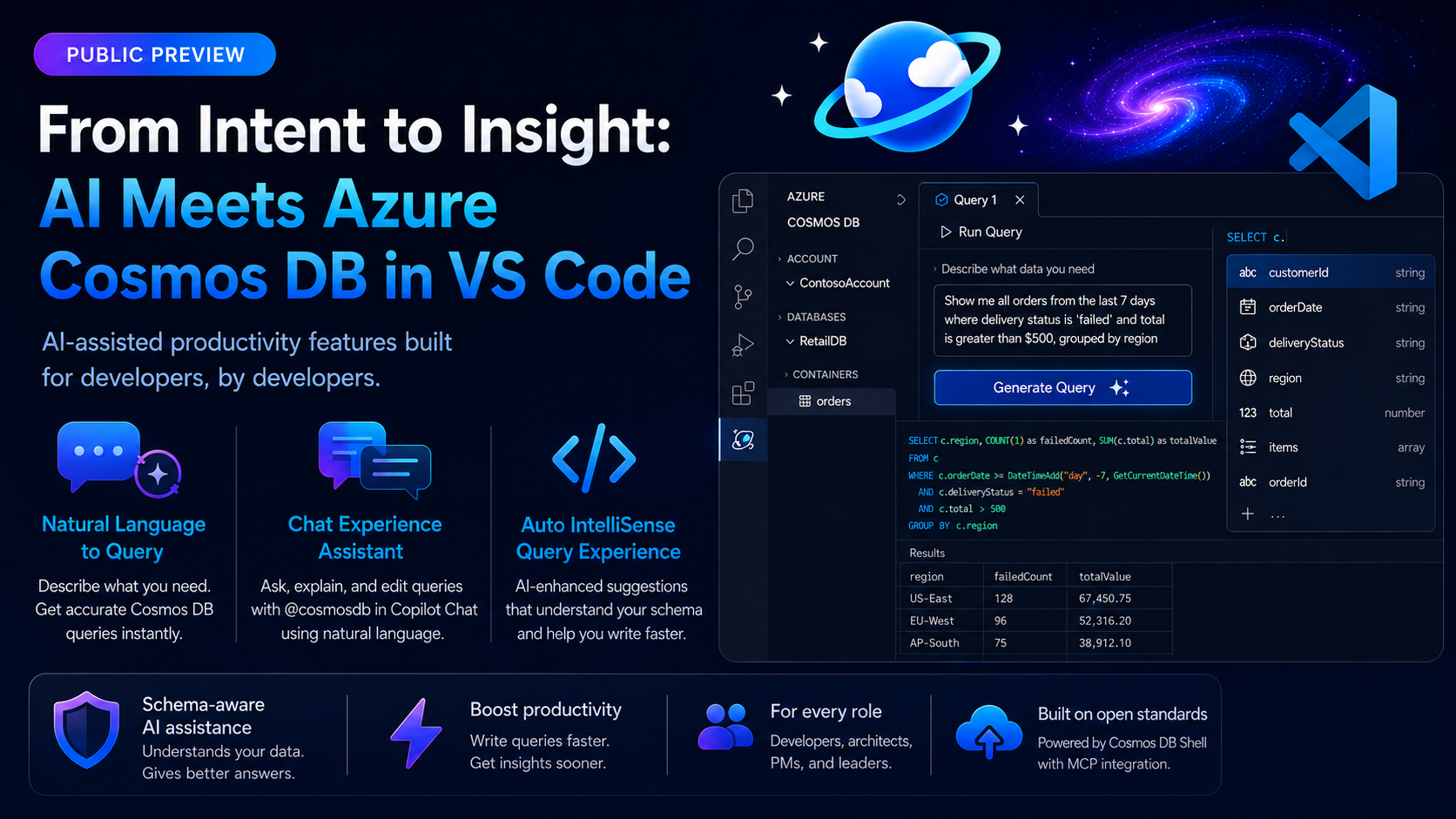
From Intent to Insight: AI Meets Azure Cosmos DB in VS Code (Public Preview)
The Problem Every Developer Knows Too Well You're building a feature. You know exactly what data you need all orders from the last week over $500, grouped by region. The logic is clear in your head. But between you and that data sits a query language, a documentation tab (or three), and fifteen minutes of trial and error before you get the syntax right. Now multiply that across a team. New developers ramping up on Cosmos DB spend days learning query patterns. Senior developers’ context-switch between writing application logic and debugging queries. Product managers wait for data answers that a developer mus...
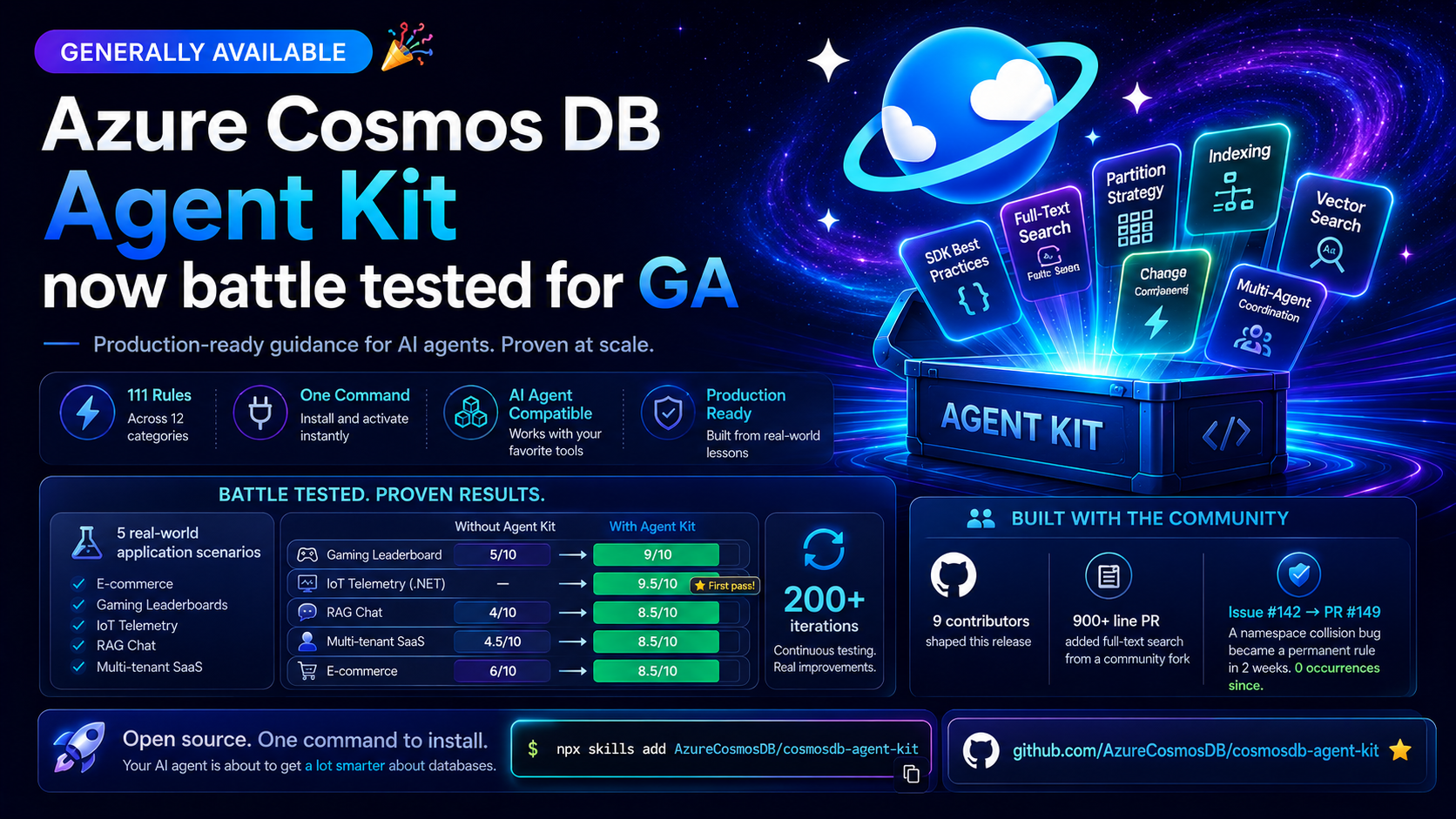
Azure Cosmos DB Agent Kit now battle tested for GA
Back in January, we shipped the Azure Cosmos DB Agent kit in preview with 45 rules and a hypothesis: if we package Azure Cosmos DB expertise into a format that AI coding agents understand, developers will stop making the same expensive mistakes. That hypothesis held up. What surprised us was how much the rules themselves needed to evolve once we started systematically testing them. Today the Agent Kit is generally available . It now contains 120+ rules across 12 categories. But the number that matters more: we've run over 200 automated test iterations where AI agents build real applications from scratch using ...
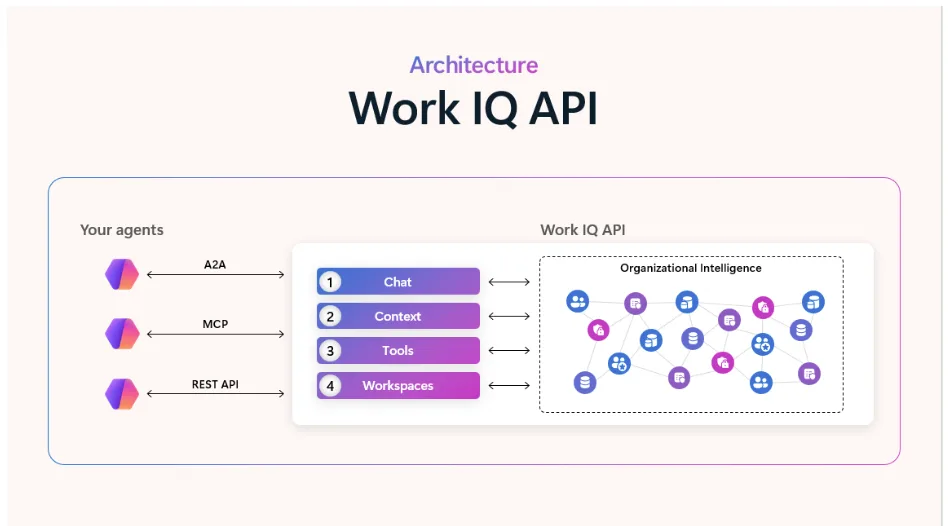
Work IQ: Production‑ready intelligence for every agent

Work IQ provides a workplace intelligence layer that enables agents to access and reason over organizational data, context, and tools, continuously building a semantic understanding across Microsoft 365 and external systems with built-in, permission-aware governance.

Build collaborative agents where work happens

At Microsoft Build 2026, we're announcing new investments to help your agents become teammates in everyday work, from new interaction patterns to streamlined tooling.

Azure DocumentDB Migration Extension for VS Code Is Now Generally Available
We are happy to share that online migration in the Azure DocumentDB Migration extension for VS Code is now Generally Available. Back in November 2025, we launched the Public Preview and since then, many customers have put it through its paces with all kinds of MongoDB workloads. Based on what we learnt from those real migrations (the issues they hit, the edge cases they uncovered, the feedback they shared), we went back and made the tool significantly more resilient, more usable, and better performing. This GA release is the result of that work. What Is the Azure DocumentDB Migration Extension? If you are runni...
Announced at MS Build 2026: Azure Cosmos DB MCP Toolkit, Semantic Reranking, Global Secondary Indexes, and more!

Microsoft Build 2026 has officially started and we’re excited to announce new capabilities for Azure Cosmos DB! We’ve launched new features to help developers build AI-powered applications and agents more easily, improve application resilience, and accelerate developer productivity. These announcements span every stage of the development lifecycle, from local development with the Azure Cosmos DB Linux Emulator, to advanced retrieval and agent memory capabilities for AI applications, to enterprise-grade operational features such as Global Secondary Indexes, Per-Partition Automatic Failover, Distributed Transact...
Azure DevOps and GitHub: Journeying into the AI Era

AI is changing how software gets planned, built, and reviewed. As teams adopt agentic development, the platform underneath those workflows matters more. They need tools that bring planning, coding, security, and collaboration together—and can keep pace with how development is evolving. That’s why we’re delivering the newest agentic capabilities on GitHub across planning, coding, code review, and security. For teams driving active development, that often means moving repositories to GitHub to unlock the latest AI-powered workflows, while continuing to use Azure Boards and Pipelines. For teams that need more time ...
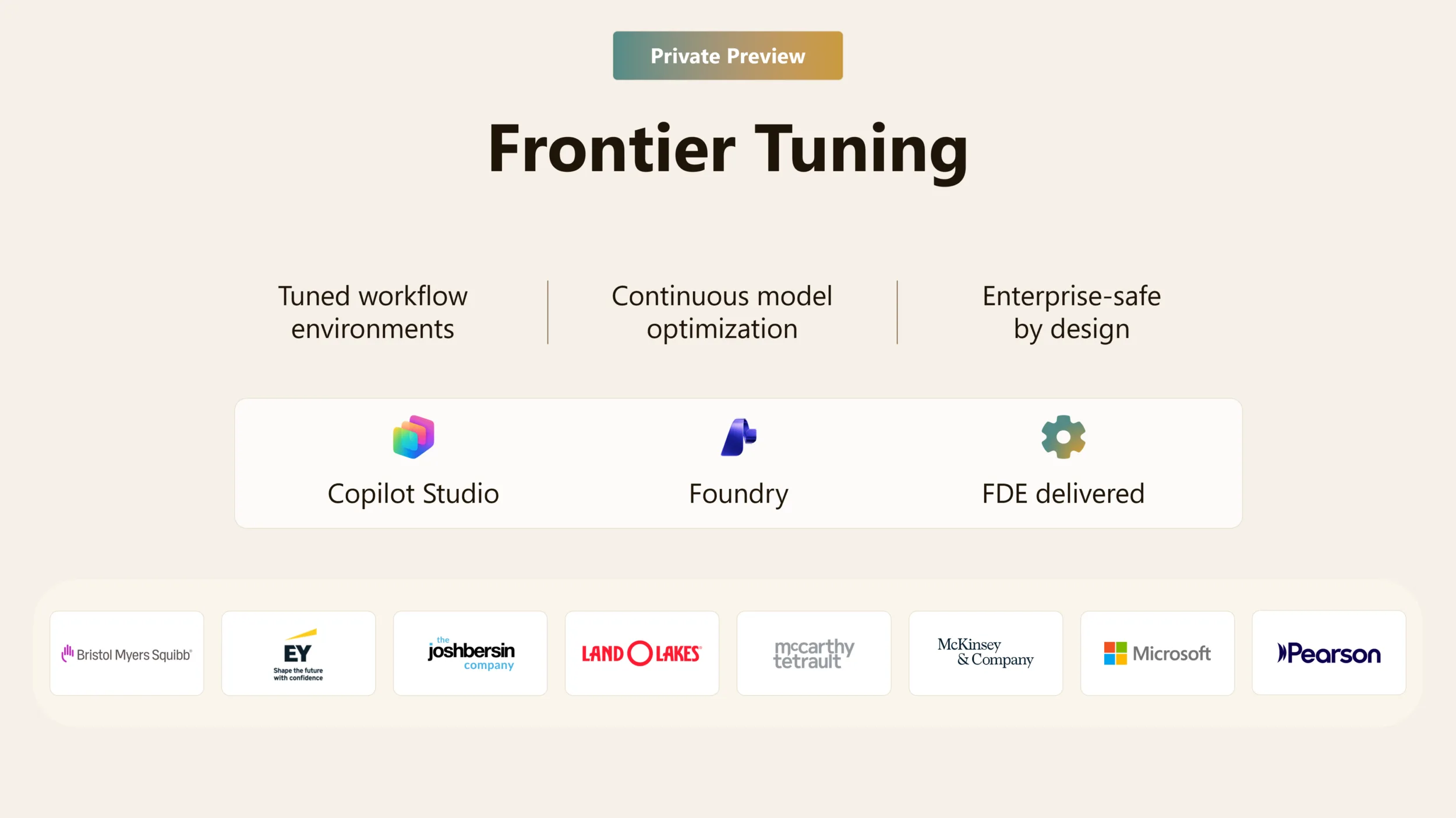
Frontier Tuning: Teaching AI to work the way you do

We're announcing the private preview of Frontier Tuning, a new approach to making AI work the way your business does by applying reinforcement learning inside your compliance boundary with your own data, processes, and conventions.

A Developer’s Guide to Managing Models, Cost and Quality in Microsoft Foundry

Learn a practical model lifecycle for Microsoft Foundry: select the right model, evaluate quality, optimize cost, operate safely, and improve as production needs change.
What’s Coming Next in Visual Studio: Our Microsoft Build 2026 Announcements
Microsoft Build kicks off today in San Francisco, June 2 and 3. If you cannot make it in person, the sessions are streaming online for free, and I want to walk you through what we are announcing for Visual Studio this week. One idea tie most of it together. Code is an asset, not just an artifact. The tools around it should help you keep it healthy, correct, and easy to evolve as your codebase grows. Every announcement below is a step toward that. Agents that participate in the work, not next to it GitHub Copilot in Visual Studio is moving beyond chat and completions. The direction is agents that can particip...
Build and run agents at scale with Microsoft Foundry at Build 2026

Learn how Microsoft Foundry helps developers build, deploy, and operate production-ready agents with Agent Framework, Toolboxes, hosted agents, Microsoft 365 distribution, observability, and agent optimization.
Foundry IQ: Build smarter agents faster with unified knowledge and serverless retrieval

Learn how Foundry IQ helps developers ground agents with unified enterprise knowledge, serverless retrieval, improved agentic retrieval quality, and production-ready security.

Build agents you can trust across any framework with open evals and a control standard

Learn how Microsoft helps developers build trustworthy AI agents with open evaluations, portable runtime controls, production observability, and security workflows that work across frameworks.
Azure Translator: Improving Translation Quality with Adaptive Datasets and Few‑Shot Learning

Your healthcare app needs "La médica" not "El médico." Your legal documents need precise terminology, not generic translations. When domain-specific language matters, generic LLM translation falls short. Azure Translator's adaptive translation lets you teach the model your terminology with just a handful of examples—no model training required. In this walkthrough, you'll create an adaptive dataset, compare baseline vs. adapted translations side-by-side, and see exactly how much difference domain context makes. What you build The playground experience can help you evaluate several aspects of translation beh...

Announcing Intelligent Terminal 0.1
Today we're announcing Intelligent Terminal version 0.1, an open-source experimental fork of Windows Terminal with native agent integration. Get started Install from the Microsoft Store: Intelligent Terminal on the Microsoft Store Install via WinGet: Visit our GitHub repository for documentation and to file issues. Here's a look at what's in this experimental stage. We will continue to iterate and listen to you, the community, as we improve the product, fix bugs, and add new features. The agent status bar at a glance The agent status bar sits at the bottom of the window and gives you quick access to ever...
Azure Translator API Version 2026‑06‑06 (GA): Supporting Multilingual Applications with Flexible Translation Options
Ship multilingual features in hours, not months Your translation workflow probably looks like this: one vendor for real-time chat, another for document translation, a custom LLM integration for nuanced content, and a spreadsheet tracking which system handles what. Azure Translator's new API (version 2026-06-06, now GA) consolidates all of this—NMT speed, LLM fluency, and adaptive customization—into a single endpoint. Why It Matters: Managing Trade‑offs Translation approaches often involve trade-offs. NMT is commonly used for fast, real‑time scenarios, while LLM-based approaches may provide more fluent ...

What’s new in Microsoft Foundry | Build Edition
Microsoft Build 2026 brings a major set of Microsoft Foundry updates for developers building agents: hosted runtimes, Toolboxes, memory, Voice Live, Foundry IQ, new models, managed compute, and trust, evaluation, and observability tools.

What’s New in Hosted Agents in Foundry Agent Service


A few weeks ago, we announced the public preview refresh of hosted agents in Foundry Agent Service — a fundamentally re-imagined agent runtime built for operationalizing production-grade AI agents in enterprise systems. Today at Microsoft Build, we are excited to share several updates that make hosted agents easier to deploy, more capable across modalities, and seamless to optimize through the agent loop. This article covers what's new, and what's coming. The Problems We Set Out to Solve Developers who want to take agents to production find themselves managing a list of things that have nothing to do with the a...
MSSQL Extension for VS Code: Azure SQL Database Provisioning and More

The MSSQL extension for VS Code v1.43 expands what’s possible inside Visual Studio Code with the General Availability of Schema Designer with GitHub Copilot, Data API builder, and SQL Notebooks. We’re also introducing the Public Preview of Azure SQL Database provisioning, giving developers a guided way to create Azure SQL databases directly from VS Code. What's new in MSSQL extension for VS Code v1.43 Here's a summary of the key features in this release: Azure SQL database Provisioning (Preview) The MSSQL extension for Visual Studio Code now introduces Azure SQL Database provisioning i...
Rotation revisited: Another unidirectional algorithm
Moving in a straight line, in a different way.
Staging Part 1 – Sharing is Caring
A key phase in installing a package is staging the package: When a package is staged for the first time, deployment performs several actions, including: Deployment secures these directories with strict permissions, typically granting users Read and potentially Execute access - but notably not Write access. This ensures one user cannot modify the contents of a package in a manner that would compromise their own environment - or anyone else's. Because MSIX guarantees the immutability of the pkgdir after staging, it can be safely shared across all users on the system - regardless of who installed the p...
Aspire 13.4 is here

Aspire 13.4 is here with TypeScript apphost GA, typed resource commands with results, server-side CLI log and telemetry search, more mature Kubernetes and AKS deployment, and more.
The placeholder name for the Windows 8 experience was “modern”
Modern this and that.

Microsoft Agent Framework at BUILD 2026
BUILD 2026 begins on Tuesday, June 2, and there will be tons of exciting announcements from the Microsoft Agent Framework team, Microsoft Foundry, and all things Microsoft AI. If you're traveling to San Francisco for BUILD, be sure to stop by the Microsoft Foundry booths to chat with folks from the Agent Framework team - there'll be stickers! If you can't make it to SF, you can still register online and check out the great sessions: Register for Microsoft Build Looking for sessions with Microsoft Agent Framework to watch online? Start with these breakout sessions. Times are shown in Pacific time; ch...

What’s new in Microsoft Foundry | May 2026
May ships trace-based evaluation for any agent on any cloud, Grok 4.3 and DeepSeek V4 in the model catalog, GPT-5 Reinforcement Fine-Tuning at gated GA, three Microsoft Research on-device agent models, Managed VNET at GA, project-level cost attribution, Content Understanding improvements reaching GA, Foundry Local 1.1 and 1.2 with live audio and vision, and azure-ai-projects 2.2.0 with skills, toolboxes, external agents, and model weight registry — plus a guide to Microsoft Foundry sessions at Microsoft Build.
Sharing the result of a single Windows Runtime IAsyncOperation among multiple coroutines, part 3
A variation where we try only once.
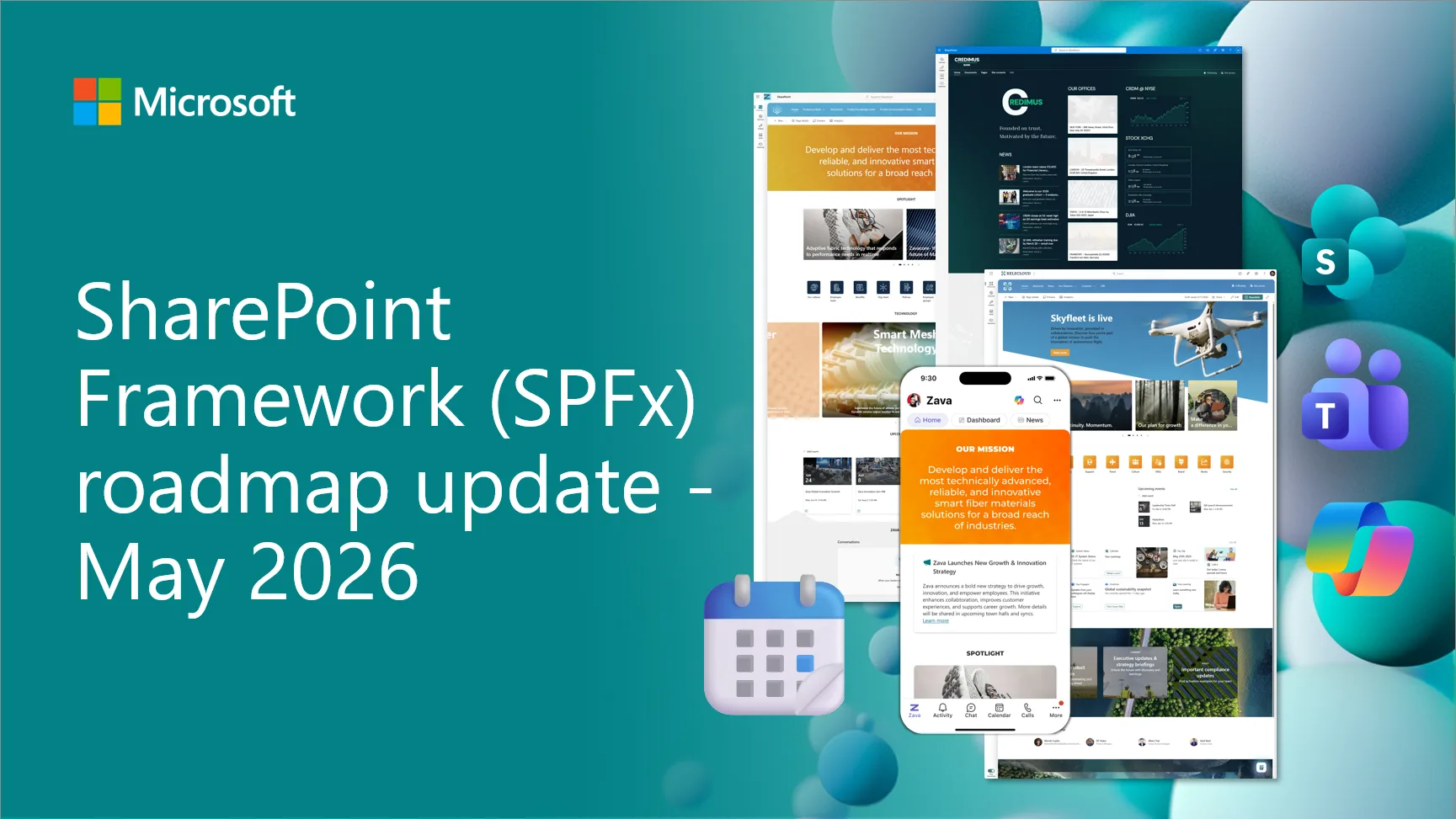
SharePoint Framework (SPFx) roadmap update – May 2026
SPFx is powering the future of Microsoft 365 with AI driven portals and deep integrations across SharePoint and Microsoft 365. The May 2026 update shares new features and the roadmap for the next evolution built for the AI era. This is a transparent community driven journey that we shape together based on your input.
Announcing AgilitySDK 721 Preview and an addition to LinAlg in Shader Model 6.10

Overview Today, we are pleased to announce Agility SDK 1.721-preview with new D3D features along with DXC 1.10.2605.4 adding VectorAccumulate to LinAlg in the existing Shader Model 6.10 preview. The previous 1.720-preview and SM 6.10 preview blog is still relevant, as all of its features are available here too. Here are the new features. More detail is further below as well as download and driver links. Downloads Drivers See Appendix > Feature Support for the full table of each feature's supported hardware. The WARP software device supports all these features...
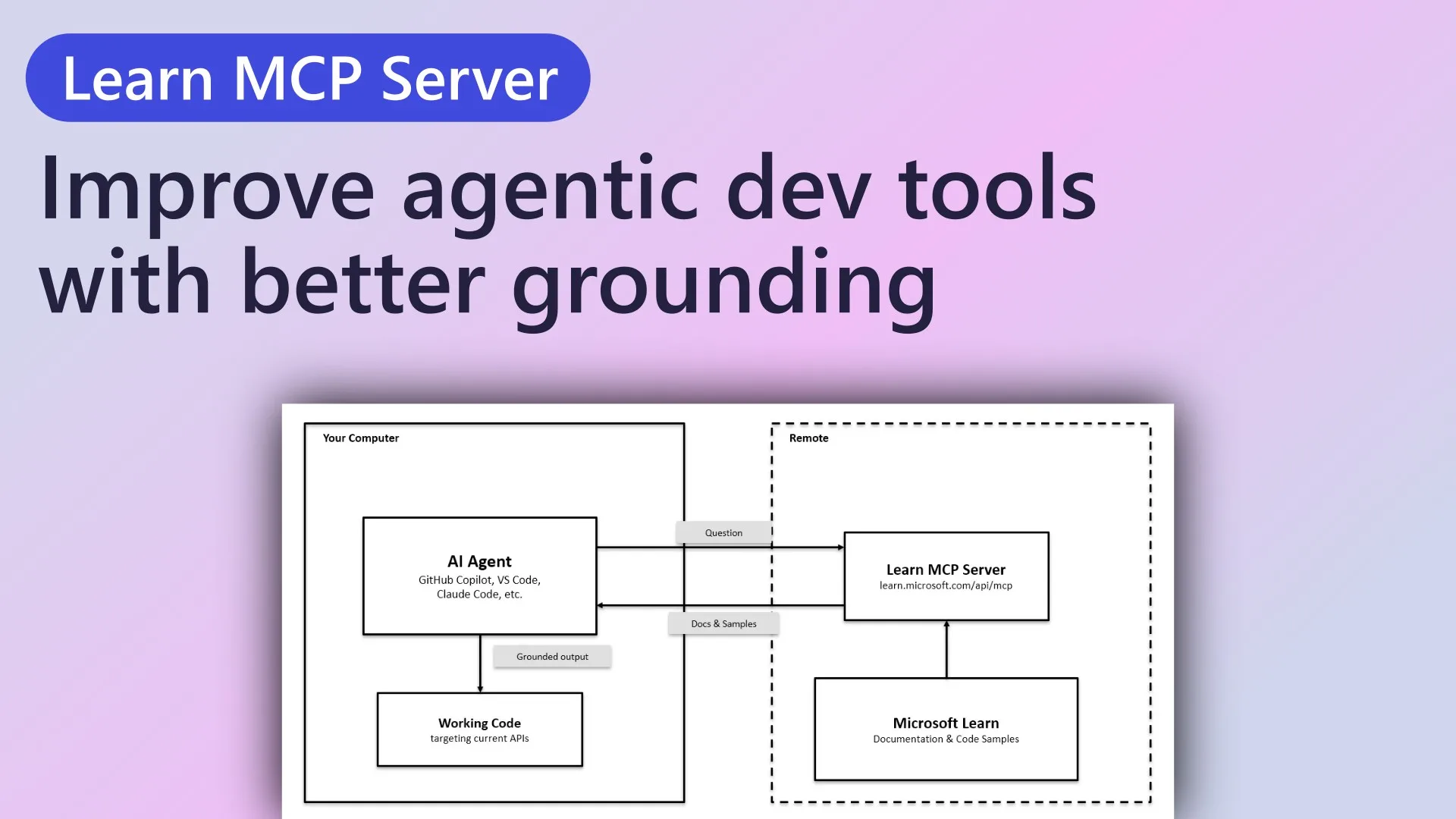
Improve your agentic developer tools by grounding in Microsoft Learn

Development workflows span terminals, IDEs, background agents, and custom assistants. What matters is whether they draw from the same current source. Learn MCP Server gives any MCP-compatible agent direct access to current Microsoft documentation - one endpoint, nothing to install, no authentication required. What does that look like in practice? You give your coding agent the prompt: "create a CLI script to deploy Azure AI Foundry." It reaches for , the Azure ML extension - the right answer a year ago. It hits a Python dependency crash, spends 15 tool calls debugging import paths, and produces a script target...
PIX 2605.28-preview: previewing new PIX and D3D12 features
Today we released PIX version 2605.28-preview, which can be downloaded here. This release complements the new D3D12 Agility SDK that was released today, version 721. This PIX release also includes initial preview versions of a lot of the exciting PIX features that we announced in our GDC session in collaboration with AMD, Intel, NVIDIA and Qualcomm. You can read more about those announcements here, and you can watch our session in the GDC vault. Please try out these new features and let us know your thoughts. The best ways to reach us are via the Send Feedback button in the PIX UI, and via the #pix channel ...

How Azure Chaos Studio ships with hermetic Aspire end-to-end tests

Learn how the Azure Chaos Studio team uses Aspire.Hosting.Testing to run hermetic, per-PR end-to-end tests across four services — with emulators, stubs, and no shared environments.
Sharing the result of a single Windows Runtime IAsyncOperation among multiple coroutines, part 2
Just let each person take turns trying.
SQL + AI, hands-on: Join a free workshop near you
If you work with Microsoft SQL regularly, the AI conversation right now probably feels a little exhausting. Every week brings a new platform, a new pattern, a new opinion about how you’re “supposed” to build AI apps. Most of it assumes you’ll start over. You don’t have to. We’re running SQL AI App in a Day workshops with Microsoft partners around the world. They’re free, hands-on, and built for developers who want to add AI to the apps they already own, using the data they already trust. You can browse upcoming sessions and register. Build on Microsoft SQL, not around it The question that keeps coming...
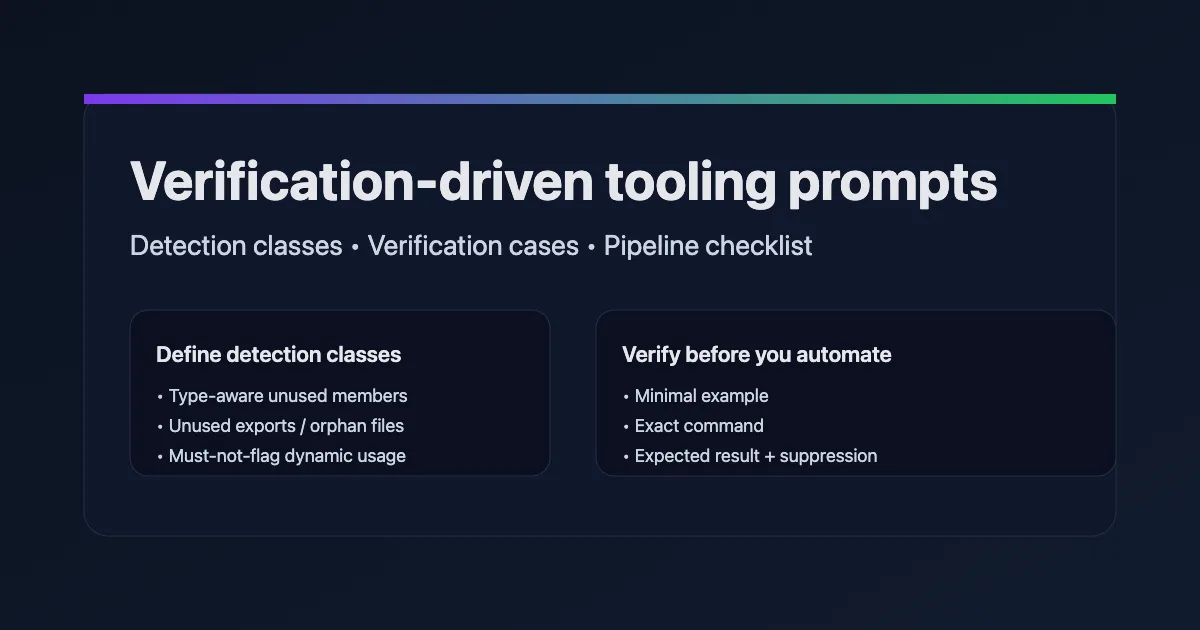
Verification-driven tooling prompts for fast-moving codebases

A practical pattern for using GenAI research agents to produce reliable internal tooling by verifying assumptions with detection classes and a final checklist.
What’s New for C++ Developers in Visual Studio 2026 (18.1 – 18.6)
Visual Studio 2026 versions 18.1 through 18.6 deliver a wave of improvements for C++ developers. For MSVC Build Tools, the v14.51 release is now generally available with runtime performance gains and improved C++23 conformance. We also introduced Sample Profile Guided Optimization to help you improve the runtime performance of your C/C++ programs. In the IDE, we made significant investments in AI-powered experiences to optimize your builds, modernize your code, debug and profile, and more. We enhanced Copilot Chat to make it easy to incorporate skills, custom agents, and MCP servers into your workflow. We also ad...
Partial Graphics Programs

Overview Following the GDC announcement of the partial graphics programs feature, we are pleased to announce that it is available today in the AgilitySDK 1.721-preview. Checkout the release blog for more details about the full release. This preview serves as a first look to explore what might be possible to ship in a future retail Agility SDK. We encourage developers to try out the feature and provide feedback to https://discord.gg/directx which may influence the final design. Downloads Drivers See Appendix > Feature Support for the full table of each feature's supported hardware. The ...

I’m Starting a New Cosmos DB App. What Security Do I Actually Need?
You just created a Cosmos DB account. The portal handed you two keys and a connection string, it worked, and you moved on. That's what most developers do, and it causes problems later. This post is a guide for developers launching a new Cosmos DB app who want a secure default setup without enterprise-grade complexity. It focuses on the decisions that matter on day one. The honest two-minute threat model Before diving into setup, it is worth noting what actually goes wrong in real apps. Most security issues in any workload are not advanced attacks. There are simple mistakes that create unnecessary risk...
How AI coding agents actually use your technology
You ship an SDK, a CLI, an API, and developers use it. Now AI coding agents use it too, except they use it differently than humans do. Most of the time you have no idea what's actually happening between "developer types a prompt" and "agent generates code with your technology." Is the agent reading your docs? Is it calling your MCP server? Is it ignoring both and guessing from memory? In the previous article, we introduced the AX stack: model, harness, and agent extensions. We talked about what's fixed and what you can influence. This time, let's trace through what actually happens, step by step, when an agent...

Introducing the Azure DocumentDB Blog

A dedicated home for MongoDB developers, MongoDB migrations, and modern document database development using Open Source on Azure Today, we're excited to launch the new Azure DocumentDB blog — a dedicated destination for developers, architects, and organizations building document-based applications with Azure DocumentDB and the open-source DocumentDB project. This blog will serve as the central place for Azure DocumentDB product updates, engineering insights, migration guidance, technical deep dives, architecture patterns, developer tutorials, and open-source ecosystem news. Whether you’re mod...
Deployment Operations, Requests and Queue
The PackageManager API submits requests to the deployment engine for processing. Each request represents an instruction for the deployment system to carry out a defined set of actions, collectively referred to as a deployment operation. The operation associated with a request depends primarily on the API used to initiate it and, in some cases, its parameters. Internally, the deployment pipeline models its work as a series of deployment operations derived from an API called and its arguments. For example, PackageManager.MovePackageToVolumeAsync() submits a request to perform a Move Package operation. In most cas...
Sharing the result of a single Windows Runtime IAsyncOperation among multiple coroutines, part 1
Caching the result and knowing when the cache is valid.
Doing More with GitHub Copilot as a .NET Developer

Want to get more out of your GitHub Copilot experience? Here are some easy ways to get started.
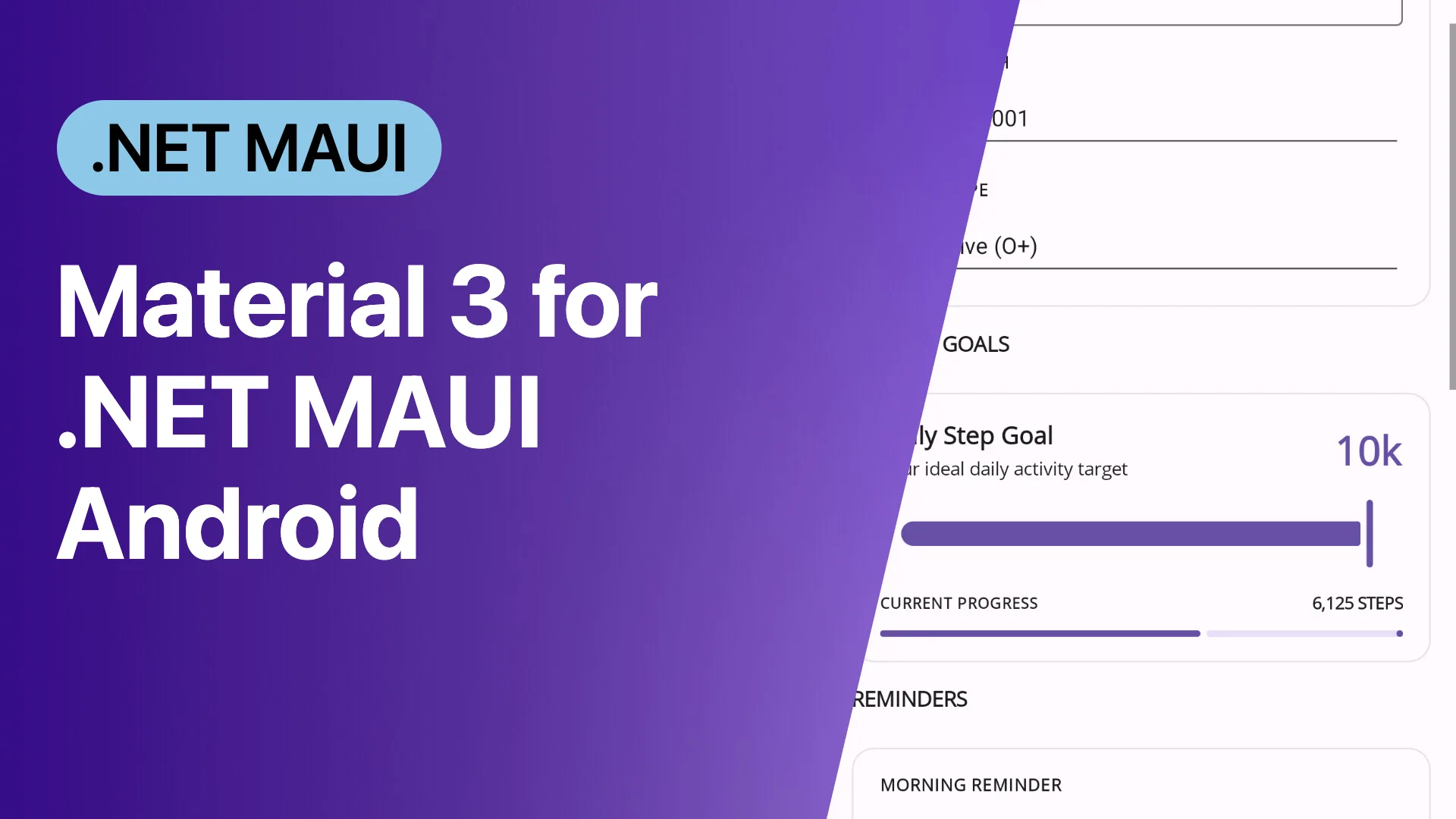
Give Your .NET MAUI Android Apps a Material 3 Makeover

Material 3 (a.k.a. Material You) support is now available for .NET MAUI apps on Android. Here is how to enable it, what changes today, and what is still on the way.
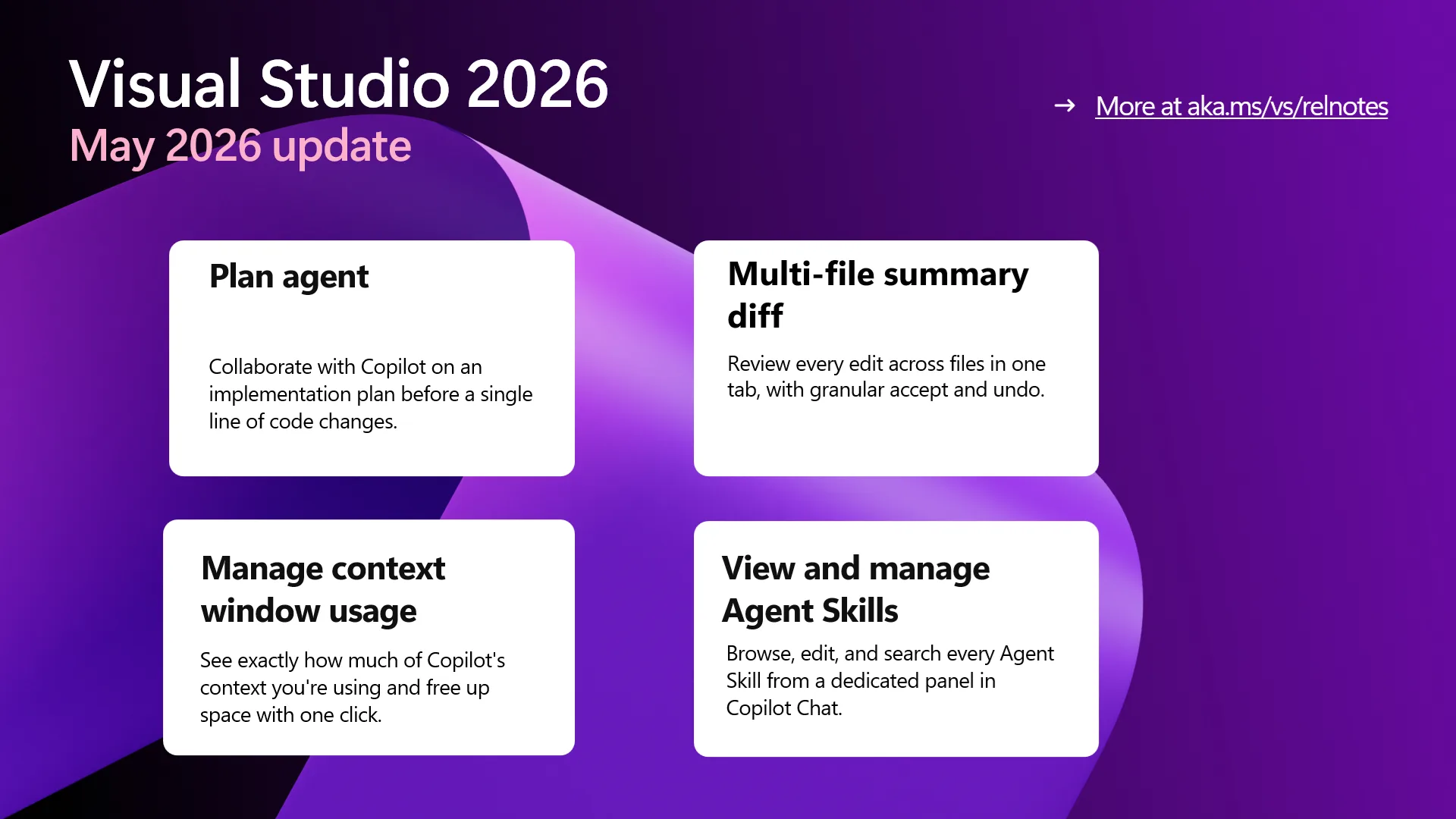
Visual Studio May Update – Plan, Review, Refine
There's a particular rhythm to good development work: you think, you try, you check, you adjust. This month's Visual Studio update leans into that rhythm. Whether you're sketching an approach with the Plan agent before touching a single file, reviewing a wave of changes across many files, or fine-tuning the context Copilot has to work with, the May release adds deliberate, observable steps between an idea and a finished change. Alongside that, we shipped a fresh release of MSVC Build Tools with a long list of C++ improvements, because foundations matter too. Download the Visual Studio 2026 Stable Channel to tr...
If C# and JavaScript lets me await a Windows Runtime asynchronous operation more than once, why not C++/WinRT?
A difference in philosophy.
A hypothetical redesign of System.Diagnostics.Process to avoid confusion over properties that are valid only when you are the one who called Start
Putting them in a place that can access only if you call <CODE>Start</CODE>.
Regex support for LOB types in T-SQL—available in Azure SQL & SQL Server 2025

At a glance — Native regular expression (regex) functions in T-SQL now accept and inputs of up to 2 MB across all seven regex functions, including the two table-valued functions ( and ). This capability ships in SQL Server 2025 CU5 and is already available in Azure SQL Database, SQL Database in Fabric and Azure SQL Managed Instance configured with the Always-up-to-date update policy. It will reach Managed Instances on the SQL Server 2025 update policy as part of the CU5 rollout. You no longer need to split log files, HTML documents, or large JSON payloads into 8,000-byte chunks just to run a pattern match. 1. ...
Why do you say that a COM STA thread must pump messages if I see sample code creating STA threads and not pumping messages?
You need to pump messages when idle, but maybe you are never idle.

Agent Skills for Python: File, Code, and Class – Composed in One Provider
Python developers working with Agent Skills can now author skills as files on disk, as inline Python code, or as reusable classes - and mix them freely through composable source classes that handle discovery, filtering, and deduplication. A skill living in your local repository, one installed from your organization's internal package index, and a quick inline bridge you wrote ten minutes ago all plug into the same provider. This is the third post in our Agent Skills series. The first post introduced file-based skills; the second added code-defined skills, script execution, and approval for Python. This post ...
How to improve AI coding agent support for your SDK, API, or CLI
AI coding agents use your SDK, API, or CLI, but often get it wrong. The stack has layers you can't change and one you can: agent extensions. Learn how to measure whether yours are helping or hurting.
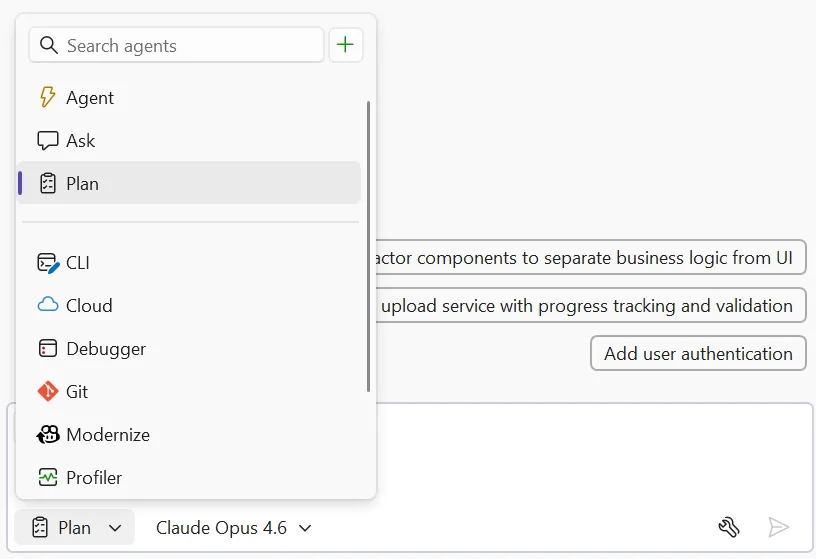
Plan Before You Build: Introducing the Plan agent in Visual Studio
You ask Copilot to tackle something big, it gets to work, and a dozen file changes later you realize you had a completely different approach in mind. The code isn't wrong... it just isn't what you were going for. Last year, we introduced planning as a feature in Agent mode to help with exactly this. Since then, you’ve told us you wanted more control over when planning happens, the ability to edit plans directly, and a way to save and share them. Your feedback shaped what came next: the new Plan agent. Instead of jumping straight into implementation, the Plan agent starts with a deeper understanding of what ...
Announcing Agent Governance Toolkit MCP Extensions for .NET

Announcing a Public Preview .NET package that adds policy enforcement, startup tool scanning, fallback governance, and response sanitization to MCP servers with a single builder extension.
Improving C# Memory Safety

The `unsafe` keyword is being redesigned to mark caller-facing contracts rather than just syntax. Safety obligations between callers and callees become visible and reviewable. The model is motivated by the rise of AI-assisted code generation and arrives as a preview in .NET 11.
How do I use Win32 structures from the Windows Runtime?
Trick question: You can't. But maybe you can fake it.
PowerShell is now notarized and hardened for macOS

PowerShell for macOS is now properly notarized and hardened, meeting both Apple and Microsoft security requirements.
Coordinating AI-Assisted Development with AGENTS.md and Skills


How to move AI-assisted development from ad-hoc experimentation to a coordinated team-wide capability using AGENTS.md and reusable skills with GitHub Copilot CLI
PowerShell PSResource Roadmap and Best Practices

PowerShell is a critical automation and configuration platform across enterprises—and as that automation grows, how you source, validate, and distribute PowerShell packages becomes just as important as the scripts themselves. Modern security guidance increasingly treats package feeds as part of the software supply chain. For PowerShell, that means being deliberate about which repositories you trust, how packages get promoted into your environment, and what your production systems are allowed to install at runtime. Below, I outline PSResourceGet best practices for secure environments, then highlight roadmap ...
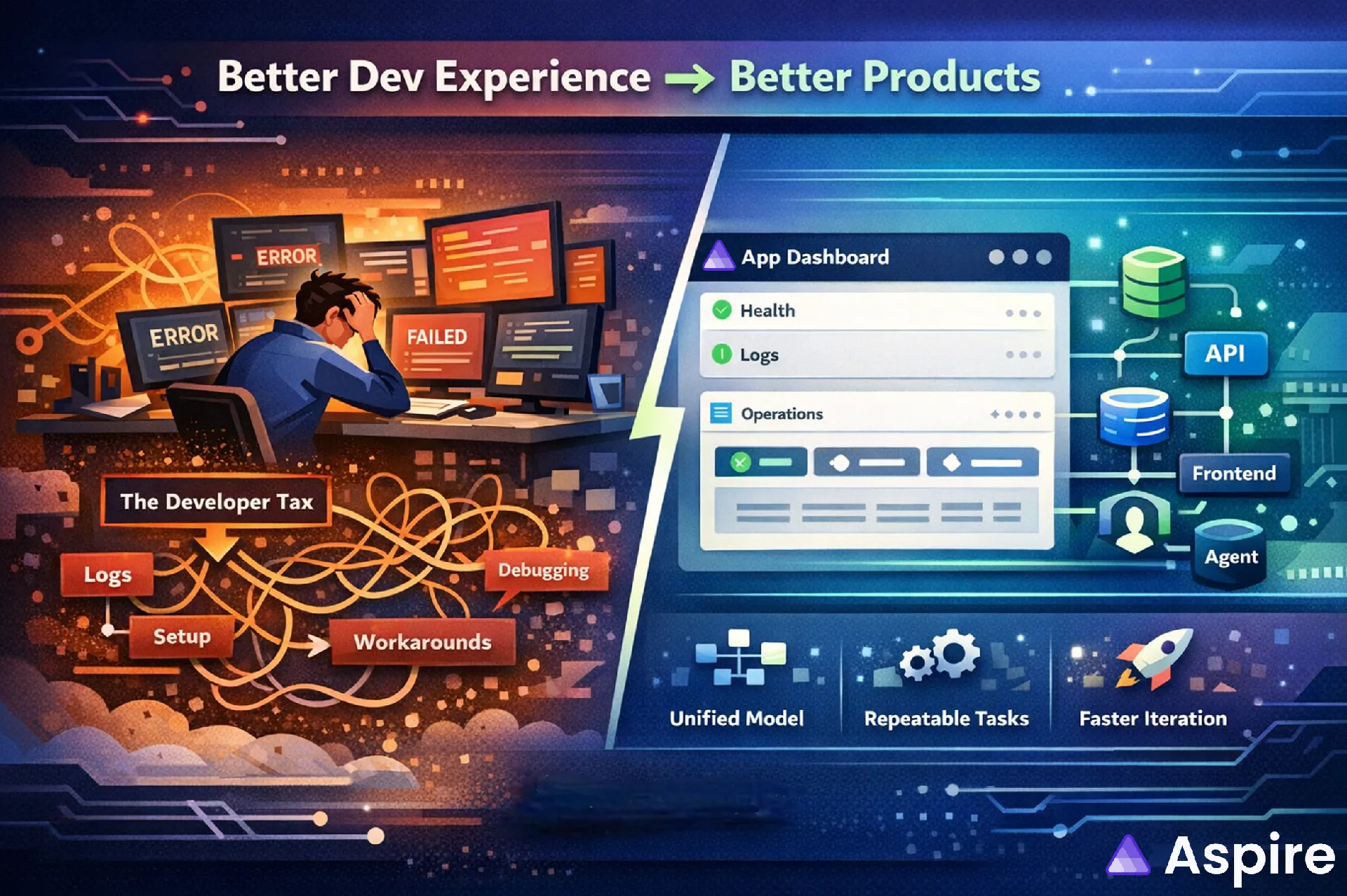
Your dev loop is full of tribal knowledge

Aspire turns a team's scattered tribal knowledge into an explicit, incrementally-adoptable app model that humans, scripts, and AI agents can all use.

Stop prompt injection from hijacking your agent, new security capabilities now released within Agent Framework


Prompt injection is the #1 risk on the OWASP LLM Top 10, and most agents in production today defend against it with one of two heuristics: a defensive system prompt, or a hand-rolled allowlist. Neither is deterministic. Both fail silently the day someone slips a line into an issue body, an email, or a tool result. With FIDES (Flow Integrity Deterministic Enforcement System) in Agent Framework, your agent gets information-flow control as a first-class middleware: every piece of content carries an integrity label (trusted/untrusted) and a confidentiality label (public/private), labels propagate automatica...
The classic TreeView control lets me sort by name or by lParam, but why not both?
You need to arrange to get one from the other.
Introducing Sample Profile Guided Optimization in MSVC

Profile Guided Optimization (PGO) has long been one of the most powerful tools in the MSVC compiler's arsenal for improving the runtime performance of C and C++ applications. By using execution profile data collected from representative workloads, PGO enables the compiler to make smarter decisions about inlining, code layout, and hot/cold code separation - decisions that are impossible to make from static analysis alone. In practice, PGO can deliver large performance improvements for C/C++ code. Today, we're introducing Sample Profile Guided Optimization (SPGO), a new approach to profile-guided optimization th...
How to run evals for the model router


Walk through running quality, cost, and latency evaluations for the Foundry model router using an open-source GitHub repo designed for router-aware eval pipelines.
Package Identity
An MSIX package identity is composed of a five-part tuple that uniquely identifies a package. It consists of the following attributes: Together, these fields form the canonical identity of a package. Programmatically, this identity can be represented using APIs such as Windows.ApplicationModel.PackageId or the PACKAGE_ID structure. Why Package Full Name? Working directly with the individual identity fields is often inconvenient. To simplify common scenarios, Windows defines an opaque string representation that encapsulates the entire five-part identity: the Package Full Name. This canonical form provi...
Agentic-Agile: Why Agent Development Needs Agile (Not Just Prompts)

"A bad system will beat a good person [or agent] every time" ~Dr. William Edwards Deming (with apologies) I started vibe coding by writing prompts (often dictated into my phone), refining them with an agent in M365 Copilot, and creating handoff files to use with GitHub Copilot CLI. The results were predictably non-deterministic. Prompt-driven development is a typical starting pattern: a developer opens a chat session, writes a prompt, reviews the output, adjusts, re-prompts. Maybe they get something useful. Maybe they spend an afternoon debugging emergent behavior that nobody specified and nobody tested. Then...

Eliminate LLM Cold starts: Load models up to 6x Faster with Azure Blob Storage and Run:AI Model Streamer

Stop paying for idle GPUs while model weights copy to disk. Stream them straight into GPU memory instead with Run:AI Streamer from Azure Blob Storage. The Problem: Every Cold Start Costs You More Than Money GPU compute is among the most expensive cloud infrastructure, and every second a GPU is allocated but unavailable for serving is real money lost. The cost also goes beyond your Azure bill: slow cold starts can delay responses, stress SLAs, and degrade user experience during traffic spikes, when users need capacity most. In many conventional inference deployments, a cold start triggered by auto-scalin...
What is the history of the ERROR_ARENA_TRASHED error code?
The storage control blocks were destroyed.

NuGet PackageReference for C++ Projects in Visual Studio
Native C++ projects (.vcxproj) now support NuGet PackageReference, the same modern package management experience .NET developers have used for years. Available as an experimental feature in Visual Studio 2026 version 18.7.

NuGet Package Pruning: Cleaner Dependencies and Actionable Vulnerability Reports

Package pruning in .NET 10 removes platform-provided packages from your dependency graph. With transitive auditing enabled by default, projects with these defaults have 70% fewer transitive vulnerability reports compared to projects using the previous defaults.
Just shows that nobody cares about debugging the parity flag any more
Reported incorrectly since the day it was written.
Advanced Shader Delivery expands Public Preview with AMD

Edit: June 11th, 2026 - Advanced Shader Delivery has expanded the preview beyond Xbox Insiders into general availability in the Xbox PC app! Additionally, AMD has expanded ASD into their entire AMD RDNA™ architecture line. See Device Requirements section below for more details. Last October, we released Advanced Shader Delivery (ASD) on the ROG Xbox Ally handhelds. Advanced Shader Delivery addresses one of the most frustrating challenges for PC players today – long load times and disruptive stuttering during a game’s first launch. The feature works by delivering precompiled shaders to your game at download tim...
The case of the CreateFileMapping that always reported ERROR_ALREADY_EXISTS
Maybe because it already exists?
Segment Heap support for C++ projects in Visual Studio

Learn how Visual Studio enables Segment Heap by default for new C++ projects and how to adopt and verify it in existing builds.
Exponential backoff and circuit breaker for Service Bus-triggered Azure Functions

Use exponential backoff and circuit breaker patterns in Azure Functions with Service Bus SDK bindings. Control retry storms, protect dependencies, and degrade gracefully under transient failures.
Considering NL2SQL? Should your database really be the prompt? How can SQL MCP Server help?
You’ve probably experienced both of these, perhaps at the same time. First, that desire to let an agent get at your data. It’s driven by simplification and better experiences for the user and for you: fewer screens, fewer queries, fewer reports, and less code overall. Second, and perhaps more importantly, that unrelenting reluctance and reticence against all of it. The voice in your head that makes you seriously uneasy. Your reputation is at stake, yes, but to your enterprise, this might be existential. It has a name: NL2SQL. NL2SQL, or Natural Language to SQL, is where an AI agent turns a natural language ...

Governance at the Speed of Agents: Microsoft Agent Framework and Agent Governance Toolkit, Better Together

Building powerful AI agents is only half the story, running them safely in production is the real challenge. As customers adopt Microsoft Agent Framework for agent orchestration, a clear need has emerged for robust, built-in governance. In this post, Imran Siddique from the AGT team walks through how Agent Governance Toolkit pairs with Agent Framework to enforce policy at runtime, govern agent actions, and provide end-to-end auditability. Turning agentic systems into production-ready platforms. The Complete Stack for Production AI Agents Microsoft Agent Framework 1.0 provides everything teams need to build, orc...

Securing Azure apps with Aspire enterprise networking

Network security has a funny way of showing up late. You start with a web app, an API, storage, and Key Vault. The app works. The demo works. Everyone is happy. Then the production checklist shows up: That is usually the point where the application model and the infrastructure model start drifting apart. The app says "I need storage and Key Vault." The networking template says "I have seven subnets, two private DNS zones, a NAT gateway, a network security group, and a growing collection of comments explaining why nobody should touch any of it." Aspire makes this a lot nicer. The new Azure networking su...

May Patches for Azure DevOps Server
We are releasing new patches for our self‑hosted product, Azure DevOps Server. We strongly recommend that all customers stay up to date with the latest, most secure version of Azure DevOps Server. The most recent release, Azure DevOps Server, is available on the download page. The following versions have been patched. For more details on these updates, see the release notes: ⬇️Azure DevOps Server Patch Download ✅Verifying Installation To verify that the patch is installed, run the following command on the Azure DevOps Server machine using the patch installer you downloaded: Replace with the name of the...

From beta to stable: Announcing the Azure SDK for Rust 🎉🦀

Announcing the stable release of the Azure SDK for Rust. This release includes stable libraries for Core, Identity, Key Vault (Secrets, Keys, Certificates), and Storage (Blobs, Queues).
VSLive! Microsoft AI Hackathon 2026: Send Your Team Home With Working Code

If you lead a development team, you already know the pattern. You approve the travel, your developers attend a great conference, they come back energized, and then the work resumes exactly as it was. The ideas don't survive contact with the backlog. This July at VSLive! @ Microsoft HQ in Redmond, we're trying to change that pattern. We're adding the VSLive! Microsoft AI Hackathon 2026, a focused, hands-on build event that runs alongside the conference. Your developers learn during the day, then build at night, on the Microsoft campus, with Microsoft engineers and MVPs in the room. They leave with workin...
A constant-space linear-time algorithm for deleting all but the 10 most recent files in a directory
Using data structures you already knew.

WebAssembly Data Processing at the Edge with Azure IoT Operations

Safe, composable dataflow operators for Azure IoT Operations, built as WASM modules using the Component Model, WIT interfaces, and WASI Preview 2.
MSVC Build Tools Preview updates – May 2026
Try the latest updates to MSVC Build Tools Preview
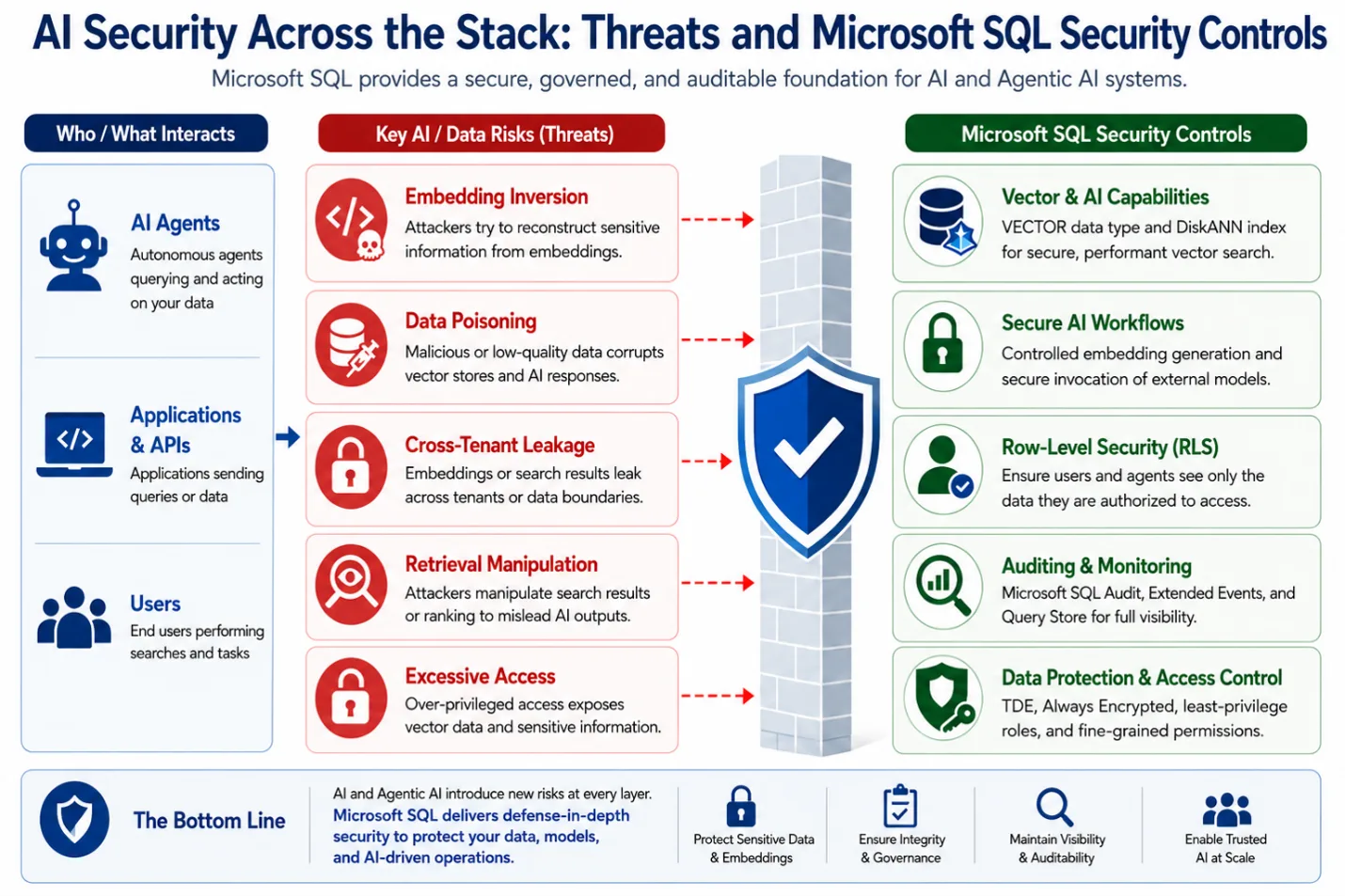
Microsoft SQL Security Across the MAESTRO Stack: Building Secure Agentic AI with Defense-in-Depth

Artificial Intelligence is evolving rapidly. What began as simple prompt-and-response systems is now transforming into fully autonomous, agentic AI architectures capable of reasoning, orchestrating tools, interacting with enterprise data, and invoking external systems dynamically. While these capabilities unlock enormous business potential, they also introduce an entirely new category of security challenges. Organizations are no longer asking only: “How do we build AI systems?” They are now asking: “How do we build AI systems securely, responsibly, and with governance built into every layer?” This ...

Process API Improvements in .NET 11

Process API improvements in .NET 11, including high-level APIs for starting processes, capturing output without deadlocks, handle inheritance control, lifetime management features, and a lightweight `SafeProcessHandle`-based API surface.
.NET MAUI Moves to CoreCLR in .NET 11
.NET MAUI apps on Android, iOS, and Mac Catalyst now run on CoreCLR by default in .NET 11, unifying the runtime across all of .NET.
Agent Skills in Visual Studio: Teach Copilot How Your Team Works
Visual Studio now supports Agent Skills, which are reusable instruction sets that teach Copilot agents how to handle specific tasks like running a build pipeline, generating boilerplate, or following your team's coding standards. Define a skill once, and the agent applies it automatically whenever it's relevant. Creating a skill You can create a skill directly from within Visual Studio. Click the tools icon in the bottom-right corner of Copilot Chat to open the skills panel, a dedicated view of every discovered skill. Click the + button in the top-right corner of the panel and follow the guided flow: choose...
The case of the hang when the user changed keyboard layouts
Keeping things moving.
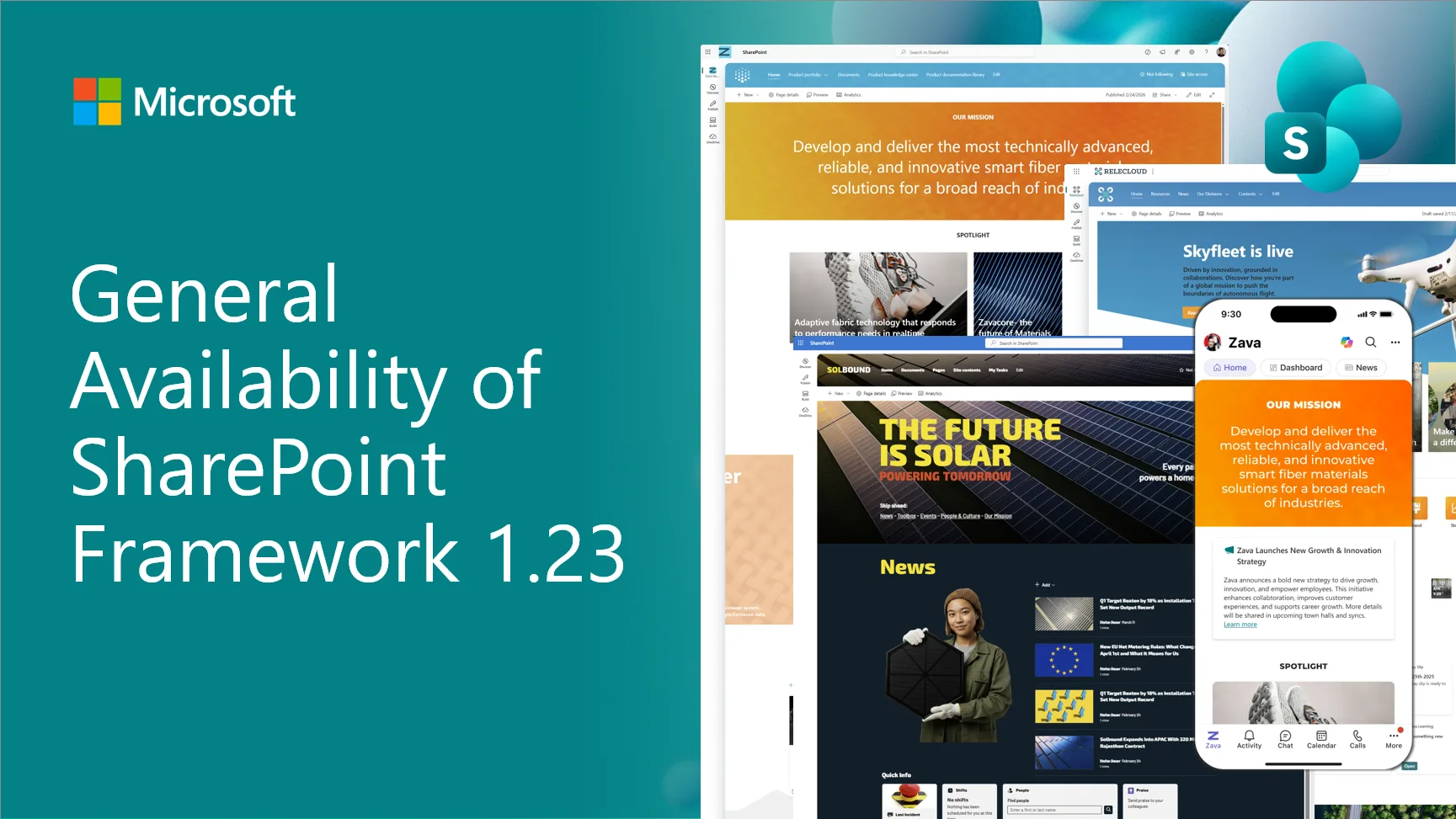
General Availability of SharePoint Framework 1.23 – Advancing the modern developer experience
We are excited to announce general availability for the SharePoint Framework 1.23. We are rolling out new features in extensions, preview of new CLI and addressing known npm audit issues.
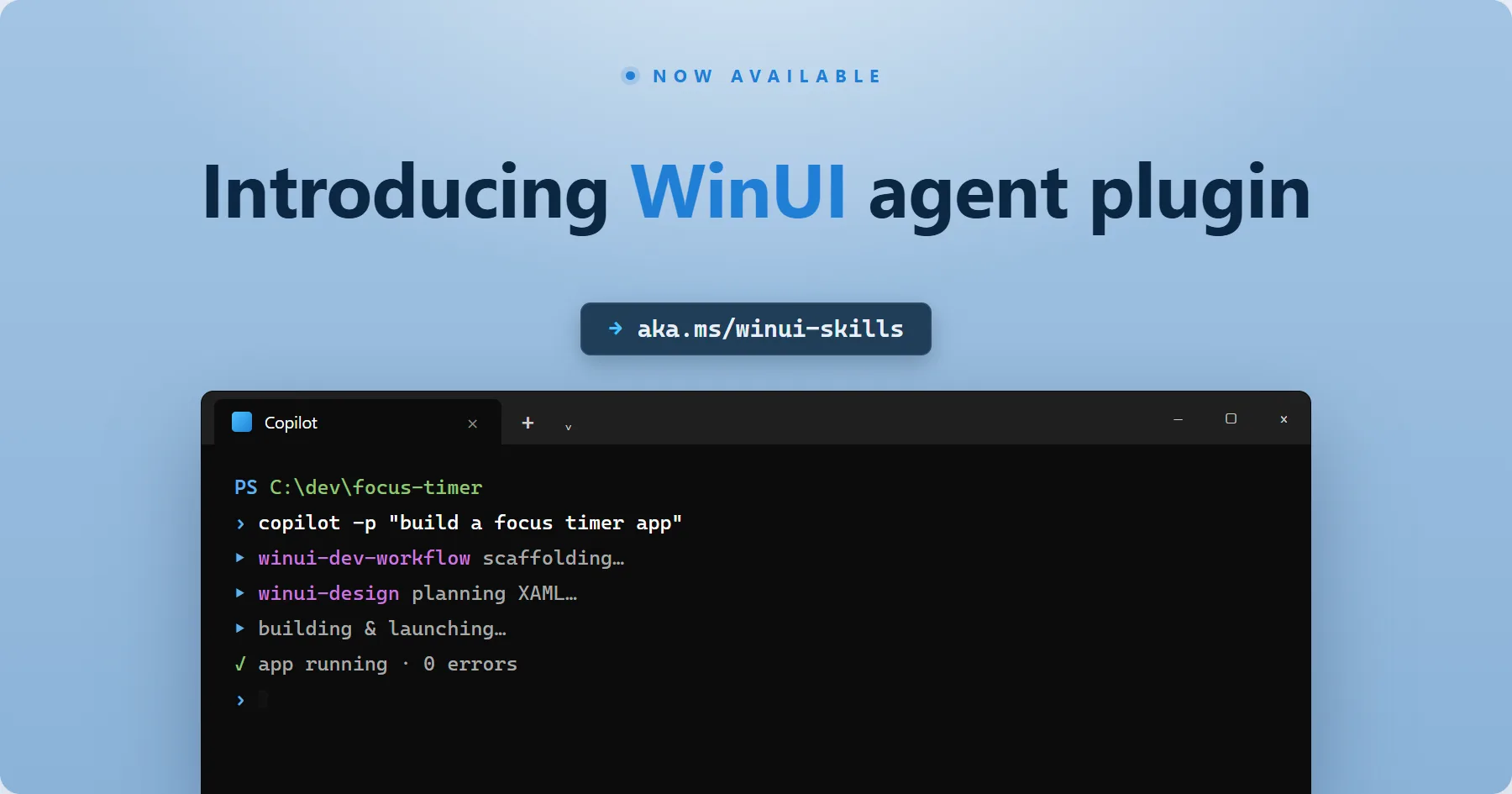
Introducing WinUI agent plugin for GitHub Copilot and Claude Code

These skills enable your agent to take your ideas to a native Windows app in minutes! They are built around the end-to-end loop: scaffold, build, run, test, iterate. They've been optimized to know how to drive each stage, recognize common failures that get normal agents stuck in loops, and steer towards successful patterns, while also minimizing the number of tokens used by your agent. We hope to continually improve this experience and outcomes as we gather more feedback and examples from our developer community! Try it Open GitHub Copilot CLI and use the following commands: Then ask GitHub Copilot for t...

MSVC Build Tools version 14.51 (GA) now available
MSVC Build Tools v14.51 GA available in Visual Studio 2026 18.6
.NET 11 Preview 4 is now available!
Find out about the new features in .NET 11 Preview 4 across the .NET runtime, SDK, libraries, ASP.NET Core, .NET MAUI, C#, Entity Framework Core, and more!
Is This a Packaged Process?
Sometimes you need to know whether the current process has package identity. Certain Windows features require it, and behaviors can differ—both technically and culturally. For example, classic Windows applications often store settings in the registry, whereas packaged applications typically use ApplicationData.LocalSettings. So how can your code determine whether it is running with package identity — that is, whether it is a packaged process? Terminology Let's begin with clear and unambiguous definitions: We deliberately say process rather than application. The distinction matters: applications have pro...

.NET and .NET Framework May 2026 servicing releases updates
A recap of the latest servicing updates for .NET and .NET Framework for May 2026.
Foundry Local 1.1: Live Transcription, Embeddings, and Responses API
Foundry Local 1.1 adds live transcription, embeddings, Responses API, WebGPU plugin, and download cancellation.
Why do Windows client editions on 32-bit x86 systems artificially limit RAM to 4 GB?
Compatibility, of course.

Introducing dotnet new WinUI templates


We've been working on something new for WinUI developers: a set of open-source project and item templates for WinUI you can use directly from the command line. 🚀 With these templates, you can now create and run a new WinUI app using , without needing to go through Visual Studio. This makes it easier to get started quickly, script your setup, use VS Code or other editors for development, or integrate WinUI into your existing workflows. These templates are currently in preview, and were developed based on the feedback by the community. We're working on bringing them into Visual Studio so you’ll ...
What’s new in Microsoft Foundry | April 2026
April brings a wave of model arrivals — GPT-5.5, GPT-image-2, Microsoft first-party MAI models for image, voice, and transcription, Gemma 4, and Claude Opus 4.7 — alongside Foundry Local GA, Microsoft Agent Framework 1.0 GA, the Microsoft Foundry Toolkit for VS Code GA, batch evaluations for third-party agents, new tracing and monitoring capabilities, SDK updates across Python, JavaScript/TypeScript, .NET, and Java, and a reminder to register for Microsoft Build.

Publishing VM Applications in a Secure World

Many of you who have published VM Applications may have come across a difficult conundrum regarding security. To create an application version, you must upload your application package to a Storage blob, then provide the address of that Storage blob for replication to occur. The problem comes to the uri of the package. Until recently, there have been two options. Before I move to the solution, a few quick words about SAS urls. First, user delegated SAS urls are sadly not supported, because the service that manages the replication can't impersonate the user. Second, you may have a question about reuse...
Additional notes on controlling which handles are inherited by CreateProcess
Putting the handles in a private container.
Generate Embeddings Function and External Model Object Support Are Now Generally Available in Azure SQL

We are excited to announce the General Availability (GA) of AI_GENERATE_EMBEDDINGS and CREATE EXTERNAL MODEL in Azure SQL Database and Azure SQL Managed Instance. These two T-SQL features — CREATE EXTERNAL MODEL and AI_GENERATE_EMBEDDINGS — work together as a single, integrated pipeline for generating vector embeddings directly from T-SQL. No data movement, no external orchestration, no application-layer pipeline required. EXTERNAL MODEL object defines where to get embeddings from and how to authenticate — registered once, reused everywhere. AI_GENERATE_EMBEDDINGS calls the external model to generate the ve...

Announcing the public preview of the Microsoft 365 Copilot Agent Evaluations tool


The Microsoft 365 Copilot Agent Evaluations tool helps developers measure and improve the quality of agents they build for Microsoft 365 Copilot.
Go 1.26.3-1 and 1.25.10-1 Microsoft builds now available
A new release of the Microsoft build of Go including security fixes is now available for download.
Developing more confidence when tracking renames via ReadDirectoryChangesW
You can track the file ID.
A Tour of Handoff Orchestration Pattern

A Tour of the Handoff Orchestration Pattern Most multi-agent systems start out simple: a router agent receives a user request, picks the right specialist, and forwards the conversation. As long as each specialist can complete its task in one pass, that model works fine. The first time it breaks is when an agent needs more: a follow-up question for the user, additional context from another specialist, or a realization mid-turn that the request belongs somewhere else entirely. At that point, a fixed pipeline or one-shot router isn’t enough. What you need is a small, bounded graph where agents themselves decid...
Project-Specific Build Optimizations with GitHub Copilot
We are excited to announce that GitHub Copilot build performance for Windows now supports project-specific builds! Available in the latest Visual Studio Insiders, you can target a single MSBuild project or CMake target instead of analyzing your entire solution. For game developers and teams working with large codebases, this eliminates the need to wait for a full-solution build when you only want to optimize one project. Since launching GitHub Copilot build performance for Windows in Public Preview, we have received a lot of feedback from game studios working on large engines and enterprise monorepos. Rebuildi...
What’s New in vcpkg (Apr 2026)
These updates include improved locking for parallel builds, cross-platform PE dependency analysis, manifest support for the depend-info command, and other improvements and bug fixes.

Announcing general availability of the mailbox import and export Microsoft Graph APIs
The mailbox import and export APIs on Microsoft Graph are now generally available.
Least privilege AI agents: A new azd template from Curity and Microsoft
If you ever built an AI agent demo, you probably had this moment. Everything works: the agent interprets natural language, calls the right tools, and returns the right data. Then you start designing for the real users of the app. You think about data boundaries: what if someone tries to get data they're not supposed to see? For example, imagine a customer support app where users can say "give me a markdown report on the last three months of stock transactions and the value of my portfolio." Then an agent does the work. First, you need to design for security so the agent doesn't commingle data from separate cus...
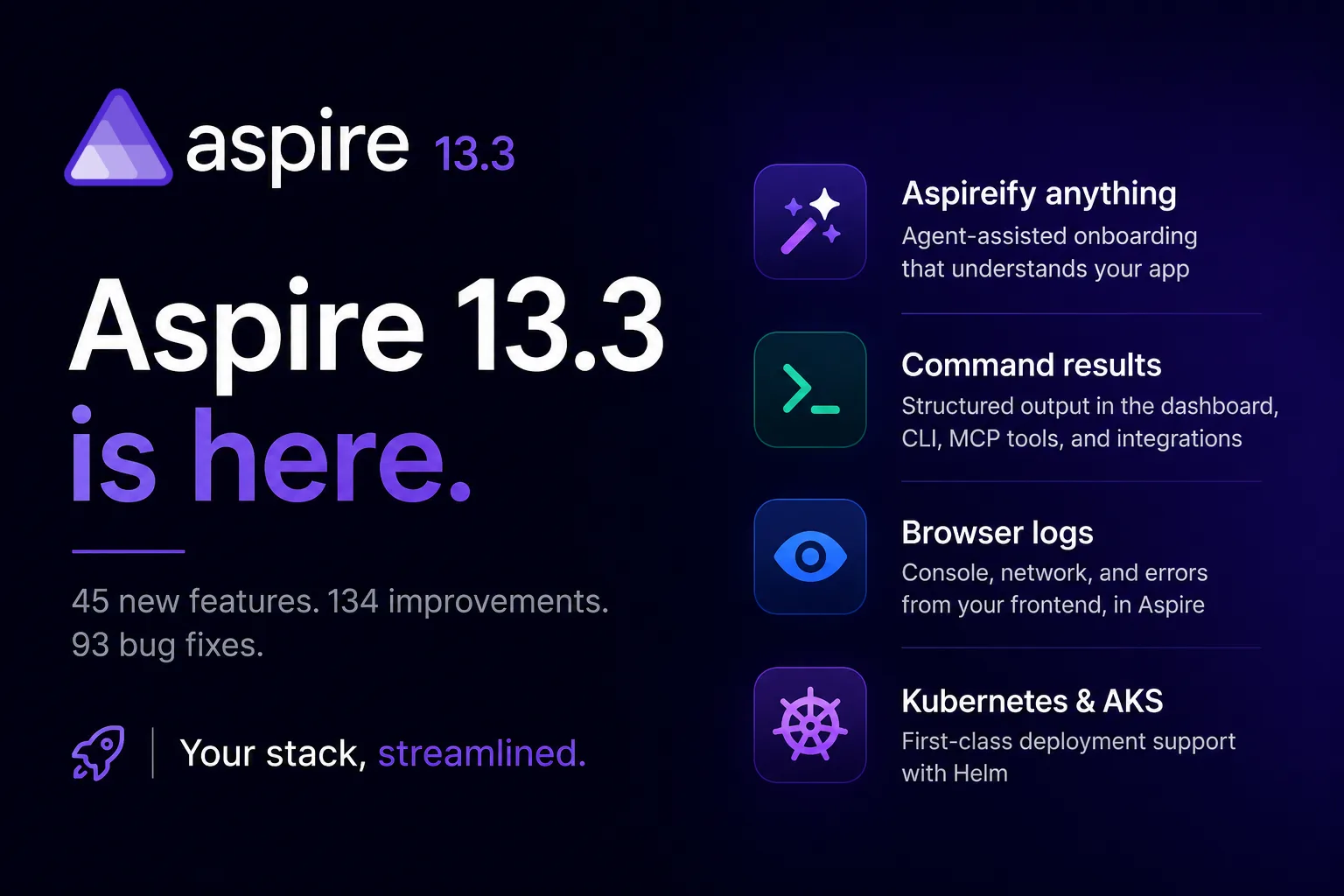
What’s New in Aspire 13.3
Aspire 13.3 is here with the Aspireify skill, command results, browser logs, Kubernetes and AKS deployment, and more.

Copilot Studio gets faster with .NET 10 on WebAssembly
Microsoft Copilot Studio recently upgraded its .NET WebAssembly engine to .NET 10. The migration was straightforward, simplified deployment, and delivered another round of meaningful performance gains for end users.
Scalable AI with Azure Cosmos DB: Bringing Generative AI to Enterprise Scale with Super Insight by AVASOFT

Azure Cosmos DB enables scalable AI-driven document processing, addressing one of the biggest barriers to operational scale in today’s enterprise AI landscape. Organizations continue to manage massive volumes of structured and unstructured content—contracts, regulatory filings, operational records, images, and field documentation—yet many workflows remain fragmented, manual, and slow. Every month, the Scalable AI in Action with Azure Cosmos DB series brings the community together with Microsoft partners who are building real, production AI systems — not slides, not demos built for the occasion, but live walkth...
When you upgrade your resource strings to Unicode, don’t forget to specify the L prefix
Otherwise, it'll get mapped back down to the 8-bit code page.
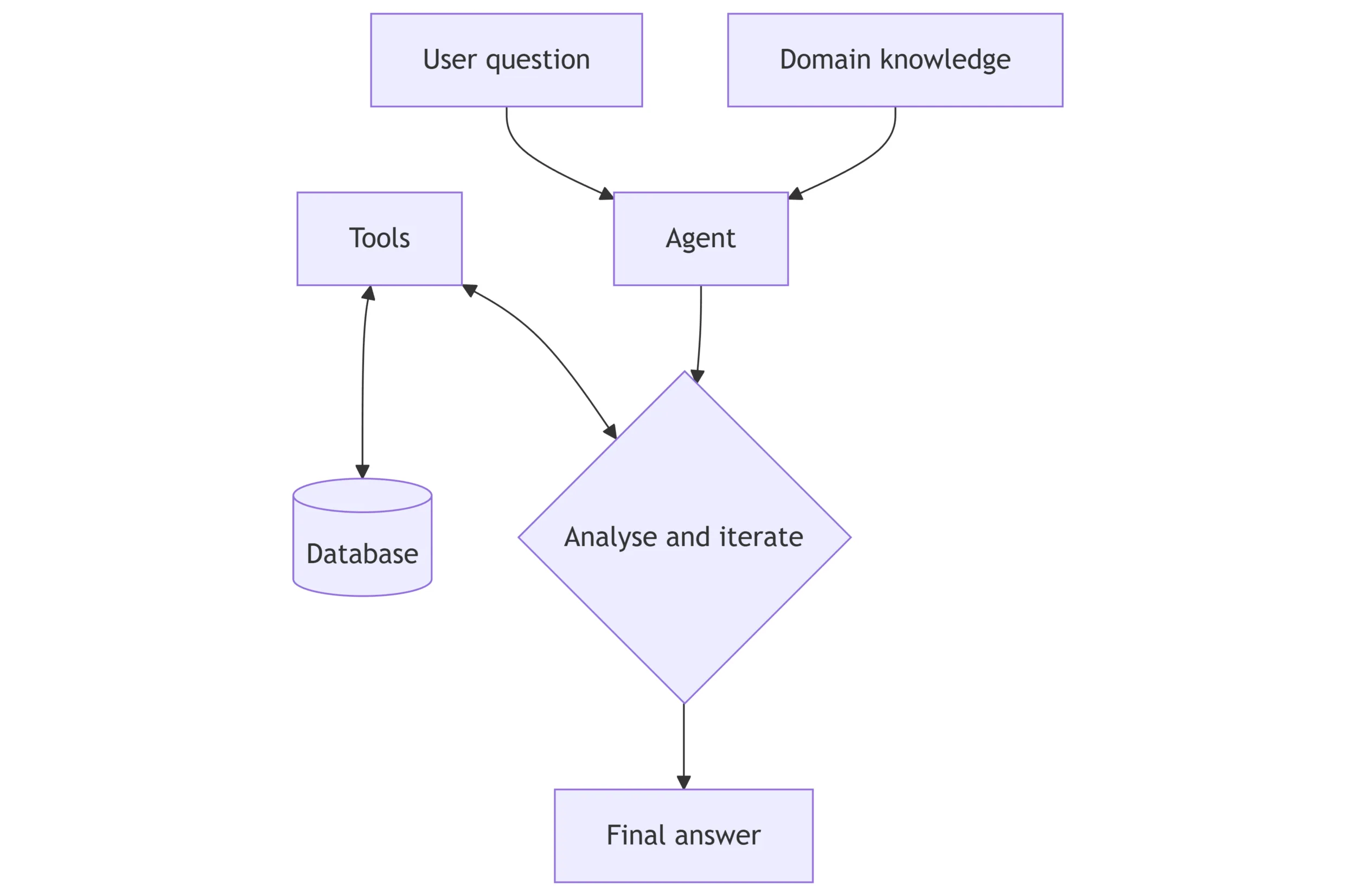
SQL query generation from natural language

Evaluating AI agents for NL-to-SQL generation across Azure Databricks AI/BI Genie, GitHub Copilot CLI, and Microsoft Agent Framework. We achieved ~75% accuracy with schema documentation and runtime validation, while discovering that business logic errors represent a fundamental limitation requiring domain expertise.

From Local to Production: Deploy Your Microsoft Agent Framework Agent with Foundry Hosted Agents

Once you have your Microsoft Agent Framework (MAF) agent or workflow happily running locally on your dev machine, it's time to decide how to deploy your agent to production, monitor it, evaluate it and version it. These decisions are just as important as getting the agent running. Hosted Agents in Foundry Agent Service is the easiest way to deploy Agent Framework agent to the cloud - with built-in identity, automatic scaling, managed session state, observability, and versioning. What are Foundry Hosted Agents? Foundry Hosted Agents are containerized applications that run inside Foundry Agent Service. Foundry Ho...
Durable Workflows in the Microsoft Agent Framework

Build durable AI agent workflows with the Microsoft Agent Framework. Start with in-process console apps, add durability with the Durable Task runtime, scale with parallel AI agents, and host on Azure Functions for serverless execution.
GitHub Copilot Modernize 101 is live on the Microsoft Developer Channel

Modernization used to be something you avoided until you couldn’t anymore. A big rewrite. A long migration plan. A risky cutover. Something you’d maybe do once every few years—if you had to. That model doesn’t work anymore. The ask has changed. It’s not just “move to the cloud.” It’s: get your apps into a state where you can actually build with AI, ship faster, and stay current. And most teams are sitting on years of accumulated tech debt blocking exactly that. Modernization is now a loop, not a project What’s different now is the tooling. With agentic workflows, modernization stops being a one-time eve...
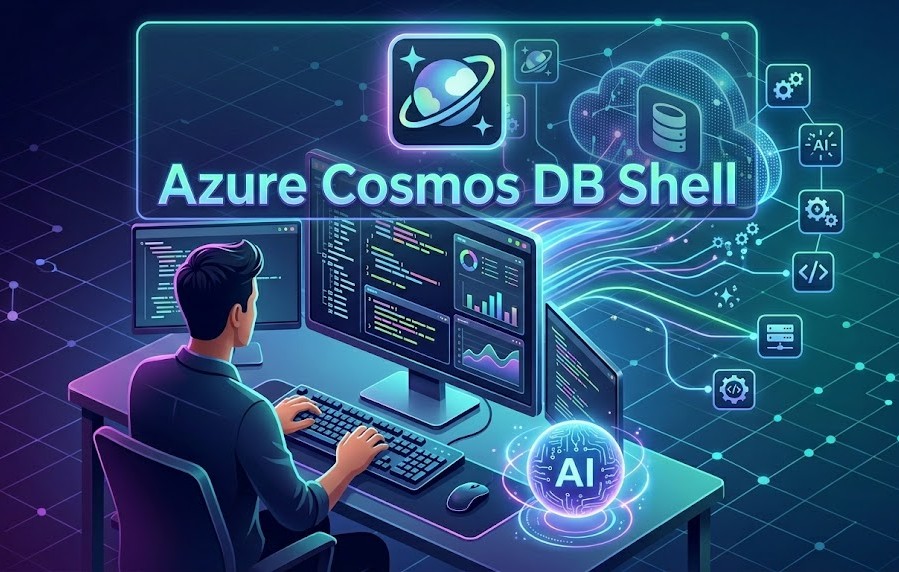
Announcing the Public Preview of Azure Cosmos DB Shell: Open-Source Power Meets AI-Driven Database Automation
Today, we're thrilled to announce the public preview of Azure Cosmos DB Shell – a powerful, open-source command-line interface that revolutionizes how developers interact with their Azure Cosmos DB databases. With integrated Model Context Protocol (MCP) server support, native agentic capabilities, and bash-like syntax, Azure Cosmos DB Shell transforms database management into an intelligent, developer-friendly experience. From Friction to Flow: Why Cosmos DB Shell, and Why Open Source If you have ever bounced between a portal tab, an SDK sample, and a half-finished script just to answer one database quest...
Why not have changes in API behavior depend on the SDK you link against?
Static libraries don't stand a chance.
Azure Cosmos DB Conf 2026 Recap: Lessons from Production

A team was running at 100% RU utilization. Throttles were compounding into retries. P99 latency was degrading. The assumption was obvious: provision more throughput. They didn’t. Instead, they found a single logical partition absorbing more than 80% of traffic. After fixing the data model—without scaling the database—RU utilization dropped to 20–35%, throttling vanished, and latency normalized. That was the real-world case study Anurag Dutt shared in his Azure Cosmos DB Conf 2026 session, From Rising RU Costs to Stable Performance. One automated integration account was generating most writes. A partition...
A dispute over the TAB key highlights a mismatch between Microsoft and IBM organizational structures
I want to speak to your manager.

Announcing the WinApp VS Code Extension — Run, Debug, and Package Windows Apps in VS Code
VS Code is where many cross-platform and web developers already work, but getting package identity, MSIX packaging, and Windows SDK tooling often meant reaching for Visual Studio or command-line tools. The WinApp VS Code extension brings the full power of the Windows App Development CLI directly into VS Code. Via the extension, you can initialize, run, debug, package, and sign Windows applications from a variety of development frameworks without ever leaving the editor. Whether you're building with .NET, WPF, WinUI, C++, Electron, Rust, Tauri, or Flutter, this extension can help you streamline your Windows...
Giving Copilot more C++ context using custom instructions in VS Code
In February, we announced how GitHub Copilot can now use C++ symbol context and CMake build configuration awareness to deliver smarter suggestions in Visual Studio Code. Today, we're excited to share new ways to further enhance your C++ development experience with Copilot and get the most out of the language-aware agentic responses, by leveraging custom instructions designed specifically for C++ language tools. Enabling Custom Instructions You can access these custom instructions in the awesome-copilot repo, a community-driven collection of instructions, prompts, and configurations to help users get the most o...
Java OpenJDK April 2026 Patch & Security Update
Hello Java customers! We are happy to announce the latest April 2026 patch & security update release for the Microsoft Build of OpenJDK. Check our release notes page for details on fixes and enhancements or download and install the binaries today. The source code of our builds are now available on GitHub for further inspection: Microsoft Build of OpenJDK specific updates OpenJDK 25 OpenJDK 21 OpenJDK 17 OpenJDK 11 Summary of Upstream Updates OpenJDK Vulnerability Advisory April 2026 Ope...
Microsoft Agent Framework – Building Blocks for AI Part 3

Build intelligent AI agents in .NET with the Microsoft Agent Framework. Learn how to create agents with tools, multi-turn conversations, memory, and graph-based workflows that bring together the building blocks from Parts 1 and 2.
SQL MCP Server as an App Service

Run SQL MCP Server on Azure App Service without containers. This walkthrough uses Data API builder to configure authentication, expose MCP, REST, and GraphQL endpoints, and deploy as code.
There is no Install – it’s ‘Stage’ and ‘Register’
"Is ContosoParts.msix installed?" is a common - but misleading - question The term install is not a formal concept in MSIX. This may seem paradoxical for a deployment technology, but it makes perfect sense once you understand MSIX deployment’s core architecture. Deployment Requests A caller makes a deployment request to the deployment engine via the PackageManager API to perform some activity. This may involve adding a package to the system, removing one, or performing another management operation. Deployment requests include: The system queues the request in the deployment engine’s memory for process...
How do I inform Windows that I’m writing a binary file?
You don't. All files are binary at the file system level.
Removing The Monkey Work of Migration
Removing The Monkey Work of Migration; in this post we show how Git-Ape analyses an AWS deployment repo and generates an Azure-native replacement, with design critique built in. This post walks through a real migration workflow: start with an AWS deployment repo and end with an Azure deployment repo. The goal isn’t a 1:1 syntax conversion. It’s intent extraction and architecture remapping—agents that read what your deployment does, propose an Azure-native equivalent, and generate deployment-ready artefacts. Along the way, a critique step flags design issues early, before you ship them. Related...
Introducing Apache Arrow Support in mssql-python

Reviewed by Sumit Sarabhai Fetching a million rows from SQL Server into a Polars DataFrame used to mean a million Python objects, a million GC allocations, and then throwing it all away to build a DataFrame. Not anymore. mssql-python now supports fetching SQL Server data directly as Apache Arrow structures - a faster and more memory-efficient path for anyone working with SQL Server data in Polars, Pandas, DuckDB, or any other Arrow-native library. This feature was contributed by community developer Felix Graßl (@ffelixg), and we are thrilled to ship it. What Is Apache Arrow? The key insight beh...
Python support for the Microsoft Teams SDK is now generally available


Python developers can now build Teams-native apps and agents using the same SDK surface that powers modern Teams experiences across our TypeScript and .NET stacks

Sponsor group type requirements for agent identities

As part of moving to general availability (GA) for Entra Agent ID, agent identity objects will only accept dynamic membership groups and unified (Microsoft 365) groups as group-type sponsors.

The new Run dialog: faster, cleaner, and more capable

We've shipped the new Run dialog - and we want to say thanks. As the team behind Windows Terminal and PowerToys, we're excited to bring this to Windows 11, and your feedback helped shape it! Run has been rebuilt from the ground up: The modern Run dialog is slowly rolling out in current Insider builds of Windows as an opt-in feature, ensuring we are collecting your feedback. To enable the new Run dialog, you’ll need to: ⛏️ How we've built it: Data-and-community driven Windows Run, also known as the Run dialog, is a surface that has been around for over 30 years. It has become a heavily relied upon...
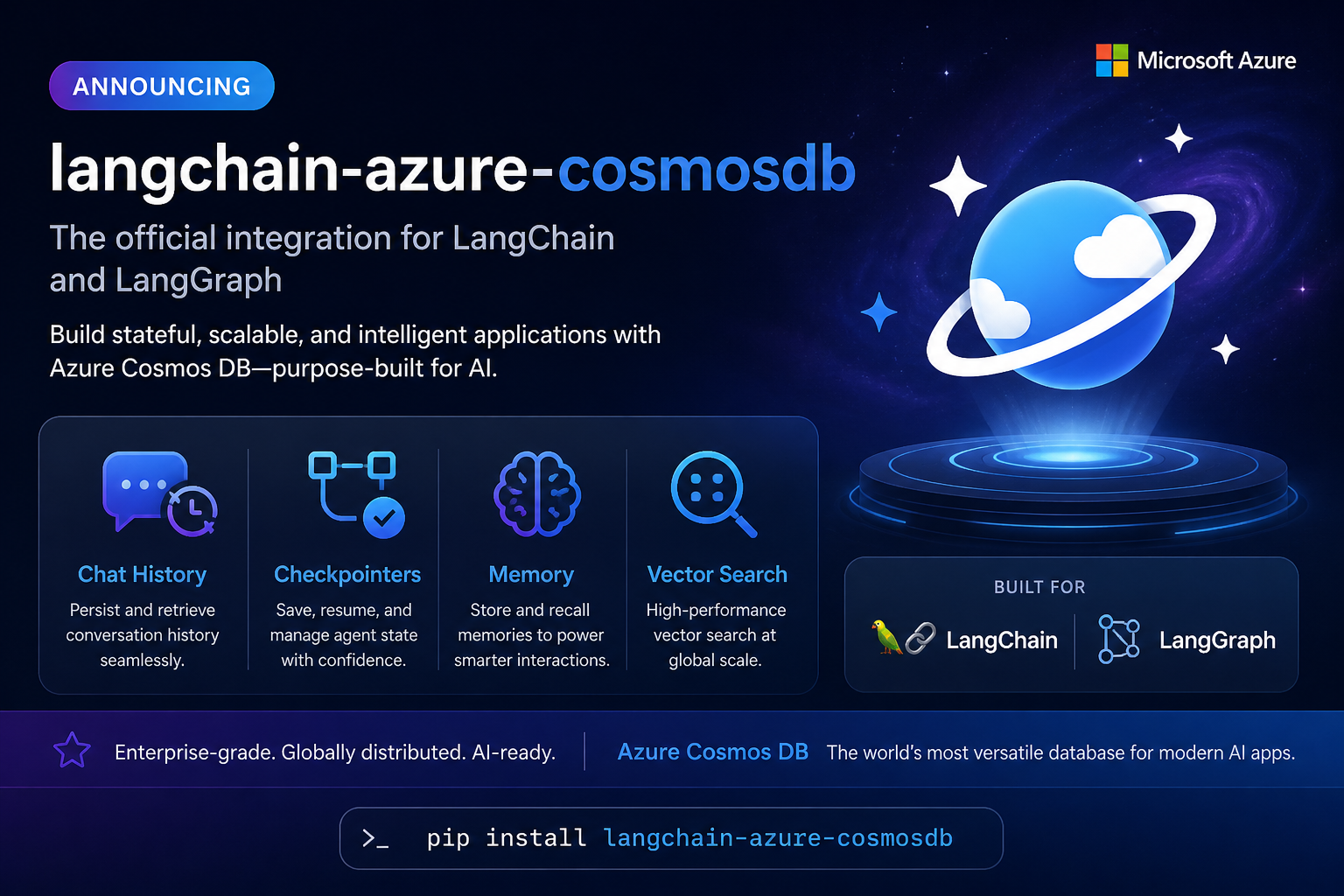
Introducing langchain-azure-cosmosdb: Build Agentic Apps and RAG with One Database

Build AI Agents and RAG Applications with the New LangChain + LangGraph Connector for Azure Cosmos DB Building AI agents and RAG applications today means stitching together half a dozen services, a vector database, a chat history store, a checkpointer for agent state, a semantic cache, a long-term memory layer. Each adds operational overhead, latency, and technical debt. langchain-azure-cosmosdb collapses that stack. It's a Python LangChain and LangGraph connector that turns Azure Cosmos DB for NoSQL into the single persistence layer for all of your agentic app scenarios. Azure Cosmos DB for NoSQL natively...
Developing a cross-process reader/writer lock with limited readers, part 4: Abandonment
Recovering from death of the owner.
Announcing WinUI 3 Gallery 2.9

Hey WinUI developers! If you’re new around here, WinUI Gallery is the go-to app for exploring WinUI 3 controls, samples, design guidance, and handy tools — all in one place. Today, we’re excited to announce WinUI 3 Gallery 2.9, our first release built on Windows App SDK 2.0, packed with brand new control samples and a few delightful additions! 📦 Built on Windows App SDK 2.0 This release upgrades the Gallery to Windows App SDK 2.0, giving you a first-hand look at the latest controls, APIs, and improvements that come with it. As always, the Gallery is the easiest way to play with what's new in Win...
Azure Developer CLI (azd) – April 2026
The Azure Developer CLI () shipped five releases in April 2026. The biggest theme this month is multi-language hook support: write hooks in Python, JavaScript, TypeScript, or .NET alongside the existing Bash and PowerShell options. Here's what's in versions 1.23.14, 1.23.15, 1.24.0, 1.24.1, and 1.24.2. To share your feedback and questions, join the April release discussion on GitHub. Highlights: New features 🪝 Multi-language hooks Hooks in now support Python, JavaScript, TypeScript, and .NET scripts, alongside the existing Bash and PowerShell options. Each language gets auto...

Dataverse Plugin Is Now on the Claude Marketplace

Dataverse gives developers a powerful platform for building enterprise applications — but getting from zero to a connected, working environment has always involved multiple tools, authentication flows, and configuration steps. The Dataverse plugin was built to accelerate that journey by letting AI coding agents handle the setup orchestration for you. Three weeks ago we introduced the Dataverse plugin for coding agents. It's an open-source plugin that lets AI coding agents like Claude Code and GitHub Copilot build and manage Microsoft Dataverse solutions through natural language. Since then, the Dataverse plugin ...

TypeScript 7 Beta Now Enabled by Default in Visual Studio 2026 18.6 Insiders 3

TypeScript 7 Beta Now Enabled by Default in Visual Studio 2026 18.6 Insiders 3 In Visual Studio 2026 18.6 Insiders 3 we have updated the built-in TypeScript SDK to TypeScript 7 Beta (native preview). The TypeScript SDK provides the compiler and language service used for TypeScript and JavaScript support in Visual Studio. This update impacts any project that uses the built-in SDK, including TypeScript projects, ASP.NET Core projects with npm packages, and any TypeScript or JavaScript files you are editing. If your project doesn't have a specific TypeScript version installed, Visual Studio will use the new nativ...
Building an AI-Powered Conference App with .NET’s Composable AI Stack

Learn how we built ConferencePulse, an AI-powered conference assistant, using .NET's composable AI stack including Microsoft.Extensions.AI, DataIngestion, VectorData, Model Context Protocol, and Microsoft Agent Framework.
Automatic Super Resolution Preview Comes to the ROG Xbox Ally X for Docked Play


We previously introduced Automatic Super Resolution (Auto SR) on select Windows 11 Copilot+ PCs, to make games look sharper and play smoother. Today, we're excited to give Xbox Insiders the opportunity to help us test and refine this feature on the ROG Xbox Ally X for docked play, where balancing framerate (FPS) and image quality can be especially challenging. Imagine this... You've just had a great gaming session on your ROG Xbox Ally X on the go. Everything looks incredibly sharp and plays smoothly on your 7-inch screen. You dock it, lean back, and look up at your TV to keep playing, but now, stretching acro...
Developing a cross-process reader/writer lock with limited readers, part 3: Fairness
Let the exclusive acquisition have a fair chance against shared acquisitions.

Propagating SharePoint Document Permissions to AI Search and RAG Pipelines

A security-first architecture that propagates SharePoint document permissions into downstream AI systems, using Microsoft Entra ID object IDs (GUIDs) for safe, query-time filtering in Azure AI Search, RAG pipelines, and Copilot extensions.
From prompt to production: Teams agent setup, simplified


Learn how to use a coding agent to register and agent with Teams.

Announcing the Private Preview of Cosmos DB Azure RBAC Integration
Introduction Managing access to Azure resources often means dealing with two separate permission models: one for management operations and another for data access. For Azure Cosmos DB customers, this split can increase complexity, slow down onboarding, and create confusion around governance and security boundaries. Today, we’re excited to announce the private preview of Integrated Azure RBAC for Cosmos DB, a major step toward a unified, intuitive permissions experience across Azure. This new capability brings Cosmos DB data plane authorization directly into Azure RBAC, allowing customers to manage both manage...
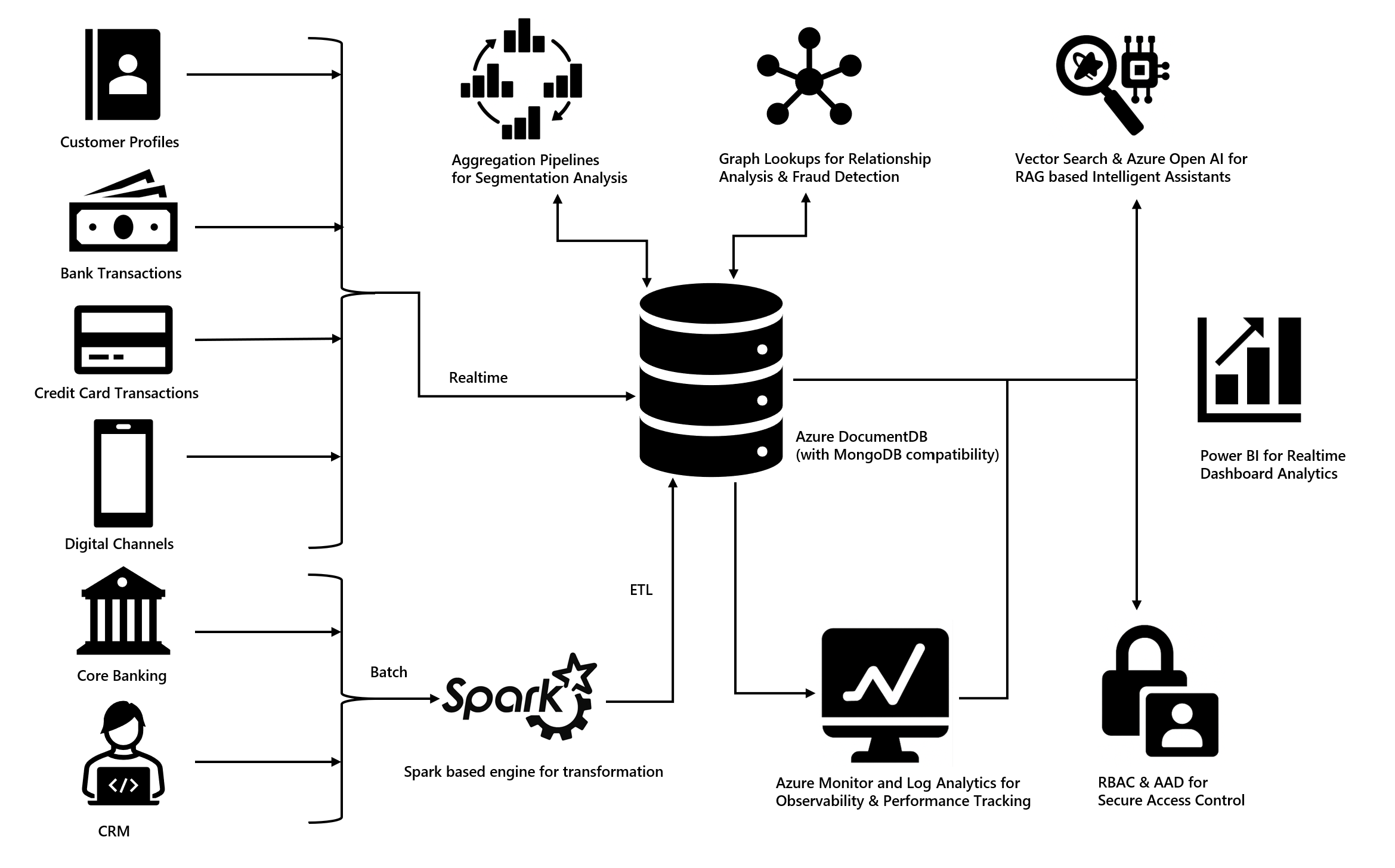
Azure DocumentDB (with MongoDB compatibility) for Banking: A Modern Customer 360 Approach

Editor's note (May 2026): This article was published in the Azure Cosmos DB Dev Blog before the launch of the dedicated Azure DocumentDB Dev Blog. Azure DocumentDB now has its own home for product announcements, engineering insights, migration guidance, technical deep dives, and developer tutorials. If you're building with Azure DocumentDB or the open-source DocumentDB project, we recommend bookmarking the Azure DocumentDB Dev Blog for the latest news and technical content. Introduction: Transforming Customer Intelligence in Banking Every day, people interact with their bank across mobile apps, branches, call c...
Announcing Microsoft Desired State Configuration v3.2.0
This post announces the General Availability of Microsoft Desired State Configuration (DSC) v3.2.0, with new Windows resources, Bicep gRPC integration, WhatIf support, expression language improvements, and adapter enhancements.

Governing MCP tool calls in .NET with the Agent Governance Toolkit
Learn how to govern MCP tool calls in .NET with the Agent Governance Toolkit—policy-based access control, security scanning, and response sanitization to reduce risk in AI agent systems.
VSTest is Removing its Newtonsoft.Json Dependency

VSTest is removing its Newtonsoft.Json dependency in .NET 11 and Visual Studio 18.8. Here's who is affected and how to fix it.

General Availability: Refresh Token (RT) Transfer to Apple Watch in Microsoft Entra External ID Native Authentication

We’re excited to announce the General Availability (GA) of Single Sign-On (SSO) from Native Apps to Embedded Web Views for Microsoft Entra External ID (EEID) Native Authentication. This release marks a major milestone in delivering end-to-end seamless authentication experiences for modern CIAM applications bridging the gap between native and web-based app surfaces. Why RT transfer matters for Native Auth Native Authentication enables developers to build fully in‑app, customizable sign-in experiences with secure token management. However, modern applications increasingly extend beyond a single device. Real-...
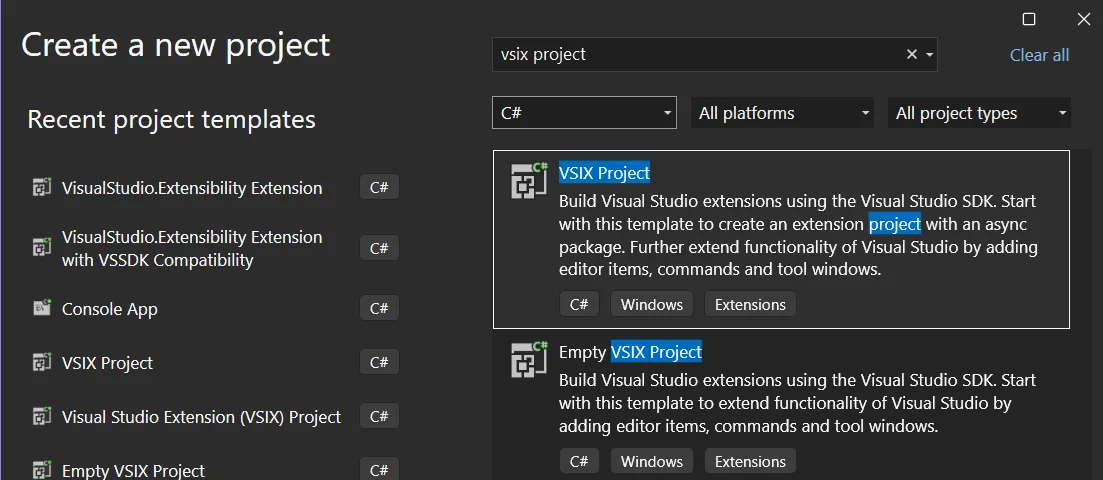
SDK-Style Support for Extension Projects

Starting in Visual Studio 18.5, you can create and build Visual Studio extensions (VSIX) using an officially supported SDK-style project. This brings VSIX projects into the modern build and deployment pipeline, improving incremental build performance and making the build → deploy → debug workflow more reliable. Install the Visual Studio extension development workload to get the templates and tooling and try it out for yourself! Note: Extensions written using the modern VisualStudio.Extensibility framework already supports SDK-style projects today. This update extends the same SDK-style experience to VSSDK-base...
Developing a cross-process reader/writer lock with limited readers, part 2: Taking turns when being grabby
Please, not everybody, everything all at once.

The New Loop: How Power Pages Builds Software with AI

Introduction When I started writing software professionally in 2015, the tech landscape looked completely different. Tools and frameworks kept evolving since then, but the process of building software barely moved for a decade. That changed in the last couple of months. Here's what has changed in how the Power Pages team builds and ships software and what hasn't. Development in the age of AI Before the arrival of coding agents like GitHub Copilot, Claude Code etc., software development was role-focused where the job of a product manager, designer, the engineer and tester was clearly defined. In fact, you can s...

A2A v1 Is Here: Cross-Platform Agent Communication in Microsoft Agent Framework for .NET
As organizations move from single-agent prototypes to multi-agent production systems, the ability for agents to communicate reliably across platforms and organizational boundaries becomes essential. With the release of A2A Protocol v1.0 and updated support in the Microsoft Agent Framework, you can now connect and expose your AI agents using a stable, production-ready interoperability standard - whether you're consuming remote agents or hosting your own. Both the A2A Agent (client-side) and A2A Hosting (server-side) .NET packages in the Agent Framework have been updated to the A2A v1 SDK. This means you can dis...
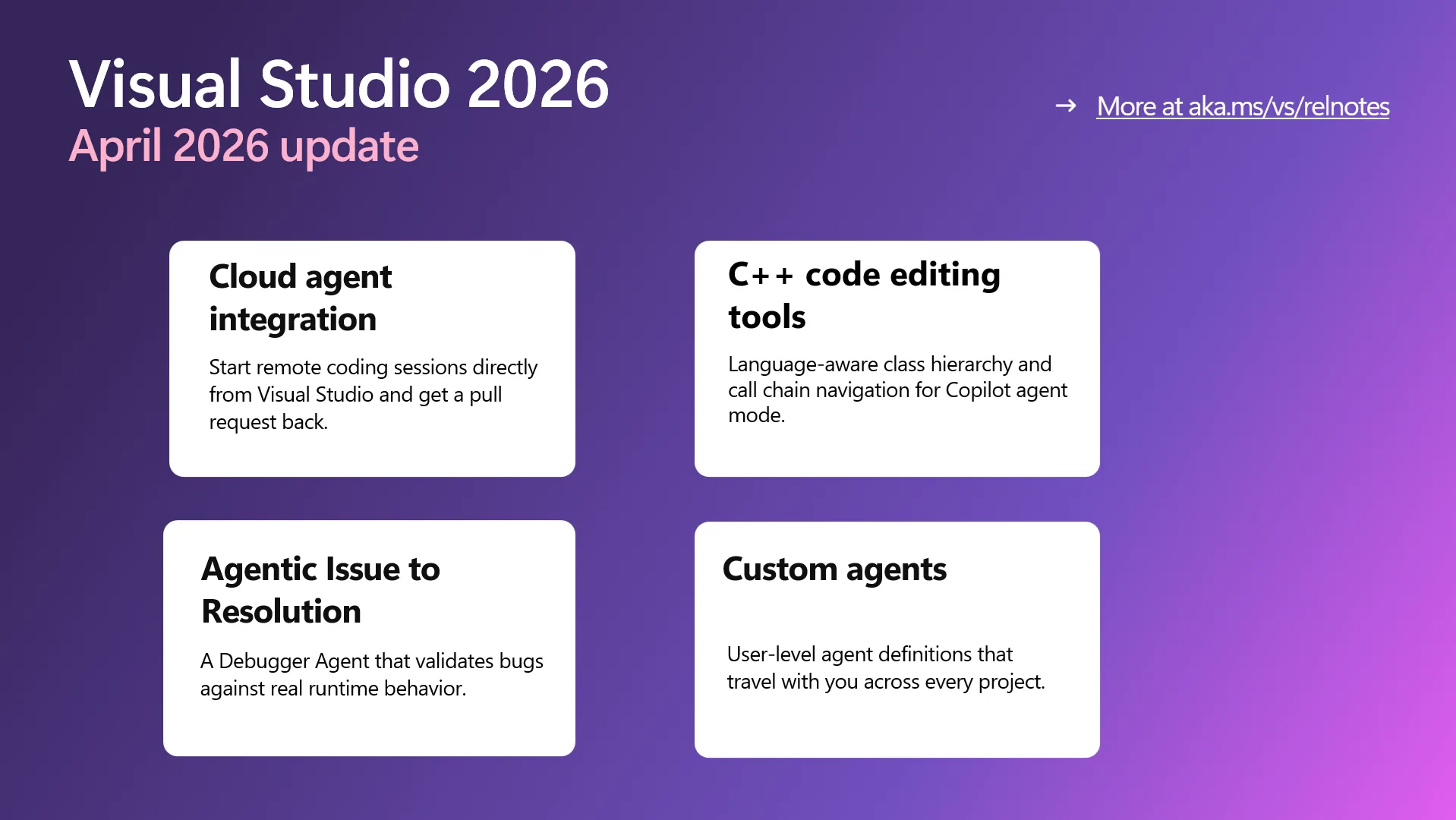
Visual Studio April Update – Cloud Agent Integration
GitHub Copilot in Visual Studio is becoming more agentic with every release. This update brings cloud agent integration front and center, letting you start remote coding sessions without leaving the IDE.
The problem: All-or-nothing batch processing in Azure Service Bus
Azure Functions lets you settle each Service Bus message on its own within a batch. Complete, abandon, dead-letter, or defer messages one by one to avoid duplicate processing and handle errors with precision.
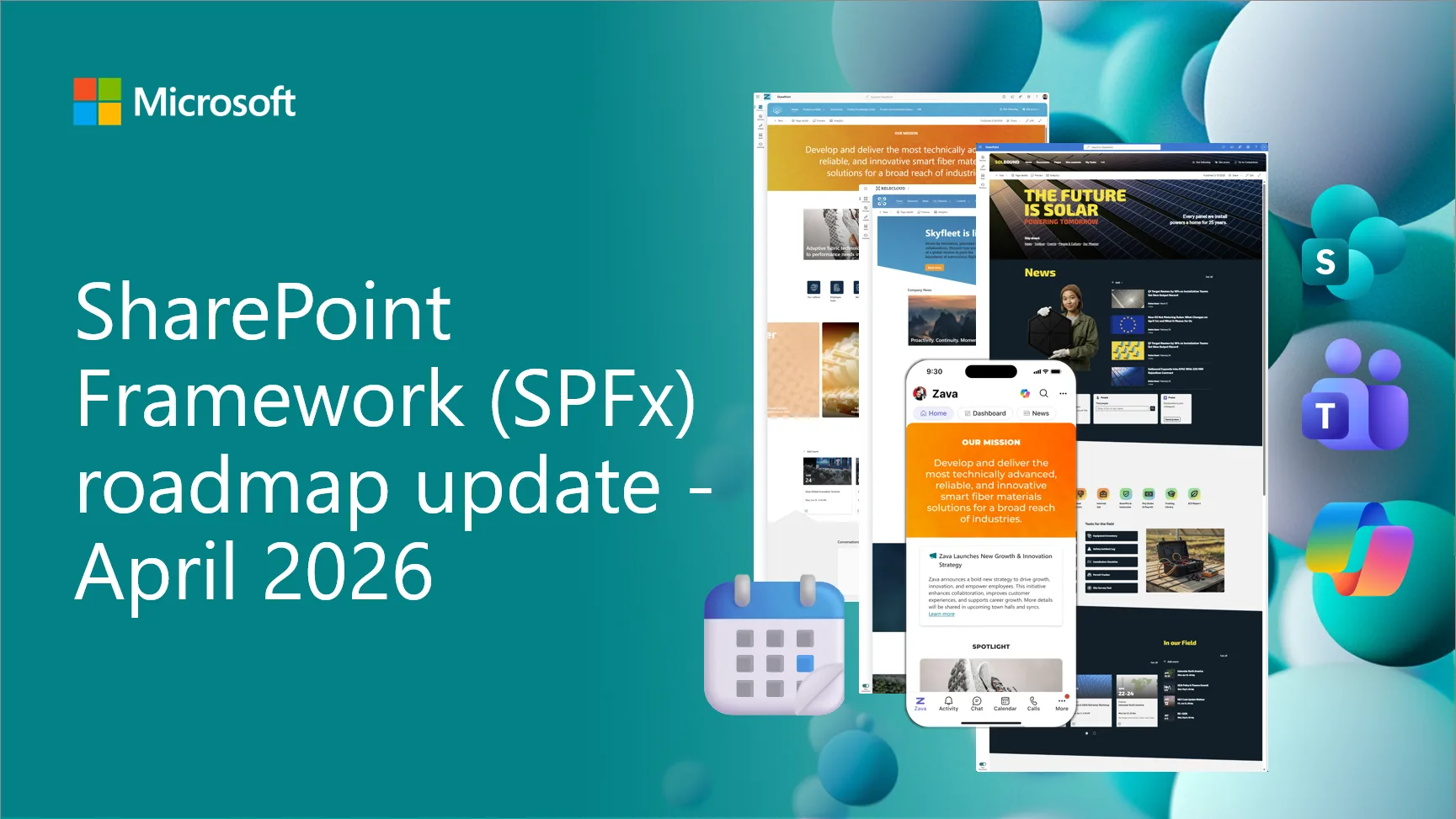
SharePoint Framework (SPFx) roadmap update – April 2026
SPFx is powering the future of Microsoft 365 with AI driven portals and deep integrations across SharePoint and Microsoft 365. The April 2026 update shares new features and the roadmap for the next evolution built for the AI era. This is a transparent community driven journey that we shape together.

Welcome to SkiaSharp 4.0 Preview 1
SkiaSharp 4.0 Preview 1 is here. Learn all about the new features and how Uno Platform has stepped up as a co-maintainer.

High-Performance Distributed Caching with .NET and Postgres on Azure

Adding caching to your application architecture can significantly improve key performance metrics, cut latency, and reduce load across downstream systems. In this walkthrough, we highlight the latest caching best practices and incorporate these design patterns into a reusable .NET application that you can reference when adding new capabilities to your application stack.
Combining API versioning with OpenAPI in .NET 10 applications

Learn how to implement API versioning in your .NET 10 applications using OpenAPI for better API management and documentation.
Developing a cross-process reader/writer lock with limited readers, part 1: A semaphore
A pot of tokens.

Welcome to Azure Cosmos DB Conf 2026
Today is the day. Azure Cosmos DB Conf 2026, in partnership with AMD, is a free virtual developer event focused on building modern, scalable applications with Azure Cosmos DB. The agenda features Microsoft engineers, product team leaders, and members of the global developer community sharing real-world solutions, deep dives into the database engine, and hands-on patterns for AI-era apps. Whether you build modern web apps, AI agents, multi-cloud platforms, or data-intensive systems on Azure — you’ll find something on the schedule that ships back with you to your codebase. 🎤 Keynote — 9:00 AM PT The ...

PowerToys 0.99 is here: new monitor controls, easier window management, and Dock upgrades
We're back with a fresh PowerToys release! This month introduces Power Display for controlling your monitors from the system tray, Grab And Move for quickly moving and resizing windows, and a wave of improvements to Command Palette and the Dock, along with updates across the utility suite. You can grab the update by checking for updates in PowerToys or by heading to the release page. Let's dive in! 🪟 Introducing Grab And Move - drag and resize windows from anywhere (Preview) This release introduces Grab And Move, a new utility that lets you drag and resize windows without having to target the title bar or w...
Python Environments Extension for VS Code- April Update

The April 2026 release update includes the Python Environments extension... Keep on reading to learn more!

Azure Data Studio is retired: Move your Azure SQL workflow to VS Code in 10 minutes

Azure Data Studio (ADS) retired on February 6, 2025, and support ended on February 28, 2026. The recommended path forward is Visual Studio Code with the MSSQL extension. If you used ADS daily, this guide gets you productive quickly in VS Code. The focus is on importing your existing setup, restoring familiar shortcuts like F5, and getting SQL Database Projects working so you can build and publish schema changes confidently from the editor. TL; DR Why this matters for Azure SQL developers Running queries is only part of the job. Most teams need repeatable workflows for schema change review, ...
Announcing Shader Model 6.10 Preview and AgilitySDK 720 Preview
Overview Today, we are pleased to announce that Shader Model 6.10 and other features have been officially released with Agility SDK 1.720-preview and complementary DXC 1.10.2605.2. AgilitySDK 1.720-preview exposes the following features. There's more detail further below, including download and driver links. Downloads Hardware Support See Appendix > Feature Support for the full table of each feature's supported hardware. Features HLSL Features (Shader Model 6.10): linalg::Matrix Shader Model 6.10 introduces a set of Matrix APIs covering a br...
D3D12 LinAlg Matrix Preview

Welcome to the D3D12 LinAlg Matrix Preview release! Today, we are excited to announce the preview release for the D3D12 Linear Algebra APIs! This feature set unlocks comprehensive hardware acceleration for Matrix-oriented operations across various use cases. Previously, we announced the WaveMMA and Cooperative Vectors features which supported narrow matrix operation use cases; the LinAlg feature set being announced today subsumes these APIs into a singular set of orthogonal APIs. With today's announcement, we are enabling developers to both efficiently drive neural rendering techniques directly from individual...
Looking at consequences of passing too few register parameters to a C function on various architectures
It's bad news no matter how you slice it, but Itanium makes it even worse.
Azure MCP Server now available as an MCP Bundle (.mcpb)

Azure MCP Server is now available as an MCP Bundle (.mcpb), enabling one-click installation into Claude Desktop and other MCP-compatible clients.
Chat History Storage Patterns in Microsoft Agent Framework
When people talk about building AI agents, they usually focus on models, tools, and prompts. In practice, one of the most important architectural decisions is much simpler: where does the conversation history live? Imagine a user asks your agent a complex question, clicks “try again,” explores two different answers in parallel, and then comes back tomorrow expecting the agent to remember everything. Whether that experience is possible depends on the answer to this question. Your choice affects cost, privacy, portability, and the kinds of user experiences you can build. It also determines whether your applic...
Defending against exceptions in a scope_exit RAII type
But maybe it's not worth it.

Axios npm Supply Chain Compromise – Guidance for Azure Pipelines Customers

On March 31, 2026, malicious versions of the widely used JavaScript HTTP client library Axios were briefly published to the npm registry as part of a supply chain attack. The affected versions — 1.14.1 and 0.30.4 — included a hidden malicious dependency that executed during installation and connected to attacker-controlled command-and-control (C2) infrastructure to retrieve a second-stage payload. Because modern development workflows frequently rely on automated dependency resolution during CI/CD builds, environments such as developer workstations and build agents—including those used in Azure Pipelines...

What’s new for .NET in Ubuntu 26.04
Ubuntu 26.04 (Resolute Raccoon) ships today with .NET 10. Here's how to install .NET 10 from the archive, use the new -resolute container tags, build Native AOT apps, and install .NET 8 and 9 from the dotnet-backports PPA.
LangChain.js for Beginners: A Free Course to Build Agentic AI Apps with JavaScript


Want to build AI agents with JavaScript that go beyond basic chat completions? Agents that reason, call tools, and pull from knowledge bases on their own? We put together a free, open source course to help you get there. LangChain.js for Beginners is 8 chapters and 70+ runnable TypeScript examples. Clone the repo, add your API key to a .env file, and start building. Why LangChain.js? If you already know Node.js, npm, TypeScript, and async/await, you don't need to switch to Python to build AI apps. LangChain.js gives you components for chat models, tools, agents, retrieval, and more so you're not wiring every...

General Availability: Single Sign-On (SSO) from Native Apps to Embedded Web Views in Microsoft Entra External ID Native Authentication
We’re excited to announce the General Availability (GA) of Single Sign-On (SSO) from Native Apps to Embedded Web Views for Microsoft Entra External ID (EEID) Native Authentication. This release marks a major milestone in delivering end-to-end seamless authentication experiences for modern CIAM applications bridging the gap between native and web-based app surfaces. Why SSO matters for Native Auth Native Authentication gives developers full control over the identity UX—enabling pixel-perfect, in-app sign-in and sign-up experiences without browser redirects. However, real-world applications rarely stay fully ...

CodeAct in Agent Framework: Faster Agents with Fewer Model Turns
Modern AI agents often aren't bottlenecked by model quality, they are bottlenecked by orchestration overhead. When an agent chains together many small tool calls, each step typically requires a new model turn, driving up latency and token usage. With CodeAct support in Agent Framework, agents can collapse those multi-step plans into a single executable code block, cutting end-to-end latency by ~50% and token usage by over 60% in representative workloads, without compromising on safety or isolation. CodeAct ships in the new (alpha) package, which runs the model-generated code in a fresh, locally isolated...
Another crash caused by uninstaller code injection into Explorer
Inadvertently destroying a staircase while standing on it.

Lessons Learned from Building a Well-Matching Intelligence Layer


Key insights from the EDA and Ground Truth journey for solving well identity resolution in the Energy industry—challenges that extend to any entity matching problem across distributed systems.
Take the 2026 ISO C++ Developer Survey!
The 2026 ISO C++ developer survey is now open: 2026 Annual C++ Developer Survey "Lite" : Standard C++ It takes about 10 minutes and directly informs the standardization committee and tooling vendors so the C++ ecosystem can continue evolving the right way. Please share your feedback and share with your colleagues!
C++ Code Intelligence for GitHub Copilot CLI (Preview)

We recently brought C++ code understanding tools to GitHub Copilot in Visual Studio and VS Code. These tools provide precise, semantic understanding of your C++ code to GitHub Copilot using the same IntelliSense engine that powers code navigation in the IDE. Until now, these capabilities have been tied to GitHub Copilot in Visual Studio and VS Code. Today, we’re bringing this same intelligence to the CLI with the release of the Microsoft C++ Language Server for GitHub Copilot CLI, now available in Preview. Why this matters C++ is difficult for tools to reason about: complex include hierarchies, macros, template...
Write azd hooks in Python, JavaScript, TypeScript, or .NET
Hooks are one of the most popular features in , and now you can write them in Python, JavaScript, TypeScript, or .NET, not just Bash and PowerShell. What's new? The Azure Developer CLI () hook system now supports four more languages beyond Bash and PowerShell. You can write hook scripts in Python, JavaScript, TypeScript, or .NET. automatically detects the language from the file extension, manages dependencies, and runs the script with no extra configuration required. Why it matters Hooks let you run custom logic at key points in the lifecycle before provisioning, after deployment, and more. Previously, hook...
PIX 2604.27004-preview – support for new D3D12 Preview features, and more

Today we released PIX version 2604.27004-preview, which can be downloaded here. This release has initial support for the new D3D12 features, notably Batched Asynchronous Command List APIs, that was released in a preview DirectX Agility SDK today. Please visit this blog post for more information about the Agility SDK release. This version also includes some bug fixes compared to the last Preview PIX release, 2602.25-preview. Details are listed below. PIX 2604.27004-preview is a preview version of PIX. We only recommend using this version of PIX if you are using a preview D3D12 feature like Batched Asynchrono...
7 tips to optimize Azure Cosmos DB costs for AI and agentic workloads

AI apps and agentic workloads expose inefficiencies in your data layer faster than any previous generation of apps. You’re storing embeddings, serving low-latency retrieval, handling bursty traffic from chat and orchestration, and often operating across regions. Done right, Azure Cosmos DB can support these patterns with high performance and cost controls built in. Done wrong, it is easy to over-provision or pay for inefficient queries. Insights from a recently published Azure Cosmos DB cost savings white paper, combined with guidance from Microsoft leader John Savill and real-world feedback from Azure Cosmos ...
Introducing Toolboxes in Foundry
Available in Public Preview Today Toolbox is a new way to curate, configure, and reuse tools across all of your AI agents without rewiring them every time from Foundry. Today, teams build agents across different frameworks and runtimes. Each agent often wires tools directly, with its own authentication, credentials, and integration code. As organizations scale agent usage, this leads to duplicated work, inconsistent behavior, and fragile production deployments. Toolbox fixes this by letting you define a curated set of tools once, manage them centrally in Foundry, and expose them through a unified endpo...
From Local to Production: The Complete Developer Journey for Building, Composing, and Deploying AI Agents


When we launched Microsoft Agent Framework last October, we made a promise: building production-grade AI agents should feel as natural and structured as building any other software. Today, we’re delivering on that promise — with the v1.0 release of Microsoft Agent Framework and the general availability of Foundry Toolkit for Visual Studio Code (formerly AI Toolkit for VS Code), new capabilities in memory (preview) in Foundry Agent Service, Toolbox in Foundry (preview) to give your agents the right tools, a faster and more secure hosted agents experience in Foundry Agent Service (preview), and Observability in ...

Introducing the new hosted agents in Foundry Agent Service: secure, scalable compute built for agents

Agents are already transforming how developers solve problems. Whether it's a coding agent that refactors your repo overnight, a research agent that synthesizes hundreds of documents into a brief, or an ops agent that monitors and remediates infrastructure — the pattern is clear. Developers are building agents that don't just answer questions, they go do things. Agents of today don’t just execute from a list of tools. They access the underlying file system, write and execute code, and persist files and memories for long running and complex tasks. Today, it is easy to build agents locally. But how do you tak...
Optimizing Git policy management at scale

With just a single improvement in the REST API of Azure DevOps, we achieved a massive reduction in CPU usage and execution time when managing Git policies: 2x less CPU and 10-15x faster execution! This change is already available to all users of Azure DevOps, and it's time to share a bit more detail: the background, what the change is, and how it helped us improve the performance. You may find this article useful if you maintain automation that manages Git policy configurations in Azure Repos using REST API. Git policy governance at a big enterprise Git policies are crucial for maintaining high quality of cod...
Securing MCP: A Control Plane for Agent Tool Execution

The Model Context Protocol (MCP) is quickly becoming a common way for AI agents to discover and use tools. It provides a consistent interface to databases, APIs, file systems, and third-party services, which makes it easier to plug capabilities into agent workflows. However, MCP standardizes the execution surface without defining how that surface should be governed. Tool definitions are fed directly to the model, tool servers can be hosted by anyone, and there is no built-in point where policy is evaluated before a call is executed. To address that gap, we’ve been building a runtime governance layer for MCP...

Windows App Development CLI v0.3: new run and ui commands, plus dotnet run support for packaged apps
Windows App Development CLI v0.3 is here! This release brings some of our best features yet including a full run-and-debug experience outside Visual Studio and built-in UI Automation from the command line. With v0.3, we've unlocked a whole class of agentic and automation scenarios. Agents or a script can now run, debug, see, and interact with a running Windows app — not just build it. Whether you're building with WinUI, WPF, WinForms, C++, Electron, Rust, Tauri, Flutter, or Avalonia — the Windows App Development CLI is for you. It provides the tooling to package, run, add Windows App SDK support, and mo...
Mapping the page tables into memory via the page tables
So-called "fractal page mapping".