


Today at Microsoft Build, we introduced Frontier Tuning, a new approach to making AI work the way your business does by applying reinforcement learning inside your compliance boundary with your own data, processes, and conventions. We’re announcing private preview, available through Forward Deployed Engineers, and upcoming availability in Microsoft Copilot Studio and Microsoft Foundry.
Inside Frontier Tuning
Frontier Tuning has three parts that work together: the environment where learning happens; the unique inputs you provide from your own business; and the tuned output models, skills, and harness that the system produces.
- A continuously evolving environment. Tuning runs in a managed Reinforcement Learning Environment (RLE) used both for post-training and inference. During training, the system learns from real workflows, tool usage, and eval signals without affecting production systems. At inference it explores multiple frontier and fine-tuned models, from Microsoft AI and OpenAI, across turns to find stronger candidate paths before returning an answer. The system improves continuously as it learns from each interaction.
- Your company’s data, domain knowledge, and workflows, in one platform. You bring your business data and know-how into the RLE: content, processes, conventions, terminology, and workflows that collectively define how your business runs. The experience is built to be easy to use, with no need for a data science degree. With a simple, guided approach, teams can bring data in and start tuning right away, enabling more people within your organization to capture the power of tuning.
- Tuned models, skills, and harness that stay within your compliance boundary. This system produces tuned models, embeddings, skills, orchestration logic, and a runtime harness. All of this runs on your data, with your controls, without leaving your compliance boundary. The models inherit your access controls, so only people who could see the underlying data can access models built from it. The tools are virtualized, so agents can improve without affecting production systems.
Together, these three pieces form a loop that gets sharper with every agent interaction. As knowledge in your environment grows, the models and harness evolve with it, so your agents keep getting better at the work you actually do.
Fits the way you operate
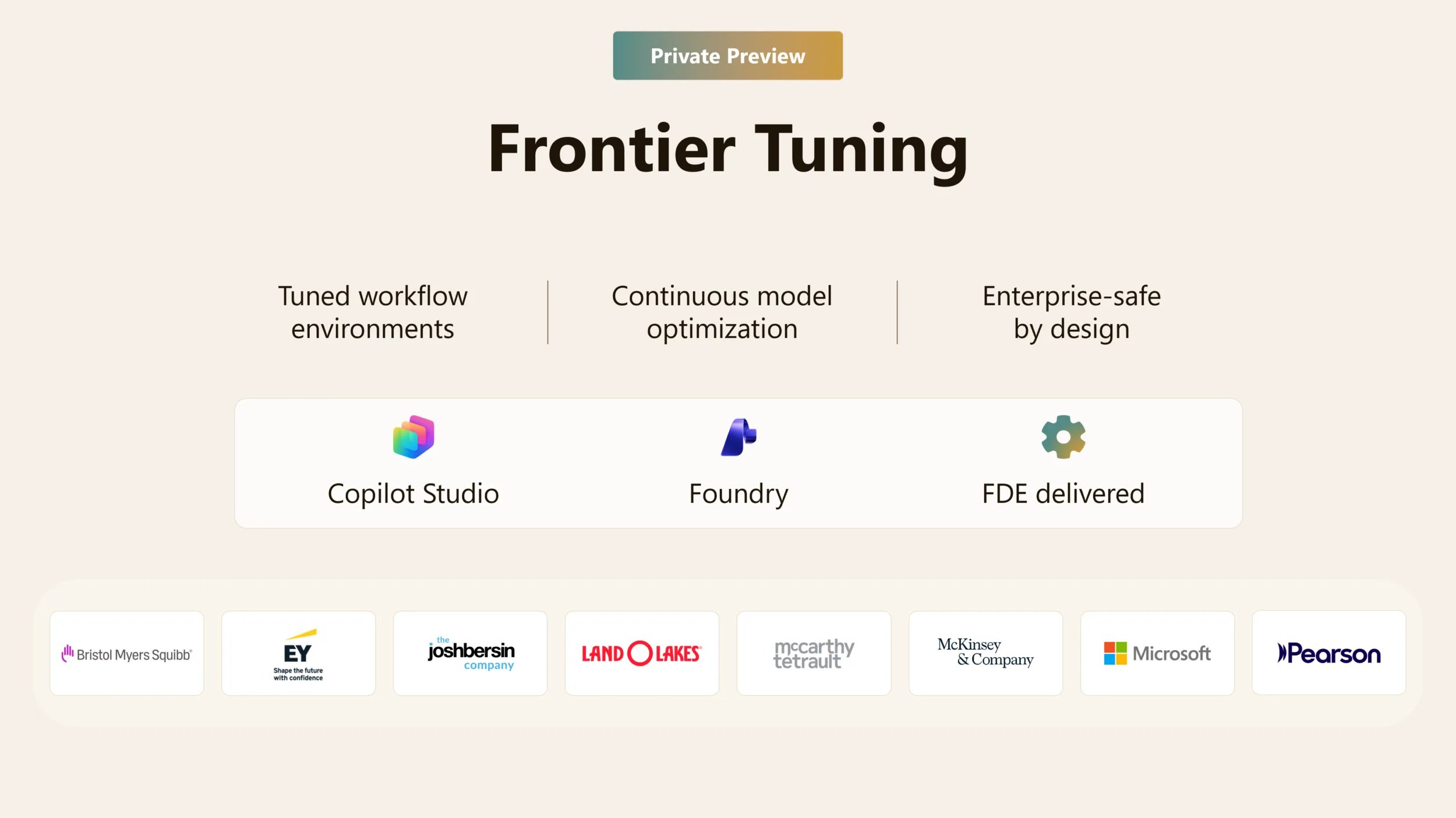
Frontier Tuning fits into how you already build and operate agents. Users interact with agents tuned on your company’s data and workflows. Makers and developers build and refine these agents in the tools you’re already using, including Microsoft Copilot Studio and Microsoft Foundry.
For example, soon within Copilot Studio, you will be able to access the RLE and use data like transcripts, knowledge bases and Microsoft 365 artifacts to improve the agents you already rely on. We’re also bringing capabilities to Foundry to allow developers to tune agents alongside the tools you already use. Here too, you’ll be able to set up an RLE, bring in your data, and tune models, including Microsoft AI models, and runtime behavior. More details on Foundry support will come in the coming months. And today, Frontier Tuning is available in Private Preview through our Forward Deployed Engineering (FDE) team. FDEs can partner with you end to end: defining the scenario, setting eval criteria, running the tuning process and delivering the agent, all within your environment.
Whether you build in Copilot Studio, develop in Foundry, or partner with an FDE, Frontier Tuning fits how your business already operates.
Frontier Tuning in action
Frontier Tuning is already in the hands of customers. We’ve partnered with a focused set of organizations including Land O’Lakes, EY, Bristol Myers Squibb, Pearson, McKinsey, McCarthy Tétrault, and the Josh Bersin Company.
“Microsoft Frontier Tuning enabled us to generate significantly better Copilot outputs for Communication Coach. The results were more closely aligned with Pearson’s learning science, giving learners clearer, more actionable feedback on how to strengthen workplace communication,” said Gian Paolo Perrucci, Product & Technology Officer, Pearson.
“Microsoft Frontier Tuning is set to transform the tax practice across the global EY organization. By combining a tax-domain–tuned reasoning LLM with our extensive enterprise knowledge and insights from our Tax Advisors, EY is elevating the delivery of tax services. Leveraging client context in Microsoft Work IQ and deep EY expertise, we are tuning an advisory agent within the RLE that will be deployed to 75,000 tax professionals globally in the coming period.” – Ben Ambrosino, EY Global Tax CTO, EY
“Microsoft Frontier Tuning has given us a powerful way to bring Galileo’s research-backed HR intelligence into bespoke agents inside the Copilot experience. It is one of the most compelling capabilities we have seen for putting deep domain expertise into the daily flow of work.” – Josh Bersin, Founder and CEO, The Josh Bersin Company
“With Frontier Tuning, we’re teaching the system how Microsoft HR works – capturing organizational knowledge in one connected environment that learns and improves with every use. We partnered with our product teams until the results were undeniable; successful task completion increased from 13% to 87%. Now we’re expanding to more HR workflows.” – Nathalie D’Hers, CVP Employee Experience
The pattern across these engagements is consistent: when you teach the system how your organization actually works, you get much higher fidelity output and more predictable execution.
Get started
If you’re interested in Frontier Tuning, visit aka.ms/frontiertuning to learn more. We will follow up with additional details.


rontier Tuning suggests a future where institutional knowledge includes governance itself. Many organizations need agents that can understand not only processes and content, but authority, jurisdiction, policy, and accountability. One of the most interesting possibilities is “constitutional compute”—teaching agents to operate within codified governance frameworks rather than relying solely on prompts and permissions. The ability to tune governance behavior may ultimately prove as valuable as tuning domain knowledge.