

Introduction
At the edge, custom logic is unavoidable: threshold filters, unit conversions, schema validations. That logic ships from different teams, often in different languages, and runs on production infrastructure that cannot tolerate crashes, memory corruption, or unauthorized resource access. Traditional approaches force a choice between performance (native binaries with full host access) and isolation (containers with significant overhead). Neither option simultaneously satisfies all three requirements: safety, portability, and language neutrality.
WebAssembly eliminates that trade-off. Originally designed as a browser compilation target, WebAssembly has evolved into a general-purpose bytecode format that runs in a memory-safe, sandboxed environment on any conforming runtime. Its companion specifications, the Component Model, WIT, and WASI, extend that core with rich type-safe interfaces, static composition, and standardized system APIs. Together, they let teams compile dataflow operators from any supported language into sealed binaries that expose only the interfaces they declare.
Azure IoT Operations dataflow graphs make this concrete. Built on the Timely dataflow computational model, dataflow graphs execute WASM modules as streaming dataflow operators at the edge: map, filter, branch, accumulate, concatenate, and delay. Processing pipelines are defined in YAML, compiled modules are pushed to a container registry as OCI artifacts, and deployment happens through Azure Resource Manager.
[!IMPORTANT] In this post, dataflow operator is the graph role, WASM module the deployable artifact, and component the WIT composition unit.

The Journey: Our Approach and Solution
Why WASM Fits Dataflow Operators
WebAssembly defines a portable binary instruction format for a stack-based virtual machine.
Source languages (Rust, C, C++, Go, Python, and others) compile to a compact .wasm binary that any conforming runtime can execute at near-native speed.
The AIO WASM module development guide officially supports Rust and Python; all examples in this post use Rust.
The format makes minimal assumptions about the host and does not specify any APIs or system calls, only an import mechanism where the embedding environment provides the functions a module needs.
Three enforcement mechanisms make WebAssembly suitable for running untrusted or multi-team dataflow operator code on production infrastructure.
Control-flow integrity validates the type signature of every function call at load time. Indirect calls through function tables are type-checked again at runtime, preventing redirection to arbitrary functions.
Memory safety comes from linear memory: a contiguous, bounds-checked byte array that the module reads and writes through indexed instructions. Every access is validated against the memory size, and out-of-bounds reads or writes trigger an immediate trap. The call stack is separate from linear memory and inaccessible to user code, eliminating a common class of vulnerabilities like stack buffer overflows found in native code.
Traps provide an immediate, non-recoverable termination path for any violation: out-of-bounds access, division by zero, integer overflow in conversion, unreachable code, or stack exhaustion. The runtime never allows a faulting module to continue executing.
For edge data processing, these guarantees are decisive. Untrusted or team-contributed dataflow operator code runs on production infrastructure knowing that a misbehaving module cannot corrupt host memory, hijack control flow, or access resources it has not been granted.
The Component Model and WIT
Core WebAssembly modules have a critical limitation at their boundaries.
The only types a module can import or export are numeric: i32, i64, f32, and f64.
Passing a string requires writing bytes into linear memory, handing the offset and length as two i32 values, and trusting the caller to read from the correct region.
Records, lists, variants, and other compound types demand the same manual memory-offset coordination on both sides.
The Component Model solves this by introducing components: self-describing WebAssembly binaries that interact through typed interfaces instead of shared memory. Each component owns an isolated linear memory region. There is no shared address space between components; the only ways a component can interact with anything outside itself are by having its exports called or by calling its imports. A Canonical ABI handles lifting and lowering between rich types (strings, records, lists, variants) and the numeric values core modules understand, invisible to the component author.
WIT (WebAssembly Interface Types) is the IDL that defines those interfaces. An interface groups related types and functions. A world describes the complete set of imports and exports for a component. If an interface is not listed in a component’s world, the component has no access to it: the sandbox is enforced structurally, not at runtime.
WASI Preview 2 builds on WIT to provide standardized system APIs (clocks, filesystem, sockets, random). Where WASI Preview 1 exposed a monolithic, POSIX-like API with file descriptors and no component model support, Preview 2 replaces that with fine-grained, composable WIT interfaces and adds async primitives through streams and futures. This solution targets WASI P2 through the wasm32-wasip2 Rust compilation target. A component that never imports wasi-filesystem cannot access files, regardless of what the underlying host runtime supports.
Four qualities make this stack valuable for dataflow operators:
- Sandboxing ensures dataflow operators cannot access host resources beyond their declared imports.
- Interoperability lets different teams contribute dataflow operators in different languages (a Rust filter and a Python map coexist in the same pipeline).
- Static analyzability allows deployment tooling to inspect component interfaces before execution, catching integration errors at build time.
- Composition, the differentiator explored in depth in this post, enables fusing independently developed components into a single deployable module through their WIT interfaces. One team owns the SDK integration layer, another ships business logic as a sealed binary, and
wasm-tools composemerges both at build time without either side accessing the other’s source code.
Two Dataflow Operator Patterns
The official AIO documentation covers monolithic operator development in Rust and Python, where a single module owns SDK integration and business logic together. This post builds on that foundation with a second pattern: composed operators that use WIT interfaces to separate SDK integration from business logic across independently developed and deployed components. Composition is the key enabler for multi-team scenarios, where one team maintains the platform integration layer and another ships domain-specific processing rules as sealed binaries, without sharing source code, build systems, or even programming languages.
Pattern 1: Monolithic Dataflow Operators
The monolithic pattern places all logic in a single crate: data type definitions, SDK integration, and business rules coexist in one module. The filter operator reads threshold parameters at initialization, then checks each incoming temperature measurement against bounds:
#[filter_operator(init = "filter_temperature_init")]
fn filter_temperature(input: DataModel) -> Result<bool, Error> {
    let payload = match input {
        DataModel::Message(Message {
            payload: BufferOrBytes::Buffer(buffer), ..
        }) => buffer.read(),
        DataModel::Message(Message {
            payload: BufferOrBytes::Bytes(bytes), ..
        }) => bytes,
        _ => panic!("Unexpected input type"),
    };

    let measurement: Measurement = serde_json::from_slice(&payload).unwrap();
    Ok(matches!(measurement, Measurement::Temperature(t)
        if t.value.is_some_and(|v| v < *UPPER_BOUND.get().unwrap()
            && v > *LOWER_BOUND.get().unwrap())))
}
The #[filter_operator] procedural macro generates the WASM exports that the AIO runtime expects. The init function reads threshold parameters from the graph definition’s moduleConfigurations section. The filter function extracts raw bytes from the DataModel, deserializes JSON, and returns true to pass the message downstream or false to discard it.
This pattern works well when one team owns everything. The limitation surfaces when business logic is proprietary or developed by a separate team, since every change to the processing rules requires access to the AIO SDK integration code.
Pattern 2: Composed Dataflow Operators via WIT
The composed pattern splits the dataflow operator into two independently compiled components connected by a WIT contract. The map operator handles AIO SDK integration, while the custom-provider implements business logic behind a clean interface boundary.
The WIT contract defines the composition surface:
package map:custom;

interface types {
    record module-configuration {
        properties: list<tuple<string, string>>,
    }
    variant error {
        invalid-argument(string),
        internal(string),
    }
    record data-model {
        payload: list<u8>,
    }
}

interface custom {
    use types.{data-model, error, module-configuration};
    process: func(message: data-model) -> result<data-model, error>;
    init: func(configuration: module-configuration) -> bool;
}

world custom-impl { import custom; }
world custom-provider { export custom; }
Three types define the contract. module-configuration carries key-value pairs from the graph definition’s runtime parameters. error is a variant with two cases for structured error reporting. data-model wraps an opaque list<u8> payload, keeping the interface decoupled from any particular serialization format.
Two worlds reference the same interface from opposite directions. The custom-impl world imports the interface, generating call stubs that the map operator uses to invoke process() and init(). The custom-provider world exports the interface, generating a Guest trait that the provider must implement.
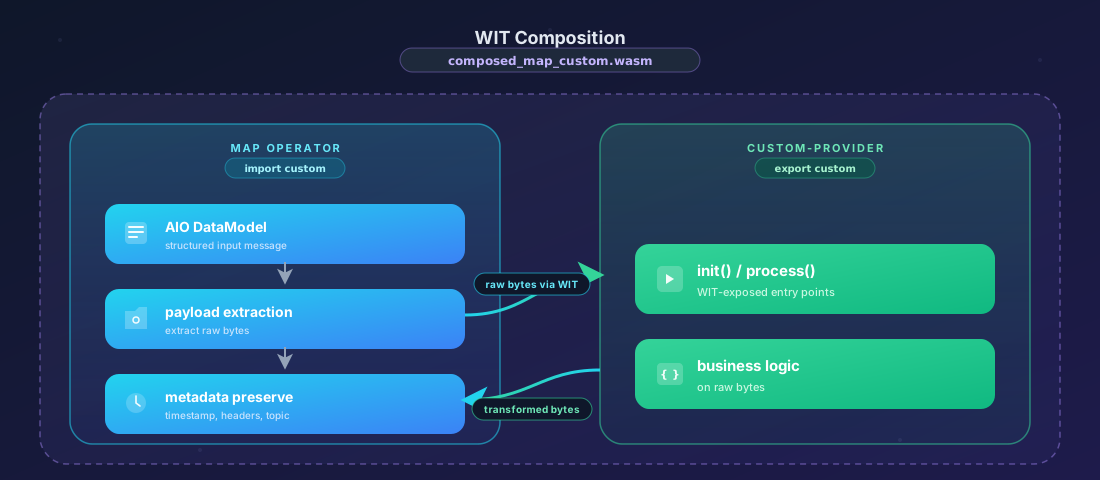
The provider operates entirely on payload: list<u8> from the WIT contract. It never encounters AIO SDK types like Message, BufferOrBytes, or HybridLogicalClock. This separation means the team can ship the custom-provider as a sealed binary, swap it for a different implementation without modifying the map operator, or write it in any language with Component Model toolchain support.
When wasm-tools compose fuses the two compiled components, it matches the map’s imports against the provider’s exports, producing a single artifact with all dependencies resolved internally.
From Source to Streaming Pipeline
Compilation and Composition
Both dataflow operator patterns target the wasm32-wasip2 Rust compilation target, which directs the compiler to emit Component Model binaries linked against WASI Preview 2 interfaces.
Monolithic dataflow operators compile to a single WASM module ready for deployment.
Composed dataflow operators require an additional step: the wasm-tools CLI from the Bytecode Alliance fuses the two independently compiled components into one artifact.
The compose subcommand inspects each component’s interface metadata, matches the map operator’s import custom against the custom-provider’s export custom, and produces a single component with all internal dependencies resolved.
The result is indistinguishable from a monolithic module at deployment time, but preserves the clean development-time separation between SDK integration and business logic.
[!TIP] The
wasm-tools composesubcommand is deprecated in favor of WAC (WebAssembly Composition), which provides the same interface-matching with additional features like dependency graphs and configuration files.
Graph Definitions and Deployment
Dataflow graphs separate the processing pipeline description from the infrastructure binding.
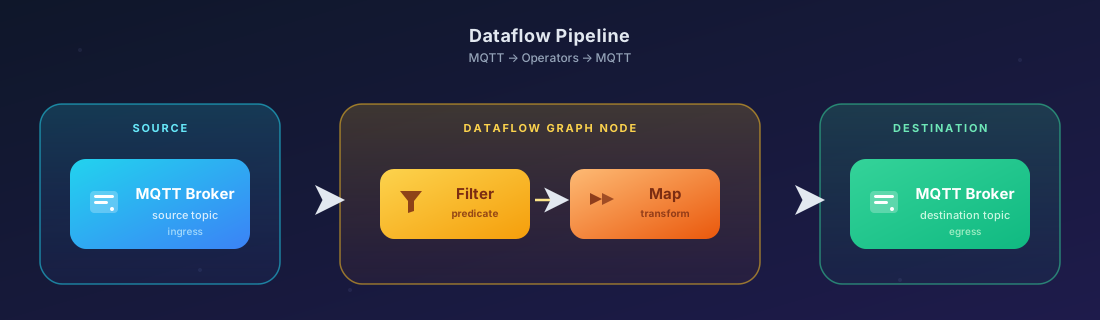
A graph definition is a YAML file validated against a JSON schema. It declares operations (source, filter, map, sink), their connections, module references with semantic version tags, and runtime configuration parameters.
The graph definition uses abstract source and sink names without specifying concrete endpoints.
[!TIP] Keep the graph definition environment-agnostic. Bind topics, endpoints, and registry access in the wrapping resource, not in the operator.
A separate dataflow graph resource, deployed through Azure Resource Manager or a Kubernetes manifest, wraps the graph definition and connects those abstract operations to concrete MQTT topics, Kafka endpoints, or OpenTelemetry collectors.
This separation is a critical design principle: the same graph definition deploys across development, staging, and production environments without rebuilding any WASM modules.
The runtime pulls the graph definition to learn the pipeline structure, then pulls each referenced WASM module by its artifact tag (e.g., filter:1.0.0), initializes modules with their configuration parameters, and begins streaming data through the graph.
Both graph definitions and compiled WASM modules are stored in a container registry as OCI (Open Container Initiative) artifacts.
The ORAS CLI handles pushing, using distinct media types so the registry and runtime can distinguish graph YAML from WASM binaries.
The azure-edge-extensions-aio-dataflow-graphs sample repository provides an end-to-end pipeline with make targets covering cluster provisioning, ACR setup, role assignments, registry endpoint configuration, module compilation, OCI push, graph deployment, and testing.
The WASM module development guide and the graph definition documentation cover the full lifecycle in detail.
The Destination: Outcomes and Learnings
WebAssembly provides the safety guarantees that edge data processing demands: a sandboxed execution environment with control-flow integrity, bounds-checked memory, and immediate trapping on violations.
The Component Model extends those guarantees with composability, enabling independently developed components to fuse through type-safe WIT interfaces into single shipping binaries.
WASI Preview 2 standardizes the system APIs these components use, while the wasm32-wasip2 compilation target and wasm-tools CLI provide the concrete toolchain.
The two-pattern approach proved effective in practice: monolithic dataflow operators keep simple logic self-contained, while the WIT composition boundary lets separate teams contribute dataflow operators independently without exposing SDK internals. The graph definition layer adds deployment flexibility by decoupling pipeline structure from infrastructure binding, enabling the same dataflow operators and graphs to move across environments without rebuilds.
Conclusion
Azure IoT Operations dataflow graphs bring the WebAssembly standards stack to production with two dataflow operator patterns: monolithic for self-contained logic, and composed for cross-team separation of concerns. The combination of memory-safe sandboxing, typed composition through WIT, and environment-agnostic graph definitions delivers a practical foundation for safe, portable edge data processing.
Call to Action
The full implementation is available in the edge-ai project, the sample repository covers the end-to-end pipeline, and the AIO dataflow graphs documentation provides the official reference.


