

Editor’s note (May 2026): This article was published in the Azure Cosmos DB Dev Blog before the launch of the dedicated Azure DocumentDB Dev Blog. Azure DocumentDB now has its own home for product announcements, engineering insights, migration guidance, technical deep dives, and developer tutorials. If you’re building with Azure DocumentDB or the open-source DocumentDB project, we recommend bookmarking the Azure DocumentDB Dev Blog for the latest news and technical content.
Introduction: Transforming Customer Intelligence in Banking
Every day, people interact with their bank across mobile apps, branches, call centers, ATMs, chatbots, and partner ecosystems. Each touchpoint holds a piece of the customer story but rarely the whole picture.
For many institutions, these moments of truth get lost in a maze of legacy systems, disconnected business units, and data locked away in silos built over decades.
Why Customer 360 Matters for Financial Enterprises
Banks often distribute customer data across various systems such as core banking, CRM, loan origination, card platforms, digital channels, and marketing platforms. This fragmentation leads to incomplete customer profiles and disjointed service, hampers the ability to identify cross-sell and up-sell opportunities, results in slow and manual investigations for fraud and risk, and creates compliance gaps along with increased audit overhead.
A Customer 360 consolidates these sources into a single, queryable view so teams can act on real‑time context: who the customer is, what they’re doing now, and what they likely need next.
How Does This Make Your Job Easier?
A unified Customer 360 view streamlines daily work for banking teams:
Relationship Managers: Instantly access complete customer profiles, recent interactions, and next-best actions—making every conversation more productive.
Contact Centre Agents: Resolve issues faster with all relevant customer data in one place, reducing call times and improving satisfaction.
Fraud & Risk Analysts: Spot suspicious patterns and linked accounts in real time, enabling quicker, more accurate investigations.
Marketing & Growth Teams: Continuously refine segments and target offers based on up-to-date customer insights.
Compliance & Audit: Simplify audits and reporting with unified logs and access controls.
In short, Customer 360 turns fragmented data into actionable insights helping every team deliver better service, faster.
This blog post explores how Azure DocumentDB, a MongoDB compatible database, provides a unified platform that simplifies achieving Customer 360. It enables advanced analytics, customer segmentation, and AI-powered insights. By serving as the foundation for a comprehensive and intelligent Customer 360 solution, Azure DocumentDB helps financial institutions enhance customer experiences, drive business growth, and maintain a competitive edge.
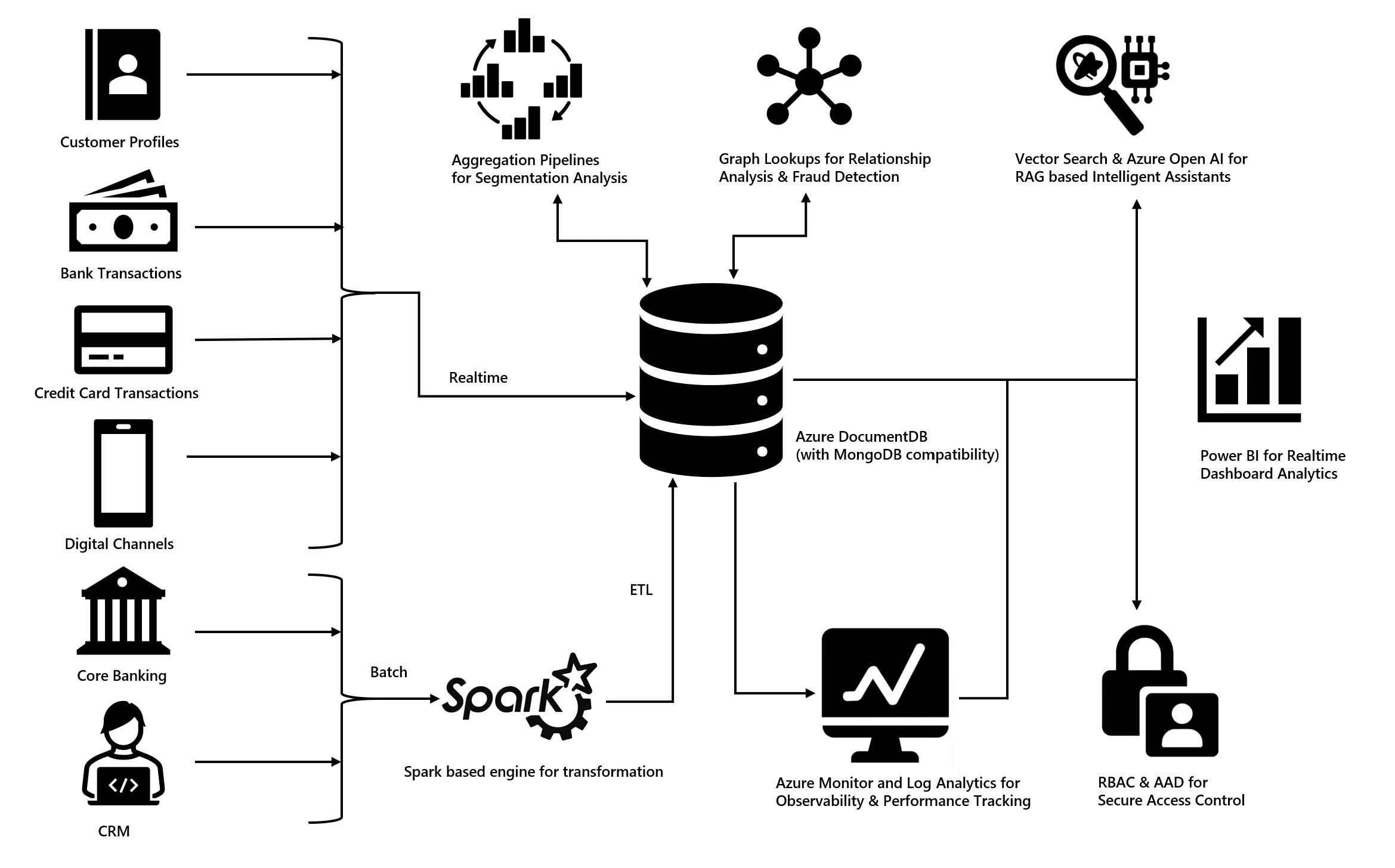
The Platform: Azure DocumentDB Built for Seamless Customer 360 Integration
You can deliver the Customer 360 experience using familiar Mongo constructs while also benefiting from enterprise-grade scale, security, and cost control. With features such as Aggregation Pipelines for joining and transforming data across collections, $graphLookup to uncover relationships between households, devices, and linked accounts, as well as advanced Segmentation & Scoring based on customer behaviour, geography, life stage, or risk, your teams have powerful tools at their disposal. Furthermore, Vector Search enables semantic retrieval and AI-powered experiences, ensuring your Customer 360 solution is both intelligent and future-ready.
Why now? You can modernize without rewriting Mongo workloads, and you get a managed foundation aligned to banking‑grade security and governance. Azure Document DB overview.
Security & Resilience: Banking‑Grade by Design
Azure DocumentDB delivers robust security, and resilience features essential for financial institutions. It ensures encryption at rest with service-managed key (SMK) or customer-managed key (CMK), provides automatic failover to guarantee high availability, and supports replica clusters both within the same region and across regions for disaster recovery and read offload. Role-Based Access Control (RBAC) is integrated with Entra ID, offering general availability for native users and Entra identities. Operational visibility is enhanced through Azure Monitor and Log Analytics, while point-in-time restore capabilities allow data recovery for up to 35 days. Network isolation is achieved using private endpoints and firewalls. The outcome is that comprehensive security and compliance controls are seamlessly embedded alongside the operational data teams rely on daily. For more information, how to secure your Document DB cluster.
Cost & Operations: Why Azure DocumentDB Wins
Azure DocumentDB (with MongoDB compatibility) offers significant advantages in terms of cost and operations. It can reduce total cost of ownership (TCO) by up to 70% compared to MongoDB Atlas, thanks to optimized compute and storage. There are no licensing fees, and users benefit from built-in compression and distributed storage. The platform provides flexible SKUs with auto-scale options to handle variable workloads, and free tools are available to support both migration and ongoing operations. Ultimately, this results in predictable costs, fewer complexities, and less time spent on undifferentiated heavy lifting. For more information, Compare Azure DocumentDB to MongoDB Atlas.
Migration: From On‑Prem or Atlas, With Minimal Code Change
Supported sources: On‑prem MongoDB, MongoDB Atlas, Cosmos DB Mongo API Tooling: Azure Data Studio extension, native mongodump/mongoimport/mongorestore, Databricks Spark utility, Azure Portal utility
The typical migration path involves an initial assessment of schemas, indexes, and workload patterns, followed by tool selection and index planning, setting up connectivity and security guardrails, and conducting a dry run or proof of concept with defined success metrics.
After that, teams proceed with a phased production cutover and post-migration validation to ensure performance, correctness, and observability. This approach allows organisations to retain their existing Mongo skills, patterns, and pipelines while simply shifting the underlying platform.
For more information, Azure Document DB migration options.
AI‑Ready Customer 360: Retrieval‑Augmented Generation (RAG)
Imagine how integrating Retrieval-Augmented Generation (RAG) into Customer 360 quickly transforms the way users interact with customer data by delivering richer, more relevant, and highly personalised insights. With the extensive support for vector store and vector search algorithms include Hierarchical Navigable Small World (HNSW), Inverted File (IVF), and DiskANN, customer-facing teams can leverage advanced AI to tap into comprehensive Customer 360 datasets, surfacing deeper context, connections, and actionable information in real time.
This seamless integration means that when a user submits a request such as a relationship manager (RM) asking, “What should I discuss with Priya?”, the system instantly springs into action. The user’s query is processed by a LangChain-powered app, which retrieves relevant Customer 360 data using vector search, enriches context with aggregation and $graphLookup, and enforces RBAC so users access only authorised information.
Once the context is assembled, Azure OpenAI generates a clear, precise, and compliant response tailored to the user’s needs. For example, the RM receives a summary highlighting Priya’s recent activity, eligibility status, and any associated risk factors all grounded in the Customer 360 platform and filtered according to the RM’s role.
This empowers teams to have more informed, timely, and impactful conversations with customers, ultimately enhancing both the customer experience and organisational outcomes. By unifying AI-driven retrieval, enrichment, and generation within Customer 360, organisations can streamline decision-making, personalise engagements, and unlock new value from their data assets.
For more information, Integrated vector store in Azure Document DB.
Real‑Time Analytics with Power BI
With no-code connectivity available over HTTPS, organisations can create live dashboards that provide real-time insights into service, risk, and marketing metrics. Shared governance is ensured through role-based access control (RBAC) and data lineage, spanning both analytics and operational domains. This approach ultimately delivers a unified view for both business and technology stakeholders, enabling consistent information sharing and facilitating quicker decision-making.
For more information, Visualize your Azure DocumentDB data using Power BI
Closing Notes & How Can You Get Started?
Azure DocumentDB (with MongoDB compatibility) is redefining how financial institutions build and scale Customer 360 solutions. From seamless migration to powerful aggregation, AI integration, robust security, cost savings, and real-time analytics, it’s the ideal platform for modernizing customer intelligence. You keep what works in Mongo, gain managed cloud advantages, and ship outcomes faster.
Blueprint for Customer 360: Try the Accelerator Today
To help you get started before committing to a full migration, you can deploy an end-to-end solution accelerator that provides a hands-on blueprint for Customer 360. This accelerator includes a sample Customer 360 schema and ingestion process, robust aggregation pipelines with graph lookups, integrated vector search and Retrieval-Augmented Generation (RAG) patterns, as well as Power BI dashboards. By experimenting with this working model, you gain the flexibility to adapt, benchmark, and extend the solution to meet your specific needs, ensuring a smoother transition and unlocking tangible value early in your cloud transformation journey.
- Explore the official documentation for deeper technical guidance.
- Try the solution accelerator to see capabilities firsthand.
- Connect with Azure experts or join community forums for
- Architectural guidance, performance tuning, and migration support.
- Take advantage of programs and offers to support your cloud transformation journey.


0 comments