
Azure Cosmos DB Blog
The latest news, updates and technical insights from the Azure Cosmos DB team
Latest posts
See our new Azure Cosmos DB Design Patterns

Design patterns are where good data modeling lives or dies. In a NoSQL database like Azure Cosmos DB, the difference between a schema that scales to millions of operations per second and one that fights you at every turn usually comes down to a handful of well‑understood patterns: how you partition, how you version, how you fan out work, how you keep concurrent writers from stepping on each other. That's exactly what the Azure Cosmos DB Design Patterns repo is for. It's a growing, hands‑on collection of small, focused samples — each one isolates a single pattern, explains why it matters, and lets you run it your...
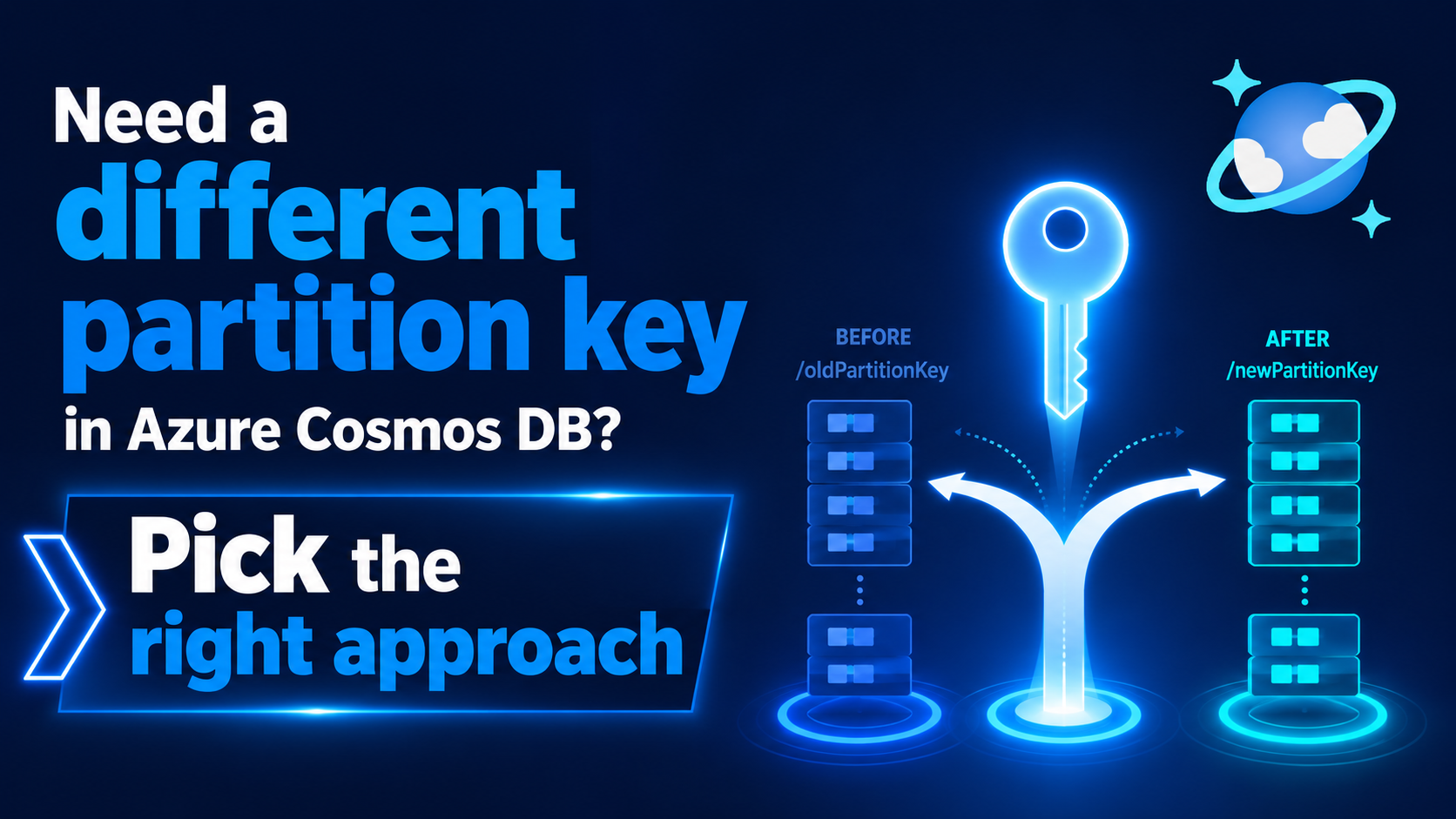
Need a different partition key in Azure Cosmos DB? Pick the right approach

Once you create a container, its partition key is fixed at creation, and you can’t change it in place. However, if your original key starts causing problems like cross-partition queries or hot partitions, you need to consider your options for changing it. This post explains the mechanics of changing a partition key, and the tradeoffs between the options. First, think about the intent of your change: Note that every “change the partition key” option is actually a move: get your data into a new container that has the new key, then point your app at it. The exception is a Global Secondary Index, whic...
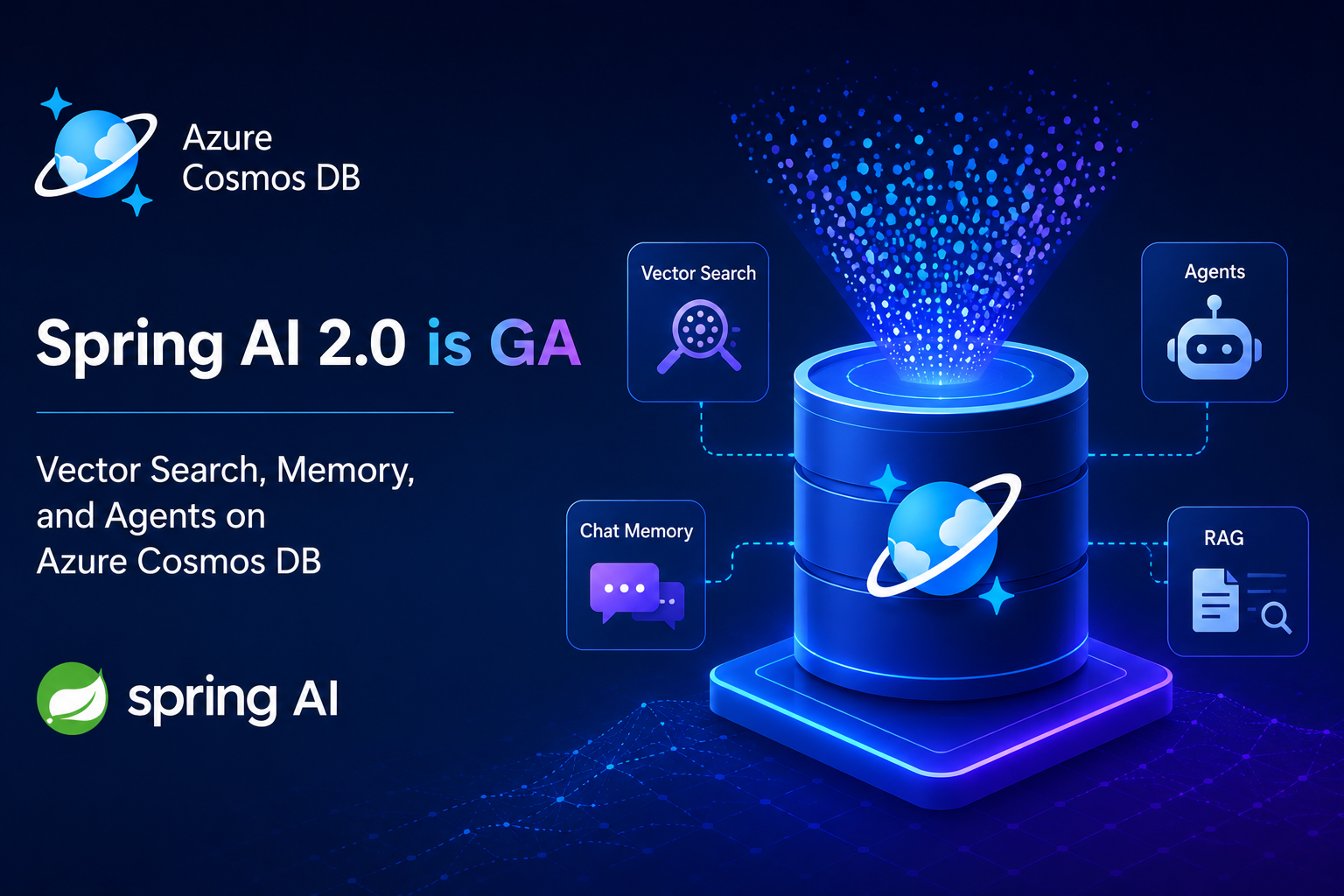
Spring AI 2.0 is GA: Vector Search, Memory, and Agents on Azure Cosmos DB

The wait is over. Spring AI 2.0 is generally available, and Azure Cosmos DB is right there with it. With this release, Spring AI graduates into a mature, production-ready framework for building AI applications in Java, and Azure Cosmos DB ships dedicated, vendor-maintained integrations that plug straight into the Spring AI ecosystem. The Spring AI 2.0 GA announcement names Azure Cosmos DB among its vendor-maintained modules, maintained directly by Microsoft rather than the core Spring AI team. This means the integration is built and supported by the engineers who work on Cosmos DB itself, bringing deep, first-ha...
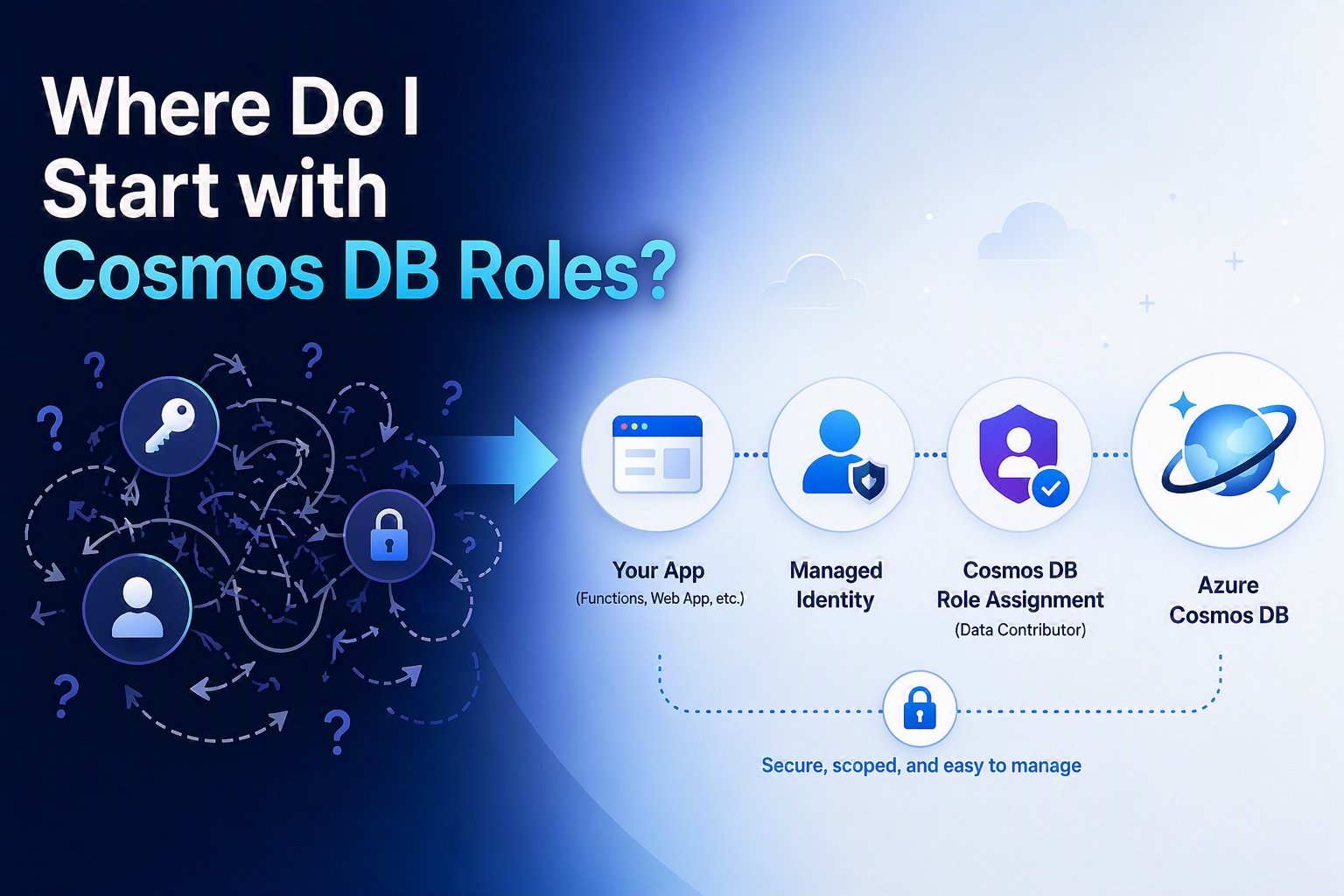
Which Azure Cosmos DB Role Does My App Need?


In the previous post in the series, we covered the security decisions you make on day one. In this part, we will talk about how to give your app access to Cosmos DB data, using roles and a managed identity instead of keys. The situation You’ve built your app. It works locally. Now you’re ready to connect it to Azure Cosmos DB, and you hit the question: how does my app get access? There are really only three questions you need to answer: First, the one distinction that trips everyone up Cosmos DB has two completely separate permission systems. If you remember nothing else from this ...
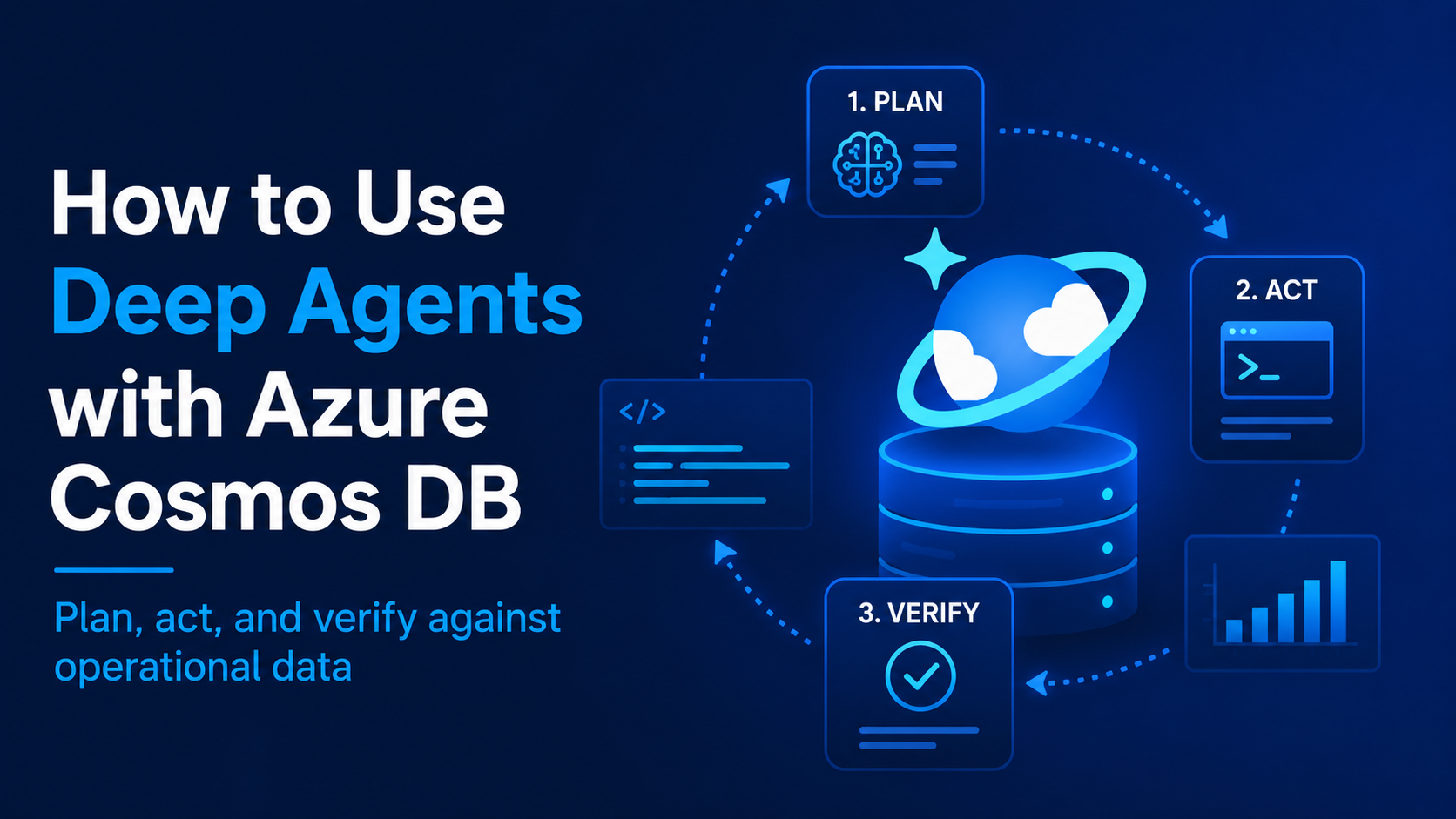
How to Use Deep Agents with Azure Cosmos DB – Plan, act, and verify against operational data
Deep Agents is an agent harness built on LangGraph, for agents that need to work through a task over many steps instead of a single LLM call. The agent runs tools, looks at the results, and uses that to pick the next one, keeping a todo list as it goes. On top of that loop the harness brings what a longer-running agent needs. It can load instructions on demand instead of holding everything in the prompt (skills), offload large tool outputs so they don’t fill the context window, and pause for human approval in apps that need an approval gate before data changes. Support Ops Agent is a sample app that puts this ...
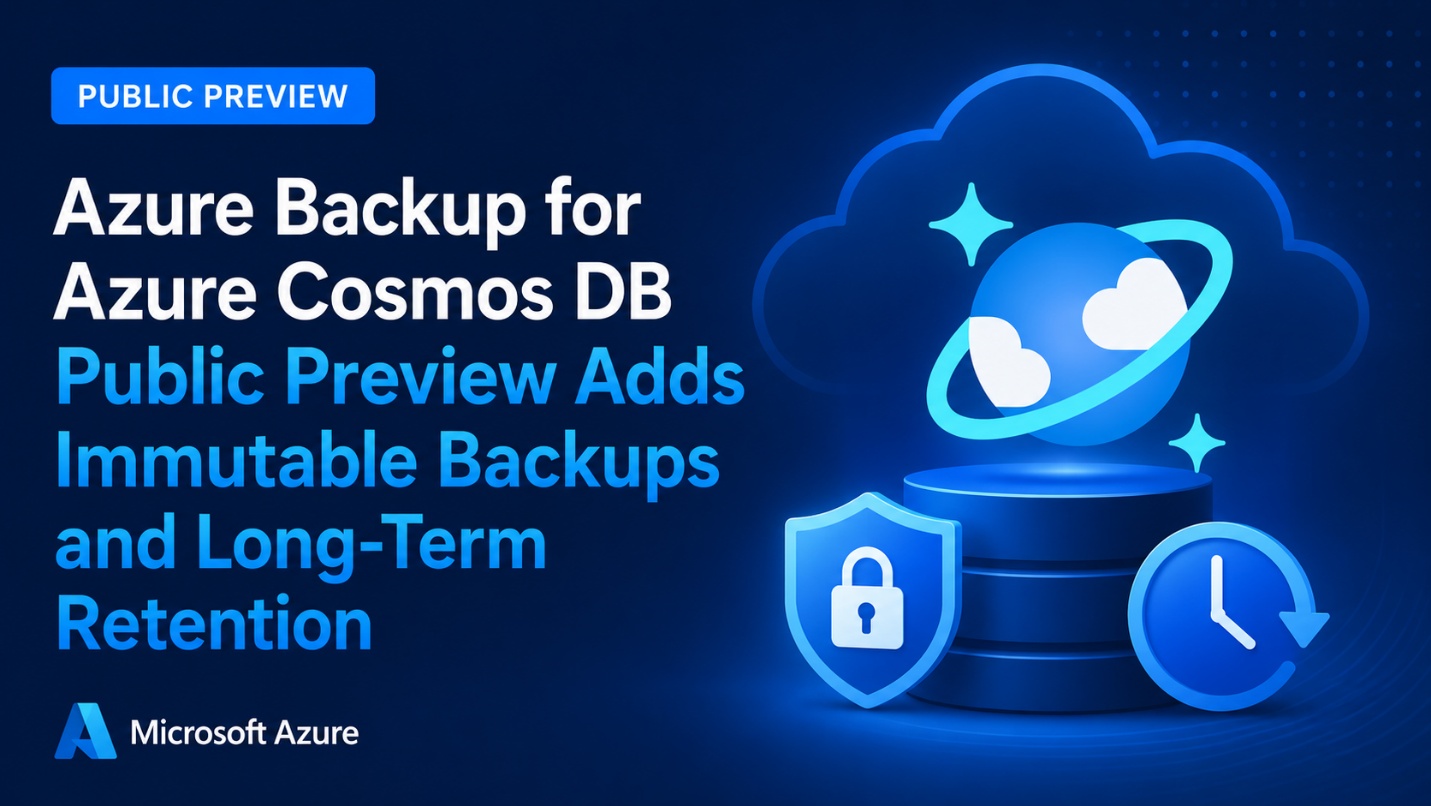
Azure Backup for Azure Cosmos DB Public Preview Adds Immutable Backups and Long-Term Retention


Azure Backup for Azure Cosmos DB Public Preview Adds Immutable Backups and Long-Term Retention Picture the first few hours after a serious data incident. A production application is down. Security teams are still trying to understand what happened. Application owners need to know which recovery points are usable, which ones are protected from tampering, and whether they can restore somewhere outside the environment under investigation. For teams running regulated or business-critical workloads on Azure Cosmos DB, that moment is exactly where backup design stops being a checkbox. It becomes part of opera...
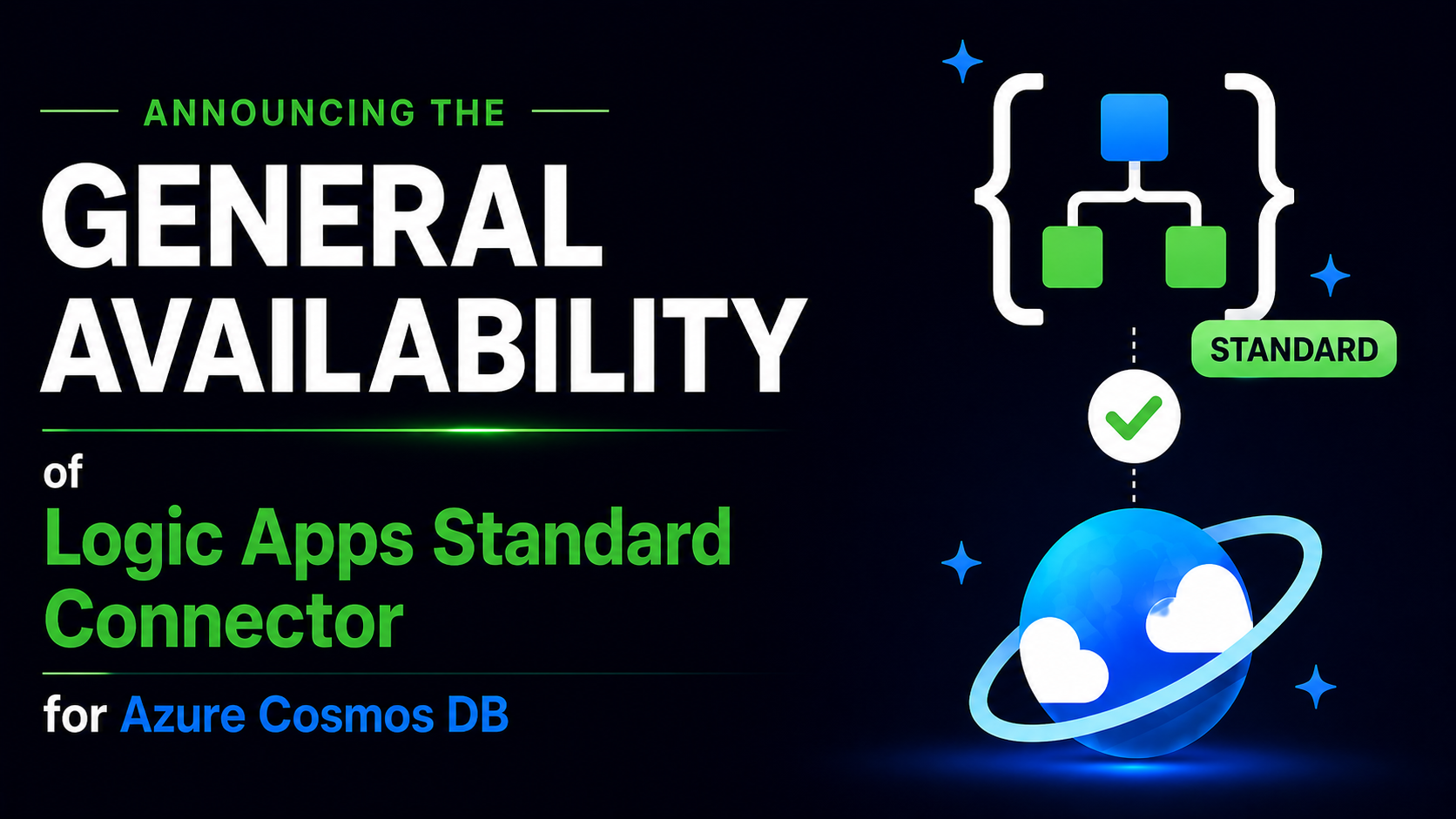
Announcing General Availability of the Azure Cosmos DB Built-in Connector for Logic Apps Standard
Today, we're excited to announce the general availability of the Azure Cosmos DB built-in connector for Azure Logic Apps Standard. This connector gives you a native, high-performance way to integrate Azure Cosmos DB into your Standard logic app workflows, with better throughput, lower latency, and richer functionality than the managed connector. That includes real-time change feed processing, bulk operations, and Microsoft Entra ID authentication. If you've been building integration workflows that read, write, or react to data in Azure Cosmos DB, this GA release means you can do all of that with production-grade...
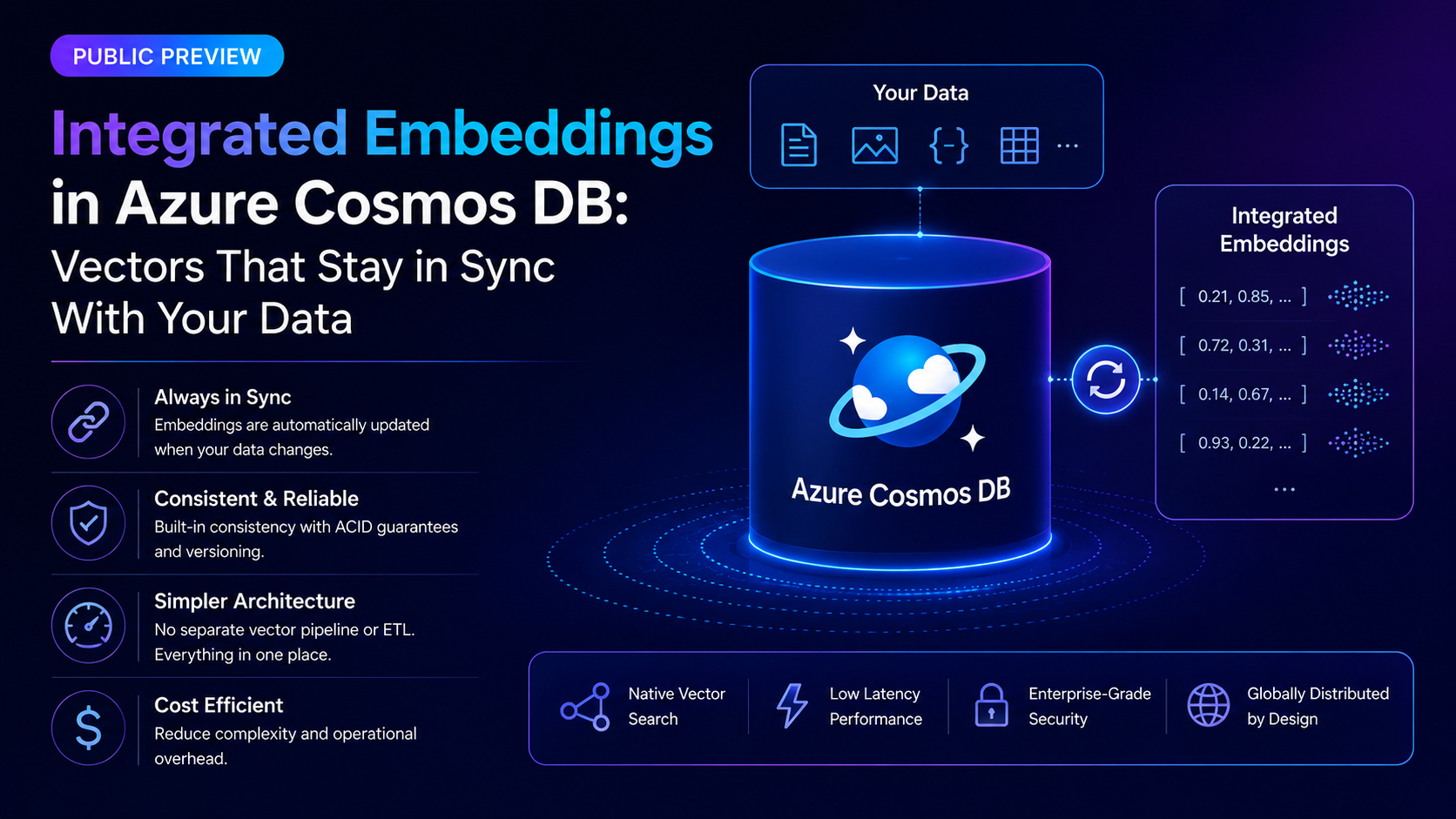
Announcing the Public Preview of Integrated Embeddings in Azure Cosmos DB: Build AI Apps With Embeddings That Stay in Sync
AI applications built on Azure Cosmos DB depend on embeddings for grounded results. Keeping them in sync with your data is the hard part: it means building and operating a separate data pipeline to track changes, call an embedding model, and write the results back to Azure Cosmos DB. In practice, that pipeline also has to handle failures and retries, throttling, scaling, and monitoring as your data and traffic grow. Integrated Embeddings in Azure Cosmos DB, now in Public Preview, removes that heavy lifting. Azure Cosmos DB automatically generates and maintains the embeddings for you as items are written and upda...
Introducing OmniVec: An Open-Source Embedding Platform for AI Apps on Azure
Today we are open-sourcing OmniVec, a platform for building and operating the embedding pipelines that keep the vector representation of your operational data in sync as it changes. You register data sources, embedding model(s), vector stores (destination), and OmniVec does the rest: initial backfill, change tracking, model invocation to geenrate, and writing them back to your vector store. We are shipping this with support for Azure Cosmos DB, PostgreSQL, SQL Server (source and destination), and Azure Blob Storage (destination). You deploy OmniVec in your own Azure subscription, and use the web UI, CLI, or the ...
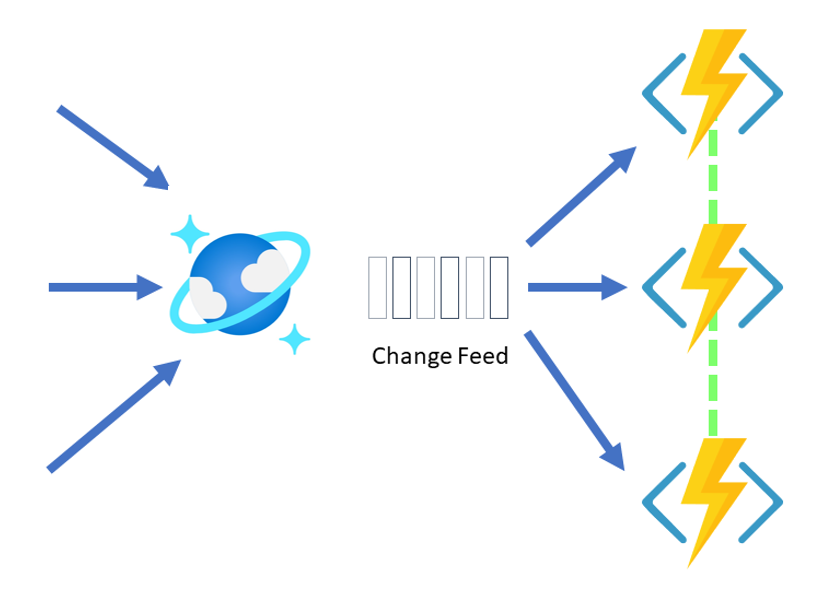
Azure Cosmos DB All Versions and Deletes Change Feed Mode is Now Generally Available

Modern applications don't just write data and move on. They react to it. A new order triggers an inventory update. A profile change syncs to a search index. A deleted record kicks off a compliance workflow. Azure Cosmos DB's change feed makes this possible by giving you a real-time stream of every change happening in your container, and it's one of the most powerful capabilities of the platform. Today, we're excited to announce that all versions and deletes change feed mode is generally available in Azure Cosmos DB for NoSQL! This mode gives you the full picture of what's changing in your data, including deletes ...
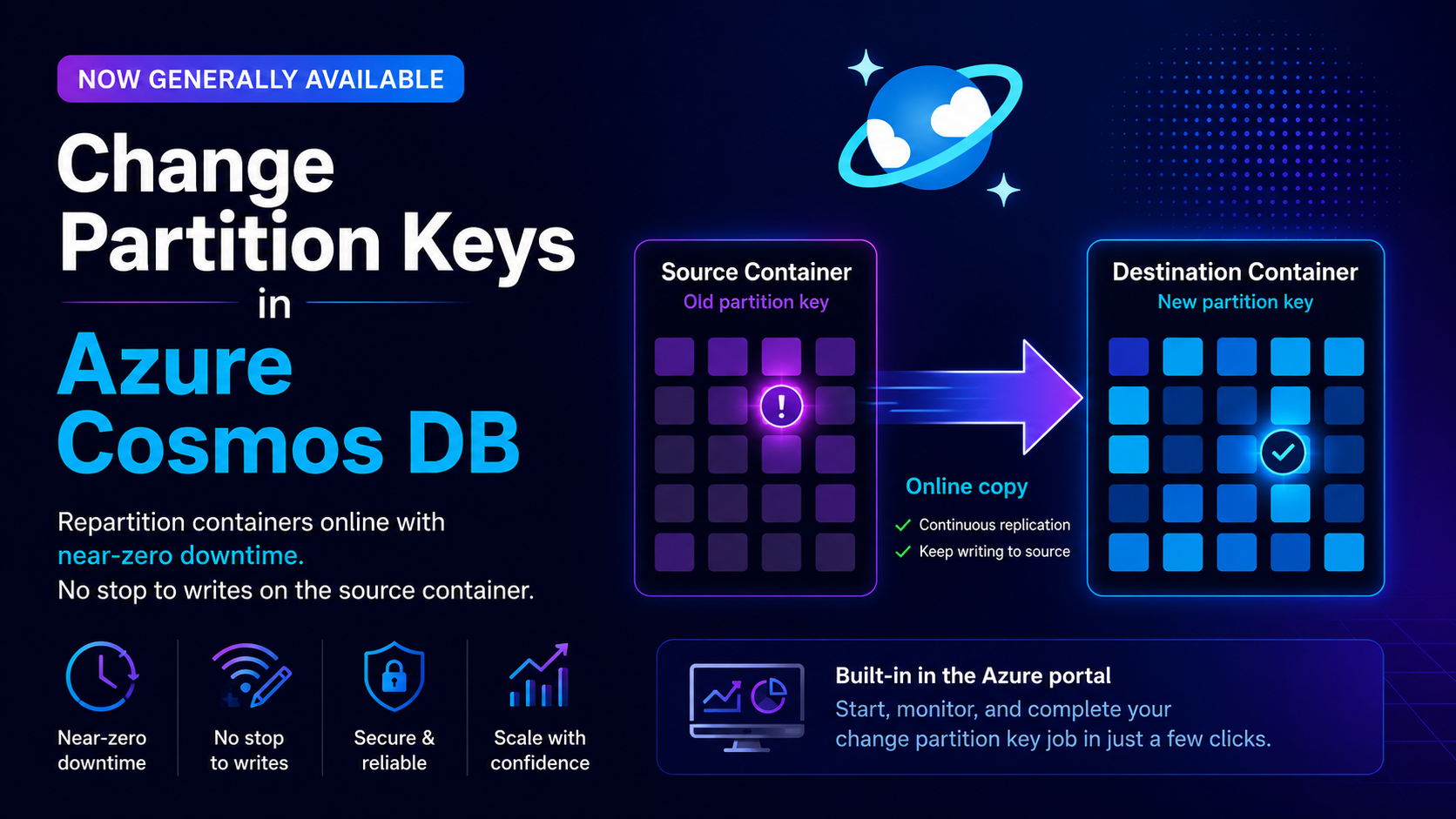
Change Partition Keys in Azure Cosmos DB is Now Generally Available

We're excited to announce the general availability of Change Partition Key in Azure Cosmos DB for NoSQL, now with online copy support. You can repartition containers directly in the Azure portal with near-zero downtime and without stopping writes to the source container. Why Partition Key Choice Matters In Azure Cosmos DB, the partition key is one of the most important design choices you make. It affects how data is distributed across physical partitions, how queries are routed, and how well your application performs at scale. But applications change over time. A partition key that worked well at launch can ...
Public Preview: AI-powered Azure Cosmos DB Migration Assistant for RDBMS to NoSQL


Today, we are excited to announce the public preview of the Azure Cosmos DB Migration Assistant for RDBMS to NoSQL, now available in the Azure Cosmos DB extension for Visual Studio Code. 📈 Modernize with confidence Why migrate from RDBMS to Azure Cosmos DB? Modernizing relational workloads has traditionally been complex, time-consuming, and risky. This new AI-assisted, phase-based workflow replaces manual analysis with structured recommendations and helps you navigate key design choices such as denormalization, partitioning, and NoSQL data modeling. It helps you move from relational databases (SQL Se...
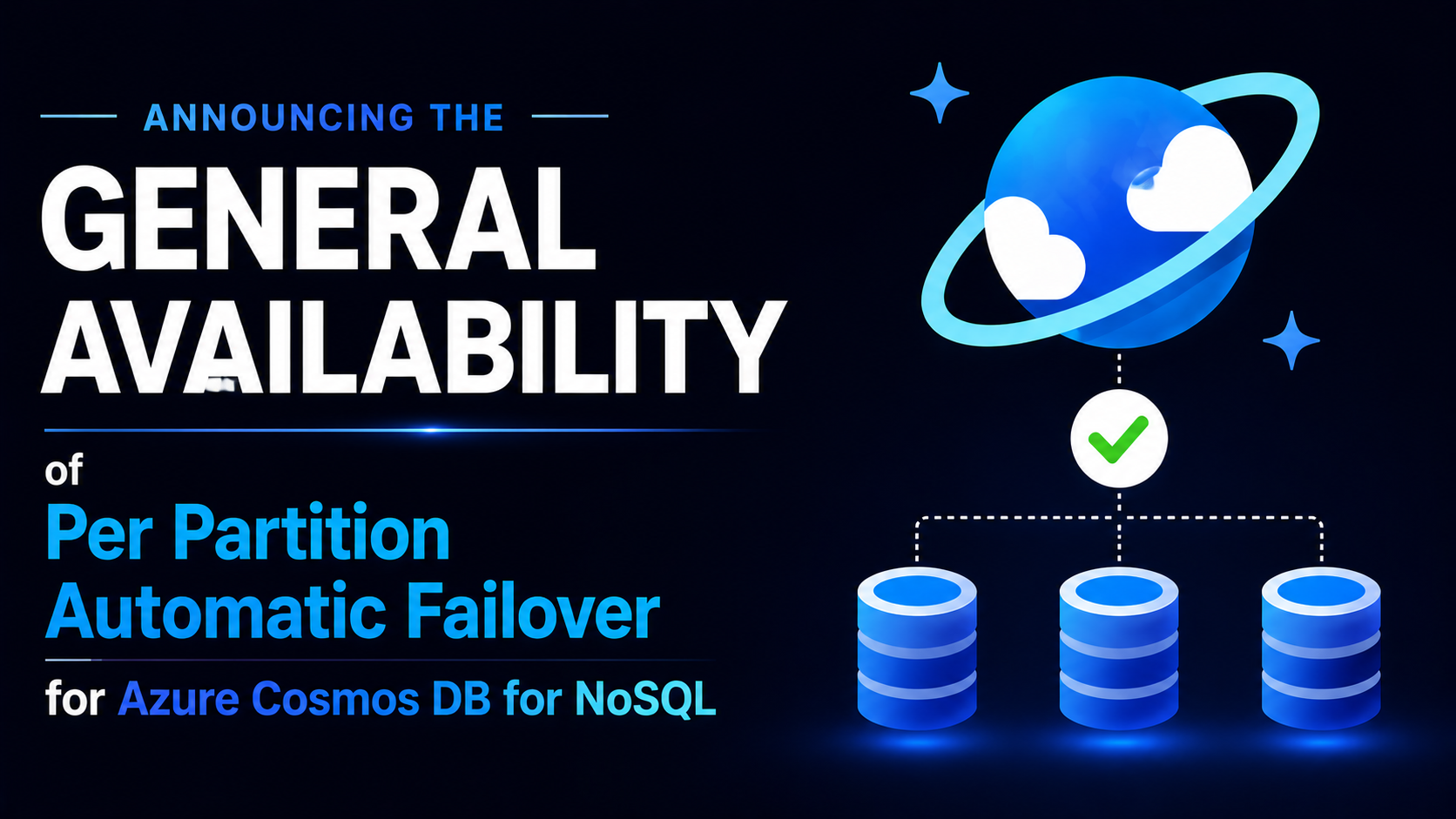
Announcing the General Availability of Per Partition Automatic Failover for Azure Cosmos DB NoSQL

Today, we are excited to announce the General Availability of Per Partition Automatic Failover (PPAF) for Azure Cosmos DB NoSQL API. PPAF is a significant advancement in how Azure Cosmos DB delivers availability and resilience for mission-critical workloads running on single-write-region accounts. If you rely on Azure Cosmos DB to be always on for your mission-critical applications — PPAF is built for you. With PPAF, Azure Cosmos DB can automatically recover affected partitions by failing over writes to a secondary region within 3 minutes at P99, without requiring application changes. A smarter, more granu...
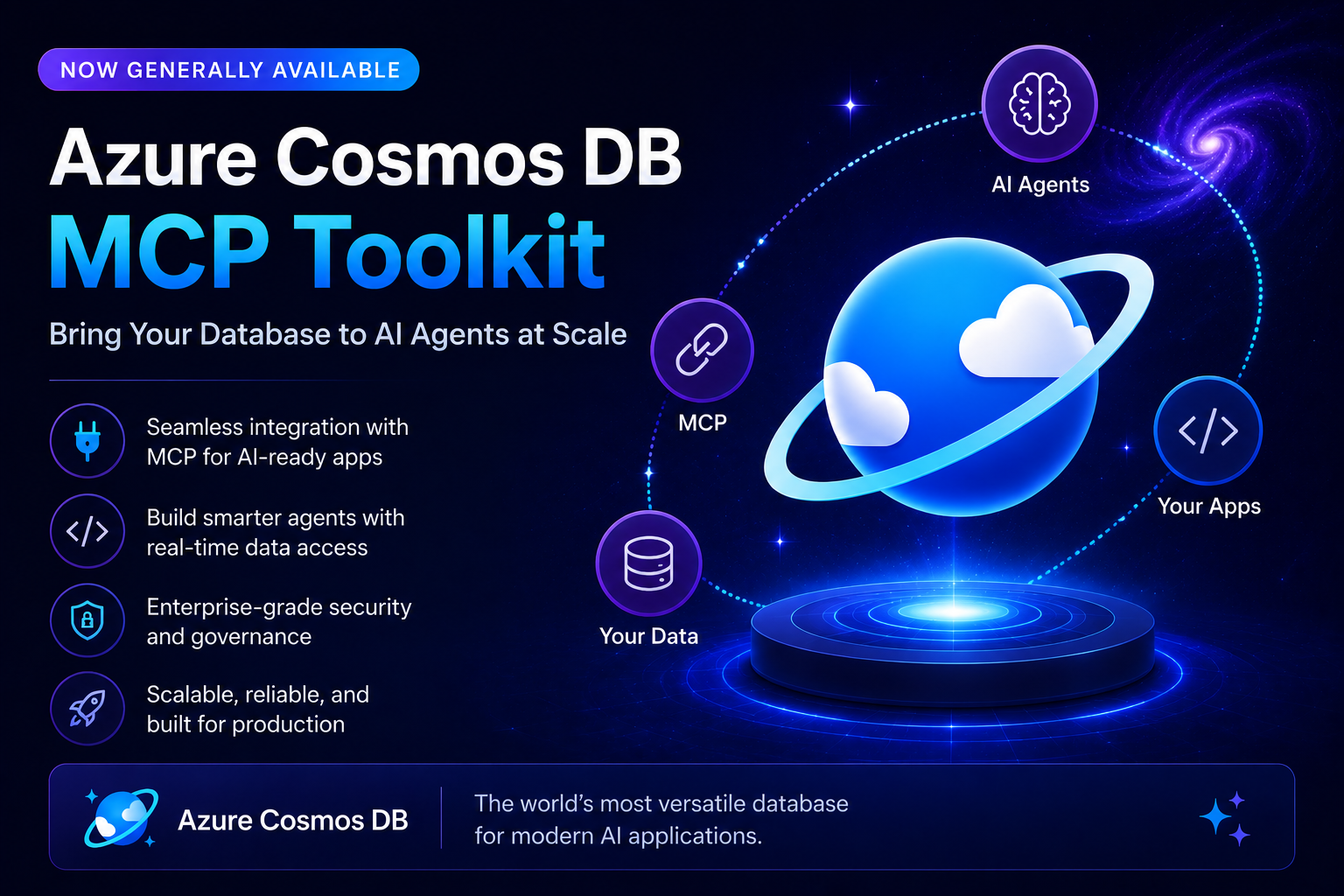
Azure Cosmos DB MCP Toolkit Is Now Generally Available — Bringing Your Database to AI Agents at Scale

Since we introduced the Azure Cosmos DB MCP Toolkit at Ignite 2025 in preview, the response has been clear: developers want a straightforward way to connect AI agents to their production databases. Customers asked for stability, broader embedding provider support, and a smoother path from experimentation to production. Today, we're announcing the general availability of the Azure Cosmos DB MCP Toolkit (v1.1.2), now with deeper Microsoft Foundry integration, multi-provider embedding support, and the reliability improvements you asked for. The Problem: Getting AI Agents to Talk to Your Data Is Harder Than I...
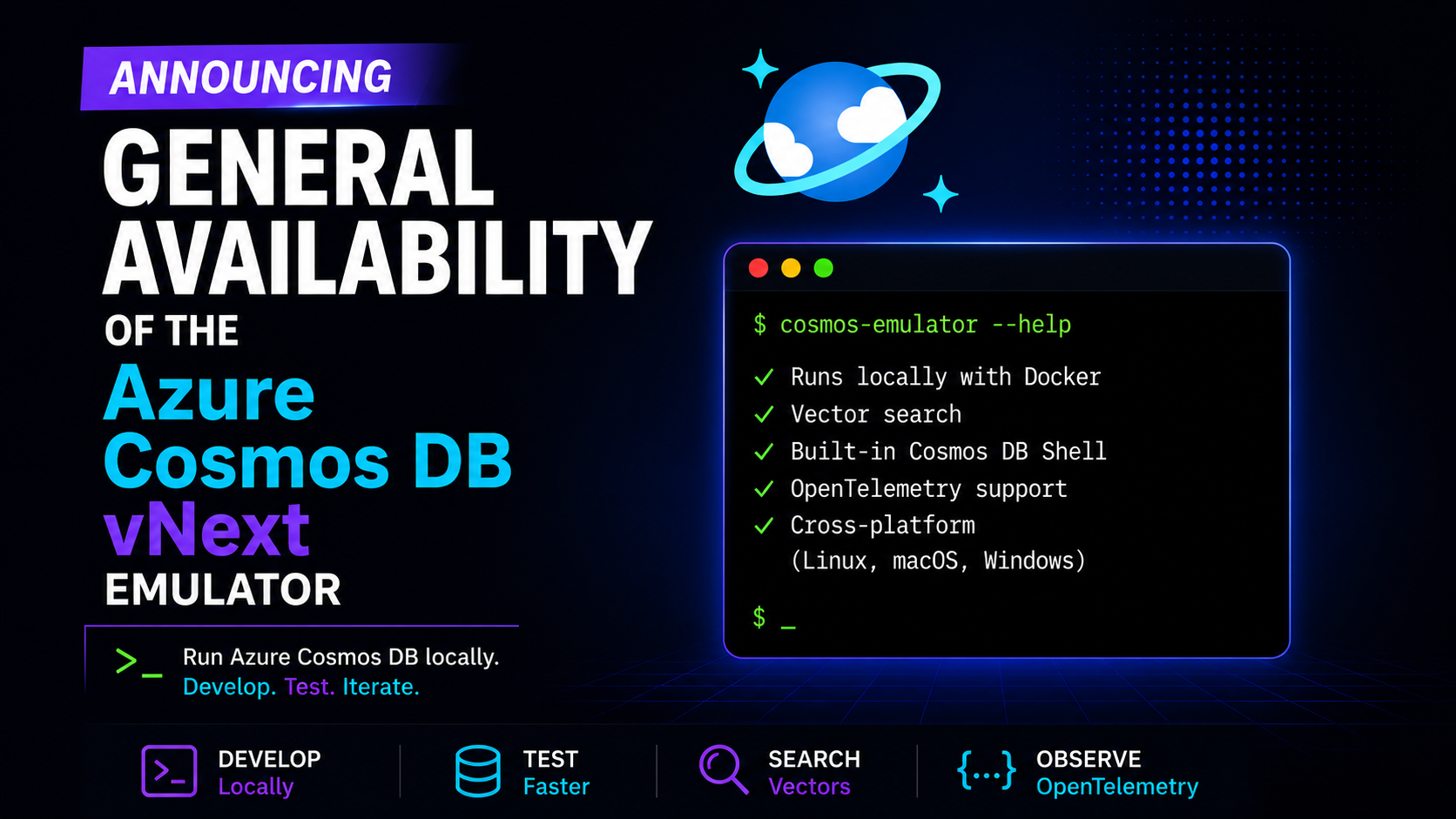
Announcing General availability of the Azure Cosmos DB vNext emulator
The Azure Cosmos DB vNext emulator is generally available today. It ships as a Docker image that runs on Linux, macOS, and Windows, on both x64 and ARM64 architectures, giving you a local Cosmos DB instance you can develop and test against. Use it for inner-loop development on your laptop, in CI integration tests, and anywhere else you’d rather not use a live account. You can get started right away with a couple of simple commands: A lot has shipped since the preview announcement: broader feature and API coverage, an embedded shell, vector search, and OpenTelemetry support. The rest of this post walks throu...
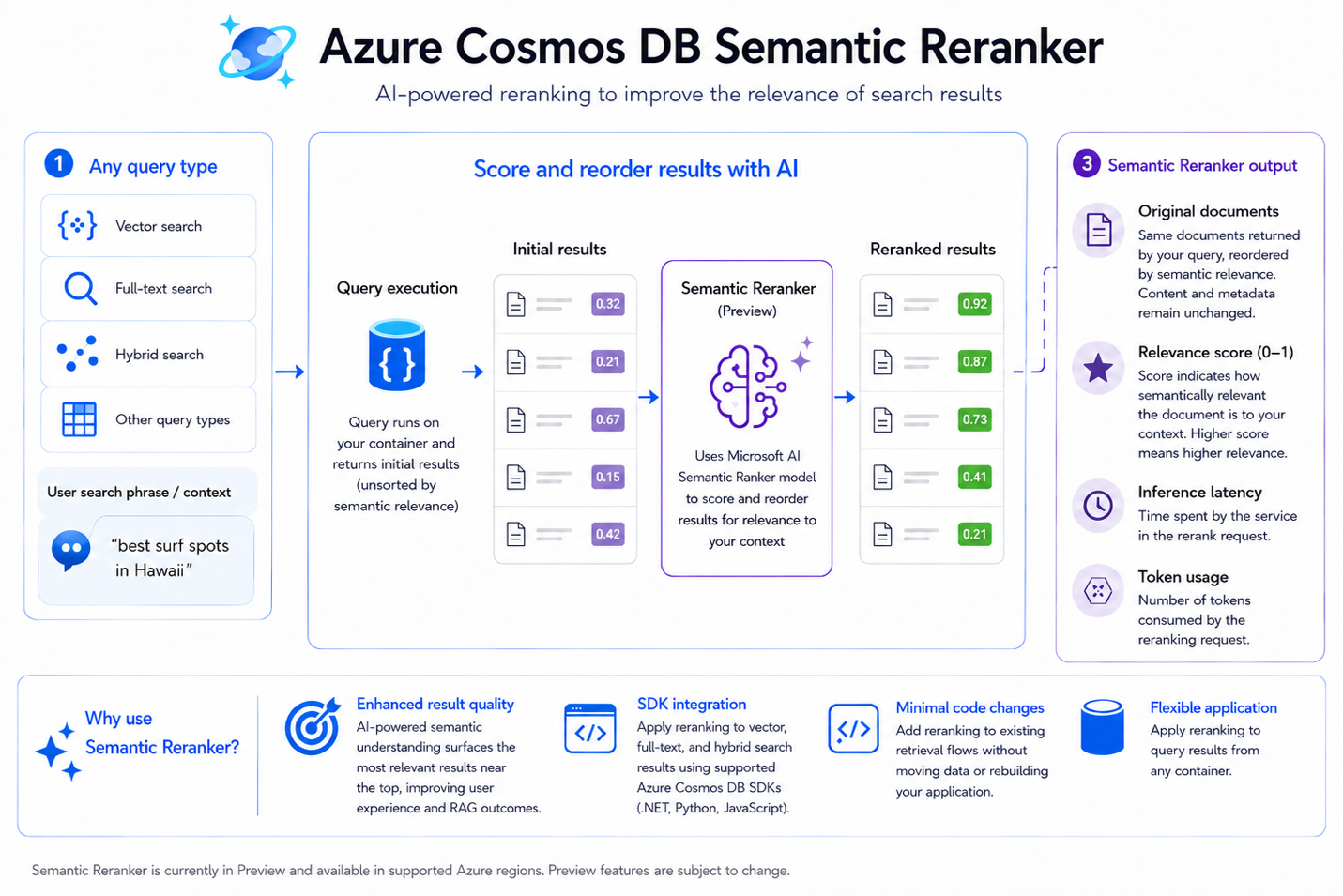
Announcing the Public Preview of Semantic Reranker in Azure Cosmos DB for NoSQL

Today we’re thrilled to announce the public preview of Semantic Reranker in Azure Cosmos DB for NoSQL, a new AI-powered capability that improves the relevancy of your search results with just a few lines of code. If you’ve ever run a vector, full-text, or hybrid search and wished the most relevant documents bubbled to the very top, this one’s for you. Semantic Reranker uses an AI model to score and reorder the results of any query based on how well each document matches the user’s intent. It’s built right into the Azure Cosmos DB SDKs (Python, .NET, and Java), so you can reorder results from any container with...
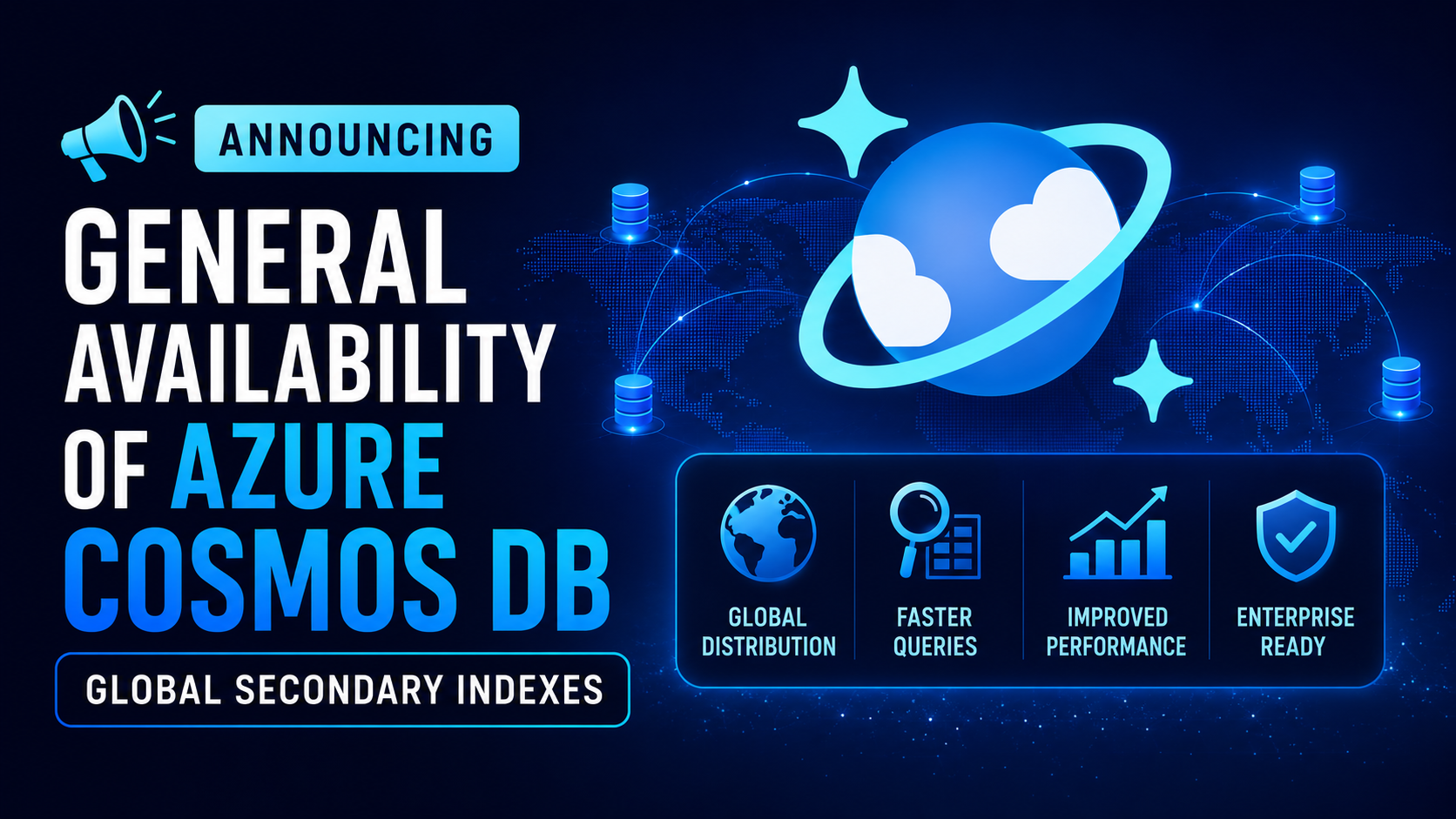
Announcing General Availability of Azure Cosmos DB Global Secondary Indexes
Have you ever needed to evolve your read patterns without losing efficiency? Maybe your app started with one access pattern, but now you need three, and the queries that don't hit your partition key are getting slower and more expensive every month. We built global secondary indexes (GSIs) for exactly this, and today we're thrilled to announce they're generally available in Azure Cosmos DB! A GSI is an automatically synced copy of your data with a different partition key, so you can query it efficiently for more read patterns. The problem GSI solves Azure Cosmos DB scales by distributing data across physical ...
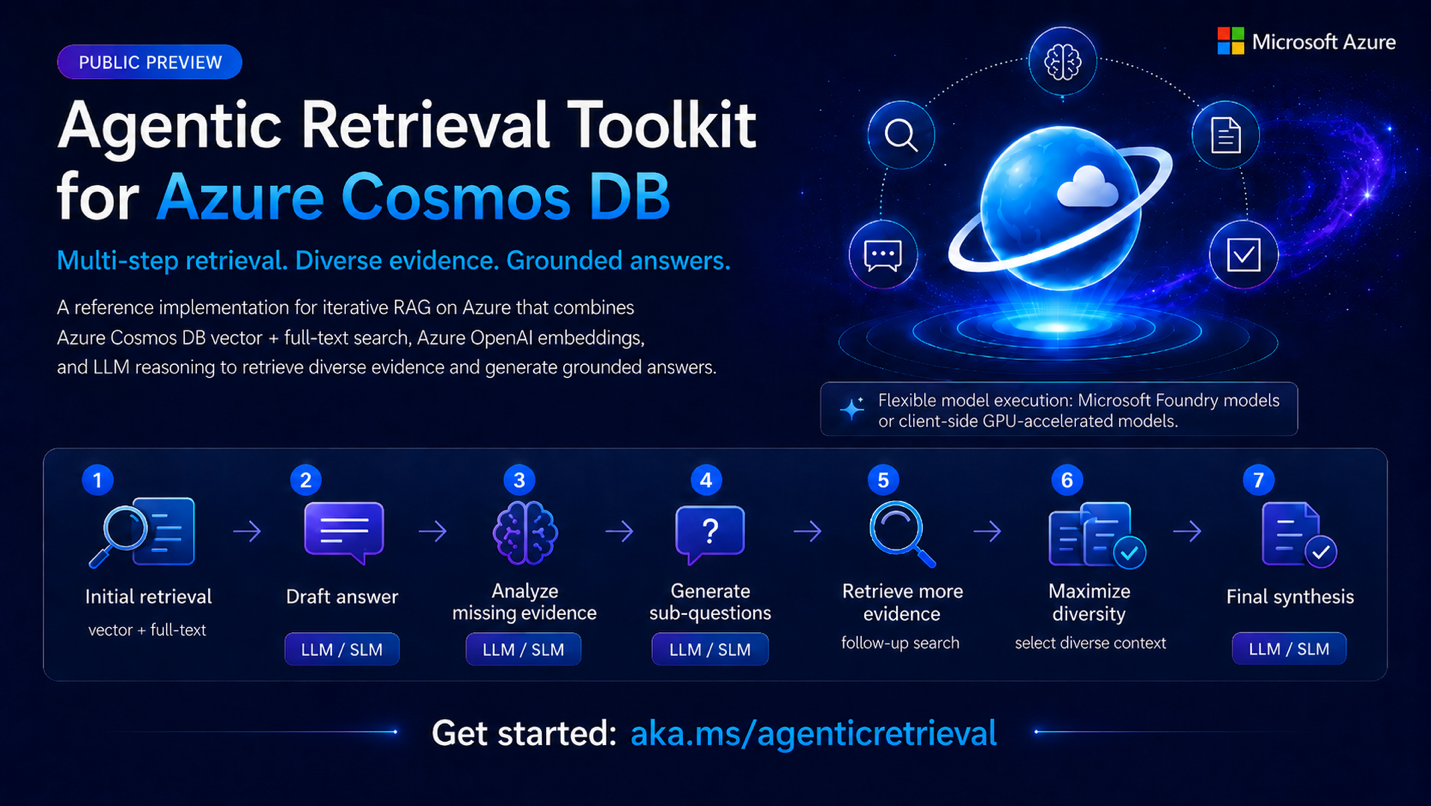
New Toolkits for Agent Memories and Agentic Retrieval in Azure Cosmos DB
Today we’re thrilled to announce the public preview of two new toolkits for Azure Cosmos DB: the Agent Memory Toolkit and the Agentic Retrieval Toolkit. If you’re building AI agents and retrieval-augmented generation (RAG) apps, these toolkits are designed to take you from prototype to production faster, giving your agents durable memory and your RAG pipelines the ability to reason over evidence in multiple passes, all backed by the database you already know and love. Both toolkits build on the same foundation: Azure Cosmos DB for NoSQL as a unified store for documents, vectors, and full-text data, with vector...
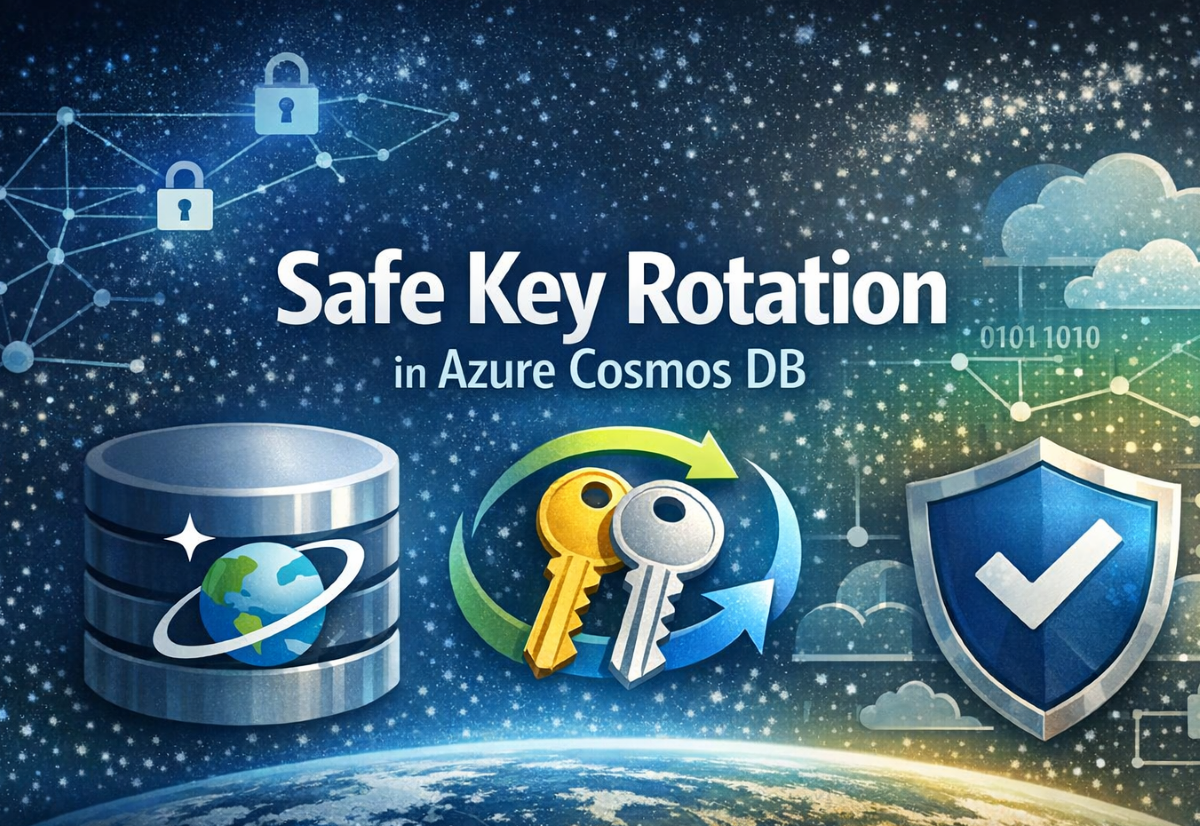
Announcing Public Preview of Safe Key Rotation in Azure Cosmos DB
In our previous post, we introduced the private preview of Safe Key Rotation, a feature that helps Azure Cosmos DB customers avoid service disruptions during key rotations. By showing when each account key was last used, it helps teams make informed decisions before rotating keys or moving to Entra ID. This capability addresses a common challenge: keys that appear unused may still support critical applications, which can lead to unexpected outages if they are rotated too soon. What is new? With public preview, we are expanding this capability to give you even more control and confidence when managing you...
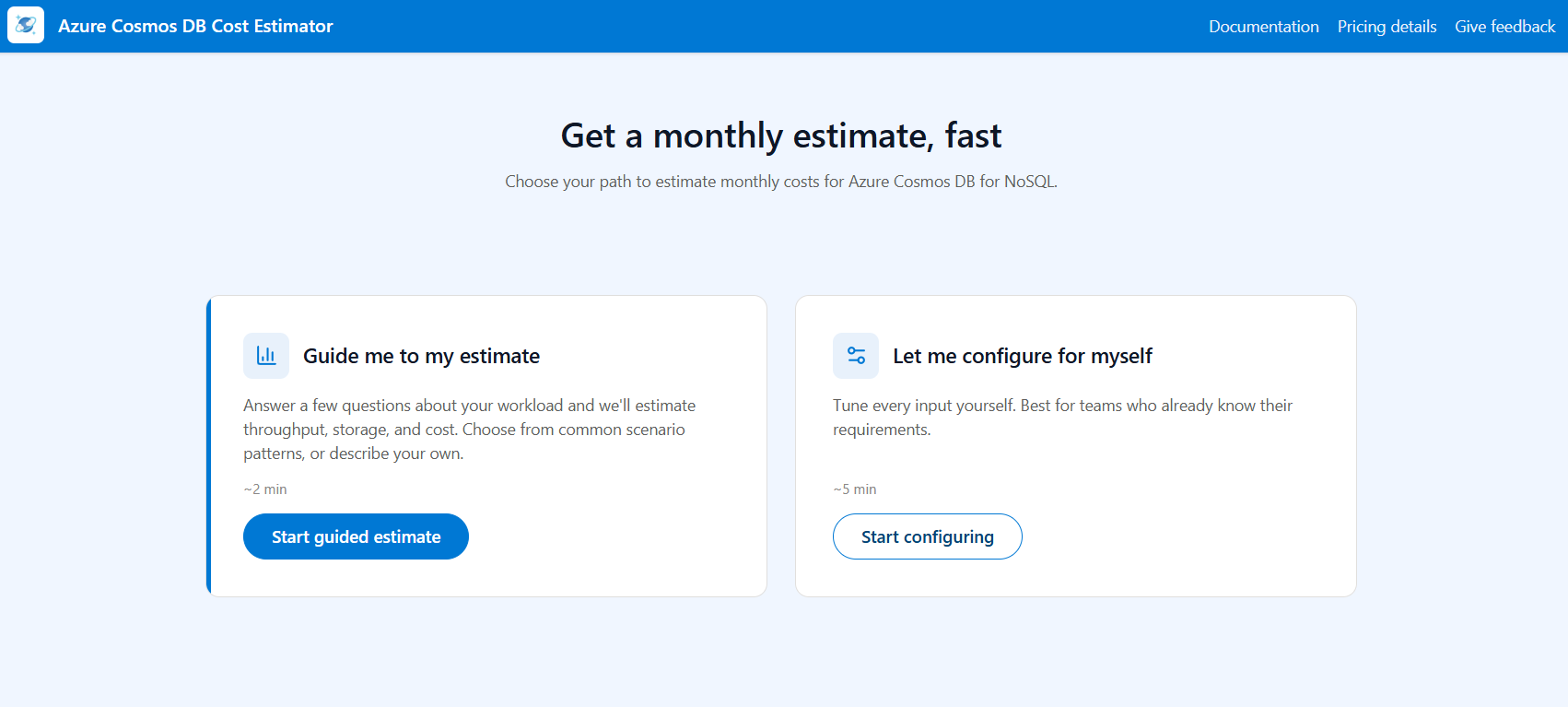
Announcing the Public Preview of the Azure Cosmos DB Cost Estimator for NoSQL

Today, we're thrilled to announce the public preview of the Azure Cosmos DB Cost Estimator, a new sizing and pricing experience that takes developers from a blank page to a defensible monthly cost estimate in minutes. Sizing an Azure Cosmos DB workload has always been one of the first questions a team has to answer, and historically one of the hardest. Every one of those decisions changes the number, and most teams need that number before they've written a single line of code. AI workloads have made this harder, not easier. RAG pipelines, AI chat sessions, vector embeddi...
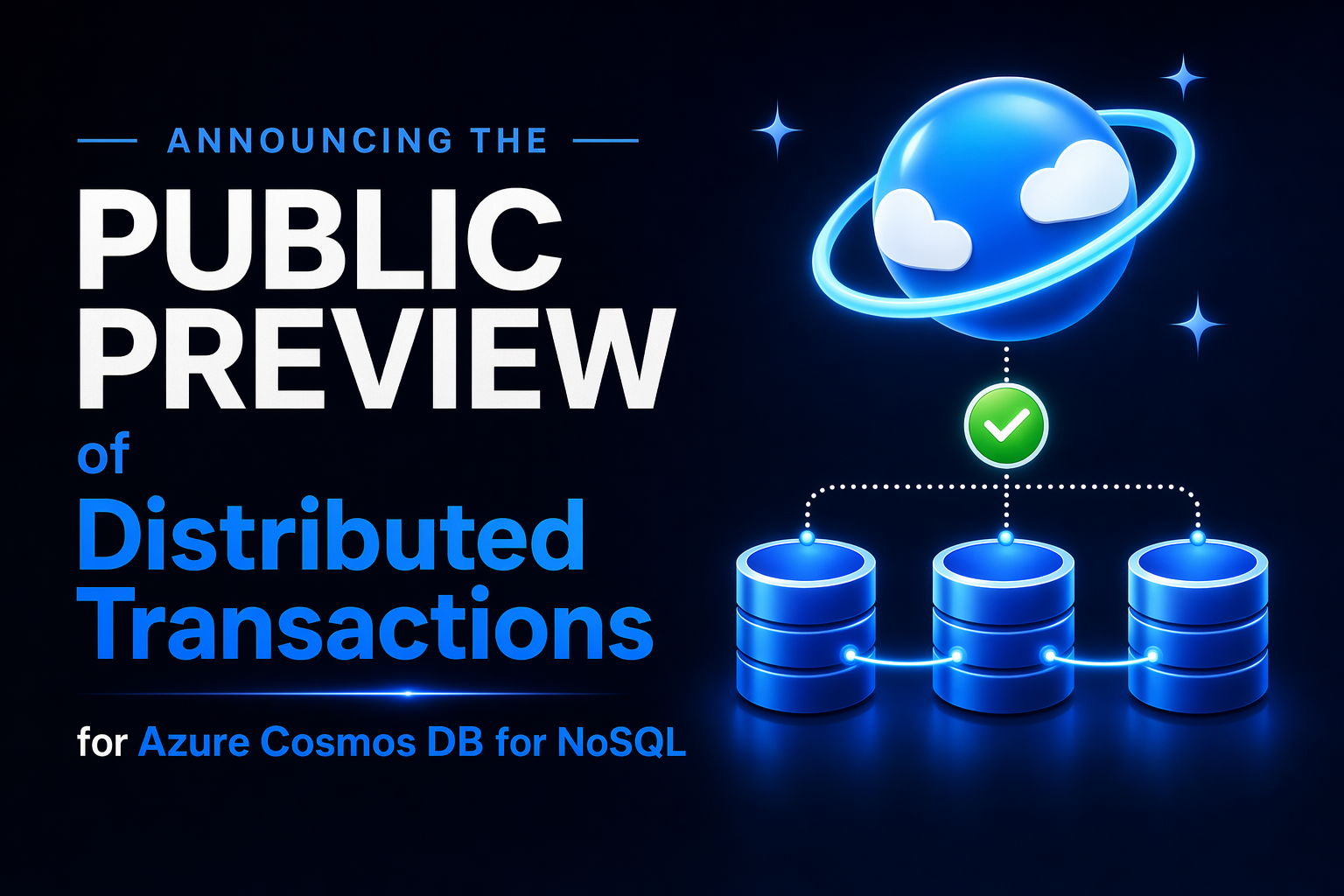
Announcing Public Preview of Distributed Transactions in Azure Cosmos DB for NoSQL
In modern cloud-native applications, correctness is often hardest to maintain at the exact moment a workflow crosses boundaries. A checkout flow writes an order in one place; decrements inventory in another and emits an audit event somewhere else. A money movement workflow debits one account, credits another, and records the transfer for compliance. An AI workflow updates state across multiple services while coordinating retries, handoffs, and downstream actions. Each step is individually straightforward. Keeping the entire workflow correct under partial failures, concurrent updates, retries, and regional events ...
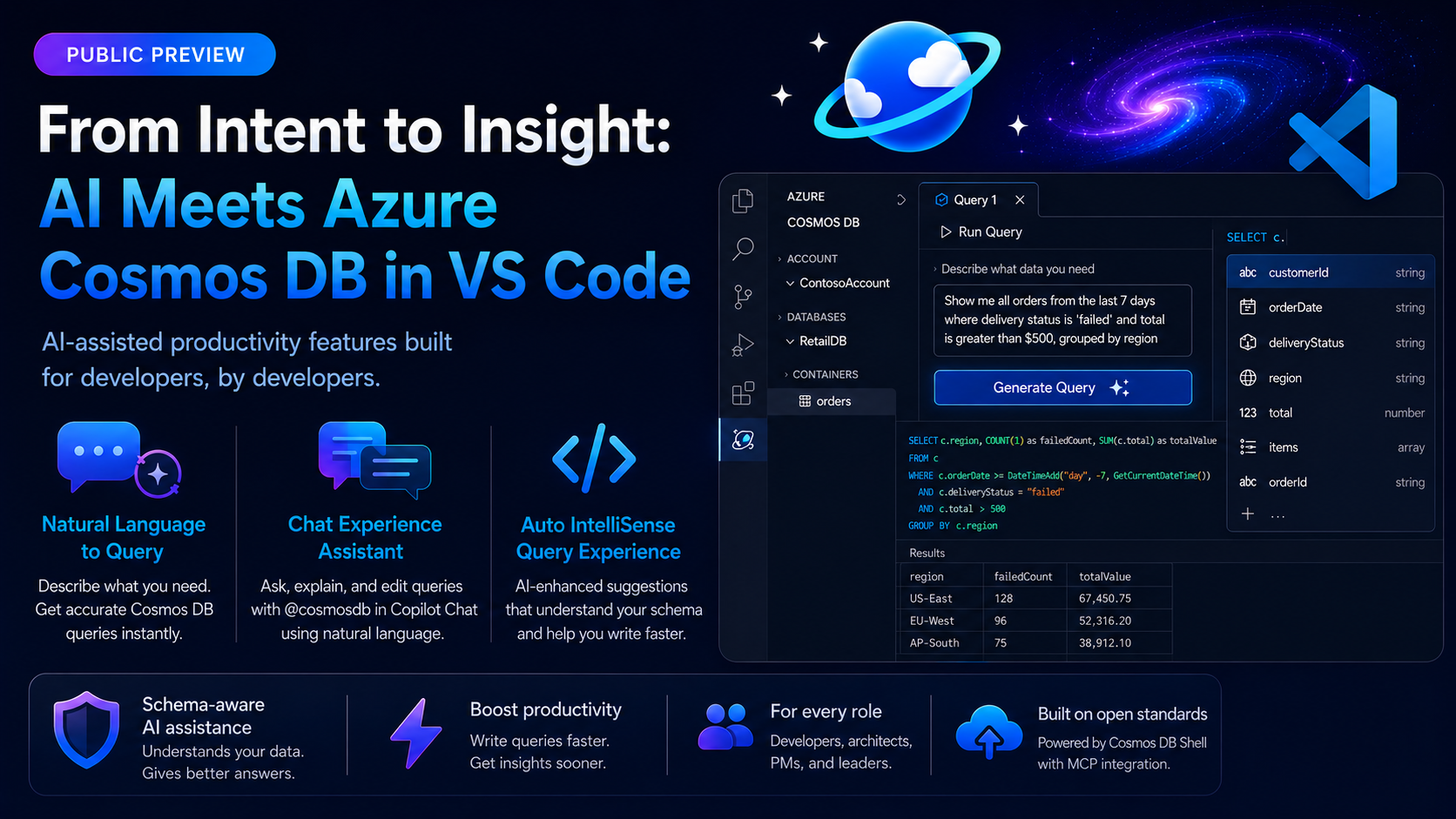
From Intent to Insight: AI Meets Azure Cosmos DB in VS Code (Public Preview)
The Problem Every Developer Knows Too Well You're building a feature. You know exactly what data you need all orders from the last week over $500, grouped by region. The logic is clear in your head. But between you and that data sits a query language, a documentation tab (or three), and fifteen minutes of trial and error before you get the syntax right. Now multiply that across a team. New developers ramping up on Cosmos DB spend days learning query patterns. Senior developers’ context-switch between writing application logic and debugging queries. Product managers wait for data answers that a developer mus...
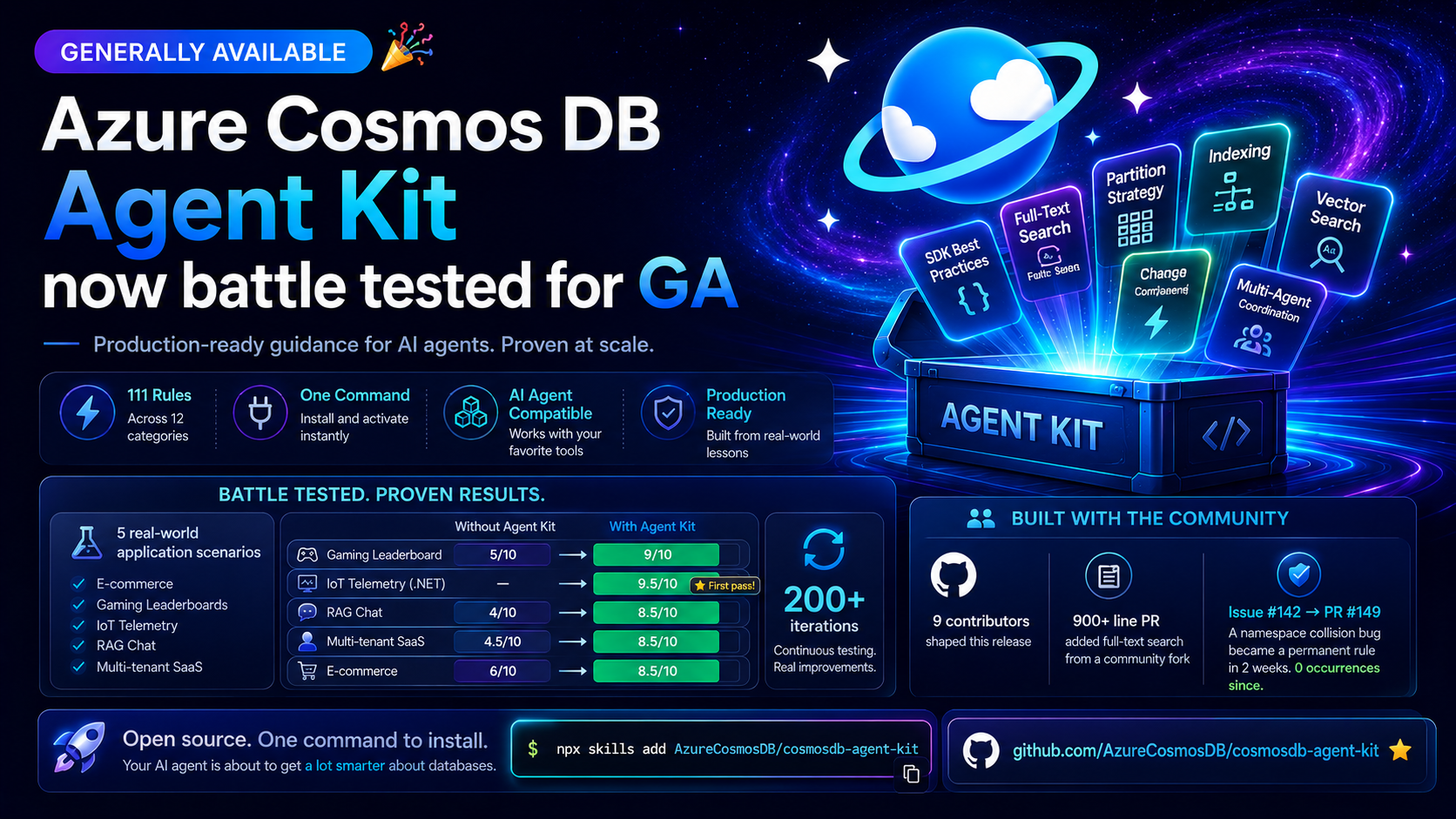
Azure Cosmos DB Agent Kit now battle tested for GA
Back in January, we shipped the Azure Cosmos DB Agent kit in preview with 45 rules and a hypothesis: if we package Azure Cosmos DB expertise into a format that AI coding agents understand, developers will stop making the same expensive mistakes. That hypothesis held up. What surprised us was how much the rules themselves needed to evolve once we started systematically testing them. Today the Agent Kit is generally available . It now contains 120+ rules across 12 categories. But the number that matters more: we've run over 200 automated test iterations where AI agents build real applications from scratch using ...

Announced at MS Build 2026: Azure Cosmos DB MCP Toolkit, Semantic Reranking, Global Secondary Indexes, and more!

Microsoft Build 2026 has officially started and we’re excited to announce new capabilities for Azure Cosmos DB! We’ve launched new features to help developers build AI-powered applications and agents more easily, improve application resilience, and accelerate developer productivity. These announcements span every stage of the development lifecycle, from local development with the Azure Cosmos DB Linux Emulator, to advanced retrieval and agent memory capabilities for AI applications, to enterprise-grade operational features such as Global Secondary Indexes, Per-Partition Automatic Failover, Distributed Transact...
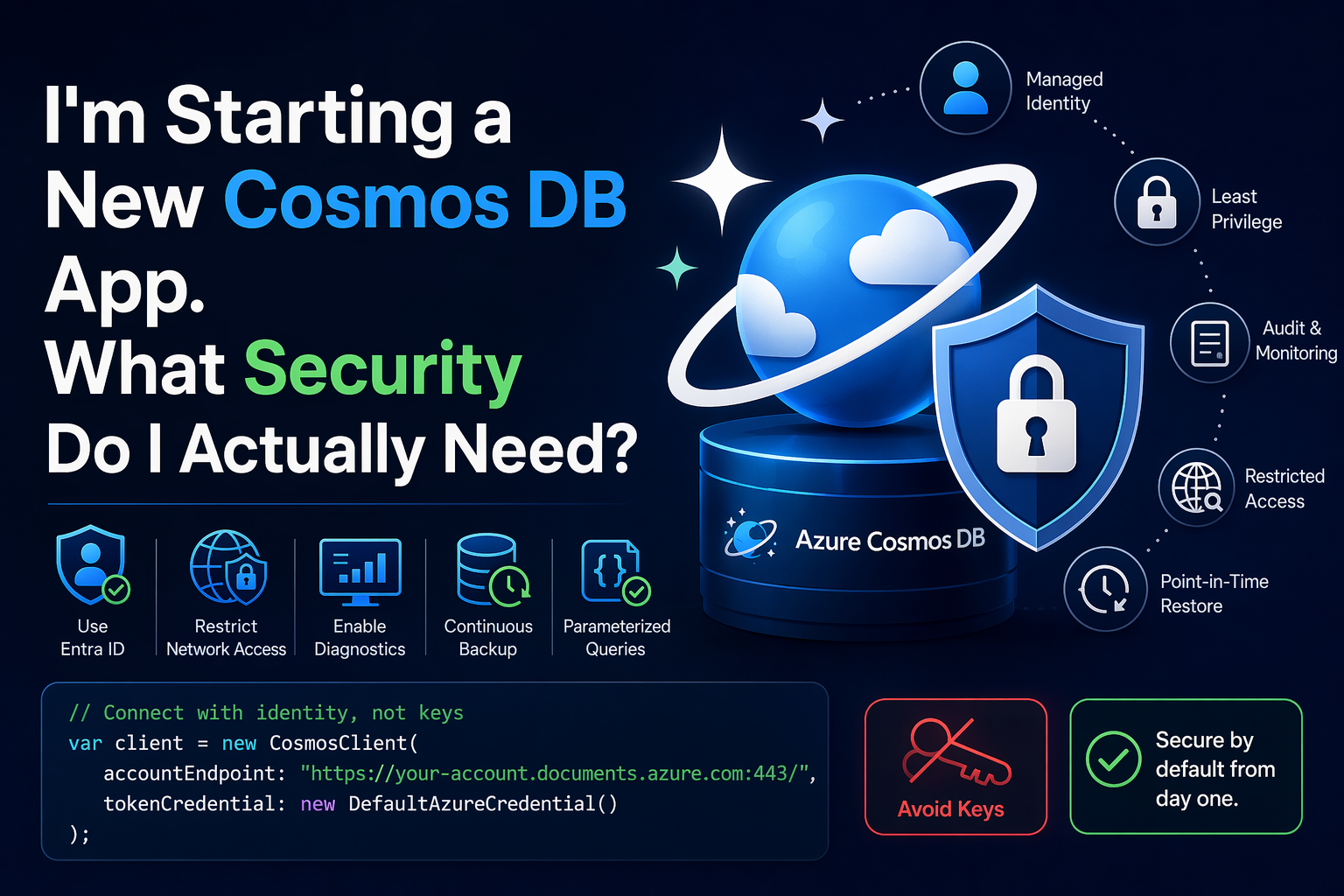
I’m Starting a New Cosmos DB App. What Security Do I Actually Need?
You just created a Cosmos DB account. The portal handed you two keys and a connection string, it worked, and you moved on. That's what most developers do, and it causes problems later. This post is a guide for developers launching a new Cosmos DB app who want a secure default setup without enterprise-grade complexity. It focuses on the decisions that matter on day one. The honest two-minute threat model Before diving into setup, it is worth noting what actually goes wrong in real apps. Most security issues in any workload are not advanced attacks. There are simple mistakes that create unnecessary risk...
Scalable AI with Azure Cosmos DB: Bringing Generative AI to Enterprise Scale with Super Insight by AVASOFT

Azure Cosmos DB enables scalable AI-driven document processing, addressing one of the biggest barriers to operational scale in today’s enterprise AI landscape. Organizations continue to manage massive volumes of structured and unstructured content—contracts, regulatory filings, operational records, images, and field documentation—yet many workflows remain fragmented, manual, and slow. Every month, the Scalable AI in Action with Azure Cosmos DB series brings the community together with Microsoft partners who are building real, production AI systems — not slides, not demos built for the occasion, but live walkth...
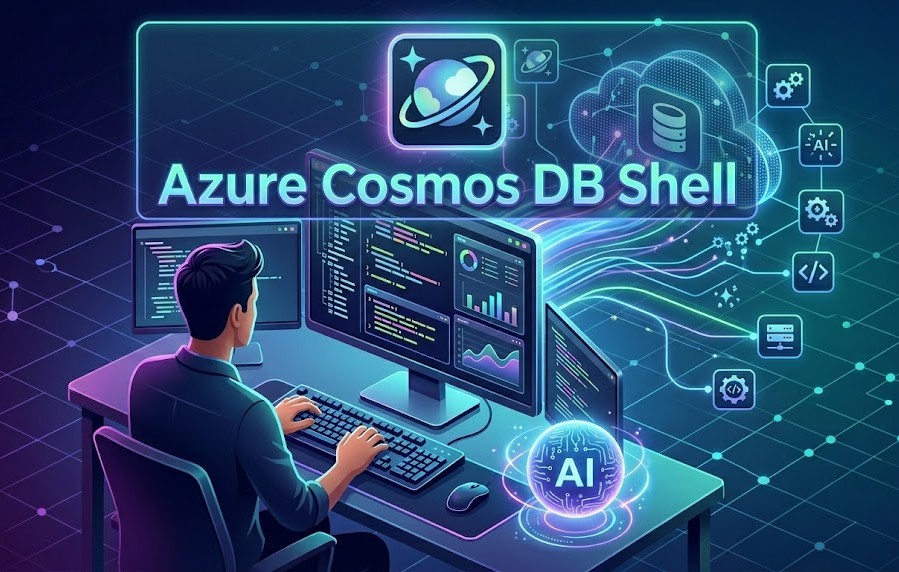
Announcing the Public Preview of Azure Cosmos DB Shell: Open-Source Power Meets AI-Driven Database Automation
Today, we're thrilled to announce the public preview of Azure Cosmos DB Shell – a powerful, open-source command-line interface that revolutionizes how developers interact with their Azure Cosmos DB databases. With integrated Model Context Protocol (MCP) server support, native agentic capabilities, and bash-like syntax, Azure Cosmos DB Shell transforms database management into an intelligent, developer-friendly experience. From Friction to Flow: Why Cosmos DB Shell, and Why Open Source If you have ever bounced between a portal tab, an SDK sample, and a half-finished script just to answer one database quest...
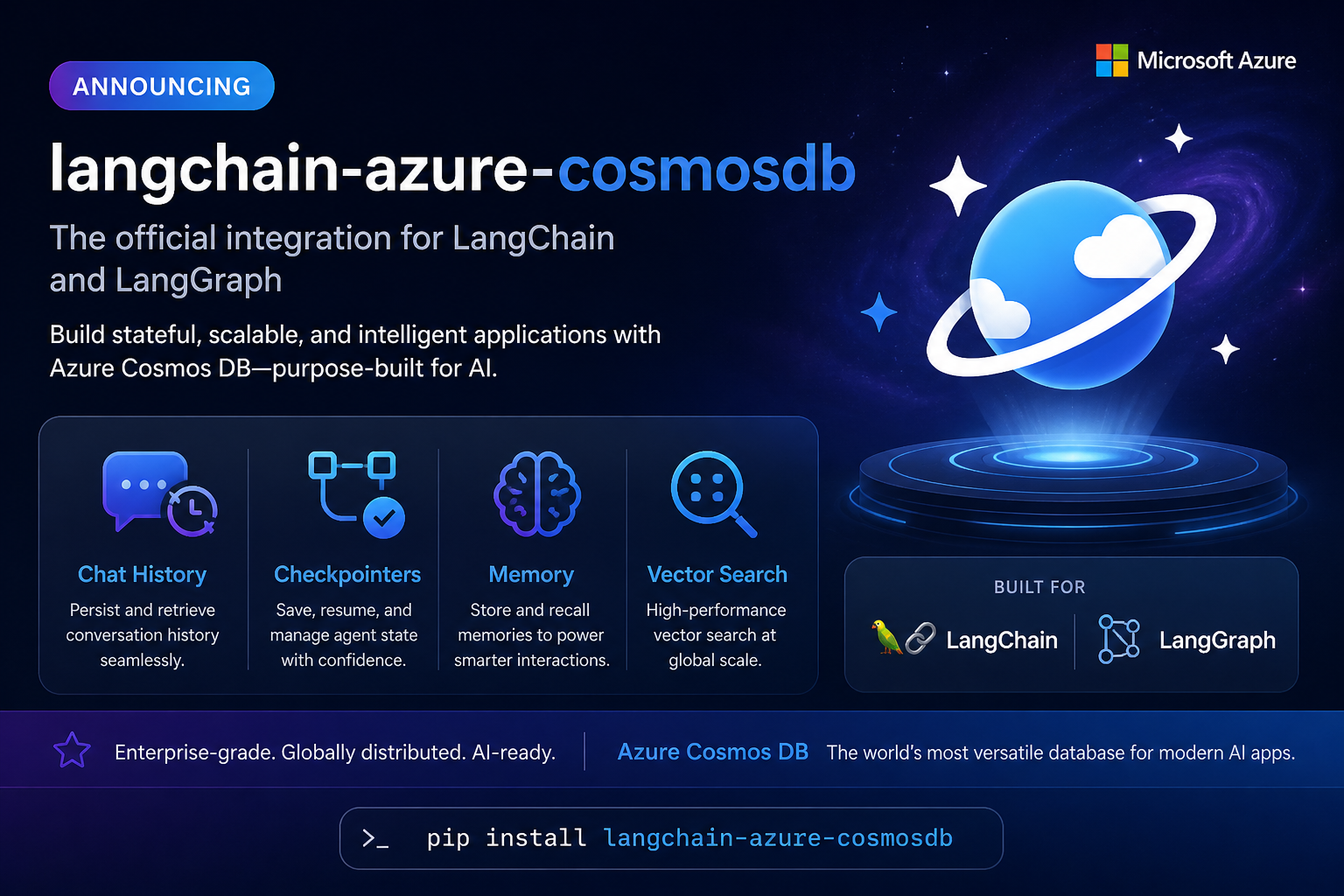
Introducing langchain-azure-cosmosdb: Build Agentic Apps and RAG with One Database

Build AI Agents and RAG Applications with the New LangChain + LangGraph Connector for Azure Cosmos DB Building AI agents and RAG applications today means stitching together half a dozen services, a vector database, a chat history store, a checkpointer for agent state, a semantic cache, a long-term memory layer. Each adds operational overhead, latency, and technical debt. langchain-azure-cosmosdb collapses that stack. It's a Python LangChain and LangGraph connector that turns Azure Cosmos DB for NoSQL into the single persistence layer for all of your agentic app scenarios. Azure Cosmos DB for NoSQL natively...
Announcing the Private Preview of Cosmos DB Azure RBAC Integration
Introduction Managing access to Azure resources often means dealing with two separate permission models: one for management operations and another for data access. For Azure Cosmos DB customers, this split can increase complexity, slow down onboarding, and create confusion around governance and security boundaries. Today, we’re excited to announce the private preview of Integrated Azure RBAC for Cosmos DB, a major step toward a unified, intuitive permissions experience across Azure. This new capability brings Cosmos DB data plane authorization directly into Azure RBAC, allowing customers to manage both manage...
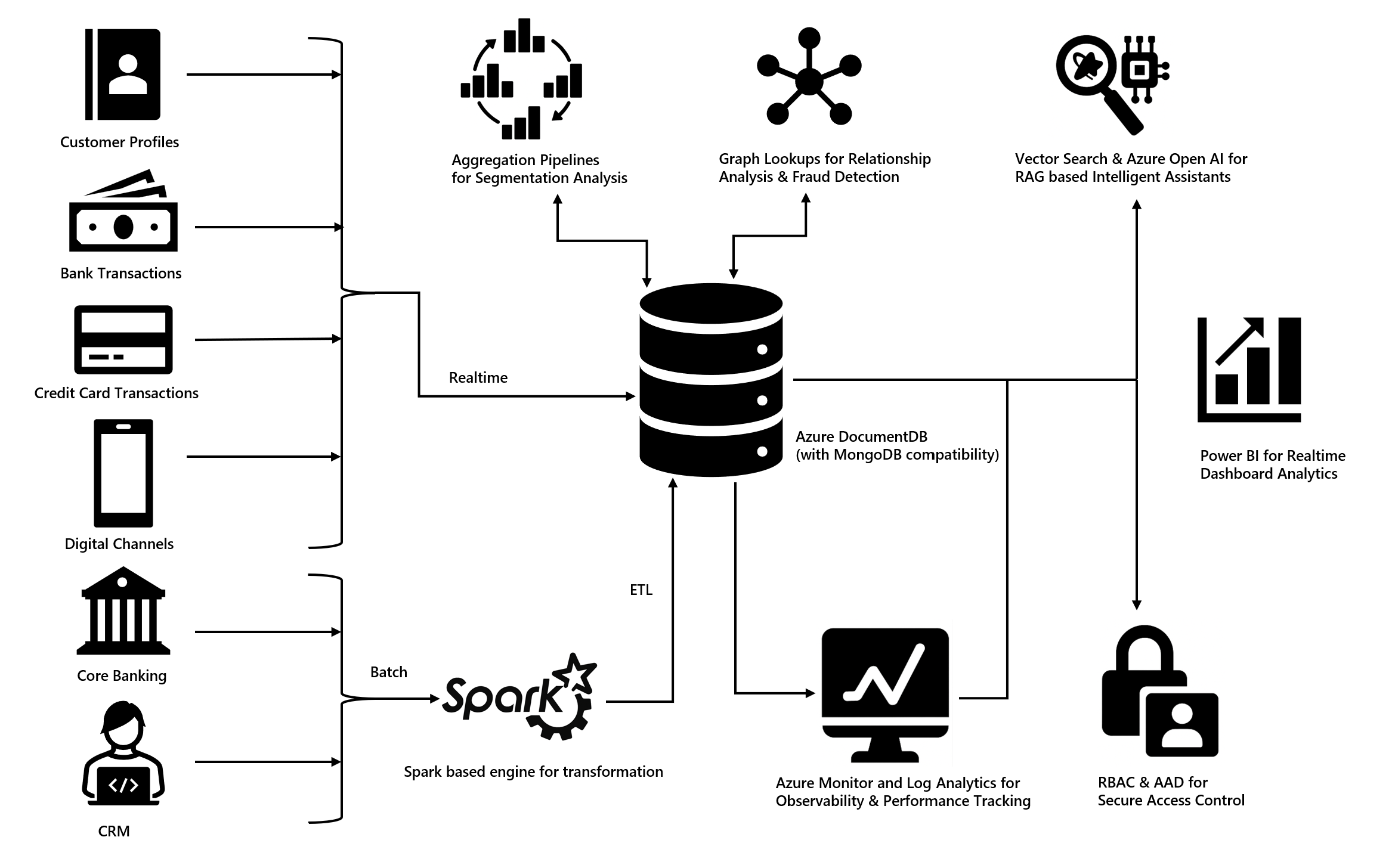
Azure DocumentDB (with MongoDB compatibility) for Banking: A Modern Customer 360 Approach

Introduction: Transforming Customer Intelligence in Banking Every day, people interact with their bank across mobile apps, branches, call centers, ATMs, chatbots, and partner ecosystems. Each touchpoint holds a piece of the customer story but rarely the whole picture. For many institutions, these moments of truth get lost in a maze of legacy systems, disconnected business units, and data locked away in silos built over decades. Why Customer 360 Matters for Financial Enterprises Banks often distribute customer data across various systems such as core banking, CRM, loan origination, card platforms, digi...
Welcome to Azure Cosmos DB Conf 2026
Today is the day. Azure Cosmos DB Conf 2026, in partnership with AMD, is a free virtual developer event focused on building modern, scalable applications with Azure Cosmos DB. The agenda features Microsoft engineers, product team leaders, and members of the global developer community sharing real-world solutions, deep dives into the database engine, and hands-on patterns for AI-era apps. Whether you build modern web apps, AI agents, multi-cloud platforms, or data-intensive systems on Azure — you’ll find something on the schedule that ships back with you to your codebase. 🎤 Keynote — 9:00 AM PT The ...
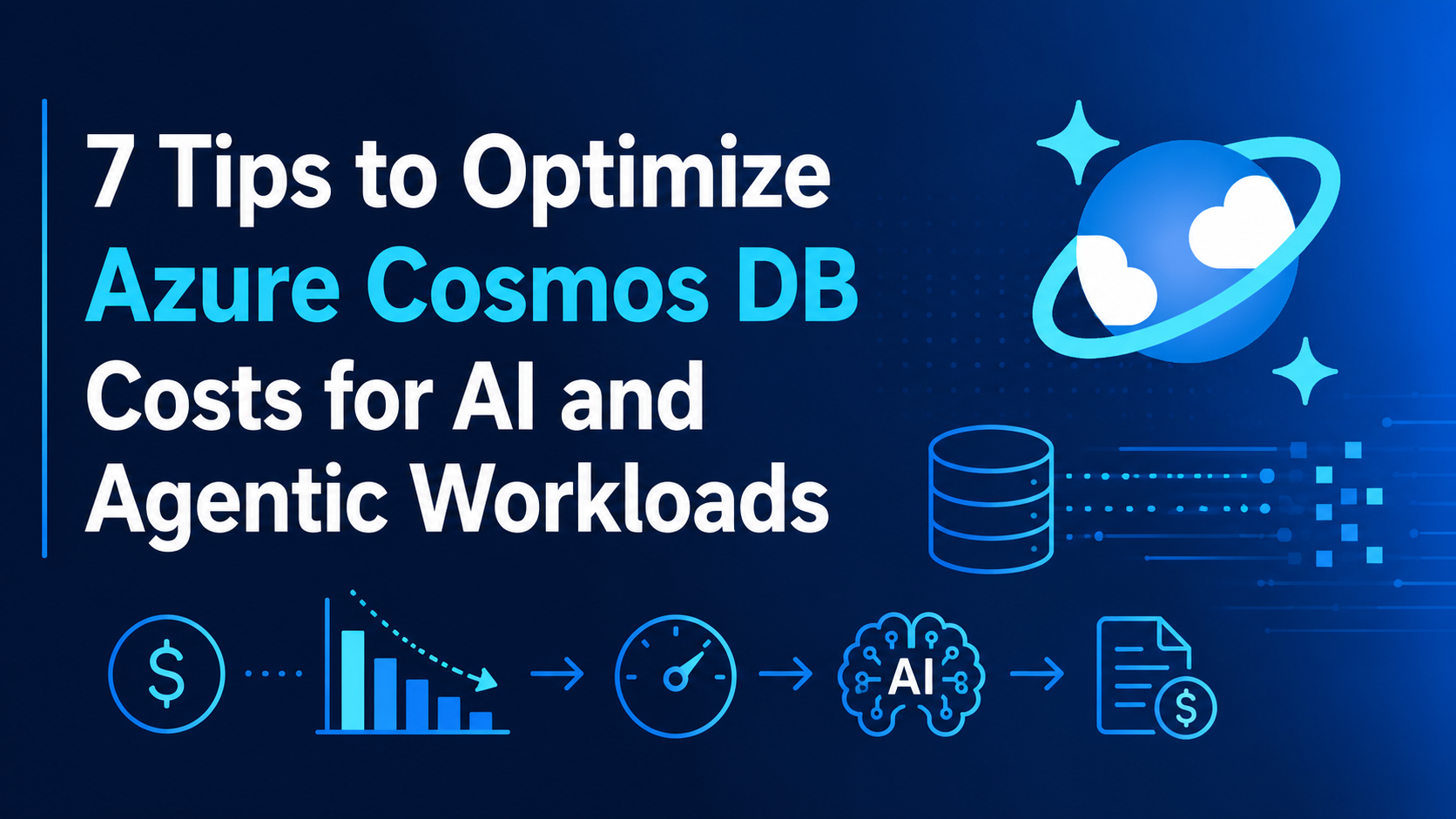
7 tips to optimize Azure Cosmos DB costs for AI and agentic workloads

AI apps and agentic workloads expose inefficiencies in your data layer faster than any previous generation of apps. You’re storing embeddings, serving low-latency retrieval, handling bursty traffic from chat and orchestration, and often operating across regions. Done right, Azure Cosmos DB can support these patterns with high performance and cost controls built in. Done wrong, it is easy to over-provision or pay for inefficient queries. Insights from a recently published Azure Cosmos DB cost savings white paper, combined with guidance from Microsoft leader John Savill and real-world feedback from Azure Cosmos ...
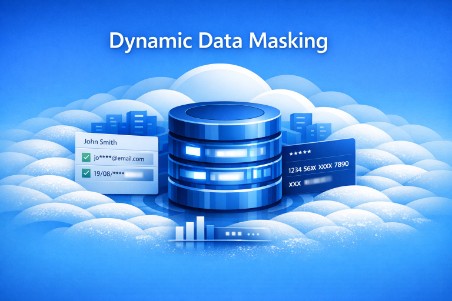
General Availability: Dynamic Data Masking for Azure Cosmos DB
Protecting sensitive data is a foundational requirement for modern applications. As organizations scale their use of Azure Cosmos DB across teams, environments, and workloads, controlling who can see sensitive information becomes increasingly important. Today, we are excited to announce the general availability of Dynamic Data Masking (DDM) for Azure Cosmos DB for NoSQL. This capability helps protect sensitive data by automatically masking it for users who do not have permission to view the original values, without requiring changes to application code or data models. Dynamic Data Masking helps teams reduce...
Scalable AI with Azure Cosmos DB: Tredence Intelligent Document Processing (IDP)
Azure Cosmos DB enables scalable AI-driven document processing, addressing one of the biggest barriers to operational scale in today’s enterprise AI landscape. Organizations continue to manage massive volumes of structured and unstructured content—contracts, regulatory filings, operational records, images, and field documentation—yet many workflows remain fragmented, manual, and slow. In this month's edition of our Scalable AI with Azure Cosmos DB series, we featured Tredence and their production-grade Intelligent Document Processing (IDP) solution—an Azure-native architecture designed to transform document-heav...
Introducing the Azure Cosmos DB Plugin for Cursor
We're excited to announce the Cursor plugin for Azure Cosmos DB bringing AI-powered database expertise, best practices guidance, and live database connectivity directly into your coding workflow. Whether you're designing a new data model, optimizing queries, or building a RAG application with vector search, the Cursor plugin gives your AI assistant deep knowledge of Azure Cosmos DB so you can write better code, faster. What's in the Plugin The Azure Cosmos DB plugin bundles three capabilities: Finding and Installing the Plugin From the Cursor Marketplace That's it. The rules ar...
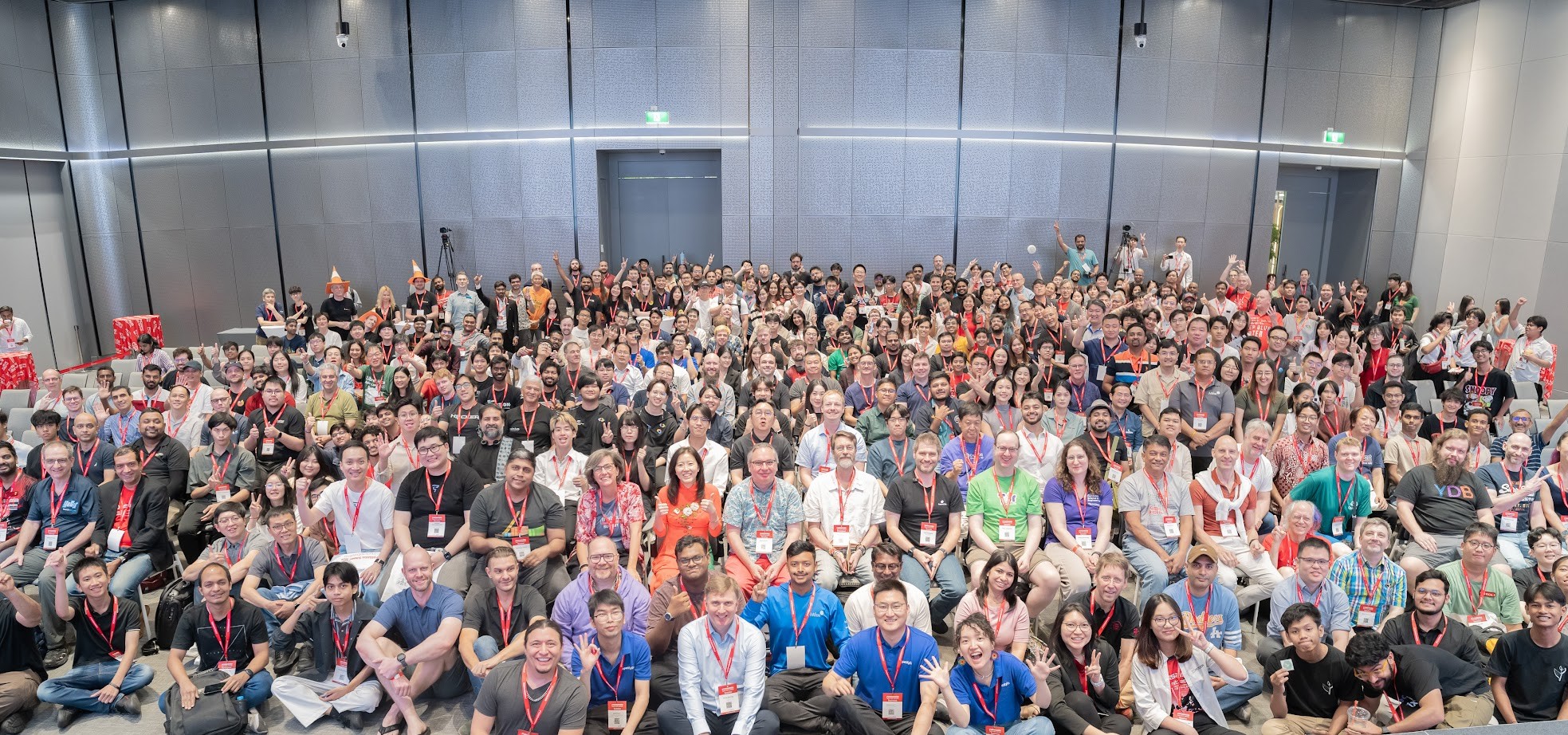
Azure Cosmos DB at FOSSASIA Summit 2026: Sessions, Conversations, and Community
The FOSSASIA Summit 2026 was an incredible gathering of developers, open-source contributors, startups, and technology enthusiasts from across the region. This year, Azure Cosmos DB and Azure DocumentDB were present at the summit with both technical sessions and a dedicated booth, giving us a great opportunity to connect with the community and talk about building modern applications with cloud-native databases. A Personal Note This was my third time attending FOSSASIA, and it was special in many ways. It was also my first time attending the summit in Bangkok, Thailand, and the venue and overall experience w...
Now Generally Available: Cosmos DB Mirroring in Microsoft Fabric with Private Networks

We’re excited to announce the general availability of private network support for Azure Cosmos DB mirroring in Microsoft Fabric, enabling customers to replicate operational data into Fabric from Azure Cosmos DB accounts secured with private endpoints or virtual networks while continuing to operate within their existing network security models. As more organizations connect operational data with analytics and AI to power new insights and intelligent applications, the ability to do so securely has become increasingly important—making private network support a key capability for bringing operational data into Fabric...
A Look Ahead at Azure Cosmos DB Conf 2026: From AI Agents to Global Scale
Join us for Azure Cosmos DB Conf 2026, a free global, virtual developer event focused on building modern applications with Azure Cosmos DB. This year, Azure Cosmos DB Conf will feature 21 speakers from across the globe, bringing together Microsoft engineers, community leaders, architects, and developers to share how they are building modern applications with Azure Cosmos DB. Attendees will hear directly from experts using Azure Cosmos DB to power real systems—from AI agent memory architectures and retrieval-augmented generation pipelines to globally distributed event-driven micros...
Azure DocumentDB: A Fully Managed MongoDB-Compatible Database

Running MongoDB at scale eventually forces a trade-off: invest heavily in managing your own infrastructure or move to a managed service and risk losing the compatibility and portability your team depends on. Azure DocumentDB is a fully managed, MongoDB-compatible database on Azure, built on an MIT-licensed open-source engine that runs consistently across on-premises, hybrid, and cloud environments. Developers keep the skills and tooling they already have. Infrastructure teams get a pricing model built on compute and storage, with no licensing fees and no throughput unit calculations. Key Capabilities ...
Maximize Azure Cosmos DB Performance with Azure Advisor Recommendations
In the first post of this series, we introduced how Azure Advisor helps Azure Cosmos DB users uncover opportunities to optimize efficiency and make smarter decisions. This follow-up dives deeper into one of the most important categories of guidance: performance. If you've ever dealt with skewed workloads, unexpected RU consumption, or queries that don’t scale as expected, Azure Advisor surfaces exactly the insights you need to diagnose and improve them. In this post, you’ll learn what performance recommendations Advisor provides, why they matter, and how you can use them to enhance the speed, reliability, a...
Building AI-Powered Apps with Azure Cosmos DB and the Vercel AI SDK
The Vercel AI SDK is an open-source TypeScript toolkit that provides the core building blocks for integrating AI into any JavaScript application. It works with 20+ AI providers out of the box—including OpenAI, Azure OpenAI, Anthropic, Google, Mistral, and more—so you can write your code once and switch providers by changing a single import. At its core, the SDK handles streaming (responses appear word-by-word instead of making users wait), tool calling (allowing the AI to invoke your functions, such as querying a database), and multi-step agentic reasoning, where the AI chains multiple tool calls together to a...
How to Enable Microsoft Entra ID for Azure Cosmos DB (NoSQL)
Strengthen Identity Security and Eliminate Account Keys Identity is becoming the new security perimeter. As organizations modernize their cloud applications, long‑lived secrets and shared keys introduce unnecessary risk. Azure Cosmos DB now fully supports Microsoft Entra ID for both control plane and data plane access, giving customers a secure, passwordless, least‑privilege alternative to legacy key‑based authentication. This blog walks through why customers are moving to Entra ID, what changes when you disable local authentication, and how to configure modern RBAC for Cosmos DB. Why Move to Microsoft Entra...
Part 2: Building a Python CRUD API with Azure Functions and Azure Cosmos DB
Series: Building Serverless Applications with Azure Functions and Azure Cosmos DB In the first post of this series, we focused on establishing the fundamentals of serverless architecture by building and deploying a simple HTTP API using Azure Functions and FastAPI. The post centred on serverless compute, showing how Azure Functions handles execution, scaling, and infrastructure management while FastAPI provides a modern, developer-friendly API framework. In this post, we extend that foundation by introducing serverless data. You’ll build a Python-based CRUD inventory API and persist data using Azure Cosmos DB...
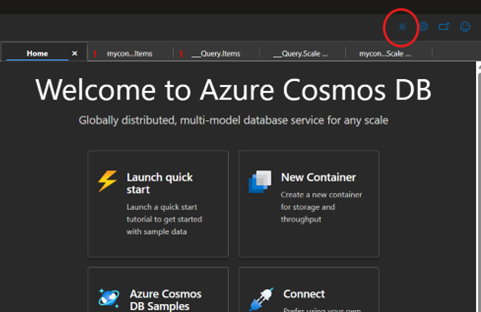
Azure Cosmos DB Data Explorer now supports Dark Mode
If you spend time in the Azure Portal’s using Azure Cosmos DB Data Explorer, you know it’s a “lots of screens, lots of tabs, lots of work happening” kind of place. So I’m excited to share a small upgrade that makes a big difference: Dark Mode is now supported in Cosmos DB Data Explorer. It just works with Azure Portal Dark Mode If you already have Dark Mode enabled in the Azure Portal, Data Explorer will automatically switch to dark with it. No extra setup, no separate preference buried in a panel somewhere. If you want to switch on the on demand, you can also use the sun/moon toggle in the Data Explorer...
Azure Cosmos DB TV Recap – From Burger to Bots – Agentic Apps with Cosmos DB and LangChain.js | Ep. 111
In Episode 111 of Azure Cosmos DB TV, host Mark Brown is joined by Yohan Lasorsa to explore how developers can build agent-powered applications using a fully serverless architecture. This episode focuses on a practical, end-to-end example that demonstrates how transactional application data and AI-driven experiences can coexist on a single platform without introducing additional infrastructure or operational overhead. The session walks through a sample application inspired by a familiar business scenario: a simple ordering system. What begins as a traditional REST-based business API evolves into an agent-enabl...
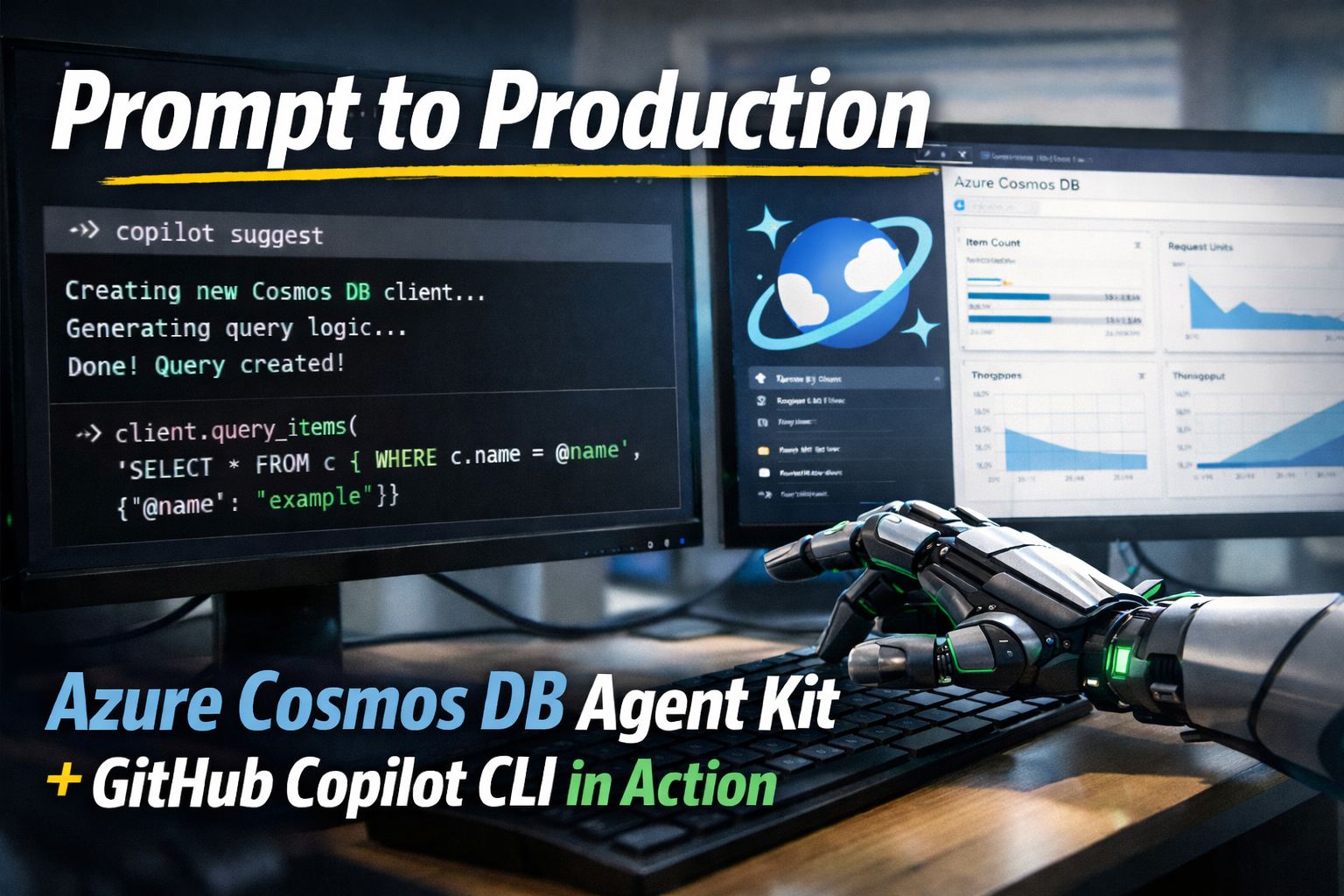
Accelerate Your Cosmos DB Infrastructure with GitHub Copilot CLI and Azure Cosmos DB Agent Kit
Modern infrastructure work is increasingly agent driven, but only if your AI actually understands the platform you’re deploying. This guide shows how to turn GitHub Copilot CLI into an Azure Cosmos DB aware infrastructure expert by loading the Azure Cosmos DB Agent Kit. In under a minute, you’ll give Copilot deep, opinionated knowledge of Azure Cosmos DB best practices so it can review, generate, and optimize your Terraform, Bicep, Docker, and CI/CD configurations directly from your terminal. TL;DR — Get Started in 30 Seconds That's it! Copilot CLI now has expert-level Azure Cosmos DB infrastructure knowl...
Azure Cosmos DB TV Recap: Supercharging AI Agents with the Azure Cosmos DB MCP Toolkit (Ep. 110)
In Episode 110 of Azure Cosmos DB TV, host Mark Brown is joined by Sajeetharan Sinnathurai to explore how the Azure Cosmos DB MCP Toolkit is changing the way developers build, deploy, and scale AI agents using real application data. As agentic AI systems evolve, one challenge continues to surface: securely and consistently connecting AI agents to operational data—without rewriting integration logic for every platform. This episode takes a deep dive into how the Model Context Protocol (MCP), along with Azure Azure Cosmos DB’s implementation, addresses that challenge. Why MCP Matters for AI Agents At its cor...
Introducing the Azure Cosmos DB Agent Kit: Your AI Pair Programmer Just Got Smarter
The Azure Cosmos DB Agent Kit is an open-source collection of skills that teaches your AI coding assistant (GitHub Copilot, Claude Code, Gemini CLI) expert-level Azure Cosmos DB best practices. Install with one command, get production-ready guidance instantly. The Challenge Every Azure Cosmos DB Developer Faces You're building a new application with Azure Cosmos DB. You've got your data, you've got your queries, but then come the questions that keep you up at night: These aren't trivial questions. Poor decisions here can mean the difference between a blazing-fast application and one that...
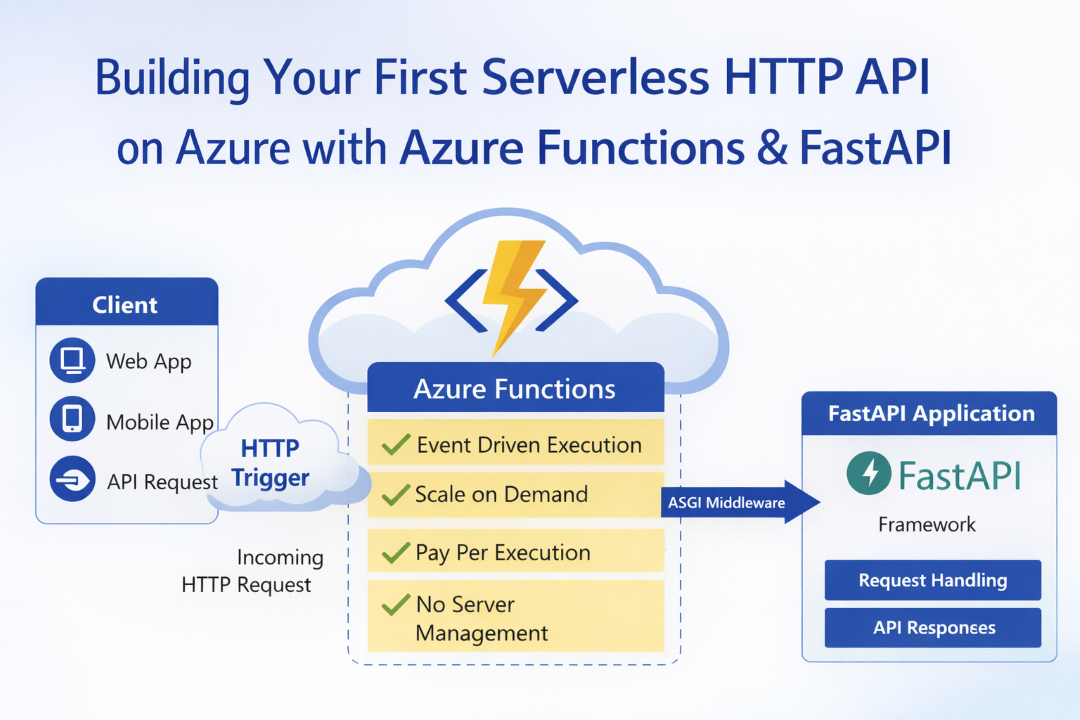
Part 1: Building Your First Serverless HTTP API on Azure with Azure Functions & FastAPI
Introduction This post is Part 1 of the series Serverless Application Development with Azure Functions and Azure Cosmos DB, where we explore how to build end-to-end serverless applications using Azure Functions for compute and Azure Cosmos DB for storage. Together, these services allow you to build scalable, event-driven, cost-efficient cloud solutions without managing servers or infrastructure. Throughout the series, you’ll progressively build real application components starting with simple HTTP APIs, adding persistent storage, implementing event-driven patterns using the Cosmos DB Change Feed, and orches...
Azure Cosmos DB Conf 2026 — Call for Proposals Is Now Open
Every production system has a story behind it. The scaling limit you didn’t expect. The data model that finally clicked. The tradeoff you had to make under real-world pressure. The solution that worked—and the lessons you’d pass on to the next team. Azure Cosmos DB Conf 2026 is where those stories get shared. This is a global, developer-first conference focused on real-world engineering with Azure Cosmos DB, Azure DocumentDB, and open-source DocumentDB. It’s about showing how things actually work in production—through real architecture, real code, and live demos—not high-level concepts or marketing ...
Powering Real-Time Gaming Experiences with Azure Cosmos DB for NoSQL
Scenario: When Every Millisecond Counts in Gaming Imagine millions of players logging in at the exact moment a new game season launches. Leaderboards light up, achievements tally, and in-game shops buzz with transactions. In these high-stakes moments, speed and reliability aren’t optional, they’re mission critical. That’s where Azure Cosmos DB with the NoSQL API steps in, powering real-time, global gaming experiences without missing a beat. Why Gaming Needs a Next-Gen Database Modern gaming experiences must withstand massive user surges, where game launches and updates can trigger huge spikes in concurrent p...
Public Preview: Cosmos DB Mirroring in Microsoft Fabric with Private Endpoints
We are very excited to announce the public preview for private endpoint support for Azure Cosmos DB Mirroring with Microsoft Fabric mirroring. This feature allows you to preserve the enhanced network security on your data in Cosmos DB from virtual networks or private endpoints, allowing you to seamlessly replicate your operational data in Cosmos DB using Mirroring into your Fabric Workspaces. Configuring Mirroring with Private Endpoints The process for configuring Mirroring on your Cosmos DB accounts with private endpoints during our preview requires multiple steps. To see these steps in detail...
Build AI Tooling in Go with the MCP SDK – Connecting AI Apps to Databases
A hands‑on walkthrough of building MCP servers that can plug AI applications into Azure Cosmos DB The Model Context Protocol (MCP) has established itself as the ubiquitous standard for connecting AI applications to external systems. Since its release, there have been implementations across various programming languages and frameworks, enabling developers to build solutions that expose data sources, tools, and workflows to AI applications. For Go developers, however, the journey to an official MCP SDK took longer (compared to other SDKs like Python and TypeScript). Discussions and design/implementation w...
How Azure Cosmos DB Powers ARM’s Federated Future: Scaling for the Next Billion Requests

The Cloud at Hyperscale: ARM’s Mission and Growth Azure Resource Manager (ARM) is the backbone of Azure’s resource provisioning and management, orchestrating billions of daily requests from customers around the globe. ARM manages all resources for Azure: VMs, Storage, Databases, etc. As Azure’s reach expands and customer expectations rise, ARM’s architecture must not only keep pace—it must set the pace for cloud-scale reliability, agility, and innovation. In recent years, ARM has seen its request volume surge at an exponential rate, reaching unprecedented levels that continually redefine the boundaries of c...
Unlock the power of distributed graph databases with JanusGraph and Azure Apache Cassandra
Connecting the Dots: How Graph Databases Drive Innovation In today’s data-rich world, organizations face challenges that go beyond simple tables and rows. Whether it’s uncovering hidden relationships in social networks, detecting fraud, or powering recommendation engines, graph databases offer a unique way to model and analyze complex connections. JanusGraph, an open-source graph database, combined with Azure Managed Instance for Apache Cassandra, provides a scalable, secure, and flexible foundation for building graph-powered applications making it easier for teams to tackle problems that traditional database...
Azure Cosmos DB vNext Emulator: Query and Observability Enhancements
The Azure Cosmos DB Linux-based vNext emulator (preview) is a local version of the Azure Cosmos DB service that runs as a Docker container on Linux, macOS, and Windows. It provides a cost-effective way to develop and test applications locally without requiring an Azure subscription or network connectivity. The latest release brings improvements in two key areas: Query Improvements This emulator release enables several query patterns that were previously unsupported. In this post, we'll focus on the following enhancements to query capabilities: Let's explore these with practical...
Azure Cosmos DB : Becoming a Search-Native Database


For years, “Database” and “Search systems" (think Elastic Search) lived in separate worlds. While both Databases and Search Systems operate in the same domain (storing, indexing and querying data), they prioritized different aspects. OLTP Databases prioritized Search Systems prioritized AI and Agents are accelerating the dissolution of the boundary between these two systems. AI solves real world problems in near-real-time that needs both of these systems. Using separate systems for these specializations not only leads to high overhead, but leads to sub-optimal relevanc...
Long-term data retention up to 10 years: Announcing Private Preview of Azure Backup for Azure Cosmos DB
Azure Backup for Azure Cosmos DB is a new option that lets you securely protect and recover your Azure Cosmos DB data for compliance, audit, and ransomware protection scenarios. It leverages Azure Backup’s vault isolation and Azure Cosmos DB’s native backup streams to deliver scalable, long-term data protection that meets regulatory requirements. How does it work? During the private preview, you can configure backup schedules and retention policies at the Azure Cosmos DB account or collection level, stream backups to a vaulted, isolated Azure Backup Vault, and restore data to an empty Azure Cosmos DB account in...

Tata Neu delivers personalized shopping experiences for millions of users with Azure DocumentDB
With Azure DocumentDB, Tata Neu delivers seamless authentication for millions of users, accelerates credit card onboarding across partners, unifies loyalty programs for hundreds of millions of members, and powers AI-driven support experiences across more than 60 brands. This article is coauthored by Anurag Mathur, the VP and Head of Foundational Services at Tata Digital, and Bhaskar Chellappa, the VP and Head of TechOps at Tata Digital Introducing Tata Neu: Tata Digital's unified app Tata Neu is designed to deliver an extensive yet highly personalized shopping experience. The culmination of more than t...
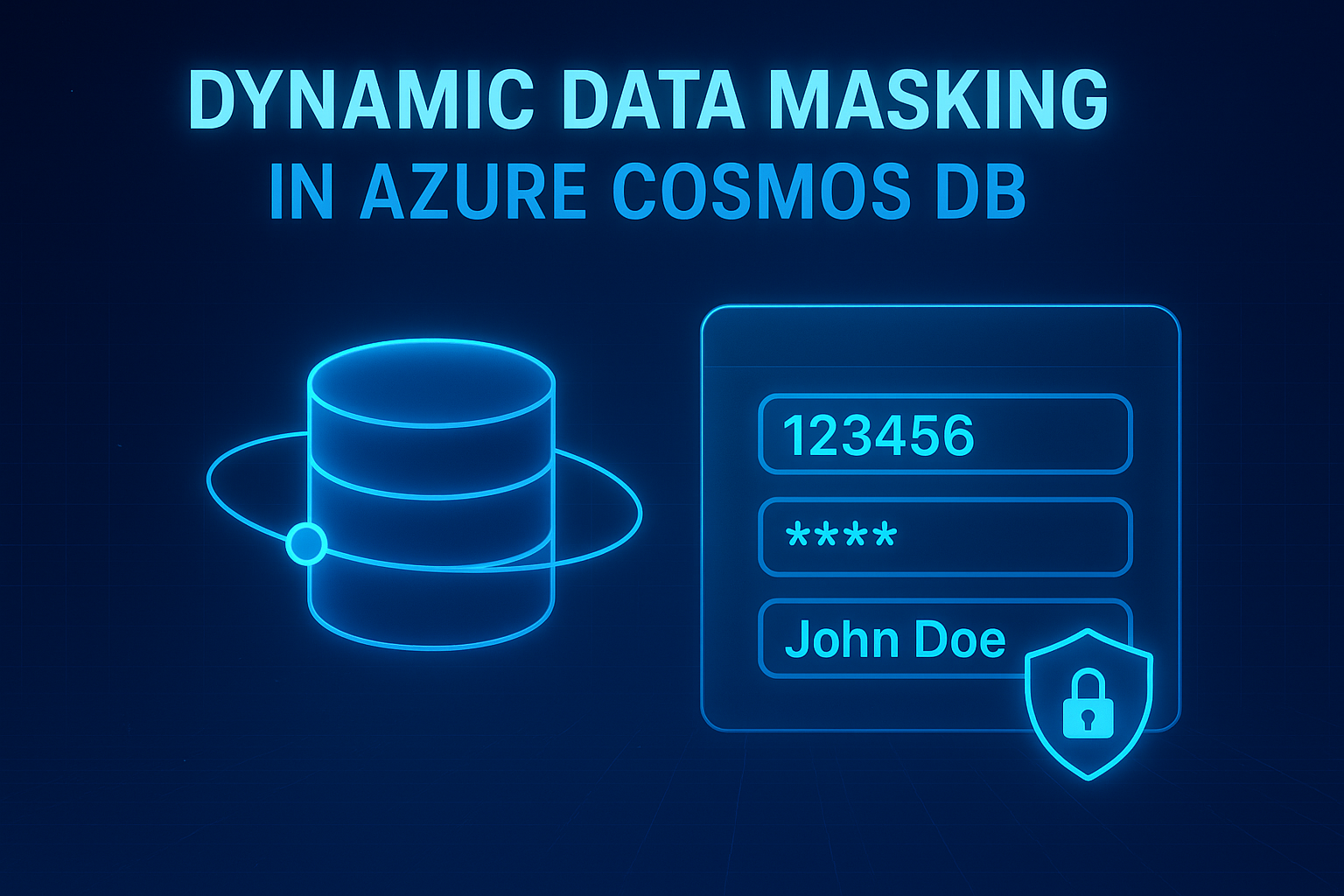
Announcing: Dynamic Data Masking for Azure Cosmos DB (Preview)
Today marks a big step forward with the public preview of Dynamic Data Masking (DDM) for Azure Cosmos DB. This feature helps organizations protect sensitive data without requiring changes to application logic or database interactions. What is Dynamic Data Masking? Dynamic Data Masking (DDM) is a server-side, policy-driven security feature that automatically masks sensitive information for non-privileged users. When enabled, DDM ensures that only authorized users can view unmasked data, while others see masked or redacted values. The original data remains unchanged in the database, and masking occurs in real tim...
Use Azure SRE Agent with Azure Cosmos DB: Smarter Diagnostics for Your Applications
We’re excited to announce the Azure Cosmos DB SRE Agent built on Azure SRE Agent; a new capability designed to simplify troubleshooting and improve reliability for your applications running on Azure Cosmos DB. Some key features of Azure Cosmos DB SRE Agent are: Benefits of using Azure Cosmos DB SRE Agent Managing distributed applications can be complex. The Azure Cosmos DB SRE Agent bridges the gap by: Azure Cosmos DB SRE Agent Scenario Integrating Azure SRE Agent with your Azure Cosmos DB resource can leverage diagnostics to help identify issues or areas for improvement....
Announcing Private Preview: Safe Account Key rotation using Account Key Usage Metadata
Account Key Usage Metadata is a new security and observability feature that helps Azure Cosmos DB customers avoid service disruptions during key rotations. It provides visibility when each account key was last used, allowing teams to make informed decisions before rotating or migrating to Entra ID. This feature addresses a common challenge of rotating a key that appears unused but is still actively relied upon by critical applications—leading to unexpected outages. How Does It Work? In the private preview, on your Azure Cosmos DB account, you can view the last usage timestamp for each key. This timestamp r...
General Availability: Priority-Based Execution in Azure Cosmos DB
Have you ever faced a situation where two different workloads share the same container, and one ends up slowing down the other? This is a common challenge for many of our customers running applications on Azure Cosmos DB. Imagine these scenarios: In all these cases, there’s one workload you’d prefer to prioritize, ensuring critical operations run smoothly while others can progress slowly during resource contention. Introducing Priority-Based Execution Priority-Based Execution solves this problem. It lets you assign high priority to critical workloads and low priority to less important ones using...

Announcing Preview of Online Copy Jobs in Azure Cosmos DB: Migrate Data with Minimal Downtime!
We are excited to announce the preview of Online Copy Jobs, a powerful new feature designed to make data migration between containers seamless and efficient with minimal downtime. With this feature, you can replicate data from a source to a destination container in real time without disrupting your applications. What is an online copy job? Online Copy Jobs allow you to copy data from a source container to a destination container while your applications continue to run on the source. All data including incremental updates is automatically replicated, ensuring the destination container becomes an up-to-date repli...
Announced at Ignite 2025: Azure DocumentDB, MCP Toolkit, Fleet Analytics, and more!
Microsoft Ignite 2025 kicked off with a wave of announcements for Azure Cosmos DB and Azure DocumentDB, setting the tone for a week of innovation in cloud databases and AI. Here’s your one-stop summary of everything unveiled—and what to watch for in the sessions ahead. Major Azure Cosmos DB announcements from Ignite 2025 Azure DocumentDB now Generally Available Azure DocumentDB is now generally available, bringing a new level of openness, flexibility, and cost efficiency to MongoDB workloads. Built on the open-source DocumentDB engine – now governed by the Linux Foundation – Azure DocumentDB delivers Mongo...

Introducing Index Advisor for Azure DocumentDB (Preview)
We’re excited to announce the public preview of Index Advisor for Azure DocumentDB (with MongoDB Compatibility). It is a built-in AI powered performance tuning assistant that helps you understand slow queries, diagnose inefficiencies, and automatically generate optimized index recommendations. With Index Advisor, you can quickly analyze query structure, execution plans, and collection statistics to receive data-driven, plain-English index recommendations. Even better, you can apply these recommendations directly inside the DocumentDB for VS Code extension, making performance tuning faster, easier, and seamles...
Azure Cosmos DB Extension for VS Code Now Generally Available
We’re thrilled to announce the general availability (GA) of the Azure Cosmos DB extension for Visual Studio Code! This powerful extension brings enterprise-grade database management directly into your development environment, making it easier than ever to build, test, and deploy applications powered by Azure Cosmos DB. Why This Matters for Azure Cosmos DB Developers As a Cosmos DB developer, you know the importance of rapid iteration and seamless workflows. The Azure Cosmos DB VS Code extension eliminates context switching by bringing your database management tools directly into your I...
Now Generally Available: Azure Cosmos DB Fleet Pools

We’re excited to announce two updates to Azure Cosmos DB fleets: Azure Cosmos DB fleets enables developers to build scalable, isolated, and cost-effective multi-tenant or Software as a Service (SaaS) applications. Today, many SaaS providers using Azure Cosmos DB isolate each tenant (the end customer of the SaaS provider) in a separate database account to meet strict performance and security requirements—for example, supporting customer-managed keys. While this approach ensures tenant isolation, it creates operational complexity at scale. Managing thousands of RU/s settings becomes difficult, and p...
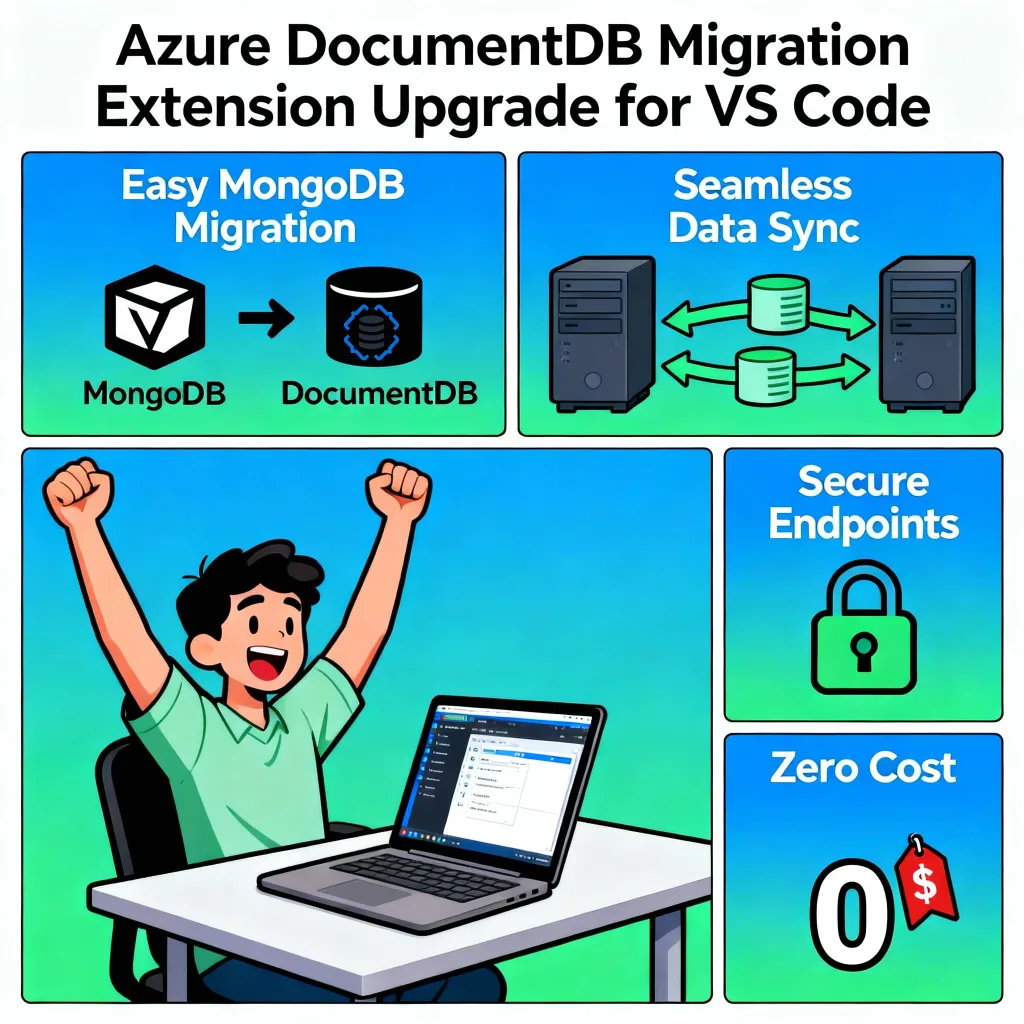
Public Preview: Azure DocumentDB Migration Extension Now Supports Online Migration to Azure DocumentDB (with MongoDB compatibility)

We’re excited to announce the Public Preview of a significant enhancement to the Azure DocumentDB (with MongoDB compatibility) Migration extension for Visual Studio Code—introducing online migration capability! This update makes it easier than ever to migrate MongoDB workloads to Azure DocumentDB with minimal downtime, maximum efficiency, and a fully managed experience. What Is the Azure DocumentDB Migration Extension? The extension is designed to simplify the migration process for MongoDB workloads. It provides a developer-friendly experience within Visual Studio Code, enabling you to assess, plan, and exe...
Azure DocumentDB is Now Generally Available

Azure DocumentDB, a fully managed MongoDB-compatible database service based on the open-source DocumentDB governed by the Linux Foundation, is now generally available. It was formerly known as vCore-based Azure Cosmos DB for MongoDB. Azure DocumentDB gives developers a multi-cloud, first-party document database on Azure that preserves MongoDB skills and tooling, improves portability through open source, and delivers clear cost control with a simple compute and storage-based model. At Ignite, we announced the AI-powered Index Advisor, Premium storage v2 disks, and the VS Code migration extensio...
Announcing: GA of Cosmos DB in Microsoft Fabric and Cosmos Mirroring
We’re excited to announce that Cosmos DB in Microsoft Fabric and Cosmos DB Mirroring are now Generally Available, uniting your operational and analytical data in one platform. You can now analyze live Cosmos DB data directly in Fabric—no complex or costly ETL required. Data stays in sync in OneLake, providing a single source of truth for real-time and historical insights. Write queries using T-SQL from a SQL Endpoint or use Python and Spark Notebooks in Fabric. As a distributed NoSQL database Cosmos DB in Fabric brings support for semi or unstructured data to analytics and ML workloads as well as a host of a...
Introducing the Azure Cosmos DB MCP Toolkit: Empowering AI Agents with Azure Cosmos DB Intelligence
We're excited to announce the Azure Cosmos DB MCP Toolkit in public preview. This open-source implementation of the Model Context Protocol (MCP) gives AI agents and LLMs direct, secure access to Azure Cosmos DB. The toolkit bridges intelligent applications and globally distributed databases, enabling AI agents to query, search, and understand data autonomously. The MCP Toolkit seamlessly integrates with Microsoft Foundry, a platform for building intelligent agents, AI workflows, and deploying AI models at scale. Developers can experiment, orchestrate, and manage AI applications from development to production. ...
What’s New in Semantic Search for Azure Cosmos DB at Ignite 2025
We’re excited to introduce new capabilities and performance improvements for vector and full-text search in Azure Cosmos DB. These updates make it easier for developers and architects to build semantic search experiences and generative AI applications on the world’s most scalable NoSQL database. Note: These new capabilities are actively rolling out. As a result, they may not yet be available in all Azure regions. Float16 Vector Support Save up to 50% on storage while maintaining high recall. You can now store and index vectors in Float16 format, reducing storage costs and memory usage while keeping...
Azure Cosmos DB Migration from MongoDB (RU) to Azure DocumentDB Is Now Generally Available!
After a successful public preview, we’re excited to announce the General Availability (GA) of online migration from RU-based Azure Cosmos DB for MongoDB to Azure DocumentDB (with MongoDB compatibility). This capability makes migration fast, simple, and cost-free—all through the Azure portal. Why This Matters If you’re running workloads on RU-based Cosmos DB for MongoDB, you can now move to Azure DocumentDB without downtime or extra cost. The GA release ensures a seamless experience: everything happens online, directly in the Azure portal, with no hidden charges or additional tools. What You Get Migration is d...

How Kraft Heinz achieved 1,400x faster data lineage with Azure DocumentDB’s DiskANN vector search and hybrid search
This article is authored by Gurvinder Singh, Principal Cloud Engineer at The Kraft Heinz Company. ICYMI: Hear how Kraft Heinz built an AI-powered data lineage solution leveraging Azure DocumentDB hybrid search and graph querying capabilities - watch the Ignite session here: Move fast, save more with MongoDB-compatible workloads on DocumentDB The enterprise-scale challenge: Data lineage across 50+ interconnected systems At Kraft Heinz, we operate one of the world’s largest CPG data ecosystems with more than 200 brands and 50+ interconnected enterprise systems—including SAP, Oracle, Snowflake, and Po...
Configuring Advanced High Availability Features in Azure Cosmos DB SDKs
Azure Cosmos DB is engineered from the ground up to deliver high availability, low latency, throughput, and consistency guarantees for globally distributed applications. As mission-critical systems increasingly rely on Cosmos DB for performance at scale, understanding and configuring advanced high availability features becomes essential. Advanced high availability capabilities in Azure Cosmos DB Azure Cosmos DB provides a rich set of features to support high availability and resilience: These capabilities form the backbone of Cosmos DB's 99.999% availability SLA. To fully realize the ...

IntelePeer supercharges its agentic AI platform with Azure Cosmos DB
Reducing latency by 50% and scaling intelligent CX for SMBs This article was co-authored by Sergey Galchenko, Chief Technology Officer, IntelePeer, and Subhash Ramamoorthi, Director, IntelePeer AI Hub. ICYMI: Discover how IntelePeer enhances agent intelligence and powers their multi-agent applications - watch the Ignite session here: From DEV to PROD: How to build agentic memory with Azure Cosmos DB. You don’t need to be an AI expert, software engineer, or data scientist to understand the importance of system reliability and performance in digital customer service platforms. If you’ve ever tried to...
From Real-Time Analytics to AI: Your Azure Cosmos DB & DocumentDB Agenda for Microsoft Ignite 2025
Microsoft Ignite 2025 is your opportunity to explore how Azure Cosmos DB, Cosmos DB in Microsoft Fabric, and DocumentDB power the next generation of intelligent, planet-scale applications. Whether you’re building real-time analytics pipelines, optimizing MongoDB-compatible workloads, or implementing AI-driven architectures, these technologies are at the heart of modern innovation. This year’s sessions feature hands-on labs, advanced breakouts, and inspiring customer stories from companies like Sam’s Club, Veeam, and Sitecore, showing how they leverage Azure Cosmos DB and DocumentDB to deliver speed, re...
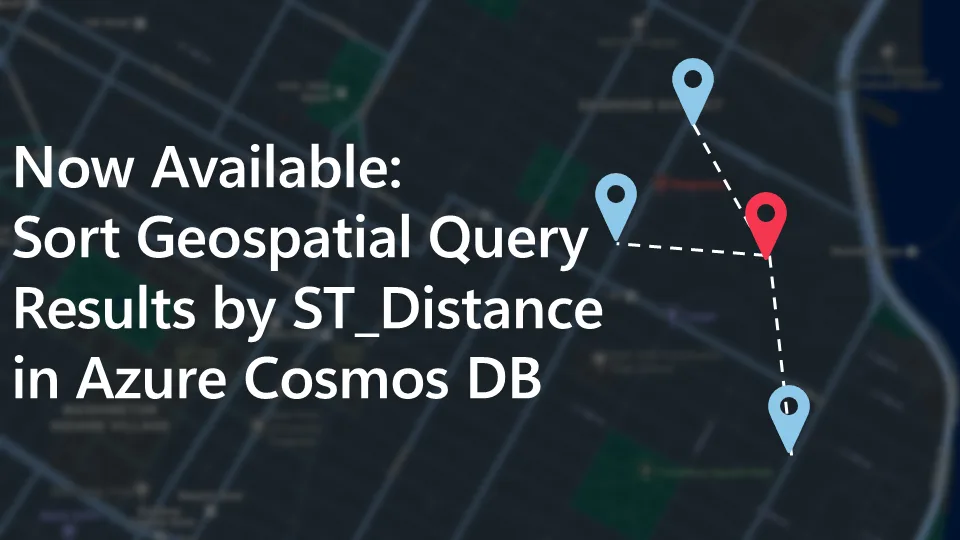
Now Available: Sort Geospatial Query Results by ST_Distance in Azure Cosmos DB
Azure Cosmos DB’s geospatial capabilities just got even better! We're excited to announce that you can now sort query results by distance using an ORDER BY ST_DISTANCE(...) clause in the NoSQL query language while leveraging a spatial index. Why is this important? Previously, you could use ST_DISTANCE in projections or WHERE clauses to filter results within a radius, for example, finding all restaurants within 5000 meters. But if you wanted to sort those results by the distance, you had to pull the data client-side and handle sorting manually. Now you can now do it directly in your query! Azure Cosmos D...
Query Advisor for Azure Cosmos DB: Actionable insights to improve performance and cost

Azure Cosmos DB for NoSQL now features Query Advisor, designed to help you write faster and more efficient queries. Whether you’re optimizing for performance, cost, or scalability, Query Advisor provides actionable recommendations to help you get the most out of your data. Why Query Optimization Matters Azure Cosmos DB’s SQL API is flexible and expressive, allowing developers to query JSON data with familiar SQL-like syntax. But as applications grow in complexity, small differences in query structure can have a big impact on performance and Request Units (RUs). For example, two queries that return the same r...
Accelerate Your Growth: Azure Cosmos DB Partner Acceleration Program
Unlock 360° Success with the Cosmos DB Engineering Team Are you ready to elevate your cloud data practice and drive innovation for your customers? The Azure Cosmos DB Partner Acceleration Program—spearheaded by the Cosmos DB Engineering Team—offers a unique, end-to-end journey for partners. This initiative is designed to empower, upskill, and accelerate your business with technical enablement, customer engagement support, and robust Go-To-Market (GTM) opportunities. Please note, it is open to all type of partners, ISVs, GISV, GSIs, SIs or Channel has technical practices. Sign up now: https://aka.ms/cdbpartner...
Failures Happen in Cloud, but how Azure Cosmos DB keeps your Applications Online
In this blog, we'll discuss how Azure Cosmos DB is engineered for resilience and how it ensures high availability when failures happen in the cloud. Why does it matter ? The only thing that’s constant in distributed systems is failures. No cloud platform is immune to failures — from regional outages and transient network blips to human errors or hardware faults. What defines resiliency & high availability isn’t the absence of failure, but how systems anticipate, isolate, and recover from them. For many internet applications and services, the database is the first layer (looking bottoms-up) that needs to...
From Backup to Discovery: Veeam’s Search Engine Powered by Azure Cosmos DB
This article was co-authored by Zack Rossman, Staff Software Engineer, Veeam; Ashlie Martinez, Staff Software Engineer, Veeam; and James Nguyen, Senior Principal Cloud Solution Architect, AI/ML, Microsoft. ICYMI: See how Veeam built their AI-powered data discovery solution with Azure Cosmos DB - watch the Ignite session here: How Veeam delivers planet-scale semantic search with Azure Cosmos DB Most people think of data resilience as two steps: backup and recovery. Backup creates a copy. Recovery brings it back when disaster strikes. But what if you can’t find the file you need to recover when it mat...
Bringing Context to Copilot: Azure Cosmos DB Best Practices, Right in Your VS Code Workspace
Developers love GitHub Copilot for its instant, intelligent code suggestions. But what if those suggestions could also reflect your specific database and workload patterns? That’s now possible with a new feature in Azure Cosmos DB for VS Code. Starting today, when you connect to your Cosmos DB account in VS Code, the extension automatically deploys an azurecosmosdb.instructions.md file to your user profile folder, ensuring it works seamlessly across all workspaces without requiring duplication in each project. This file acts as a context provider for GitHub Copilot a bridge that helps the AI understand your ...
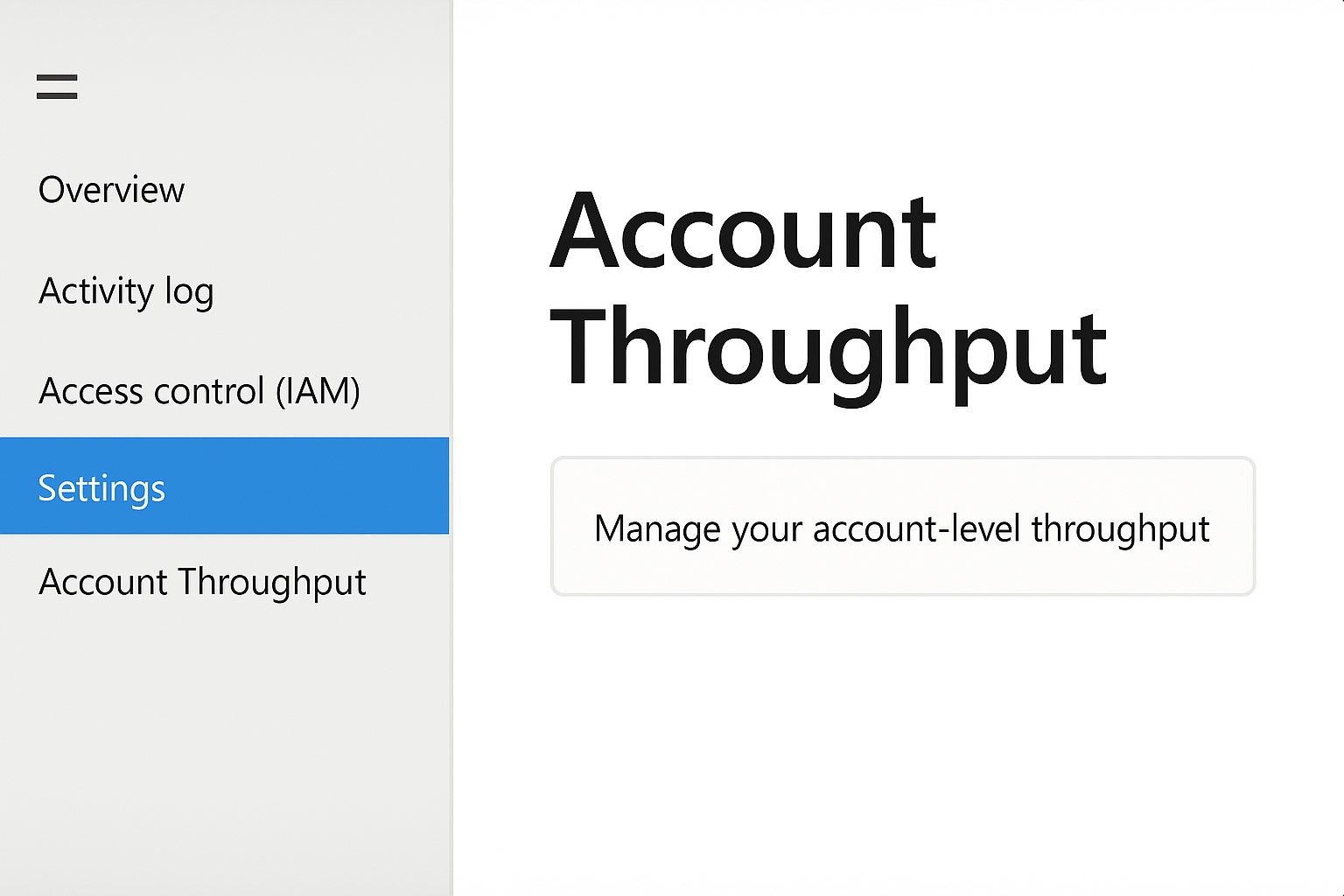
“Cost Management” Is Now “Account Throughput” and It’s Moving
We’ve made a small but important change in the Azure portal for Azure Cosmos DB to make it easier to manage your account-level throughput. The “Cost Management” section has been renamed to “Account Throughput” and can now be found under the Settings section of your Azure Cosmos DB account in the Azure portal. What you can do in Account Throughput From Account Throughput you can: Where to find it In the Azure portal, open your Azure Cosmos DB account from the left navigation side bar→ Settings → Account Throughput. This update does not change how the feature works, only where you will fin...
Announcing latest Azure Cosmos DB Python SDK: Powering the Future of AI with OpenAI
We're thrilled to announce the stable release of Azure Cosmos DB Python SDK version 4.14.0! This release brings together months of innovation and collaboration, featuring ground-breaking capabilities that have been battle-tested in production environments. Many of these features were developed in close partnership with OpenAI, who rely heavily on Cosmos DB to store chat data for ChatGPT at massive scale. What Makes This Release Special After extensive beta testing, we're proud to deliver a stable release that combines performance, intelligence, and developer productivity. The features in this release have bee...
Boost your Azure Cosmos DB Efficiency with Azure Advisor Insights
Azure Cosmos DB is Microsoft’s globally distributed, multi-model database service, trusted for mission-critical workloads that demand high availability, scalability, and low latency. In this post we will discover how to maximize the full potential of Azure Cosmos DB using Azure Advisor recommendations to help you build smarter, faster, and more securely. What is Azure Advisor? Azure Advisor is your cloud optimization assistant. It analyzes your Azure resources and configurations, then delivers personalized, actionable recommendations to help you: These recommendations are grou...
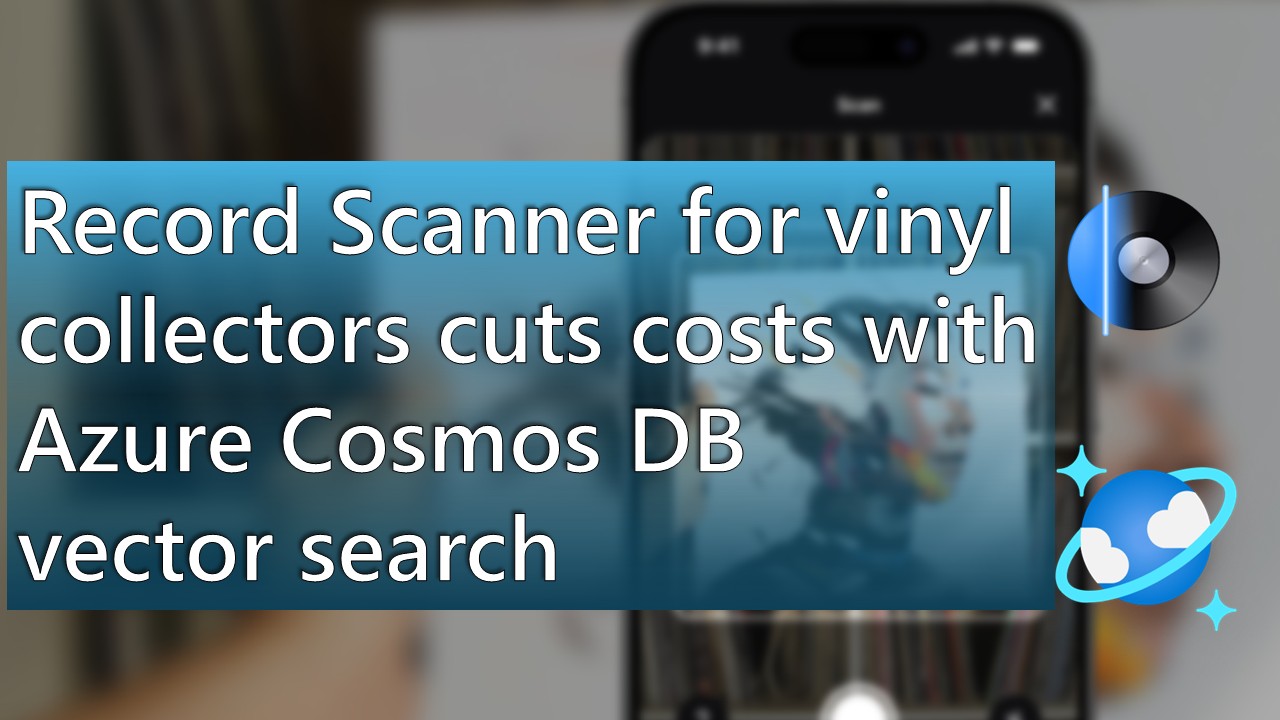
Record Scanner for vinyl collectors cuts costs with Azure Cosmos DB vector search
by Artur Drozdz, Founder of Record Scanner (recordscanner.com) If you’re like me, there’s at least one room in your home with an entire cabinet dedicated to your growing vinyl collection. At this point, you’ve probably heard that vinyl is making a comeback, it’s not just vintage anymore. In fact, after hitting a low during the 90s and 2000s, sales of records grew by 10 percent in 2024, largely driven by Gen Z-ers. About seven years ago, I looked at my collection and decided it was time to finally organize it. I went searching for an app to help me catalog my treasures, but the solutions I found were not eas...
🚀 Introducing the New VS Code Extension for Azure Cosmos DB
We’re excited to share that the Azure Databases extension for Visual Studio Code is now officially rebranded as the Azure Cosmos DB extension! 🎯 Why the Change? This rebranding is part of our effort to provide dedicated, streamlined tooling for each Azure database service. Similar to our extensions for MongoDB and PostgreSQL, the new Cosmos DB extension is now focused exclusively on Azure Cosmos DB for NoSQL, giving you a faster, simpler, and more optimized developer experience. ✨ What’s in for Azure Cosmos DB for NOSQL? 💡Good news: If you’re already using Cosmos DB NoSQL, you don’t need to do a...
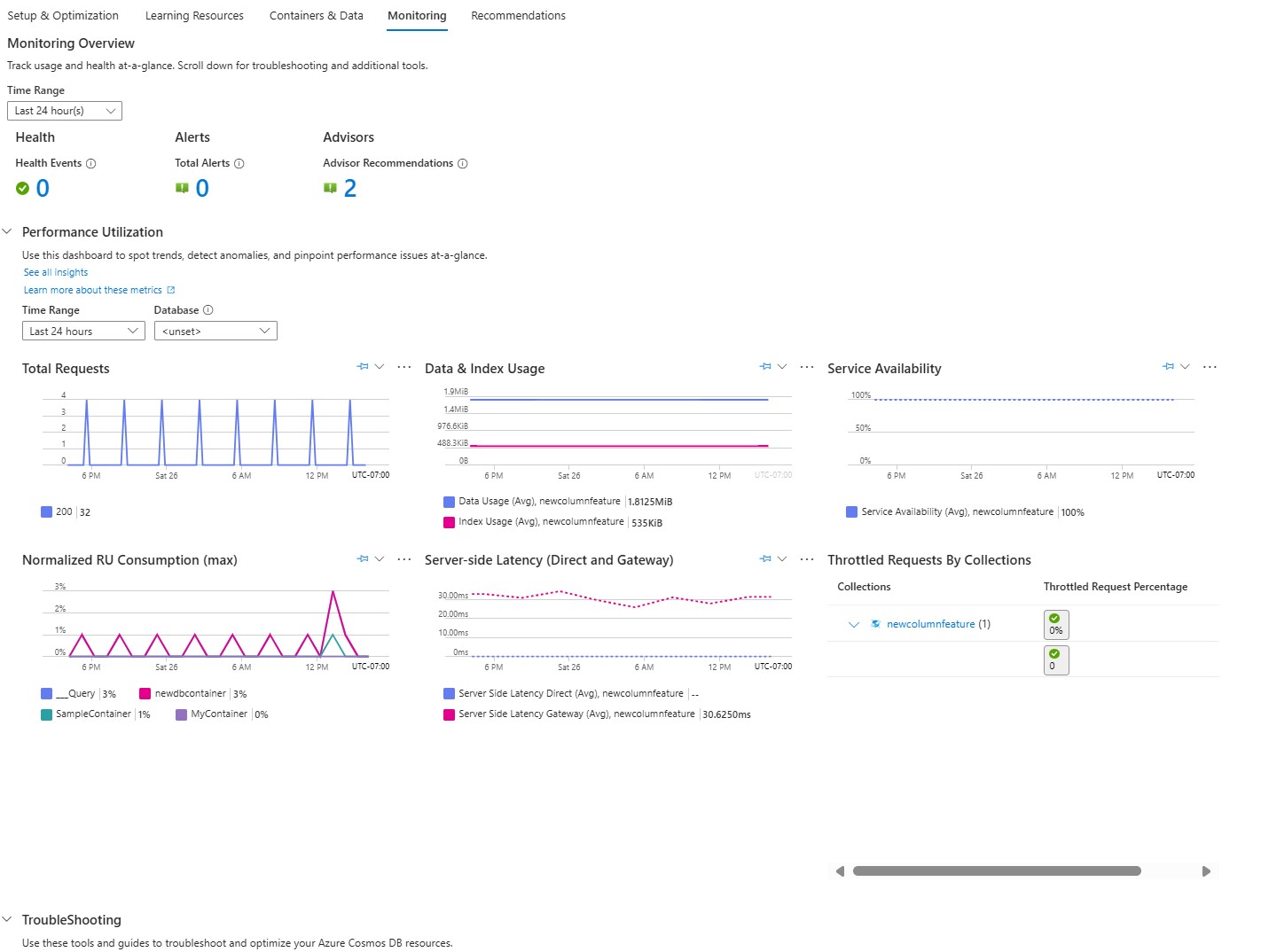
Introducing the Azure Cosmos DB Account Overview Hub
A Simpler Way to Navigate, Learn, and Optimize your Azure Cosmos DB Account within the Azure Portal. Whether you are just getting started with Azure Cosmos DB or managing a production workload, finding the right tools and guidance in the Azure portal should be simple. The new Cosmos DB Account Overview Hub makes that possible. It brings together setup help, data access, monitoring tools, learning resources, and recommendations, all in one central, easy-to-navigate view. Try it out by navigating to your Azure Cosmos DB account, then navigate to the left navigation pane and select Overview. What You will...
Secure Your Connections with Entra ID Support in the DocumentDB VS Code Extension
Today, we're thrilled to announce a major update to the DocumentDB for VS Code extension that will make life easier for enterprise developers. With version 0.3, you can now connect to your Azure Cosmos DB for MongoDB (vCore) clusters using Microsoft Entra ID authentication. For many organizations, using a central identity provider is a top security priority. Entra ID (formerly Azure AD) provides a secure, passwordless authentication method that helps you move away from managing connection strings with secrets. This update brings that modern security standard directly into your VS Code workflow so you can conn...

Everyone is talkin’ bout vibes
Leading up to Microsoft Ignite, I wanted to pressure-test something the community keeps talking about: vibe coding. It’s a style of AI-assisted development where you describe outcomes in natural language and your assistant does most of the scaffolding, refactoring, and glue. You keep momentum by talking through the work, and you only drop to raw code when you need to tighten the screws. If you’ve ever written music, the metaphor fits: you’re chasing a riff, not over-theorizing scales. A writing partner sits beside you, nudging phrasing, trimming bars, and pushing you through the bridge. After a few loops, you’ve...
Data encryption with customer-managed key (CMK) for Azure Cosmos DB for MongoDB vCore

Built-in security for every configuration Azure Cosmos DB for MongoDB vCore is designed with security as a foundational principle. Regardless of how your cluster is configured—whether it's a single-node deployment or a multi-shard architecture—your data is always encrypted at rest using the AES-256 cipher, one of the most trusted and widely adopted encryption standards. This encryption is automatically handled using a service-managed key (SMK). There’s no setup required, no toggle to enable—it’s always on. SMK-based encryption ensures that your data is protected by default, delivering all the benefits of AES-...
Azure Managed Instance for Apache Cassandra v5.0 Generally Available!
Azure Managed Instance for Apache Cassandra Upgrade to Cassandra v5.0 is now generally available, bringing a host of powerful new features and performance improvements to your cloud-native applications. This release marks a significant milestone for developers and data platform teams looking to modernize their distributed data infrastructure. Why Upgrade to Cassandra v5.0? Cassandra v5.0 introduces several enhancements that make it a compelling upgrade for existing users and an attractive option for new workloads. With support for ACID transactions, Dynamic Data masking, Vector Search, Storage-attached inde...
Build a RAG application with LangChain and Local LLMs powered by Ollama
Local large language models (LLMs) provide significant advantages for developers and organizations. Key benefits include enhanced data privacy, as sensitive information remains entirely within your own infrastructure, and offline functionality, enabling uninterrupted work even without internet access. While cloud-based LLM services are convenient, running models locally gives you full control over model behavior, performance tuning, and potential cost savings. This makes them ideal for experimentation before running production workloads. The ecosystem for local LLMs has matured significantly, with several exce...
Scalable AI with Azure Cosmos DB – Video Series
Scalable AI in Action with Azure Cosmos DB – A Monthly Partner Showcase As AI continues to reshape industries, customers are seeking scalable, real-time solutions that integrate seamlessly with their existing data platforms. Azure Cosmos DB, with its global distribution, low latency, and multi-model support, is uniquely positioned to power intelligent applications at scale. To help customers explore what’s possible, we’re launching the Scalable AI in Action with Azure Cosmos DB series—a monthly video session that highlights how partners are building transformative AI solutions using Azure Cosmos DB and Azur...
Scaling multi-tenant Go applications: Choosing the right database partitioning approach
Multi-tenant applications face a fundamental challenge: how to efficiently store and query data for tenants of vastly different sizes? Consider the typical scenario where your platform serves both enterprise clients with hundreds of thousands of users, as well as small businesses with just a handful. With traditional database partitioning strategies you are likely to run into these common issues: Azure Cosmos DB has been a go-to solution for multi-tenant applications due to its global distribution, automatic scaling, and flexible data models. Its partition-based architecture naturally aligns ...
Integration testing for Go applications using Testcontainers and containerized databases
Integration testing has always presented a fundamental challenge: how do you test your application against real dependencies without the complexity of managing external services? Traditional approaches often involve either mocking dependencies (which can miss integration issues) or maintaining separate test environments (which can be expensive and difficult to manage consistently). Hello Testcontainers! Testcontainers solves this problem elegantly by providing a way to run lightweight, throwaway instances of databases, message brokers, web servers, and other services directly within your test suite. Instead of ...
Build reliable Go applications: Configuring Azure Cosmos DB Go SDK for real-world scenarios
When building applications that interact with databases, developers frequently encounter scenarios where default SDK configurations don't align with their specific operational requirements. They need to customize SDK behavior to address real-world challenges like network instability, performance bottlenecks, debugging complexity, monitoring requirements, and more. These factors become even more pronounced when working with a massively scalable, cloud-native, distributed database like Azure Cosmos DB. This blog post explores how to customize and configure the Go SDK for Azure Cosmos DB beyond its default settin...
Announcing Cosmos DB in Microsoft Fabric (Preview) with New Capabilities!
We’re excited to unveil the open Public Preview of Cosmos DB in Microsoft Fabric, now available to all users! Since our initial announcement at Microsoft Build 2025, we’ve introduced an array of powerful new features to enhance your data workflows. With this release, you can seamlessly access and analyze your operational data across the Fabric ecosystem. Leverage real-time intelligence, Copilot-powered Power BI, and SQL queries in OneLake—all without the hassle of managing multiple services. We’re committed to expanding integration support to help you get even more value from your data in Fabric. Why Cosm...
Building Event-Driven Go applications with Azure Cosmos DB and Azure Functions
The Go programming language is a great fit for building serverless applications. Go applications can be easily compiled to a single, statically linked binary, making deployment simple and reducing external dependencies. They start up quickly, which is ideal for serverless environments where functions are frequently invoked from a cold start. Go applications also tend to use less memory compared to other languages, helping optimize resource usage and reduce costs in serverless scenarios. Azure Functions supports Go using custom handlers, and you can use triggers and input and output bindings via extension bundl...

Latest NoSQL Java Ecosystem Updates: June 2024 – June 2025
Welcome to the latest roundup of key updates across the Azure Cosmos DB Java ecosystem! The largest external customers of Azure Cosmos DB API for NoSQL, running some of the biggest and most mission critical workloads in Azure, are primarily Java users! From powerful new AI integrations to improvements in the Java SDK, Spring Data, Spark, and Kafka connectors, the past year has been transformative for developers building cloud-native and AI-powered applications. It's never been easier or more powerful to build modern Java applications on Azure Cosmos DB! Stay tuned for more updates in the future. Happy coding! ...

Building a Modern Python API with Azure Cosmos DB: A 5-Part Video Series

I'm excited to share our new video series where I walk through building a production-ready inventory management API using Python, FastAPI, and Azure Cosmos DB NoSQL. This project demonstrates modern async patterns, clean architecture, and enterprise-grade features like batch operations and optimistic concurrency control. This builds on our Getting Started Series, check out those videos to grasp the fundamentals first. Video 1: Data Modeling with Pydantic In the first video, I dive deep into data modeling using Pydantic v2, showing how to create robust, type-safe models with built-in validation. The...
Powering Real-Time Messaging at Scale with Azure Cosmos DB

Microsoft Teams, Copilot, Azure Communication Services and many other product offerings from Microsoft, rely on a unified messaging platform that powers real-time communication and collaboration at an unprecedented scale. This messaging platform has become critical for enabling boundary-less collaboration, supporting hundreds of millions of users worldwide. To ensure global discovery, durable storage and performance needed for real time communication, the messaging platform relies on Azure Cosmos DB as one of its data storages. It has data distributed in most Azure regions, has several Petabytes of data and perfo...
Building Multi-Agent AI Apps in Java with Spring AI and Azure Cosmos DB!
As AI-driven apps become more sophisticated, there's an increasing need for them to mimic collaborative problem solving - like a team of domain experts working together. Multi-agent apps offer exactly that: collections of specialized agents that cooperate to handle complex tasks. But to make them production-grade, you need more than just clever prompts - you need structure, orchestration, memory, and insight. In this blog, we will walk through the multi-agent-spring-ai sample - a full-stack example of how to build a custom multi-agent orchestration framework using Spring AI, Azure Cosmos DB, and Azure OpenAI. ...

Azure Cosmos DB TV – Everything New in Azure Cosmos DB from Microsoft Build 2025

Microsoft Build 2025 brought major innovations to Azure Cosmos DB, and in Episode 105 of Azure Cosmos DB TV, Principal Program Manager Mark Brown sits down with Kirill Gavrylyuk, Vice President and GM of Azure Cosmos DB, to break it all down. Whether you're developing AI-native apps, building with MongoDB, or just looking for better performance and observability, this episode covers all the latest updates—designed to help developers build faster, scale smarter, and integrate AI more seamlessly. Let’s recap the key features and announcements covered in the episode and point you to the full Build 2025 sessions to...
DocumentDB Local – MongoDB API on Your Machine

Introduction DocumentDB Local provides a lightweight, containerized environment that lets you develop and test applications locally using a MongoDB-compatible interface. It’s ideal for prototyping or running integration tests without needing a cloud setup. When paired with the DocumentDB Extension for Visual Studio Code, it creates a focused and consistent local development environment. DocumentDB Local is part of the broader open-source DocumentDB project, a document-oriented database engine built on PostgreSQL. You can explore the project and follow its updates here: https://github.com/microsoft/documentdb ...

Announcing General Availability of JavaScript SDK v4 for Azure Cosmos DB
We’re excited to launch version 4 of the Azure Cosmos DB JavaScript SDK! This update delivers major improvements that make it easier and faster to build high-performance apps with the Azure Cosmos DB for NoSQL API. Version 4 is available now and targets Node.js v18 and above, introducing a host of new capabilities, including: Version 4 of the SDK is open source, built entirely in TypeScript, and designed for modern JavaScript development. It offers full support for Promises and the async/await pattern, enabling clean and efficient coding. The SDK also follows official JavaScript SDK d...

Confluent Cloud Releases Managed V2 Kafka Connector for Azure Cosmos DB
This article was co-authored by Sudhindra Sheshadrivasan, Staff Product Manager at Confluent. We’re excited to announce the General Availability (GA) of the Confluent Cloud-managed V2 Kafka Connector for Azure Cosmos DB! This release marks a major milestone in our mission to simplify and streamline real-time data streaming from and into Azure Cosmos DB using Apache Kafka. The V2 connector is now production-ready and available directly from Confluent Cloud’s connector catalog. This managed connector allows you to seamlessly integrate Cosmos DB with your Kafka-powered event streaming architecture, without wor...
Meet the DocumentDB Extension for VS Code and DocumentDB Local — A Fast, Friendly Way to Work with DocumentDB, Locally and Beyond
Say hello to the new DocumentDB extension for Visual Studio Code—an efficient open-source database tool that brings your MongoDB API and DocumentDB databases right into your editor. Designed for developers building cloud apps, working in hybrid or local setups, or debugging live production systems, this extension lets you browse, manage, and query your data directly from VS Code with ease. DocumentDB, Now Seamlessly Integrated into VS Code With the DocumentDB extension installed you can browse collections, inspect documents, run queries, and even make quick data edits, all from a clean, native experienc...
Now in Public Preview: Azure Functions Trigger for Azure Cosmos DB for MongoDB vCore
The Azure Cosmos DB trigger for Azure Functions is now in public preview—available for C# Azure Functions using Azure Cosmos DB for MongoDB vCore! This new capability allows developers to easily trigger Azure Functions in response to changes in a MongoDB vCore collection, making it simple to build real-time, event-driven applications with minimal setup. 🔍 What’s New? Until now, change feed-based triggers in Azure Functions were only available for the API for NoSQL. With this new extension, MongoDB developers using Azure Cosmos DB’s vCore architecture now get first-class serverless support. The Cosmos ...

Now Available: Migrate from RU to vCore for Azure Cosmos DB for MongoDB via Azure Portal
We are thrilled to introduce a cost-effective, simple, and efficient solution for migrating from RU-based Azure Cosmos DB for MongoDB to vCore-based. You can now move to vCore-based Azure Cosmos DB for MongoDB at no cost using the Azure portal. How is the vCore model different? Azure Cosmos DB offers two pricing models: Request Units (RU) and vCore. The RU-based model ensures dynamic pricing based on throughput consumption, allowing dynamic scaling and optimized performance. With higher scale-out elasticity, top-end scalability, and consistent availability, RU-based provisioning works best for workloads with...

Generally Available: Seamless Migration from Serverless to Provisioned Throughput in Azure Cosmos DB
We are excited to announce the general availability (GA) of a highly requested capability in Azure Cosmos DB: the ability to migrate from serverless to provisioned throughput mode—without manual recreation, or downtime. This release builds on the momentum of our public preview and is now fully supported across all regions. Why it matters Azure Cosmos DB offers two powerful capacity modes designed to match your application's scale and usage patterns: With this new capability, you can now start with serverless—avoiding the need to estimate or configure throughput early—and transition seamlessly to...

Public Preview: Shape and Control Workloads with Throughput Buckets in Azure Cosmos DB
Imagine your application is processing customer checkouts in real-time, while a background process synchronizes data for reporting. Suddenly, the seamless user experience falters because the sync job consumes more RU/s than anticipated. Many teams face a common challenge: multiple workloads share the same container resources, yet each has different performance requirements. We're excited to introduce the public preview of Throughput Buckets in Azure Cosmos DB for NoSQL—a new solution designed to address this challenge. Introducing Throughput Buckets Throughput Buckets allow you to set a maximum RU/s c...

Microsoft Entra ID integration with Azure Cosmos DB for MongoDB (vCore)
Security is no longer a nice-to-have—it’s a foundational requirement for any cloud-native architecture. As organizations adopt managed database services to support mission-critical applications, they must prioritize robust, scalable, and centralized security. Azure Cosmos DB for MongoDB (vCore) delivers high performance and flexibility, but it provides the most value when paired with well-implemented security practices. Authentication anchors any effective security strategy. It verifies that only authorized users and applications can access your data and serves as the first line of defense against unauthorized...

DiskANN and Filtered Vector Search are Now Generally Available in Azure Cosmos DB for MongoDB (vCore)
We’re excited to announce general availability of DiskANN and Filtered Vector Search on Azure Cosmos DB for MongoDB (vCore), starting with M30 cluster tiers and above. You can now use these features in production to store and query vector embeddings directly alongside your operational data—efficiently and in one integrated vector database. DiskANN Indexing: Scaling Vector Search to Massive Datasets Efficient vector indexing is critical for AI applications that process large-scale datasets. While HNSW and IVF each offer advantages, we recommend DiskANN for datasets with more than 1 million documents. Dis...
Now in Preview: Azure Cosmos DB Fleets

We’re excited to announce the preview of Azure Cosmos DB fleets. Azure Cosmos DB fleets address common challenges that developers face when building and managing multi-tenant or Software as a Service (SaaS) applications. Today, many SaaS providers using Azure Cosmos DB isolate each tenant in a separate database account to meet strict performance and security requirements—for example, supporting customer-managed keys. While this approach ensures tenant isolation, it creates operational complexity at scale. Managing thousands of RU/s settings becomes difficult, and provisioning dedicated capacity for every te...
General Availability of Change Streams in vCore-Based Azure Cosmos DB for MongoDB

We’re excited to announce the general availability (GA) of Change Streams for Azure Cosmos DB for MongoDB (vCore)—empowering developers to build real-time, event-driven applications with ease and scale. With Change Streams now in GA, your applications can react instantly to data changes in the database, enabling low-latency use cases such as live dashboards, alerting systems, and reactive microservices. Whether you're building IoT platforms, order processing systems, or collaborative applications, Change Streams provides the foundation for responsive, modern architectures. Key Capabilities Now Availab...

Announced at Build 2025: Foundry connection for Azure Cosmos DB, Global Secondary Index, full-text search, and more
The countdown to innovation has begun: Day 1 of Microsoft Build 2025 bought several new announcements, demos, and live coding sessions to in-person and online audiences, showcasing the potential of cloud-native and AI-driven applications. Azure Cosmos DB is at the forefront of this innovation. From powering multi-agent applications and unlocking high-speed analytics to delivering new features designed for faster and easier app development, we highlighted once again why Azure Cosmos DB is the go-to database for developers building at the edge of what’s possible. Here’s a look at what we announced today and Day...

Accelerating MongoDB Development on Azure: What’s New at Microsoft Build 2025
Microsoft Build 2025 is underway in Seattle, bringing developers together to shape the future of cloud-native app development. If you build MongoDB workloads in Azure, this year’s updates give you even more tools to accelerate development. We’ve streamlined how you build and modernize MongoDB applications in the cloud with our managed service- vCore-based Azure Cosmos DB for MongoDB- powered by DocumentDB, our fully open-source, MongoDB-compatible, multi-cloud engine. Whether you're driving real-time workloads, creating AI-powered chatbots, or scaling mission-critical applications, here’s everything new for M...

New Generally Available and Preview Search Capabilities in Azure Cosmos DB for NoSQL
At Microsoft Build 2025, we're excited to announce general availability of search capabilities for Azure Cosmos DB, including full-text and hybrid search, enabling developers to build highly performant, scalable, and intelligent applications. We're also introducing new preview enhancements such as multi-language support and fuzzy search, further enriching search accuracy and flexibility across the globe. To streamline developer productivity, we're announcing improved developer tooling, featuring Entity Framework integration and robust LINQ support for Azure Cosmos DB search capabilities. Additionally, Filtered Ve...

What’s new in Azure Cosmos DB for NoSQL at Microsoft Build 2025

Building modern, scalable applications often comes with the challenge of managing and scaling your database infrastructure. That’s exactly why we built Azure Cosmos DB – to provide a fast, flexible NoSQL database service that frees you from the operational heavy lifting. With automatic scaling, built-in high availability, and consistent single-digit millisecond performance at any scale, Azure Cosmos DB lets you focus on innovating rather than database administration. Today, at the Microsoft Build 2025 conference, we're excited to announce powerful new features to Azure Cosmos DB aligned to four key investm...
Boost Query Performance with Global Secondary Indexes in Azure Cosmos DB
Global secondary indexes for Azure Cosmos DB—now in Public Preview—make it easier to query data efficiently, especially as your datasets grow. Distributed databases like Azure Cosmos DB scale with dataset growth by partitioning data across multiple physical machines. When your queries include the partition key, the client routes them directly to the appropriate partition. Queries that include the partition key remain low-latency regardless of how many partitions exist. But in real-world applications, or in the case of AI apps and agents, you often need to query data without including the partition key. Th...

Elevating Azure Cosmos DB Resilience with Per Partition Automatic Failover
Announcing Per Partition Automatic Failover for Azure Cosmos DB Today, we’re excited to announce the preview of Per Partition Automatic Failover (PPAF) for Azure Cosmos DB, a significant improvement to our single-region write accounts that boosts availability and resilience. If you rely on Azure Cosmos DB to be “always on” for your mission-critical applications, this new feature is built for you. Per Partition Automatic Failover enables Azure Cosmos DB to recover more quickly and efficiently during regional outages. Azure Cosmos DB already supports active-active deployment using multi-writes. With PPAF, we no...

Azure AI Foundry Connection for Azure Cosmos DB and BYO Thread Storage in Azure AI Agent Service
We’re announcing new integrations between Azure Cosmos DB and the Azure AI ecosystem: the Azure AI Foundry Connection for Azure Cosmos DB and bring-your-own thread storage in Azure AI Agent Service. These capabilities make it easier for developers to build enterprise-ready agentic applications using their own data stored in Azure Cosmos DB. Azure AI Foundry Connection for Azure Cosmos DB The Azure AI Foundry Connection for Azure Cosmos DB for NoSQL is a foundational step toward enabling rich data scenarios for AI and agentic applications. This integration opens the door to advanced data capabilities within the ...

Build 2025 Preview: Transform Your AI Apps and Agents with Azure Cosmos DB
Microsoft Build is less than a week away, and the Azure Cosmos DB team will be out in force to showcase the newest features and capabilities for building AI apps and agents with scalable, fast, high-performance data. Whether you’re in person at the Seattle Convention Center or watching the live or on-demand digital show, we can’t wait to show you what we’ve been up to. Add these breakout, demo, and labs sessions to your Build schedule: Monday, May 19th 🗓️ 11:45am PT: What’s New in Microsoft Databases: Empowering AI-Driven App Dev (BRK204) with Shireesh Thota, Corporate VP of Engineering – Databases...

Fabric Mirroring for Azure Cosmos DB: Public Preview Refresh Now Live with New Features
We’re thrilled to announce the latest refresh of Fabric Mirroring for Azure Cosmos DB, now available with several powerful new features that enhance your data analytics infrastructure. This update significantly improves the experience, making it easier than ever to replicate your Azure Cosmos DB data into OneLake in Microsoft Fabric—giving you more control and flexibility over your mirrored databases. New Features Entra ID Authentication Support for Source Connections Azure Cosmos DB Mirroring now supports authentication via Microsoft Entra ID (formerly Azure AD), in addition to account keys. This enhancem...

Azure Cosmos DB with DiskANN Part 4: Stable Vector Search Recall with Streaming Data


Vector search with Azure Cosmos DB In Part 1 and Part 2 of this series, we explored vector search with Azure Cosmos DB and best practices for scaling it to 1 billion vector datasets while maintaining low query latency. In Part 3, we saw how we can create efficient sharded DiskANN indices for multi-tenant apps. In Part 4, we’ll look at the effect that streaming ingestion, a stream of inserts, deletes, and replaces of vectors in the database, has on the quality of the vector index. This is unlike the often reported single-shot ingestion where data is ingested once in bulk and recall is measured at the end whe...

General Availability for Data API in vCore-based Azure Cosmos DB for MongoDB

Title: General Availability for Data API in vCore-based Azure Cosmos DB for MongoDB We’re excited to announce the general availability of the Data API for vCore-based Azure Cosmos DB for MongoDB! Overview The Data API is a RESTful HTTPS interface that enables developers to interact with their MongoDB data hosted in vCore-based Azure Cosmos DB directly from their applications—no drivers or complex query logic required. It offers a simple, efficient way to connect your MongoDB data with web apps, mobile apps, and tools like Power BI. At launch, the Data API supports the following read operations: ...
Getting Started with Azure Cosmos DB Using the Python SDK
If you're new to Azure Cosmos DB and looking to build applications with Python, you're in the right place. I’ve created a four-part video series designed to take you from the basics to practical, real-world querying techniques—no prior experience required. Whether you’re setting up your first database, learning how to model your data, or optimizing your queries, this series will help you build confidence with each step. This blog post is your companion guide. It introduces key concepts, outlines what each video covers, and provides helpful context so you can follow along more effectively. Whether you're a stud...

Fast, Accurate, and Affordable: Sharded DiskANN for Multitenant Vector Search in Azure Cosmos DB


Introduction Azure Cosmos DB now includes Sharded DiskANN, a powerful capability that optimized for large-scale multitenant apps by splitting a DiskANN index into smaller, more performant pieces. When you specify a VectorIndexShardKey in your container’s indexing policy, Azure Cosmos DB creates multiple DiskANN indexes, one for each unique value of the selected document property. This can provide multiple benefits including: Use Cases Sharded DiskANN is especially valuable in scenarios where data isolation and targeted search are essential, such as: How is it different than...
Azure Cosmos DB Conf 2025 Recap: AI, Apps & Scale
On April 15, 2025, developers from around the world came together for Azure Cosmos DB Conf 2025—a free virtual event co-hosted by Microsoft and the vibrant Azure Cosmos DB community. From early-morning keynotes to lightning talks and live demos, the event was packed with fresh insights, expert guidance, and real-world examples of how developers are solving complex challenges with Azure Cosmos DB. This year’s sessions explored a broad spectrum of themes, including AI-powered workloads, real-time analytics, cost optimization, open-source tools, hybrid and vector search, and data security. Whether attendees were new...

Azure Cosmos DB with DiskANN Part 2: Scaling to 1 Billion Vectors with <100ms Search Latency
Introduction In the first part of our series on Azure Cosmos DB Vector Search with DiskANN, we explored the fundamentals of vector indexing and search capabilities using Azure Cosmos DB for NoSQL and demonstrated a few early performance and cost characteristics. In Part 2, we’ll demonstrate how to scale to 1 billion vector datasets, while maintaining a query latency of under 100 milliseconds with > 90% recall, all in a cost-effective manner. Along the way, we will review concepts like partitioning for managing large-scale vector data in Azure Cosmos DB, along with optimizations & best practices for faster...

Introducing Region Selection in Azure Cosmos DB Data Explorer for NoSQL Accounts

You asked—we delivered! Users can now manually select the region Data Explorer sends requests to! When you use Entra Authentication with NoSQL accounts, you can now enable the Region Selection option in settings. This new capability gives you precise control over where your requests are sent, helping you test, troubleshoot, and optimize performance by targeting a specific Azure region directly from the portal. When you select a specific region, the Azure Cosmos DB client disables endpoint discovery and sends requests only to that region. This works similarly to using a regional connection string at https://...

Getting insights from changes to items in Azure Cosmos DB just got easier!
Azure Cosmos DB’s change feed provides a view of changes to data in your container. This enables patterns like event sourcing, auditing and synchronizing downstream systems. Change feed can be read in real time or on demand, giving you the most flexibility for processing and reprocessing changes. Change feed is available in two modes, latest version mode and all versions and deletes mode. The all versions and deletes mode Public Preview is now easier to use and you can enable it directly on your accounts without registering your subscription! Latest version mode gives you changes from create and update operati...
Unlock Real-Time Insights: Power BI Integration with vCore-based Azure Cosmos DB for MongoDB Now in Public Preview!
We are excited to introduce Power BI integration for vCore-based Azure Cosmos DB for MongoDB. This certified solution brings your operational data to life through real-time dashboards, directly in the Power BI interface that your analytics teams already love. You can now connect Power BI Desktop directly to your vCore-based Azure Cosmos DB for MongoDB instance, choose your collections, and start building dynamic dashboards using native MongoDB queries. Track real-time user activity, monitor inventory levels, or visualize your order pipeline right from your production database. This connector brings product an...

Exact Nearest Neighbor (ENN) Vector Search for Precise Retrieval
In applications such as personalized recommendations and scientific research, accurately identifying the closest data points to a given query is crucial. Traditional methods like Approximate Nearest Neighbor (ANN) search offer faster retrieval times by approximating results but may sacrifice accuracy, leading to potential errors in scenarios where precision is essential. This trade-off between speed and accuracy poses a significant challenge when exact results are necessary. Exact Vector Search (ENN) is a search method that compares your input vector to every single vector in the dataset to find the closest ma...
Azure Cosmos DB Conf 2025: Learn, Build, and Connect with the Community
Join us for the 5th annual Azure Cosmos DB Conf, a free virtual developer event co-hosted by Microsoft and the Azure Cosmos DB community. This is your opportunity to learn from Microsoft product managers, industry experts, and real-world customers who are building applications with Azure Cosmos DB. This year, we received over 100 session proposals from 87 unique speakers, making it one of our most competitive and diverse events yet. Why You Should Watch Whether you’re a developer getting started or an experienced architect, this conference offers something for everyone. Expect engaging 25-minute sessio...
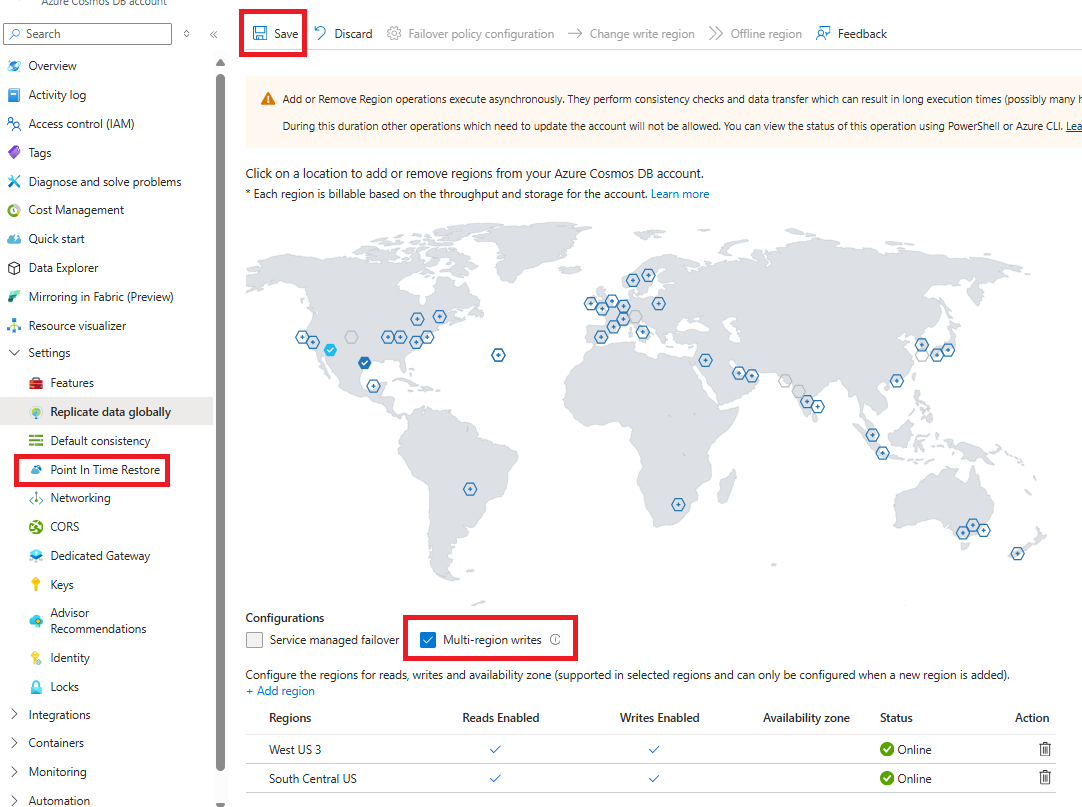
Enable continuous backup for multi-region write account

Azure Cosmos DB already delivers 99.999% availability with multi-region write capability and continuous backup for point-in-time restores within a 7 or 30 day retention period. Now, we’re making it even better! Going forward - There are no special charges - the existing point in time charges for backup, restore and multi region write cost continue. Please check out the documentation about multi-region writes, point in time restore capability Go ahead give it a try! (With care from - Min Ho Kang, Mayank Katwal, Vivek Agarwal, Vinh Trinh, Kalyan Khandrika, Kshittiz Kumar, Dinesh...

TLS 1.3 support in Azure Cosmos DB
This article follows announcement on a previous article that mentioned the end of support for Transport Security Layer (TLS) 1.0/1.1. TLS 1.3 is the latest version of the internet’s most deployed security protocol, which encrypts data to provide a secure communication channel between two endpoints. Microsoft has implemented updates to enable TLS 1.3 for Azure Cosmos DB. When will TLS 1.3 support begin? Effective March 31, 2025, support for TLS 1.3 will be enabled for Azure Cosmos DB. What issues might TLS 1.3 cause? If your application relies on an Azure Cosmos DB SDK version between 4.20.0 and 4.40.0 with...
Effortless Scaling: Autoscale goes GA on vCore-based Azure Cosmos DB for MongoDB

We’re thrilled to announce that Autoscale is now generally available (GA) for vCore-based Azure Cosmos DB for MongoDB! Say goodbye to manual scaling and overprovisioning—Autoscale dynamically adjusts your database capacity in real time, ensuring peak performance exactly when you need it. Unlike traditional managed MongoDB solutions that take hours (or even days) to scale, Autoscale responds instantly, optimizing resources and cutting unnecessary costs. The future of database scaling is here—provision Autoscale today and let your MongoDB workloads take care of themselves! Leave a rev...
Making MongoDB workloads more affordable with M10/M20 tiers in vCore-based Azure Cosmos DB
vCore based Azure Cosmos DB for MongoDB is expanding its offerings with the new cost-effective M10 and M20 tiers for vCore-based deployments. These tiers lower the entry barrier for organizations adopting MongoDB within the Azure ecosystem, offering market-leading affordability while maintaining Azure's enterprise-grade reliability and features. Market-leading Affordability These new dedicated cluster tiers demonstrate Azure's commitment to making MongoDB accessible to all users, starting a 1.9 cents/hour! Cost is not a barrier to choosing vCore-based Azure Cosmos DB for your MongoDB workloads. Consist...
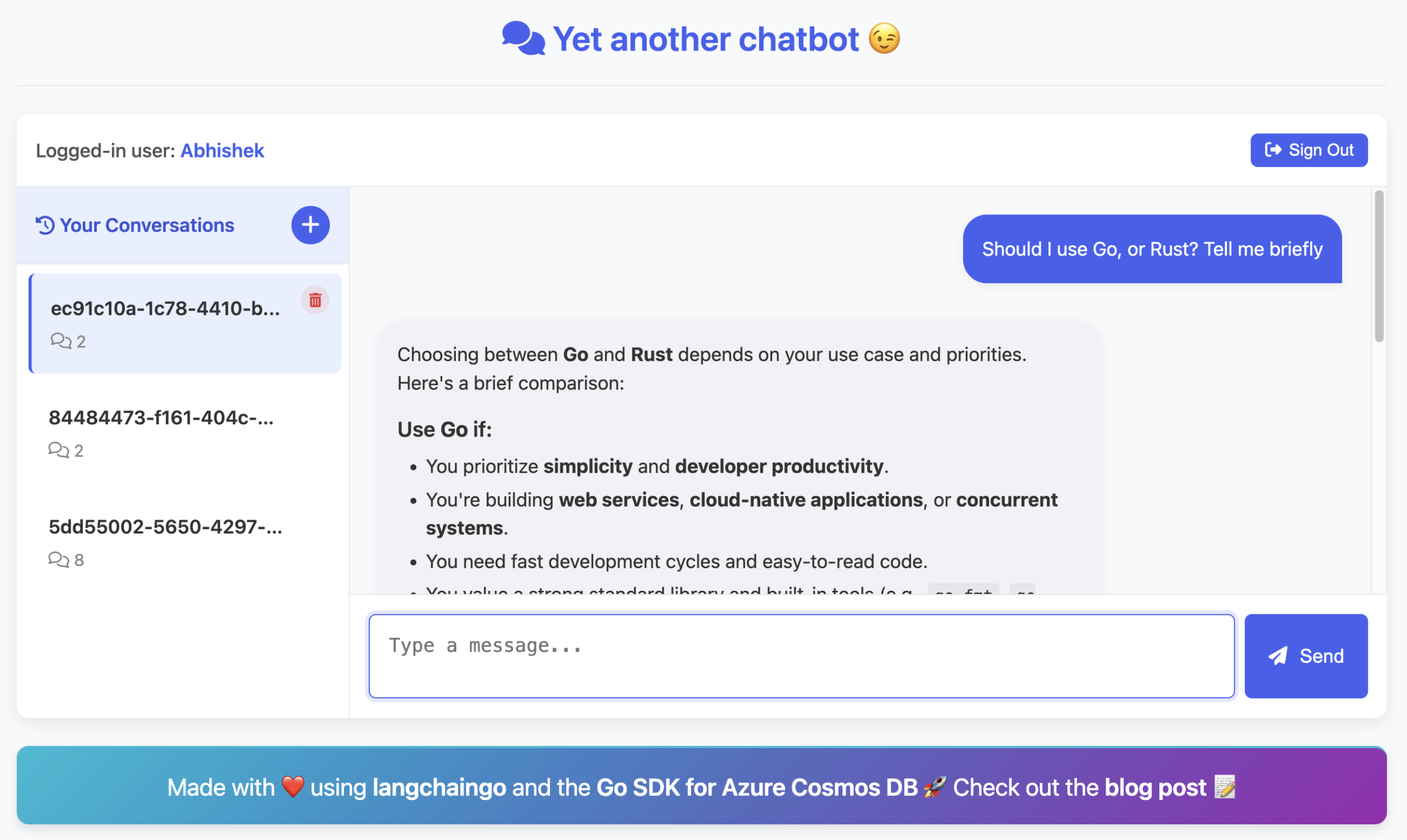
Implementing Chat History for AI Applications Using Azure Cosmos DB Go SDK
This blog post covers how to build a chat history implementation using Azure Cosmos DB for NoSQL Go SDK and langchaingo. If you are new to the Go SDK, the sample chatbot application presented in the blog serves as a practical introduction, covering basic operations like read, upsert, etc. It also demonstrates using the Azure Cosmos DB Linux-based emulator (in preview at the time of writing) for integration tests with Testcontainers for Go. Go developers looking to build AI applications can use langchaingo, which is a framework for LLM-powered (Large Language Model) applications. It provides pluggable APIs for ...
How Microsoft Copilot scales to millions of users with Azure Cosmos DB
This article is guest authored by Youssef Moussaoui, member of the technical staff, Microsoft Copilot. As part of the team developing Microsoft Copilot, we’re constantly looking for ways to improve the application and keep our millions of users engaged. With this in mind, we recently evaluated the structure of our backend and began looking for a database that would set the foundation for Copilot’s future. Copilot today processes billions of messages from millions of active users, so we needed a database solution that not only delivered a fast, engaging experience, but also provided worldwide coverage to sup...

Announcing the Public Preview of the Azure Cosmos DB SDK for Rust!
We’re excited to announce the public preview of the Azure Cosmos DB SDK for Rust, a native Rust SDK that enables developers to interact with Azure Cosmos DB for NoSQL accounts from their Rust applications. Following the release of Azure SDK for Rust Beta, the Azure Cosmos DB Rust SDK provides an idiomatic API for performing operations on databases, containers, and items. With this release, Rust developers can now build high-performance, scalable applications using Azure Cosmos DB. Rust is an excellent choice for modern application development due to its focus on performance, memory safety, and concurrency. ...

Migrating data from DynamoDB to Azure Cosmos DB
Co-authors: RK Iyer, Mangal Dutta Migrating stateful systems, such as databases, is a complex process. A frequent requirement for customers is to transfer data from DynamoDB to Azure Cosmos DB for NoSQL. This process involves several stages, including exporting data from DynamoDB, performing necessary transformations, and importing the data into Azure Cosmos DB. Common migration techniques: Offline and Online Migration strategies include offline and online approaches, which can be used independently or combined based on your needs. Online migration is ideal for applications requiring real-time data transfer ...

New Azure Cosmos DB Design Patterns Video Series – Learn, Implement, and Contribute!
We’re excited to introduce the Azure Cosmos DB Design Patterns video series—your go-to resource for learning how to design scalable, efficient, and cost-effective applications with Azure Cosmos DB. Built on real-world use cases, each episode explores a proven design pattern, walking through how it works, when to use it, and how to implement it using sample code from the Azure Cosmos DB Design Patterns GitHub repository. Hosted by Mark Brown (Azure Cosmos DB Principal Program Manager) and Jasmine Greenaway (Microsoft Senior Cloud Advocate), this series provides actionable insights to help you optimize your data ...
Moving to TLS 1.2 for Azure Cosmos DB: Ensuring Secure Connections
Security and reliability are at the core of modern cloud applications. To strengthen data protection and align with industry best practices, we encourage all Azure Cosmos DB customers to transition to TLS 1.2. This post explains why this change is important, how to make the transition, and the benefits it brings to your applications. Why Move to TLS 1.2? Transport Layer Security (TLS) is a critical component in securing data transmitted over networks. TLS 1.2 offers enhanced security features compared to its predecessors, TLS 1.0 and 1.1. By moving to TLS 1.2 or later, you ensure that your data is protected wi...

DocumentDB is Gaining Momentum in the Open-Source Database World

In the short amount of time since we unveiled DocumentDB, our open-source document database platform powering the vCore based Azure Cosmos DB for MongoDB, and the feedback has been nothing short of phenomenal. In this short time, we've received a lot of attention from tech media and community members alike. Rapid Community Adoption Developers and database enthusiasts have embraced DocumentDB with overwhelming enthusiasm, rapidly driving traction among both users and contributors. In just under a week, our project earned 1000 GitHub stars, nearly 50 forks, and multiple pull requests and issues—clear evidence of ...

A Powerful, Open-Source MongoDB GUI for Everyone
Introduction Azure Cosmos DB for MongoDB provides robust support through its Request Units (RU) model and vCore-based architecture, enabling flexible and scalable options for various workloads. We are now on a mission to deliver the ultimate developer experience. To achieve this, we have integrated Azure Cosmos DB for MongoDB support into the Azure Databases VS Code Extension. The free Azure Databases VS Code Extension, available on the VS Code Marketplace, provides a reliable and intuitive MongoDB GUI for developers, database administrators, and teams working with MongoDB - on Azure and beyond. MongoDB Supp...
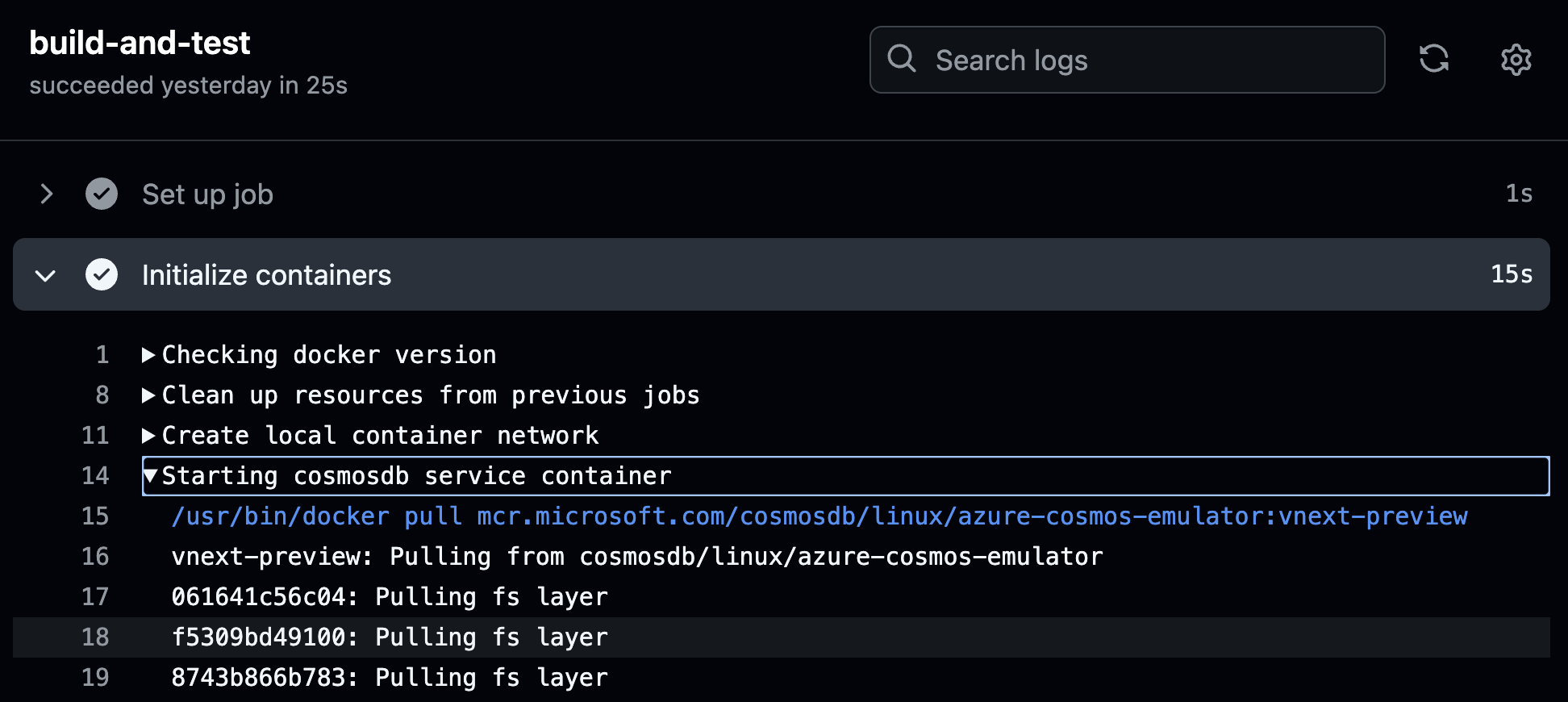
Use Azure Cosmos DB as a Docker container in CI/CD pipelines
There are lot of benefits to using Docker containers in CI/CD pipelines, especially for stateful systems like databases. For example, when you run integration tests, each CI job can start the database in an isolated container with a clean state, preventing conflicts between tests. This results in a testing environment that is reliable, consistent, and cost effective. This approach also reduces latency and improves the overall performance of the CI/CD pipeline because the database is locally accessible. The Linux-based Azure Cosmos DB emulator is available as a Docker container and can run on a variety of platf...

Doctors generate faster, more accurate medical charts with Sayvant and Azure Cosmos DB
This article is guest authored by Justin Mardjuki, CEO, Sayvant. Emergency rooms and urgent care facilities handle an estimated 350 million visits each year. Acute care environments are fast-paced, unpredictable, and high stakes. In these settings, providing care quickly is paramount. That’s why we created Sayvant, the leading clinical documentation AI solution for acute care. Sayvant helps clinicians generate accurate, defensible medical charts in seconds, enabling them to focus on delivering patient care instead of administrative tasks like documentation. Sayvant automates the creation of clinically accurate...
Revolutionizing Large-Scale AI with Janusgraph and Azure Managed Instance for Apache Cassandra

JanusGraph is a high-performance graph database that offers flexibility in choosing storage backends. Apache Cassandra is a distributed NoSQL database known for its scalability and fault tolerance. Combining these two technologies can create a robust and efficient graph database solution. You can use the Azure Managed Instance for Apache Cassandra which is a fully-managed offering on Azure with boasts of features such as Turnkey Horizontal and Vertical Scaling, Support for Customer Managed Keys, LDAP support, auto patch of OS, automatic repairs, Azure Monitor, Lucene Index support and keeping in line with tod...

Join the Conversation: Call for Proposals for Azure Cosmos DB Conf 2025!
Are you passionate about Azure Cosmos DB? Do you have insights, experiences, or innovations that the developer community would love to hear? Now is your chance to shine at the Azure Cosmos DB Conference 2025 – a free, virtual developer event co-organized by Microsoft and the vibrant Azure Cosmos DB community. Mark your calendar for April 15, 2025, and join us online for an exciting day of learning, sharing, and inspiration! This is our fifth annual conference, and we’re looking for YOU to contribute to making it an unforgettable experience! Why Submit a Proposal? Azure Cosmos DB Conference 2025 isn't jus...

Cosmos DB Embeddings Generator Sample
Ever since our first preview announcement for vector indexing and support for DiskANN and then again when we announced the GA for these features, customers have been asking us to make it easier to generate Azure OpenAI embeddings on their data in Azure Cosmos DB. So we did just that and created the Azure Cosmos DB Embeddings Generator sample application and hosted it on GitHub. This sample shows how to use an Azure Cosmos DB Trigger and Output Binding in Azure Functions to automatically generate Azure OpenAI embeddings on a new or updated item, then save it back to the same item in Cosmos DB. There is bo...

An introduction to Multi-Agent AI apps with Azure Cosmos DB and Azure OpenAI
Azure Cosmos DB was named by Bloomberg as the no. 1 Database of choice for Retrieval Augmented Generation (RAG) and Large Language Model (LLM) customization. It is used by OpenAI to scale it’s ChatGPT service, and by many thousands of customers worldwide, serving billions of end-users with globally distributed apps at planet scale. In this blog we will explore a simple example for lightweight multi-agent orchestration in Python using OpenAI Swarm. We’ll also see the benefits of being able to use Azure Cosmos DB as both a vector store and an operational database. What are multi-agent apps? Multi-agent AI apps...
Announcing Azure Cosmos DB Integration with Spring AI and Langchain4J!
We’re continuing to simplify AI app development by integrating Azure Cosmos DB’s cost-effective and scalable vector search directly with Spring AI and LangChain4J! These frameworks empower Java developers to efficiently manage fast and accurate data retrieval with Azure Cosmos DB’s scalability and efficient vector indexing and search capabilities, allowing for efficient handling of high-dimensional vectors. By using Azure Cosmos DB’s vector store, developers can keep vectors directly within their documents, enabling seamless integration with Spring AI or Langchain4J for advanced vector search queries. Spring AI ...
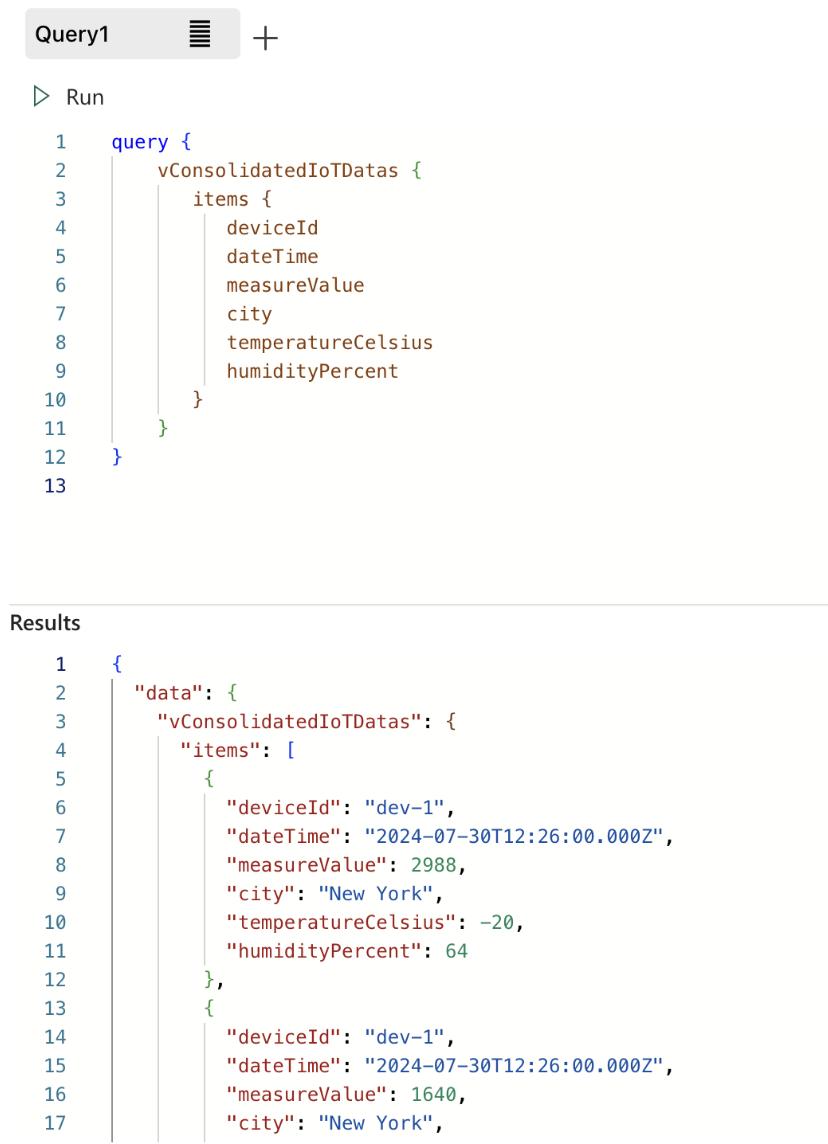
Microsoft Fabric API for GraphQL™ for Azure Cosmos DB Mirroring

The Microsoft Fabric API for GraphQL™ provides a data access layer that enables you to query multiple data sources quickly and efficiently using a widely adopted and familiar API technology. This API abstracts the specifics of backend data sources, allowing you to focus on your application's logic and deliver all the data a client needs in a single call. Microsoft Fabric's Mirroring enables you to seamlessly integrate your existing Azure Cosmos DB data with the rest of your data in Microsoft Fabric, eliminating the need for ETL. You can replicate your Azure Cosmos DB data continuously into OneLake in ne...

Introducing the new Linux-based Azure Cosmos DB Emulator (Preview)
We are excited to announce the preview release of the new Linux-based Azure Cosmos DB Emulator! This latest version is built to provide faster startup times and broader platform compatibility, addressing one of the most requested features in the Azure Cosmos DB User Voice community. The emulator can now seamlessly run on Apple silicon and Microsoft ARM chips without any workarounds or virtual machines necessary. A Seamless Experience for ARM and Apple Silicon Users For a long time, developers using Apple’s M1/M2 series or Microsoft ARM-based devices encountered significant challenges when trying to run the Azu...
Azure Cosmos DB Shines at Microsoft Ignite 2024!
Microsoft Ignite 2024 took over the Windy City this week, bringing with it new technological innovation and exciting product announcements aplenty! If you missed the first day of the show, don't worry – we’ve got you covered with all the latest and greatest Azure Cosmos DB news. This year's event saw great enthusiasm and attendance at McCormick Place, in Chicago, with attendees flocking to keynotes, breakout sessions, hands-on labs, and demos offering a glimpse into the future of data and AI. Check out the Azure Cosmos DB highlights from day one below. Noteworthy Sessions Microsoft Ignite Keynote Micr...
Autoscale in public preview for vCore-based Azure Cosmos DB for MongoDB
Managing workloads with unpredictable spikes can be a real challenge, especially when it comes to ensuring your database can handle sudden surges in traffic. Often, this leads to overprovisioning resources to play it safe, resulting in higher costs and wasted capacity. But what if there was a better way? We're excited to introduce Autoscale for vCore-based Azure Cosmos DB for MongoDB, a feature designed to take the guesswork out of scaling. With Autoscale, your database seamlessly adjusts to meet peak demand, eliminating the need for overprovisioning, cutting costs, and maintaining peak performance effortless...
New RBAC Features for vCore-based Azure Cosmos DB for MongoDB
We’re excited to announce a major security enhancement for the vCore-based Azure Cosmos DB for MongoDB: Role-Based Access Control (RBAC) Integration for Secondary Users with Read/Read Write Privileges. Now available in public preview, this feature enables organizations to control data access with greater precision while preserving the flexibility and high performance that Azure Cosmos DB delivers. What’s New? With this release, administrators using vCore-based Azure Cosmos DB for MongoDB can assign specific access roles to secondary users, granting them the required Read or Read Write privileges to access clust...
Data API Public Preview in vCore-based Azure Cosmos DB for MongoDB
We're excited to announce that the Data API for vCore-based Azure Cosmos DB for MongoDB is now in public preview. This Data API offers a flexible and powerful way for you to interact with your database using HTTP-based API calls. The Data API for vCore-based Azure Cosmos DB for MongoDB lets you work with your MongoDB vCore data through straightforward HTTP requests, removing the need for traditional drivers or complex queries. You can easily perform basic operations like creating, reading, updating, and deleting data directly from your applications. This approach simplifies connecting your MongoDB data to web ...
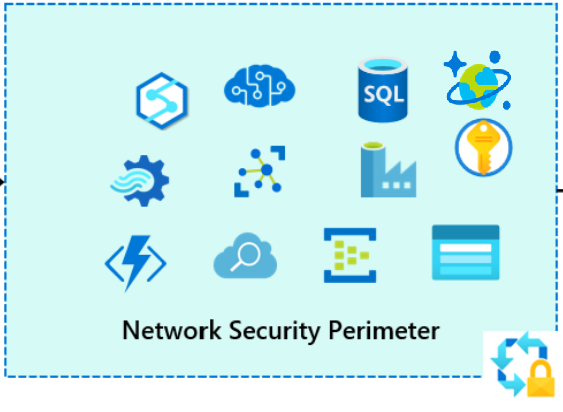
Introducing Network Security Perimeter for Azure Cosmos DB: A New Way to Enhance Application Security
Security is essential for any application, and we are pleased to announce the public preview of Azure Network Security Perimeter, a feature that lets Azure Cosmos DB customers enhance their application security by creating a logical network boundary that isolates your applications network from external networks, such as the internet. Network security perimeter provides an extra layer of security to block unauthorized access to your data. Why use network security perimeter? Azure Network Security Perimeter provides a secure perimeter for your PaaS services like Azure Cosmos DB that are deployed outside of your v...

Achieving Production Readiness with Cross-Region Replication in Azure Cosmos DB for MongoDB (vCore)
In today's digital landscape, cross-region replication has become a foundational feature for any managed database service aiming to provide high availability, disaster recovery, and global scalability. Ensuring data continuity and availability even during regional outages or unexpected events is essential, and Azure Cosmos DB for MongoDB (vCore) now offers a robust generally available (GA) cross-region replication feature designed to meet these needs. This feature empowers organizations to maintain a complete replica of their data in another Azure region, enabling seamless disaster recovery (DR) and scalable, glo...
How Toyota uses Azure Cosmos DB to power their multi-agent AI system for enhanced productivity

This article was co-authored by Kenji Onishi, Senior Manager, Powertrain Performance Development, Toyota Motor Corporation; Kosuke Miyasaka, Azure App Innovation Specialist; and Keisuke Hatasaki, Azure Sr. Specialist, GBB. Executive Summary: Toyota Motor Corporation, one of the world’s largest automobile manufacturers, has adopted Azure Cosmos DB in its new multi-agent AI system designed to improve development processes. This move is aimed at enhancing efficiency and reducing the time required for developing new vehicle models in a highly competitive automotive industry. Introduction Toyota Motor Corporat...
New Vector Search, Full Text Search, and Hybrid Search Features in Azure Cosmos DB for NoSQL
We’re excited to announce several new features and advancements for search and retrieval functionalities in Azure Cosmos DB for NoSQL including: These features open the door to building new search and AI scenarios on Azure Cosmos DB, particularly benefiting Retrieval-Augmented Generation (RAG) and multi-agent AI applications by enhancing the relevance and accuracy of generated content. Together, they empower developers to build sophisticated AI applications that provide users with more relevant and timely information. Note: The public previews of Full Text Search and Ranking and Hybrid Sea...
Public Preview: Vector Search in Azure Cosmos DB for MongoDB with DiskANN
We’re excited to announce the preview of DiskANN vector indexing for vCore-based Azure Cosmos DB for MongoDB! This feature empowers you to perform efficient, low-latency searches on large vector datasets, making it perfect for scaling applications that depend on fast similarity searches—like recommendation engines, document retrieval, and AI insights. With DiskANN, you can “do more with less” by allowing you to handle larger vector datasets and achieve superior search performance even on smaller SKUs. What Is DiskANN? Microsoft Research developed DiskANN, which already powers high-speed, large-scale vector se...
Change Streams in public preview for vCore-based Azure Cosmos DB for MongoDB
Change streams provide a real-time flow of database changes from your database to your application. This feature enables the development of reactive applications by allowing you to subscribe to database changes. Configuring Change Streams To get started with change streams, let's look at an example code snippet that initiates a change stream on the collection. This script continuously monitors for any changes and prints the change event in JSON format. Personalise stream with pipeline stages You can customize your change stream output by specifying an array of one or more pipeline stages during confi...
Announcing Public Preview: VS Code Extension for Azure Cosmos DB
We’re excited to announce the public preview of the latest update to the Azure Databases Visual Studio Code extension, which brings the full power of Azure Cosmos DB to your favorite editor! This extension integrates a robust GUI right into Visual Studio Code, allowing you to connect, query, and manage your Azure Cosmos DB resources seamlessly. This new addition speeds up your workflow, enhances security, and boosts efficiency. What Does the Extension Offer? With this extension, handling your Azure Cosmos DB workloads is simpler and faster. Here’s what’s now at your fingertips: ...

Elevate Your Skills with Azure Cosmos DB: Must-Attend Sessions at Ignite 2024
Calling all Azure Cosmos DB enthusiasts: Join us at Microsoft Ignite 2024 to learn all about how we’re empowering the next wave of AI innovation! Azure Cosmos DB will be featured in a robust lineup of sessions at Ignite. This premier event is perfect for enterprise architects, developers, and IT professionals eager to learn new skills and explore the future of AI and novel technologies. Join us online from November 19–21, 2024, or in-person in Chicago from November 19–22, 2024 (in-person tickets are already sold out!). Azure Cosmos DB sessions and labs will be jam-packed with practical, real-world knowledge...
Updates to Azure Cosmos DB’s Portal Networking Settings
We are happy to share with you an update to the Azure Cosmos DB networking configuration options within the Azure Portal. This update introduces a split in the IP address list, now presented as two distinct categories: user IP addresses and Portal Middleware IPs. Managing IP access control policies is essential for maintaining a secure environment. Earlier this year, new Portal IP addresses were introduced as part of the Azure Cosmos DB portal service upgrade. Now, you can easily update these addresses with a single click in the portal. Understanding the Changes This update aims to give users a more streamlin...
Debug Queries More Efficiently with the Improved Error Messaging in Azure Cosmos DB Data Explorer
Azure Cosmos DB Data Explorer is a web-based tool available in the Azure Portal that allows you to manage data, as well as track and fix issues with your queries. In this blog post, we will focus on some of the new features in data explorer that improve the error messaging in the query editor, making it easier for you to debug queries in Azure Cosmos DB. These were developed in response to user feedback through our NPS survey. To share feedback, click the Feedback icon in the Azure portal on any Cosmos DB blade, or submit it through the Net Promotor Score (NPS) survey. Improving the error message for complete d...
Meet the Winners | Microsoft Developers Azure AI & Azure Cosmos DB Learning Hackathon

Azure Cosmos DB powers some of the world’s most popular intelligent apps like ChatGPT. In a recent hackathon, Over 9,500 developers engaged with Azure Cosmos DB and Azure AI services, making it one of the most popular on Devpost, ranking in the top 0.2% of all Devpost hackathons. Participants explored AI fundamentals and built their own AI applications using Azure. We're excited to showcase the top three winners, who leveraged Azure Cosmos DB and Azure AI to address diverse use cases, including acing job interviews, streamlining video editing, and offering insightful dietary recommendations. We also want to h...
Enhancing Data Explorer: Custom Columns, Filter History, and Query Views Explained
Managing large amounts of data is exciting. As a dataset grows in complexity and size, finding efficient ways to sort and analyze this info becomes more important. Azure Cosmos DB Data Explorer is a tool to query, review, and manage your data. We’ve heard from your feedback in our NPS survey that there’s a need for more options to dive deeper into your data within Data Explorer when using filters. Users have often faced challenges in customizing their data views, sorting their Items and quickly reapplying previous filters. These pain points can lead to inefficiencies and frustrations, especially when time is tig...

Introducing RBAC Authentication and more for the Azure Cosmos DB Integrated Cache
We’re excited to announce new features for the Azure Cosmos DB integrated cache! The integrated cache is built into the dedicated gateway, and now there’s new ways to authenticate your requests. Security is top of mind for many organizations, and you can now use Role-Based Access Control (RBAC) with Microsoft Entra ID to authenticate to the dedicated gateway, eliminating the security risks and complications that come with key-based authentication. Additionally, there’s a new request option that gives you fine grained control over which requests populate the integrated cache. RBAC authentication with Microsof...
Microsoft DiskANN in Azure Cosmos DB Whitepaper
We are excited to publish a new whitepaper titled, Microsoft DiskANN in Azure Cosmos DB, where we examine the impressive capabilities of Microsoft DiskANN, a state-of-the-art indexing system designed for accurate and cost-efficient vector search at any scale. We start off with a review of key vector search and database concepts, then follow by describing Microsoft DiskANN and how it works. We conduct comparisons against other popular vector indexing algorithms on two datasets and demonstrate how Microsoft DiskANN requires up to 10x lower memory, which is critical to making vector search more cost-effective and...
Announcing Private Preview: VS Code Extension of vCore-based Azure Cosmos DB for MongoDB
Overview We're excited to introduce a new VS Code extension for vCore-based Azure Cosmos DB for MongoDB ! This tool allows users to connect, query, and manage vCore-based Azure Cosmos DB for MongoDB directly within VS Code, streamlining your workflow. Limited Private Preview We’re currently offering a limited private preview of the VSCode extension for vCore-based Azure Cosmos DB for MongoDB. Features Supported What to Expect As this is a private preview release, you might encounter some rough edges. But your feedback is crucial ...
Introducing New Storage Sizes for vCore-Based Azure Cosmos DB for MongoDB: Unlock More Capacity and Performance
We’re thrilled to announce the preview of new storage sizes for vCore-based Azure Cosmos DB for MongoDB, designed to provide more capacity and enhanced performance for your MongoDB workloads. Whether you’re managing large, complex datasets or high-throughput applications, these new storage tiers—8 TiB, 16 TiB, and 32 TiB per physical shard—offer the flexibility to scale effortlessly and optimize your MongoDB database operations. Expanded storage options: 8 TiB, 16 TiB, and 32 TiB per physical shard vCore-based Azure Cosmos DB for MongoDB now offers larger storage capacities per physical shard, with new tiers of...
Announcing Azure Cosmos DB Integration with LangChain.js!
Announcing Azure Cosmos DB Vector Store Integration with LangChain.js! We're simplifying AI app development by integrating Azure Cosmos DB's cost-effective and scalable vector search directly with LangChain.js! This powerful combination empowers JavaScript developers to efficiently manage fast and accurate data retrieval with Azure Cosmos DB's scalability and efficient vector search capabilities. This offers a powerful solution for developers aiming to leverage vector search capabilities in their applications. Azure Cosmos DB supports vector indexing and search, allowing for efficient handling of high-dimensiona...