
Azure Cosmos DB Blog
The latest news, updates and technical insights from the Azure Cosmos DB team
Latest posts

Configure customer-managed keys for your existing Azure Cosmos DB accounts!

Encryption options for data at rest on Azure Cosmos DB that is available today. Azure Cosmos DB strives to provide the best-in-class security features. Encryption of data at rest is one such important security feature. Encryption of data at rest using Microsoft's service-managed keys is enabled by default. In addition to this default encryption, Azure Cosmos DB allows customers to add a second layer of encryption using customer-managed keys or CMK. Currently, this feature is available only during new account creation. New announcement! We are excited to announce General Availability (GA) for enabling Cust...

Azure Cosmos DB Keyboard Shortcuts: Streamline Your Workflow in Data Explorer

Working with databases just got a whole lot easier in Azure Cosmos DB Data Explorer, thanks to some nifty new keyboard shortcuts. Now you can speed through your database tasks and manage your data with keyboard clicks. This update is about making your workflow smoother and faster. We heard your feedback and now with a few key presses, you can run queries, add new containers, edit items, and do so much more. It’s all designed to help you get more done in less time. And if you’ve ever hit F5 mistakenly and watched your work disappear, you’ll be happy to know it’s no longer a problem. These shortcuts are smart...

Sign up for the Microsoft Developers AI Learning Hackathon and Compete for $10,000 in Prizes!


Are you ready to learn about building your very own AI apps in Azure? Participate in the Microsoft Developers AI Learning Hackathon and discover how to build your own custom AI copilot using Azure Cosmos DB for MongoDB and the Azure OpenAI API. Whether you're a seasoned developer or just starting, this event is perfect for anyone eager to dive into AI app development. Why Participate? Who Can Join? This hackathon is open to anyone above the legal age of majority in their country of residence. Please note that specific countries and territories are excluded. Check the full rules for-el...
Azure Cosmos DB design patterns – Part 9: Schema versioning
Welcome to Part 9 of our Azure Cosmos DB Design Patterns series, focusing on Schema Versioning. This edition is particularly useful for those new to NoSQL databases or looking to understand Azure Cosmos DB's unique capabilities. Here, we will explore how schema versioning can help manage and evolve your database schema efficiently, drawing on real-world applications and specific patterns. By the end of this post, you'll have a clear roadmap for implementing schema versioning in your projects, ensuring your database keeps pace with application development without downtime or data corruption. We have expande...
Reduce TCO with Azure Cosmos DB for MongoDB

Azure Cosmos DB for MongoDB is a fully managed MongoDB compatible cloud database service. Built on top of a proprietary engine to provide scale, performance and availability guarantees, the service eliminates the operational overhead of running self-hosted MongoDB instances. In this blog, we dig into seven specific reasons why total cost of ownership of your MongoDB database can be minimized with the vCore based offering for Azure Cosmos DB for MongoDB. Separating the cost of Storage and Compute Although you can view Compute cluster tiers and their attached storage disks as a single entity replicated for ...
Optimize Your Azure Cosmos DB Costs with New Reserved Capacity Tiers

Commit to a reservation for Azure Cosmos DB resources using Azure Cosmos DB reserved capacity to save money. Starting with our new 100 RU/s option, any customer can now reduce costs using Azure Cosmos DB request units (RU/s). You can buy any quantity of the 100 RU/s reservation, at any time. There is no limit to the number of reservations, and the purchase process is simplified in the Azure Portal. Discounts Azure Cosmos DB reserved capacity offers a minimum 20% discount on the provisioned throughput for resources such as databases or containers (tables, collections, and graphs). We are announcing the s...
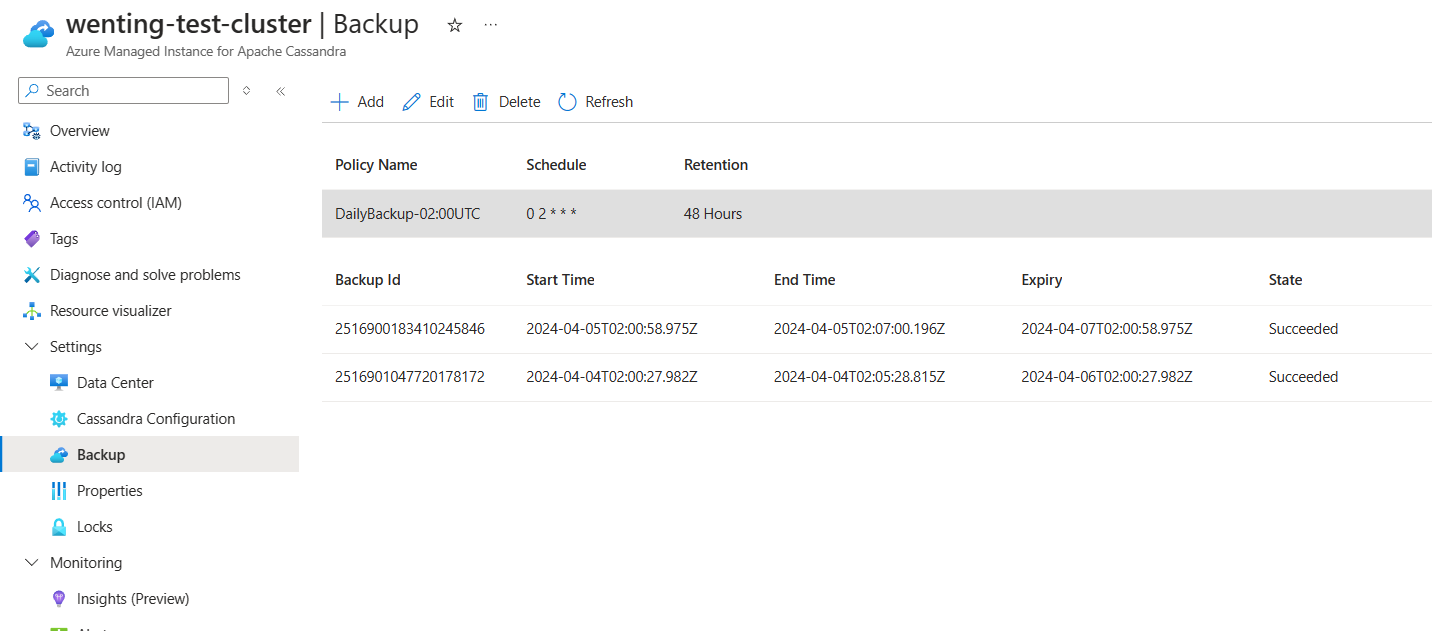
Backups for Azure Managed Instance for Apache Cassandra®

In the dynamic landscape of cloud-based data management, Azure Managed Instance for Apache Cassandra® (Azure MI Cassandra) stands out as a fully managed service that simplifies the deployment and management of Cassandra clusters on the Azure platform. Beyond its core functionalities, Azure MI Cassandra offers a valuable backup feature, allowing users to capture snapshots of their Cassandra clusters at critical moments. In this blog, we'll explore how to leverage this feature to create robust backups for your Azure MI Cassandra cluster. Why Backups Matter In the context of an Azure MI Cassandra cluster, backups ...
Introducing vCore-based Azure Cosmos DB for MongoDB’s Latest Features

Editor's note (November 2025): Azure Cosmos DB for MongoDB (vCore) has been renamed to Azure DocumentDB. This article was originally published before the rename, so it uses the product name that was current at the time. While the product name has changed, the technical concepts discussed in this article remain applicable unless otherwise noted. For the latest Azure DocumentDB announcements, features, and technical guidance, visit the Azure DocumentDB Dev Blog. The vCore-based Azure Cosmos DB for MongoDB unveils significant AI enhancements. The updated integrated vector database introduces groundbreaking featur...

Optimizing database performance: Change partition keys of a container in Azure Cosmos DB for NoSQL API (preview)

Partitioning is a key concept in Azure Cosmos DB, a fully managed, globally distributed, multi-model database service that offers unlimited scalability and low latency. By distributing data across multiple physical partitions based on the partition key(s), Azure Cosmos DB optimizes data access and distribution, profoundly impacting database performance and cost. Therefore, choosing the right partition key is paramount to achieving the right performance and cost. Challenges with partition keys Choosing the right partition key is not always easy. Sometimes, the partition key that is initially chosen may not be op...