
Azure Cosmos DB Blog
The latest news, updates and technical insights from the Azure Cosmos DB team
Latest posts
Introducing New Storage Sizes for vCore-Based Azure Cosmos DB for MongoDB: Unlock More Capacity and Performance

Editor's note (November 2025): Azure Cosmos DB for MongoDB (vCore) has been renamed to Azure DocumentDB. This article was originally published before the rename, so it uses the product name that was current at the time. While the product name has changed, the technical concepts discussed in this article remain applicable unless otherwise noted. For the latest Azure DocumentDB announcements, features, and technical guidance, visit the Azure DocumentDB Dev Blog. We’re thrilled to announce the preview of new storage sizes for vCore-based Azure Cosmos DB for MongoDB, designed to provide more capacity and enhanced ...
Announcing Azure Cosmos DB Integration with LangChain.js!

Announcing Azure Cosmos DB Vector Store Integration with LangChain.js! We're simplifying AI app development by integrating Azure Cosmos DB's cost-effective and scalable vector search directly with LangChain.js! This powerful combination empowers JavaScript developers to efficiently manage fast and accurate data retrieval with Azure Cosmos DB's scalability and efficient vector search capabilities. This offers a powerful solution for developers aiming to leverage vector search capabilities in their applications. Azure Cosmos DB supports vector indexing and search, allowing for efficient handling of high-dimensiona...
Scale Your Database Workloads with Multishard Clusters in vCore-based Azure Cosmos DB for MongoDB
Editor's note (November 2025): Azure Cosmos DB for MongoDB (vCore) has been renamed to Azure DocumentDB. This article was originally published before the rename, so it uses the product name that was current at the time. While the product name has changed, the technical concepts discussed in this article remain applicable unless otherwise noted. For the latest Azure DocumentDB announcements, features, and technical guidance, visit the Azure DocumentDB Dev Blog. We’re excited to introduce significant enhancements to vCore-based Azure Cosmos DB for MongoDB with the release of multishard clusters preview, designed...
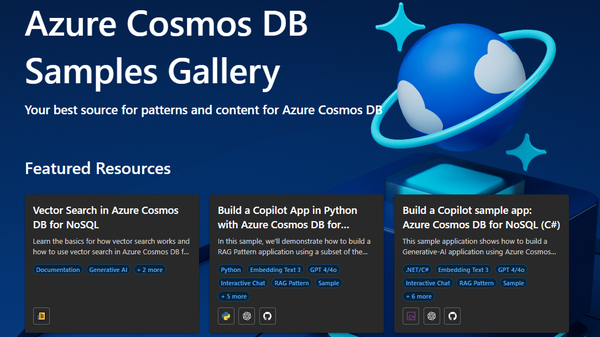
Discover the New Azure Cosmos DB Samples Gallery!

We are thrilled to introduce the Azure Cosmos DB Samples Gallery —your ultimate destination for top-tier Azure Cosmos DB samples, technical guidance, and content created by both Microsoft and the community, including Azure OpenAI samples. Who is it for? Designed for developers and technical professionals, this gallery is an invaluable resource for both new and existing customers. What can you find? Explore a diverse array of content tailored for Azure Cosmos DB, including: Why use it? The gallery features intuitive filters to help you quickly find content related to AI app...
Announcing Private Preview: Read and Read/Write Privileges with Secondary Users for vCore-Based Azure Cosmos DB for MongoDB

Editor's note (November 2025): Azure Cosmos DB for MongoDB (vCore) has been renamed to Azure DocumentDB. This article was originally published before the rename, so it uses the product name that was current at the time. While the product name has changed, the technical concepts discussed in this article remain applicable unless otherwise noted. For the latest Azure DocumentDB announcements, features, and technical guidance, visit the Azure DocumentDB Dev Blog. We are excited to announce the private preview of a new feature in vCore-based Azure Cosmos DB for MongoDB —Role-Based Access Control (RBAC) Integratio...
Announcing the GA of Dynamic Scaling (Per Region and Per Partition Autoscale)

We are excited to announce the GA of Azure Cosmos DB dynamic scaling – among multiple new features (Binary Encoding, Reserved Capacity) released recently to make your Azure Cosmos DB workloads even more cost efficient. Dynamic scaling is an enhancement to autoscale which provides cost optimization for nonuniform workloads. In the earlier version of autoscale, all partitions scaled uniformly based on the most active partition, which caused unnecessary scale-ups if only one or a few partitions were active. With this new feature, partitions and regions now scale independently, improving cost efficiency for non-unif...
Announcing Cost and Performance Improvements with Azure Cosmos DB’s Binary Encoding

We are excited to announce a significant enhancement to Azure Cosmos DB, bringing substantial cost savings and performance improvements to our users. The new binary encoding feature is now available for new containers and will soon be available for existing ones. What is Binary Encoding? Binary encoding converts JSON or other text-based data formats into a compact binary representation. Instead of storing data as human-readable text, it stores it as a sequence of bytes, which takes up less space and can be processed more quickly by computers. Key Benefits When will it be available Binary-encoding...
DiskANN for Azure Cosmos DB Now in Open Public Preview!
We’re excited to announce that the DiskANN vector index is now in open public preview in Azure Cosmos DB for NoSQL! This means that anyone who enrolls an Azure Cosmos DB for NoSQL resource in the Vector Search Public Preview now automatically gets access to the most powerful and scalable vector index on the planet. What is DiskANN? DiskANN is a powerful set of algorithms developed at Microsoft Research for low-latency, cost-effective, and highly accurate vector search at scale. It's an ideal solution for applications requiring fast and efficient search capabilities without compromising on ...
Enabling IP Access Control Policy for Azure Portal: A Necessity

Managing IP access control policies is essential for maintaining a secure Azure environment. These policies allow you to restrict access to your resources based on specific IP addresses, adding an extra layer of security to prevent unauthorized access. To avoid disruptions when accessing your Azure Cosmos DB for MongoDB or Apache Cassandra API accounts through the Azure Portal, be sure to enable requests from the portal. This step ensures that features like Data Explorer remain accessible. Follow the instructions in this blog post to configure your IP access control policies correctly. New Portal IP Addresses...