
Azure Cosmos DB Blog
The latest news, updates and technical insights from the Azure Cosmos DB team
Latest posts
Cosmos DB Mirroring in Fabric Now Supports Virtual Network Data Gateways

Azure Cosmos DB mirroring in Microsoft Fabric now offers a simpler way to connect accounts secured by private endpoints or virtual networks. A virtual network data gateway provisioned inside your own virtual network keeps public network access disabled throughout setup and ongoing replication. This release builds on the general availability of private network support announced earlier this year, and it reflects the feedback we received from enterprise and regulated customers about reducing the configuration effort required to bring secured operational data into OneLake. A simpler path for secured accounts ...
Announcing Public Preview for Azure Cosmos DB in Fabric Database Hub!
Azure Cosmos DB support in Fabric Database Hub is now available in public preview. For the first time, Azure Cosmos DB customers can discover and monitor their accounts from Database Hub alongside other Microsoft database engines. Database Hub provides a single place to view every Azure Cosmos DB account you can access, compare health and performance, review key security findings, and create new accounts. Your accounts remain in their existing subscriptions, resource groups, and regions. A single view of your Azure Cosmos DB estate Most Azure Cosmos DB customers do not operate a single account. Accoun...
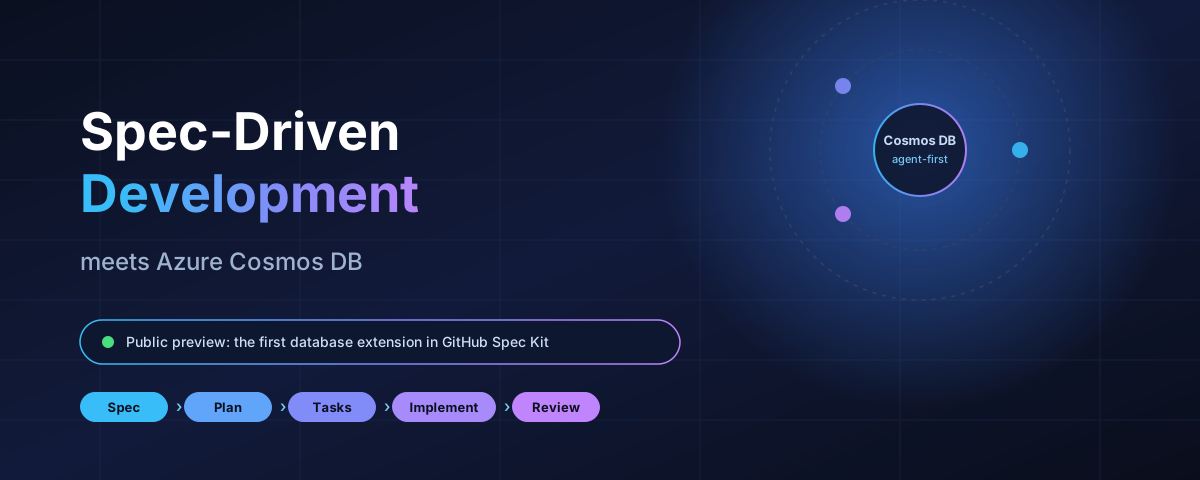
Spec-Driven Development comes to Azure Cosmos DB: The First Database Extension for GitHub Spec Kit

AI coding agents can write much of an application's code, but developers still need to review the decisions behind it. For a Cosmos DB application, that includes choosing partition keys, modeling access patterns, and configuring the client. Those decisions affect cost, performance, and reliability long after the code compiles. We've written before about how Azure Cosmos DB supports agents at query time, with tools and guidance for exploring and querying data. Today we're announcing the public preview of the Azure Cosmos DB extension for GitHub Spec Kit, the first database extension in its ecosystem. It brings Co...
MulticloudDB SDK: Cross-cloud portability in the coding agent era
Building cross-cloud solutions with best-of-breed cloud-native databases means learning multiple SDKs, translating queries, handling different errors, and testing across providers. The Multicloud DB SDK for Java lets you share that work across Azure Cosmos DB, Amazon DynamoDB, and Google Cloud Spanner. You (or your coding agent) write CRUD and query logic against one Java API, with provider selection and connection settings in configuration. We demonstrated one application running unchanged across two providers at Azure Cosmos DB Conf 2026 on April 28, 2026, in MultiCloudDB: Write Once. Run Anywhere.. The SDK is...
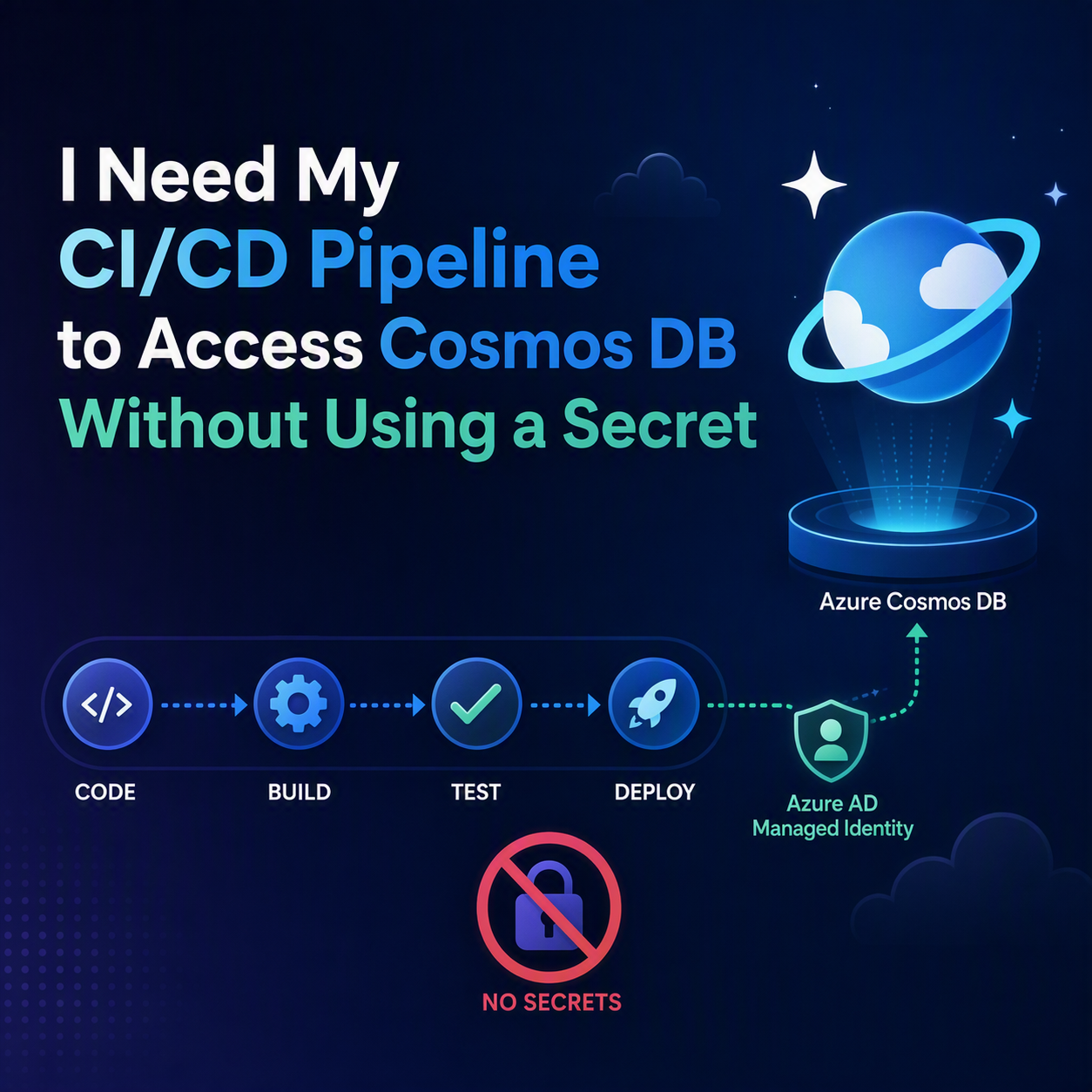
I Need My CI/CD Pipeline to Access Cosmos DB Without Using a Secret


In the last post we walked through why RBAC broke your app and how to fix it. Your app is now running on a managed identity, keys are off, and everything is green. Then your build pipeline runs, and it needs to seed test data. Suddenly you're staring at a secret in your CI settings and wondering if you just undid all that work. As we continue this security series, let's get your pipeline to Cosmos DB with no secret anywhere. The situation You did the hard part. Your app uses , you assigned a data plane role, and you set . Passwordless, done. Then you look at your CI/CD pipeline and find this sitting in yo...
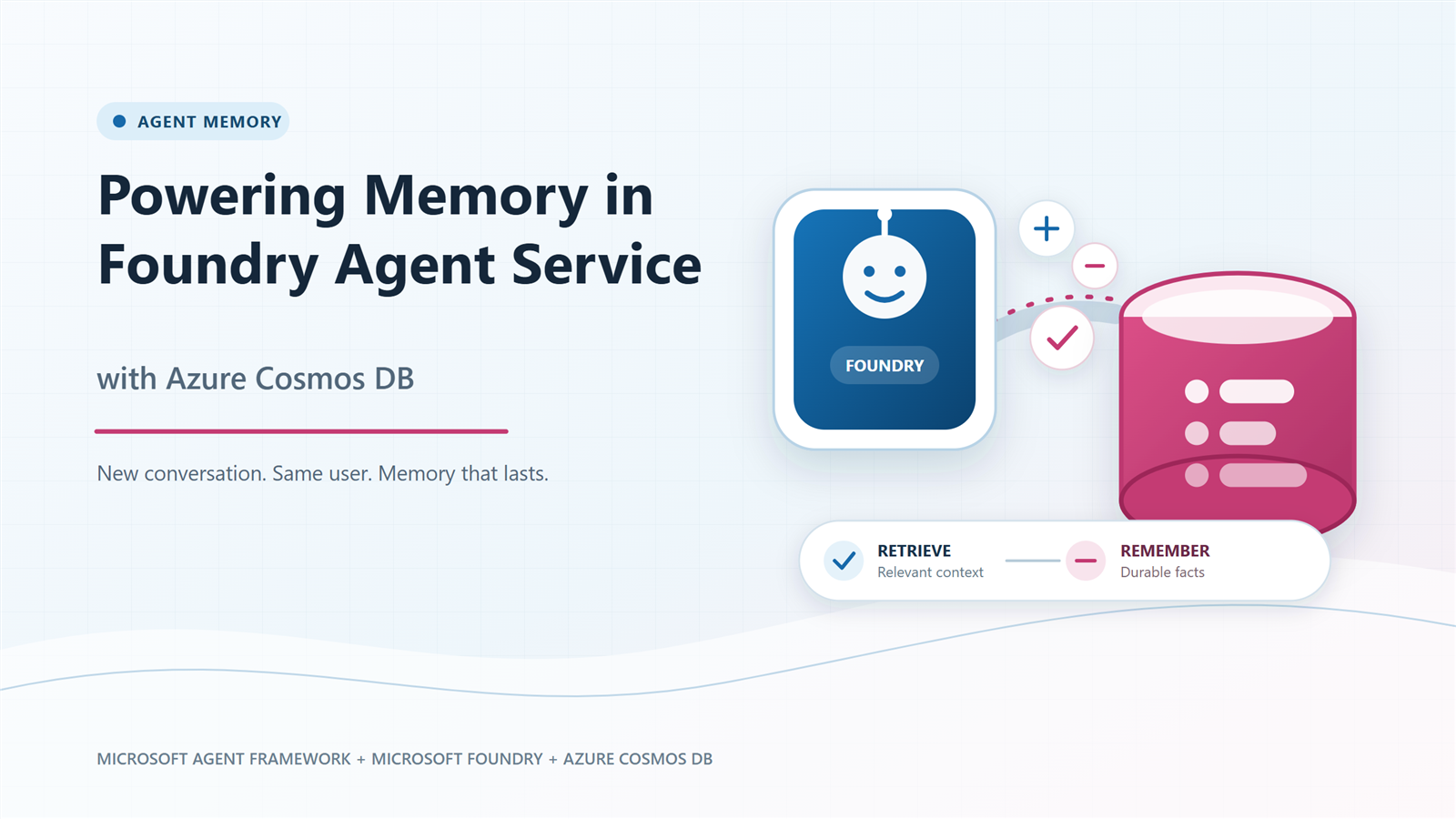
Powering Memory in Foundry Agent Service, with Azure Cosmos DB
Move from a locally composed memory-enabled agent to a deployed Foundry Agent Service agent, with keyless Azure infrastructure and an interactive browser sample. In Native Agent Memory for Microsoft Agent Framework, Powered by Azure Cosmos DB, we introduced : a Microsoft Agent Framework context provider that extracts useful information from conversations, stores it in Azure Cosmos DB, and retrieves it before later agent runs. That article used a locally composed Agent Framework agent and . It was a useful way to isolate the memory concepts: one provider, two lifecycle hooks, and a stable u...
Azure Cosmos DB in the Agentic Era: Data Tools for Developers and AI Agents

Anthropic's 2026 Agentic Coding Trends Report captures an important tension in how developers use AI. Engineers report using AI in roughly 60% of their work, yet say they can fully delegate only 0–20% of their tasks. AI is becoming a constant collaborator, but it still needs setup, supervision, validation, and human judgment. That gap is especially relevant when an agent starts working with a database. Database requests often sound easy. “Show me the failed orders from last week.” “Why is this query expensive?” “Does this container have the field I need?” For a developer, answering those question...
I Enabled RBAC and Everything Broke. What Did I Do Wrong?
We covered the roles your Azure Cosmos DB app needs in our previous post. Now let’s look at what happens after you’ve assigned those roles, switched identities, disabled keys and suddenly staring at a . As we continue this security series, we’ll walk through the most common causes, how to diagnose them, and how to get back to green quickly. The situation You did everything right. You gave your app a managed identity, assigned a data role, switched your code over to , and turned off key-based auth like all the good security guidance told you to. Then you deploy, and every single call comes back with this: Res...
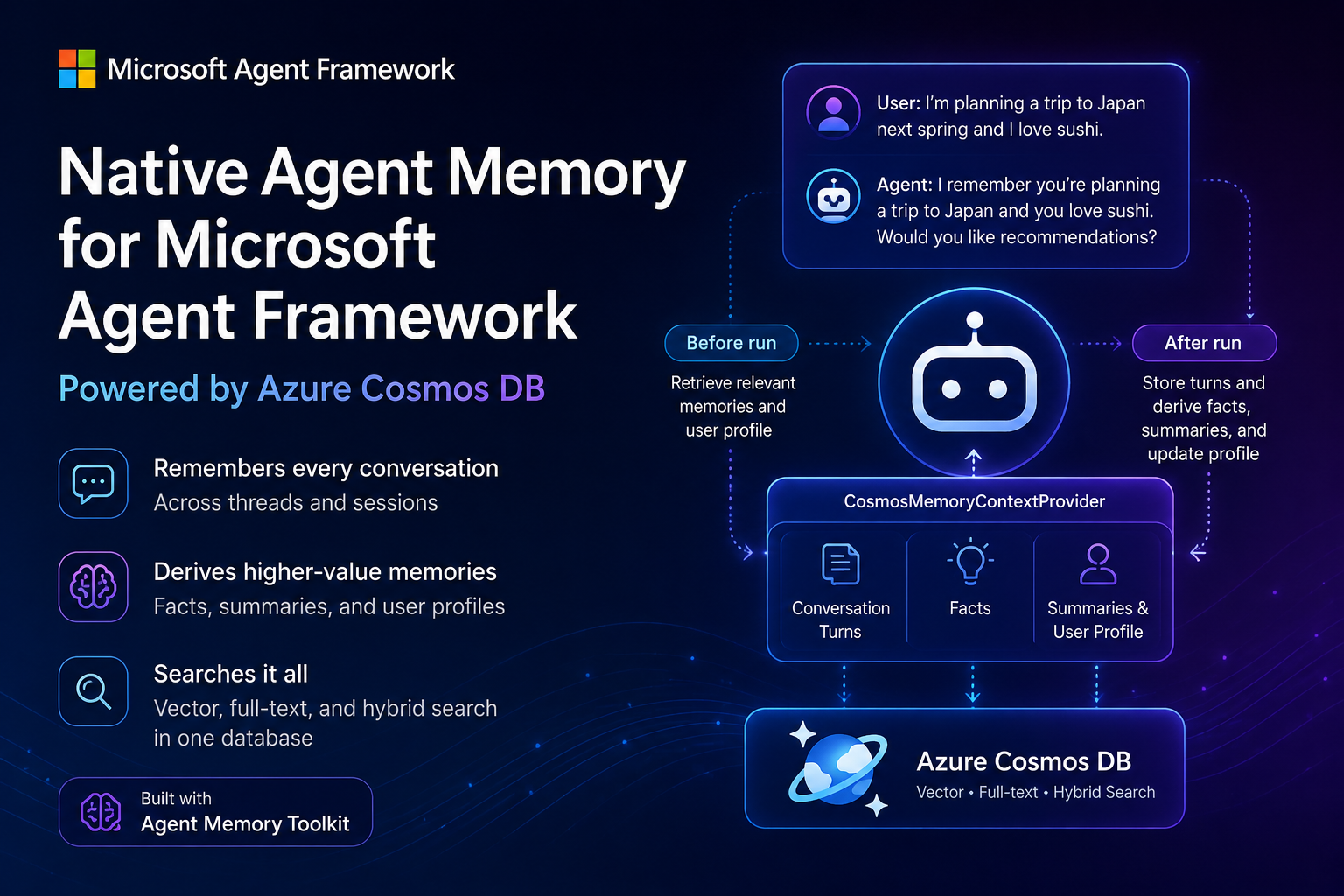
Native Agent Memory for Microsoft Agent Framework, Powered by Azure Cosmos DB
Recently we introduced the Agent Memory Toolkit and the Agentic Retrieval Toolkit for Azure Cosmos DB. The Agent Memory Toolkit gives your agents durable, Cosmos-backed memory: it stores raw conversation turns and then distills them into higher-value derived memories (thread summaries, extracted facts, and cross-thread user profiles), all searchable with vector, full-text, and hybrid search in the one database you already use. Today we're taking the next step. With the latest release of Microsoft Agent Framework, you can now drop that memory into an agent with a single object: the , shipped in the new package f...