Microsoft Agent Framework
The latest news from the Microsoft Agent Framework team for developers
Latest posts
Governance at the Speed of Agents: Microsoft Agent Framework and Agent Governance Toolkit, Better Together
Building powerful AI agents is only half the story, running them safely in production is the real challenge. As customers adopt Microsoft Agent Framework for agent orchestration, a clear need has emerged for robust, built-in governance. In this post, Imran Siddique from the AGT team walks through how Agent Governance Toolkit pairs with Agent Framework to enforce policy at runtime, govern agent actions, and provide end-to-end auditability. Turning agentic systems into production-ready platforms. The Complete Stack for Production AI Agents Microsoft Agent Framework 1.0 provides everything teams need to build, orc...
A Tour of Handoff Orchestration Pattern
A Tour of the Handoff Orchestration Pattern Most multi-agent systems start out simple: a router agent receives a user request, picks the right specialist, and forwards the conversation. As long as each specialist can complete its task in one pass, that model works fine. The first time it breaks is when an agent needs more: a follow-up question for the user, additional context from another specialist, or a realization mid-turn that the request belongs somewhere else entirely. At that point, a fixed pipeline or one-shot router isn’t enough. What you need is a small, bounded graph where agents themselves decid...
From Local to Production: Deploy Your Microsoft Agent Framework Agent with Foundry Hosted Agents
Once you have your Microsoft Agent Framework (MAF) agent or workflow happily running locally on your dev machine, it's time to decide how to deploy your agent to production, monitor it, evaluate it and version it. These decisions are just as important as getting the agent running. Hosted Agents in Foundry Agent Service is the easiest way to deploy Agent Framework agent to the cloud - with built-in identity, automatic scaling, managed session state, observability, and versioning. What are Foundry Hosted Agents? Foundry Hosted Agents are containerized applications that run inside Foundry Agent Service. Foundry Ho...
A2A v1 Is Here: Cross-Platform Agent Communication in Microsoft Agent Framework for .NET
As organizations move from single-agent prototypes to multi-agent production systems, the ability for agents to communicate reliably across platforms and organizational boundaries becomes essential. With the release of A2A Protocol v1.0 and updated support in the Microsoft Agent Framework, you can now connect and expose your AI agents using a stable, production-ready interoperability standard - whether you're consuming remote agents or hosting your own. Both the A2A Agent (client-side) and A2A Hosting (server-side) .NET packages in the Agent Framework have been updated to the A2A v1 SDK. This means you can dis...
Chat History Storage Patterns in Microsoft Agent Framework
When people talk about building AI agents, they usually focus on models, tools, and prompts. In practice, one of the most important architectural decisions is much simpler: where does the conversation history live? Imagine a user asks your agent a complex question, clicks “try again,” explores two different answers in parallel, and then comes back tomorrow expecting the agent to remember everything. Whether that experience is possible depends on the answer to this question. Your choice affects cost, privacy, portability, and the kinds of user experiences you can build. It also determines whether your applic...
CodeAct in Agent Framework: Faster Agents with Fewer Model Turns
Modern AI agents often aren't bottlenecked by model quality, they are bottlenecked by orchestration overhead. When an agent chains together many small tool calls, each step typically requires a new model turn, driving up latency and token usage. With CodeAct support in Agent Framework, agents can collapse those multi-step plans into a single executable code block, cutting end-to-end latency by ~50% and token usage by over 60% in representative workloads, without compromising on safety or isolation. CodeAct ships in the new (alpha) package, which runs the model-generated code in a fresh, locally isolated...
Agent Skills in .NET: Three Ways to Author, One Provider to Run Them
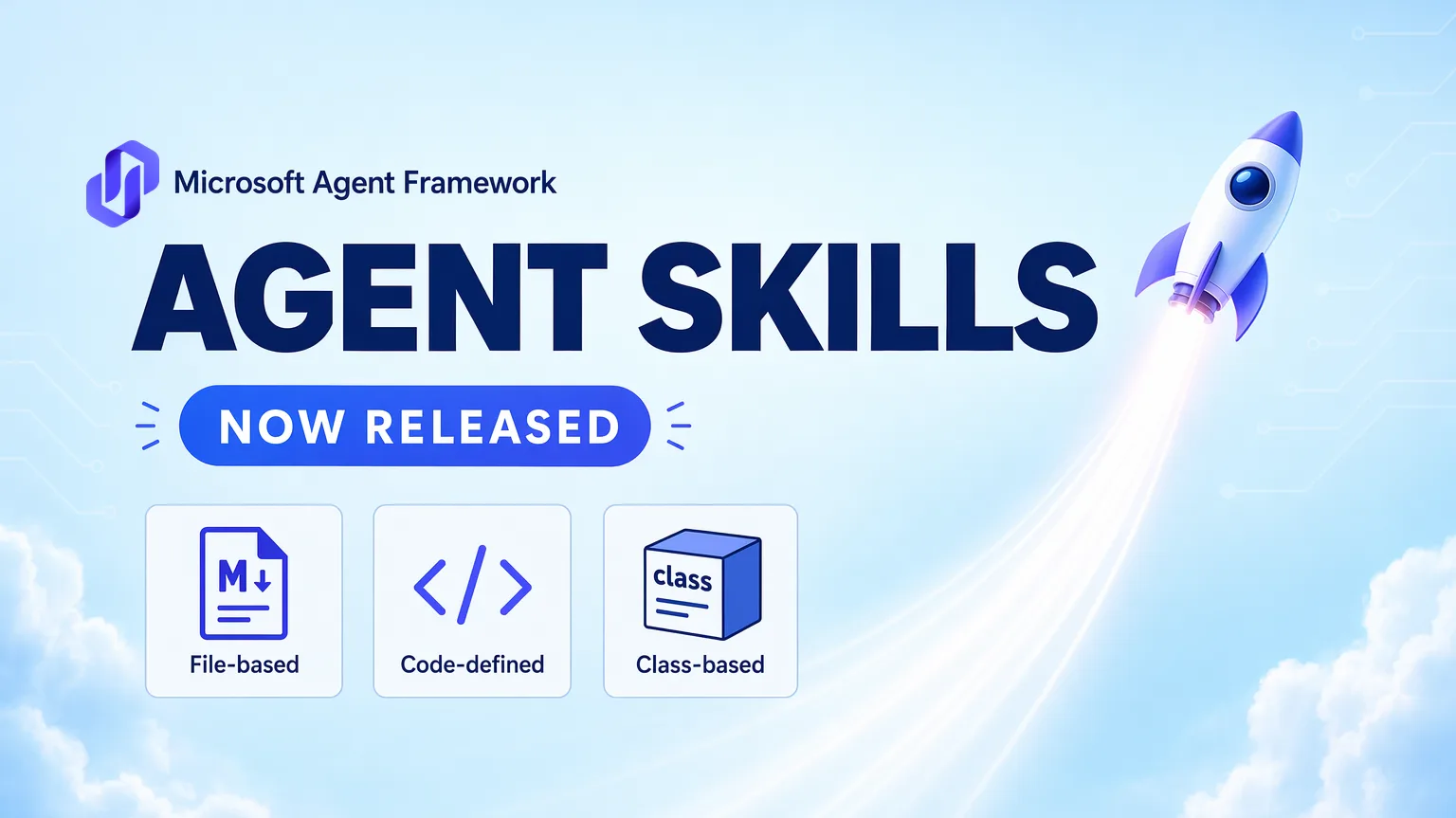
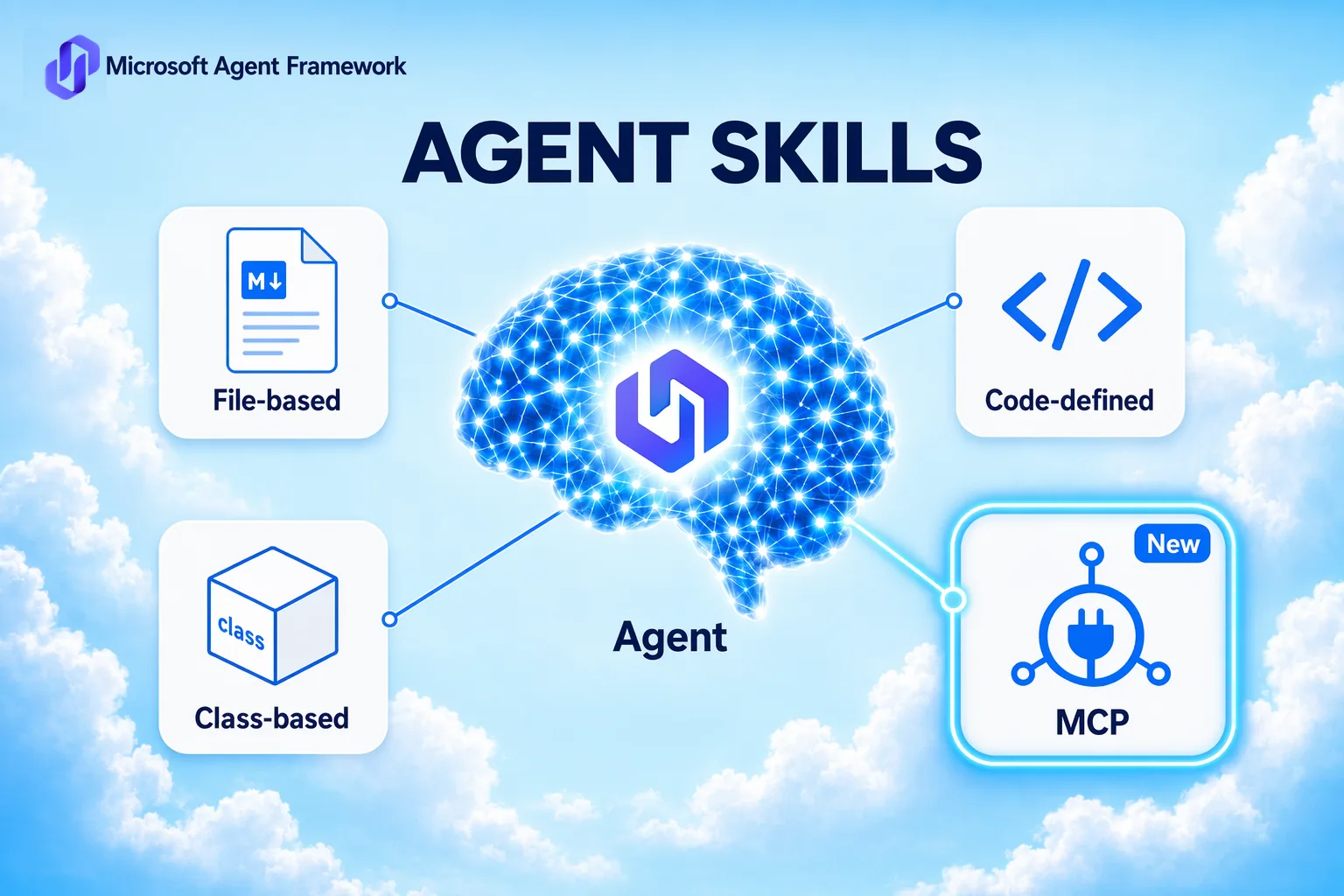
Your agents can now draw on skills authored in three different ways – as files on disk, as inline C# code, or as encapsulated classes – and combine them freely in a single provider. Add built-in script execution support and a human-approval mechanism for script calls, and you have a practical authoring model that fits real-world scenarios: skills that evolve over time, skills owned by different teams, and scripts that need human oversight before they act on your systems. The scenario You're building an HR self-service agent for your company. It starts life with a single file-based skill that walks new hires thr...
Building a Real-Time Multi-Agent UI with AG-UI and Microsoft Agent Framework Workflows
Multi-agent systems demo beautifully. Putting them in front of real users is another story. In early prototypes, a terminal or a basic chat window is enough. But once agents start handing off to each other, pausing for approvals, or asking follow-up questions, those interfaces fall apart. Which agent is active? Why is the system waiting? What's it about to do on the user's behalf? Without answers to those questions, a multi-agent workflow stops feeling like a product and starts feeling opaque. This post shows what a better answer looks like. We'll build a customer support workflow that pairs M...
Microsoft Agent Framework Version 1.0
Today, we're thrilled to announce that Microsoft Agent Framework has reached version 1.0 for both .NET and Python. This is the production-ready release: stable APIs, and a commitment to long-term support. Whether you're building a single assistant or orchestrating a fleet of specialized agents, Agent Framework 1.0 gives you enterprise-grade multi-agent orchestration, multi-provider model support, and cross-runtime interoperability via A2A and MCP. When we introduced Microsoft Agent Framework last October, we set out to unify the enterprise-ready foundations of Semantic Kernel with the innovative orchestrations...
Handling Long-Running Operations with Background Responses
Handling Long-Running Operations with Background Responses AI agents powered by reasoning models can take minutes to work through complex problems — deep research, multi-step analysis, lengthy content generation. In a traditional request-response pattern, that means your client sits idle waiting for a connection that may time out, or worse, fails silently and loses all progress. Background responses in Microsoft Agent Framework let you offload these long-running operations so your application stays responsive and resilient, regardless of how long the agent takes to think. With background responses, you start ...
What’s New in Agent Skills: Code Skills, Script Execution, and Approval for Python
Code-Defined Skills, Script Execution, and Approval for Agent Skills in Python When we introduced Agent Skills for Microsoft Agent Framework, you could package domain expertise as file-based skill directories and have agents discover and load them on demand. Now, the Python SDK takes skills further — you can define skills entirely in code, let agents execute scripts bundled with skills, and gate script execution behind human approval. These additions give you more flexibility in how you author skills, more power in what agents can do with them, and more control over when agents are allowed to act. Code-Defined ...
Agent Harness in Agent Framework
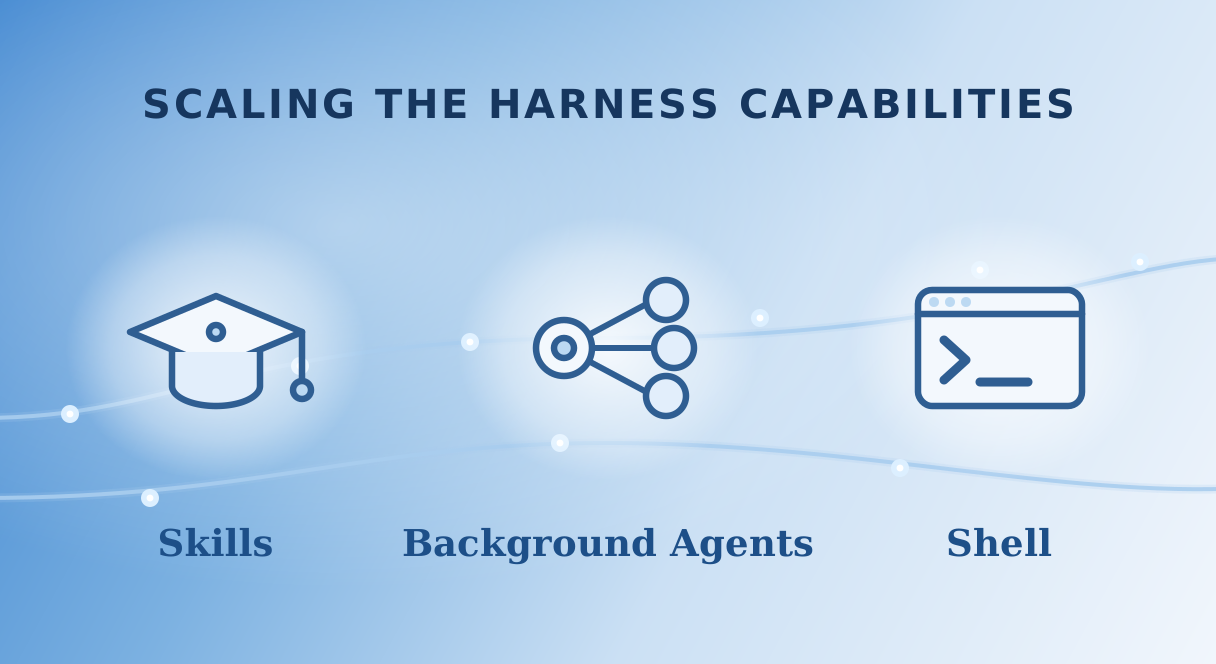
Agent harness is the layer where model reasoning connects to real execution: shell and filesystem access, approval flows, and context management across long-running sessions. With Agent Framework, these patterns can now be built consistently in both Python and .NET. In this post, we’ll look at three practical building blocks for production agents: Shell and Filesystem Harness Many agent experiences need to do more than generate text. They need to inspect files, run commands, and work with the surrounding environment in a controlled way. Agent Framework makes it possible to model those capabil...
Give Your Agents Domain Expertise with Agent Skills in Microsoft Agent Framework
You can now equip your Microsoft Agent Framework agents with portable, reusable skill packages that provide domain expertise on demand — without changing a single line of your agent's core instructions. With built-in skills providers for both .NET and Python, your agents can discover and load Agent Skills at runtime, pulling in only the context they need, when they need it. What Are Agent Skills? Agent Skills is a simple, open format for giving agents new capabilities and expertise. At the core of every skill is a file — a markdown document that describes what the skill does and provides step-by-step instr...
Migrate your Semantic Kernel and AutoGen projects to Microsoft Agent Framework Release Candidate
We're thrilled to announce that Microsoft Agent Framework has reached Release Candidate status for both .NET and Python. Release Candidate is an important milestone on the road to General Availability — it means the API surface is stable, and all features that we intend to release with version 1.0 are complete. Now is the time to move your Semantic Kernel project to Microsoft Agent Framework and give us your feedback before final release. Whether you're building a single helpful assistant or orchestrating a team of specialized agents, Agent Framework gives you a consistent, multi-language foundation to do it. Wh...
From Local Models to Agent Workflows: Building a Deep Research Solution with Microsoft Agent Framework on Microsoft Foundry Local
Introduction: A New Paradigm for AI Application Development In enterprise AI application development, we often face this dilemma: while cloud-based large language models are powerful, issues such as data privacy, network latency, and cost control make many scenarios difficult to implement. Traditional local small models, although lightweight, lack complete development, evaluation, and orchestration frameworks. The combination of Microsoft Foundry Local and Agent Framework (MAF) provides an elegant solution to this dilemma. This article will guide you from zero to one in building a complete Deep Research agent w...
Build AI Agents with Claude Agent SDK and Microsoft Agent Framework
Microsoft Agent Framework now integrates with the Claude Agent SDK, enabling you to build AI agents powered by Claude's full agentic capabilities. This integration brings together the Agent Framework's consistent agent abstraction with Claude's powerful features, including file editing, code execution, function calling, streaming responses, multi-turn conversations, and Model Context Protocol (MCP) server integration — available in Python. Why Use Agent Framework with Claude Agent SDK? You can use the Claude Agent SDK on its own to build agents. So why use it through Agent Framework? Here are the key reasons: ...
Build AI Agents with GitHub Copilot SDK and Microsoft Agent Framework
Microsoft Agent Framework now integrates with the GitHub Copilot SDK, enabling you to build AI agents powered by GitHub Copilot. This integration brings together the Agent Framework's consistent agent abstraction with GitHub Copilot's capabilities, including function calling, streaming responses, multi-turn conversations, shell command execution, file operations, URL fetching, and Model Context Protocol (MCP) server integration — all available in both .NET and Python. Why Use Agent Framework with GitHub Copilot SDK? You can use the GitHub Copilot SDK on its own to build agents. So why use it through Agent Frame...
The “Golden Triangle” of Agentic Development with Microsoft Agent Framework: AG-UI, DevUI & OpenTelemetry Deep Dive
In the explosive era of Agentic AI, we're not just seeking more powerful models—we're searching for a development experience that lets developers actually get some sleep. When building Agents locally, we've traditionally faced three major challenges: Today, I'll walk you through a classic case from Microsoft Agent Framework Samples—GHModel.AI—to reveal the "Golden Triangle" development stack that perfectly solves these pain points: DevUI, AG-UI, and OpenTelemetry. Let's explore how this powerful combination empowers the entire local development lifecycle. Phase 1: Creation — Standing on t...