Microsoft Foundry Blog
Your source for learning and building with our models, agents, and tools.
Featured posts
Build and run agents at scale with Microsoft Foundry at Build 2026
Learn how Microsoft Foundry helps developers build, deploy, and operate production-ready agents with Agent Framework, Toolboxes, hosted agents, Microsoft 365 di...
Foundry IQ: Build smarter agents faster with unified knowledge and serverless retrieval
Learn how Foundry IQ helps developers ground agents with unified enterprise knowledge, serverless retrieval, improved agentic retrieval quality, and production-...
What’s new in Microsoft Foundry | Build Edition
Microsoft Build 2026 brings a major set of Microsoft Foundry updates for developers building agents: hosted runtimes, Toolboxes, memory, Voice Live, Foundry IQ,...
Latest posts
Accelerate Edge AI Development with Foundry Local
Why edge AI development is still hard AI is no longer confined to cloud experiments. Developers are increasingly expected to deliver AI inside apps, devices, and edge systems where responsiveness, privacy, resilience, and local control are essential. But building those experiences for production is still difficult. Teams often have to solve model packaging, runtime fragmentation, hardware differences, and deployment complexity before they can ship a single reliable feature. That slows iteration and makes it harder to move from prototype to product. At Microsoft Build 2026, we’re announcing updates acros...
Build 2026: From observability to ROI for AI agents on any framework
9 min read · June 3, 2026 · Sebastian Kohlmeier Shipping an AI agent is the easy part. Keeping it accurate, safe, and accountable in production is where teams get stuck. Agents are non-deterministic. Their behavior shifts as models update, tools change, and traffic patterns evolve and most of that drift happens silently, long after the demo. End-to-end observability covering the full development lifecycle is how you close that gap: See every step an agent takes, evaluate quality and safety against criteria you define, optimize what isn’t working, and prove the business value of what is. This spring w...
Expanding the Reach of Document Translation – New Capabilities Announced at Microsoft Build
Learn how new Document Translation capabilities in Azure Translator, available in Foundry Tools, help developers translate images, PDFs, Office files, DITA, XLIFF, and future LLM-powered document workflows.
Announcing Foundry Managed Compute: Run open models in Microsoft Foundry
Microsoft Foundry Managed Compute is a new GPU platform-as-a-service for hosting open-source and custom AI models behind the same endpoint, SDKs, and bill as frontier models.
Introducing Agent Optimizer in Foundry Agent Service
With hosted agents, we made it straightforward to build and deploy agents on Foundry. You write your logic, run azd deploy, and your agent is live. But “live” and “production-ready” aren’t the same thing. The gap shows up quickly. Your customer support agent handles requests, but it forgets to ask for an order number before looking up status. It answers warranty questions without checking the purchase date. It gives electrical wiring advice when it should decline and recommends a professional. Each fix means rewriting your system prompt, testing by hand, and hoping you didn’t break something else in the proces...
Making agent memory more reliable, transparent, and production-ready
Memory has always mattered for personalization and continuity. But as customers move agents from demos into production, another requirement becomes just as important: reliability. Enterprise teams need agents that not only remember facts, but also apply what they have learned to follow procedures consistently, recover from repeated failure modes, and complete tasks with greater confidence over time. Memory in Foundry Agent Service is built for this shift, with new procedural memory capability, management experiences, and a set of new features such as time-to-live that give developers more visibility and cont...
Discovery to Execution: Scaling Agents with Toolboxes and Routines in Microsoft Foundry
Tooling doesn’t break at a small scale—it breaks when teams move to production. AI adoption accelerates, so does the number of tools available to them. Discovering, managing and securing the right tools has quickly become one of the biggest challenges in building production-grade agents. Today, we are announcing new capabilities in Toolboxes in Foundry: Most of the capabilities in this post are delivered through Toolboxes in Foundry—the layer where agents discover, access, and use tools at runtime. Routines (preview) is the exception: it’s part of Foundry Agent Service and handles agent run c...
From Building Agents to Working with Them: Enterprise Agent Distribution in Microsoft Foundry
The past year was about building agents. The next year is about putting them to work. Organizations have moved quickly from experimenting with AI agents to building ones that perform complex business processes and execute long-running tasks. But the bottleneck has shifted. The challenge is no longer building agents — it's getting them into the hands of employees in the tools they already use and governing them at scale. Today we're announcing three things that close that last mile: Publish to Microsoft 365 Copilot and Teams In Foundry, you can publish any agent directly into M...
Build smarter document workflows: What’s new in Azure Content Understanding at Build 2026
Azure Content Understanding (CU) in Foundry Tools is Microsoft's comprehensive content AI service. It ingests diverse data types — documents, audio, images, and video — and extracts the most critical information to power well-grounded, reliable generative AI and agentic solutions. Azure Content Understanding brings together Azure Document Intelligence's proven traditional AI with advanced LLM-based content reasoning, enabling both structured and unstructured content extraction, as well as multimodal understanding to address your full spectrum of processing needs. Accelerating customer momentum Leading organizat...
A Developer’s Guide to Managing Models, Cost and Quality in Microsoft Foundry
Learn a practical model lifecycle for Microsoft Foundry: select the right model, evaluate quality, optimize cost, operate safely, and improve as production needs change.
Build and run agents at scale with Microsoft Foundry at Build 2026
Learn how Microsoft Foundry helps developers build, deploy, and operate production-ready agents with Agent Framework, Toolboxes, hosted agents, Microsoft 365 distribution, observability, and agent optimization.
Build agents you can trust across any framework with open evals and a control standard
Learn how Microsoft helps developers build trustworthy AI agents with open evaluations, portable runtime controls, production observability, and security workflows that work across frameworks.
Foundry IQ: Build smarter agents faster with unified knowledge and serverless retrieval
Learn how Foundry IQ helps developers ground agents with unified enterprise knowledge, serverless retrieval, improved agentic retrieval quality, and production-ready security.
Azure Translator: Improving Translation Quality with Adaptive Datasets and Few‑Shot Learning
Your healthcare app needs "La médica" not "El médico." Your legal documents need precise terminology, not generic translations. When domain-specific language matters, generic LLM translation falls short. Azure Translator's adaptive translation lets you teach the model your terminology with just a handful of examples—no model training required. In this walkthrough, you'll create an adaptive dataset, compare baseline vs. adapted translations side-by-side, and see exactly how much difference domain context makes. What you build The playground experience can help you evaluate several aspects of translation beh...
Azure Translator API Version 2026‑06‑06 (GA): Supporting Multilingual Applications with Flexible Translation Options
Ship multilingual features in hours, not months Your translation workflow probably looks like this: one vendor for real-time chat, another for document translation, a custom LLM integration for nuanced content, and a spreadsheet tracking which system handles what. Azure Translator's new API (version 2026-06-06, now GA) consolidates all of this—NMT speed, LLM fluency, and adaptive customization—into a single endpoint. Why It Matters: Managing Trade‑offs Translation approaches often involve trade-offs. NMT is commonly used for fast, real‑time scenarios, while LLM-based approaches may provide more fluent ...
What’s new in Microsoft Foundry | Build Edition
Microsoft Build 2026 brings a major set of Microsoft Foundry updates for developers building agents: hosted runtimes, Toolboxes, memory, Voice Live, Foundry IQ, new models, managed compute, and trust, evaluation, and observability tools.
What’s New in Hosted Agents in Foundry Agent Service
A few weeks ago, we announced the public preview refresh of hosted agents in Foundry Agent Service — a fundamentally re-imagined agent runtime built for operationalizing production-grade AI agents in enterprise systems. Today at Microsoft Build, we are excited to share several updates that make hosted agents easier to deploy, more capable across modalities, and seamless to optimize through the agent loop. This article covers what's new, and what's coming. The Problems We Set Out to Solve Developers who want to take agents to production find themselves managing a list of things that have nothing to do with the a...
What’s new in Microsoft Foundry | May 2026
May ships trace-based evaluation for any agent on any cloud, Grok 4.3 and DeepSeek V4 in the model catalog, GPT-5 Reinforcement Fine-Tuning at gated GA, three Microsoft Research on-device agent models, Managed VNET at GA, project-level cost attribution, Content Understanding improvements reaching GA, Foundry Local 1.1 and 1.2 with live audio and vision, and azure-ai-projects 2.2.0 with skills, toolboxes, external agents, and model weight registry — plus a guide to Microsoft Foundry sessions at Microsoft Build.
How to run evals for the model router
Walk through running quality, cost, and latency evaluations for the Foundry model router using an open-source GitHub repo designed for router-aware eval pipelines.
Foundry Local 1.1: Live Transcription, Embeddings, and Responses API
Foundry Local 1.1 adds live transcription, embeddings, Responses API, WebGPU plugin, and download cancellation.
What’s new in Microsoft Foundry | April 2026
April brings a wave of model arrivals — GPT-5.5, GPT-image-2, Microsoft first-party MAI models for image, voice, and transcription, Gemma 4, and Claude Opus 4.7 — alongside Foundry Local GA, Microsoft Agent Framework 1.0 GA, the Microsoft Foundry Toolkit for VS Code GA, batch evaluations for third-party agents, new tracing and monitoring capabilities, SDK updates across Python, JavaScript/TypeScript, .NET, and Java, and a reminder to register for Microsoft Build.
Introducing Toolboxes in Foundry
Available in Public Preview Today Toolbox is a new way to curate, configure, and reuse tools across all of your AI agents without rewiring them every time from Foundry. Today, teams build agents across different frameworks and runtimes. Each agent often wires tools directly, with its own authentication, credentials, and integration code. As organizations scale agent usage, this leads to duplicated work, inconsistent behavior, and fragile production deployments. Toolbox fixes this by letting you define a curated set of tools once, manage them centrally in Foundry, and expose them through a unified endpo...
From Local to Production: The Complete Developer Journey for Building, Composing, and Deploying AI Agents
When we launched Microsoft Agent Framework last October, we made a promise: building production-grade AI agents should feel as natural and structured as building any other software. Today, we’re delivering on that promise — with the v1.0 release of Microsoft Agent Framework and the general availability of Foundry Toolkit for Visual Studio Code (formerly AI Toolkit for VS Code), new capabilities in memory (preview) in Foundry Agent Service, Toolbox in Foundry (preview) to give your agents the right tools, a faster and more secure hosted agents experience in Foundry Agent Service (preview), and Observability in ...
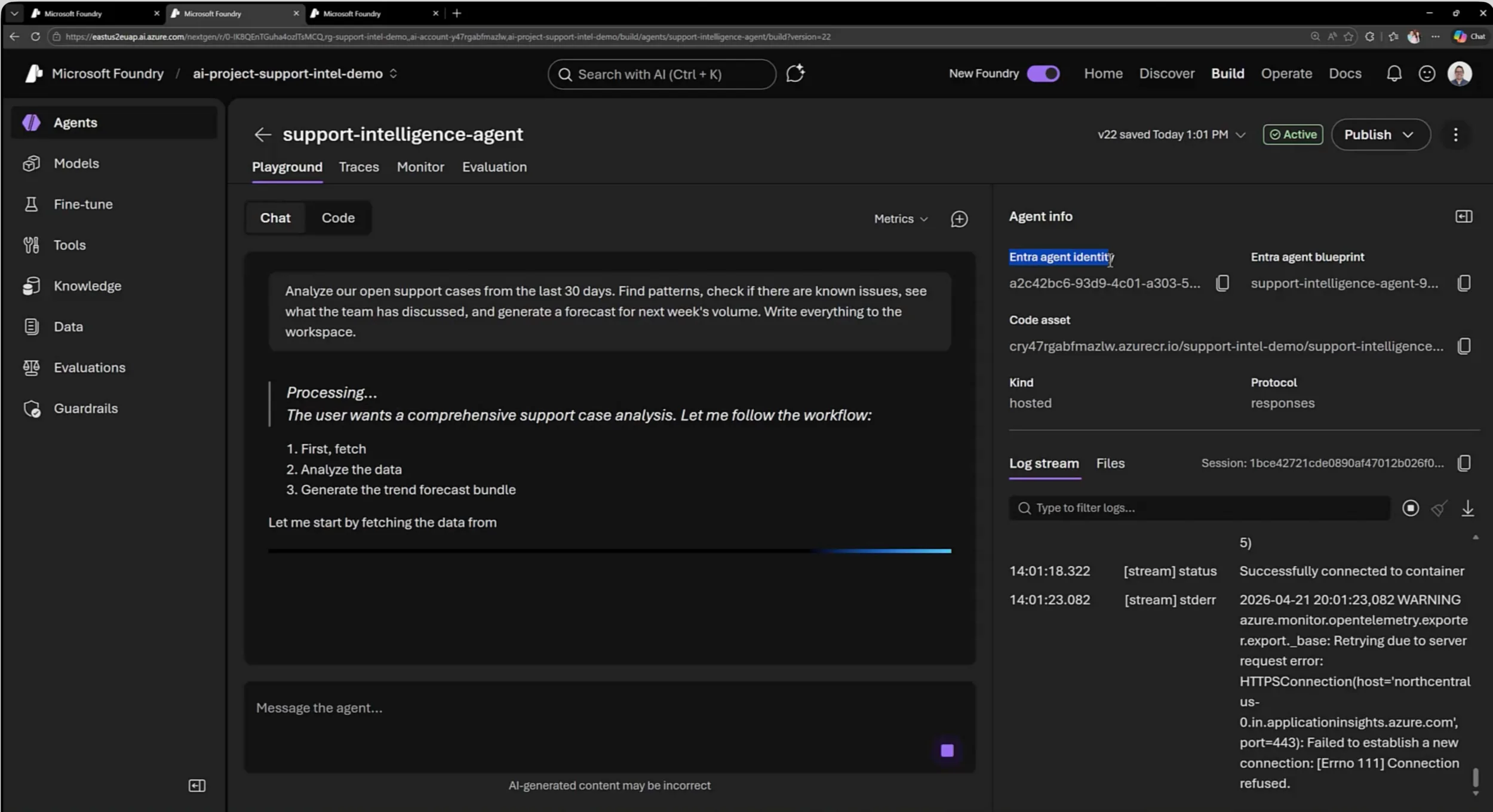
Introducing the new hosted agents in Foundry Agent Service: secure, scalable compute built for agents
Agents are already transforming how developers solve problems. Whether it's a coding agent that refactors your repo overnight, a research agent that synthesizes hundreds of documents into a brief, or an ops agent that monitors and remediates infrastructure — the pattern is clear. Developers are building agents that don't just answer questions, they go do things. Agents of today don’t just execute from a list of tools. They access the underlying file system, write and execute code, and persist files and memories for long running and complex tasks. Today, it is easy to build agents locally. But how do you tak...
What’s New in Microsoft Foundry Fine-Tuning | April 2026
April 2026 brings three major Reinforcement Fine-Tuning updates: Global Training for o4-mini with lower per-token rates across 12+ regions, new GPT-4.1 model graders for richer reward signals, and a comprehensive RFT best practices guide to help you ship specialized models faster.
What’s new in Microsoft Foundry | March 2026
March ships Foundry Agent Service GA with private networking, GPT-5.4 and GPT-5.4 Mini, Priority Processing, Phi-4 Reasoning Vision, SDK 2.0 GA across Python, JS/TS, Java, and .NET, Fireworks AI and NVIDIA Nemotron models, and third-party guardrails from Palo Alto and Zenity.
Foundry Local is now Generally Available
Ship local AI to millions of devices - fast, private on-device inference with no per-token costs.
Foundry Agent Service is GA: private networking, Voice Live, and enterprise-grade evaluations
The next-gen Foundry Agent Service is generally available today with end-to-end private networking, Voice Live integration, expanded MCP authentication, GA evaluations with continuous monitoring, and hosted agent deployments in six new Azure regions.
What’s new in Microsoft Foundry | February 2026
February brings Anthropic's Claude Opus 4.6 and Sonnet 4.6 with 1M-token context, GPT-Realtime-1.5 and GPT-Audio-1.5, Grok 4.0 GA, the Microsoft Agent Framework reaching Release Candidate, and the Foundry REST API quietly going GA — laying the foundation for imminent SDK GA announcements across Python, .NET, JS/TS, and Java.
Microsoft Agent Framework Reaches Release Candidate
We're happy to announce that Microsoft Agent Framework is now in Release Candidate status for both .NET and Python. Release Candidate is an important milestone on the road to General Availability — it means the API surface is stable, and all features that we intend to release with version 1.0 are complete. Whether you're building a single helpful assistant or orchestrating a team of specialized agents, Agent Framework gives you a consistent, multi-language foundation to do it. Microsoft Agent Framework is the easy and most powerful way to build agents and agent systems using Microsoft Foundry or any model or AI s...
What’s new in Microsoft Foundry | Dec 2025 & Jan 2026
Catch up on all the new models, audio updates, fine-tuning expansions, and SDK updates from Microsoft Foundry spanning December 2025 and January 2026 — including GPT-5.2, Codex Max, DeepSeek V3.2, FLUX.2, and the azure-ai-projects v2 beta consolidation.
DPO Fine-Tuning Using Microsoft Foundry SDK
In the rapidly evolving landscape of large language models (LLMs), achieving precise control over model behavior while maintaining quality has become a critical challenge. While models like GPT-4 demonstrate impressive capabilities, ensuring their outputs align with human preferences—whether for safety, helpfulness, or style—requires sophisticated fine-tuning techniques. Direct Preference Optimization (DPO) represents a breakthrough approach that simplifies this alignment process while delivering exceptional results. This comprehensive guide explores DPO fine-tuning, explaining what it is, how it works, when t...
Beyond the Prompt – Why and How to Fine-tune Your Own Models
Large Language Models (LLMs) have reached a point where general intelligence is no longer the bottleneck. The real challenge in enterprise AI systems behavioral alignment ensuring models that produce consistent, reliable, policy-compliant outputs on a scale. Prompt engineering and Retrieval-Augmented Generation (RAG) are powerful but they do not change model behavior. Fine-tuning will solve this by customizing a pretrained AI model with additional training on a specific task or dataset to improve performance, add new skills, or enhance accuracy. This post explores what Microsoft Foundry fine-tuning is, when us...
Building an AI Skills Executor in .NET: Bringing Anthropic’s Agent Pattern to the Microsoft Ecosystem
We welcome guest author, Matt Kruczek, to share how to build a complete Skills Executor in .NET, combining Azure OpenAI with the Model Context Protocol (MCP) C# SDK to bring the same agentic patterns to the Microsoft ecosystem. You’ll see how to define reusable skills, connect local and external tools, and orchestrate intelligent agent loops—so enterprise teams can standardize AI behavior without hardcoding business logic.
What’s new in Microsoft Foundry | October and November 2025
Azure AI Foundry is now Microsoft Foundry. Read the latest announcements about agents, models, tools and more.
Foundry IQ in Microsoft Agent Framework
Build enterprise-grade RAG agents with Foundry IQ Knowledge Bases in ~20 lines of Python. Learn how the Azure AI Search Context Provider brings intelligent, multi-hop retrieval to the Microsoft Agent Framework—no fragmented pipelines, just plug in the knowledge your agent needs.