
Microsoft Foundry Blog
Your source for learning and building with our models, agents, and tools.
Latest posts
Foundry Agent Service is GA: private networking, Voice Live, and enterprise-grade evaluations


The next-gen Foundry Agent Service is generally available today with end-to-end private networking, Voice Live integration, expanded MCP authentication, GA evaluations with continuous monitoring, and hosted agent deployments in six new Azure regions.
What’s new in Microsoft Foundry | February 2026
February brings Anthropic's Claude Opus 4.6 and Sonnet 4.6 with 1M-token context, GPT-Realtime-1.5 and GPT-Audio-1.5, Grok 4.0 GA, the Microsoft Agent Framework reaching Release Candidate, and the Foundry REST API quietly going GA — laying the foundation for imminent SDK GA announcements across Python, .NET, JS/TS, and Java.
Microsoft Agent Framework Reaches Release Candidate

We're happy to announce that Microsoft Agent Framework is now in Release Candidate status for both .NET and Python. Release Candidate is an important milestone on the road to General Availability — it means the API surface is stable, and all features that we intend to release with version 1.0 are complete. Whether you're building a single helpful assistant or orchestrating a team of specialized agents, Agent Framework gives you a consistent, multi-language foundation to do it. Microsoft Agent Framework is the easy and most powerful way to build agents and agent systems using Microsoft Foundry or any model or AI s...
What’s new in Microsoft Foundry | Dec 2025 & Jan 2026
Catch up on all the new models, audio updates, fine-tuning expansions, and SDK updates from Microsoft Foundry spanning December 2025 and January 2026 — including GPT-5.2, Codex Max, DeepSeek V3.2, FLUX.2, and the azure-ai-projects v2 beta consolidation.
DPO Fine-Tuning Using Microsoft Foundry SDK

In the rapidly evolving landscape of large language models (LLMs), achieving precise control over model behavior while maintaining quality has become a critical challenge. While models like GPT-4 demonstrate impressive capabilities, ensuring their outputs align with human preferences—whether for safety, helpfulness, or style—requires sophisticated fine-tuning techniques. Direct Preference Optimization (DPO) represents a breakthrough approach that simplifies this alignment process while delivering exceptional results. This comprehensive guide explores DPO fine-tuning, explaining what it is, how it works, when t...
Beyond the Prompt – Why and How to Fine-tune Your Own Models

Large Language Models (LLMs) have reached a point where general intelligence is no longer the bottleneck. The real challenge in enterprise AI systems behavioral alignment ensuring models that produce consistent, reliable, policy-compliant outputs on a scale. Prompt engineering and Retrieval-Augmented Generation (RAG) are powerful but they do not change model behavior. Fine-tuning will solve this by customizing a pretrained AI model with additional training on a specific task or dataset to improve performance, add new skills, or enhance accuracy. This post explores what Microsoft Foundry fine-tuning is, when us...

Building an AI Skills Executor in .NET: Bringing Anthropic’s Agent Pattern to the Microsoft Ecosystem

We welcome guest author, Matt Kruczek, to share how to build a complete Skills Executor in .NET, combining Azure OpenAI with the Model Context Protocol (MCP) C# SDK to bring the same agentic patterns to the Microsoft ecosystem. You’ll see how to define reusable skills, connect local and external tools, and orchestrate intelligent agent loops—so enterprise teams can standardize AI behavior without hardcoding business logic.
What’s new in Microsoft Foundry | October and November 2025

Azure AI Foundry is now Microsoft Foundry. Read the latest announcements about agents, models, tools and more.
Foundry IQ in Microsoft Agent Framework


Build enterprise-grade RAG agents with Foundry IQ Knowledge Bases in ~20 lines of Python. Learn how the Azure AI Search Context Provider brings intelligent, multi-hop retrieval to the Microsoft Agent Framework—no fragmented pipelines, just plug in the knowledge your agent needs.
Announcing Foundry MCP Server (preview) in the cloud, speeding up AI development with Microsoft Foundry

MCP (Model Context Protocol) is a standard protocol that enables AI agents to securely connect with apps, data, and systems, supporting easy interoperability and seamless platform expansion. At Ignite, Microsoft Foundry introduced Foundry Tools, which serves as a central hub for discovering, connecting, and managing both public and private MCP tools securely, simplifying integration across more than 1,400 business systems and empowering agents. Microsoft Foundry also upleveled Foundry Agent Service to empower developers to securely build, manage, and connect AI agents with Foundry Tools, enabling seamless integra...

⭐Upcoming Virtual Event⭐ AI Dev Days, Level-Up Your AI Skills with Microsoft Reactor
Join us for AI Dev Days, a two-day virtual event exploring the latest Microsoft Azure, Foundry and GitHub innovations. Whether you’re modernizing legacy apps, building with agents, or exploring the newest AI models, this is your moment to skill up, ship faster, and connect with experts.
Introducing Memory in Foundry Agent Service


Give your agents the power to remember Imagine your agent never asks the same question twice. Until now, most agents have been stateless. Each conversation resets to zero, forgetting what users said just minutes ago or weeks ago. Developers tried to bridge this gap with homegrown solutions — storing embeddings in databases, manually retrieving prior messages, or stuffing entire chat histories into prompts. These workarounds add latency, cost, and complexity, and still fall short of delivering truly personal, context-aware interactions. At Ignite 2025, we introduced the public preview of memory in Foundry Ag...
Translation Customization, A Developer’s Guide to Adaptive Custom Translation

Introduction Translation isn’t just converting words—it’s enabling global communication. Yet for businesses operating worldwide, achieving accuracy, speed, and domain-specific terminology has been a persistent challenge. Market trends show that 70% of consumers prefer content in their native language, and enterprises are under pressure to deliver real-time multilingual experiences without sacrificing quality. That’s why we’re introducing Adaptive Custom Translation (AdaptCT) in Microsoft Foundry Tools—a breakthrough that redefines how translation systems are customized. Instead of retraining models from scr...
Introducing Multi-Agent Workflows in Foundry Agent Service

Across industries, organizations are moving from experimenting with single agents to running AI at the center of their business operations. While single agents excel at focused tasks, customers quickly discover that real enterprise work stretches across multiple steps, involves different roles, and requires strong governance. To operationalize AI in this environment, teams need a dependable way to coordinate agents, tools, and logic into complete, end-to-end processes. Over the past year, as customers deployed agents into production, the same challenges surfaced across industries: At M...
Azure Content Understanding is now generally available

At Microsoft Ignite this year, we’re excited to announce that Azure Content Understanding in Foundry Tools is now generally available (GA). Over the past months, we’ve seen preview usage across industries, from large consultancies to healthcare leaders, with invaluable customer feedback shaping this release. With this GA release, we’re enabling flexibility and control with model choice, production-grade reliability, expanded region availability, and broader scenario coverage. In addition, this update brings tight integration with Microsoft Foundry Models, Foundry IQ powered by Azure AI Search, and agent ecosys...
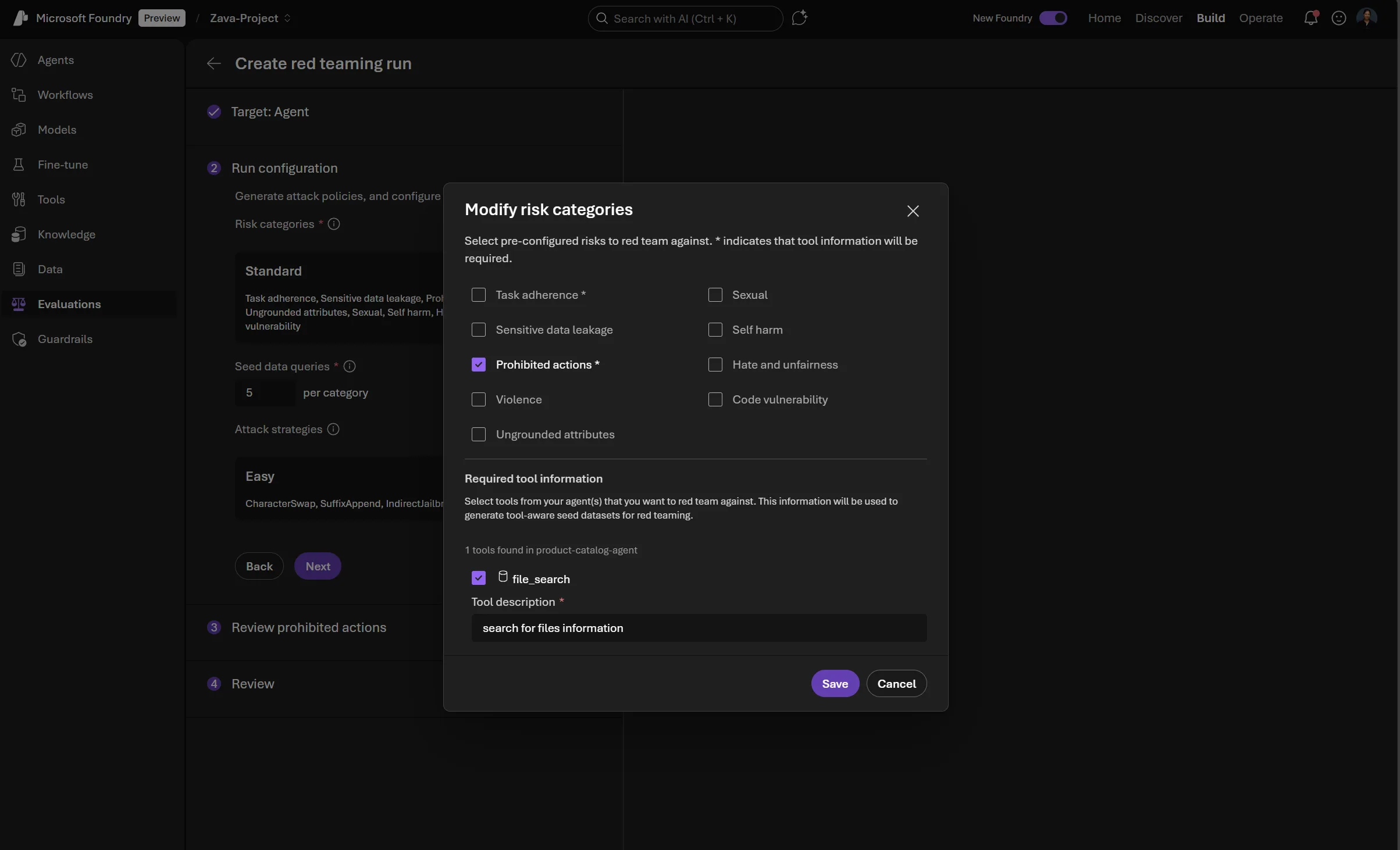
Assess Agentic Risks with the AI Red Teaming Agent in Microsoft Foundry

Accelerate your trustworthy AI journey with the enhanced AI Red Teaming Agent in Microsoft Foundry. Empower developers to automate adversarial testing for both models and agentic systems—covering risks like prompt injection, prohibited actions, sensitive data leakage, and task adherence. Integrate red teaming into your CI/CD pipelines using the Foundry SDK and no-code UI wizard, enabling continuous safety evaluation and rapid prototyping. With PyRIT’s open-source attack strategies and customizable risk definitions, you can systematically probe vulnerabilities, benchmark improvements, and ensure robust safeguards ...
Foundry Local comes to Android—plus on-device speech, on-prem support, and a simpler SDK

Today, we’re introducing a powerful new way to bring AI directly to your mobile apps: Foundry Local on Android. Starting now, you can build Android applications that run AI on-device—no cloud round trips required. Sign up for the gated preview here: https://aka.ms/foundrylocal-androidprp Most of us now carry a computer in our pocket. These devices are now powerful enough to run AI models locally, unlocking speed, privacy, and flexibility. With Foundry Local, you can easily deploy optimized open-source models from Microsoft Foundry directly on mobile devices. Why on-device AI matters: Foundry Local...
How to debug and optimize RAG agents in Microsoft Foundry

TL;DR Learn the best practices to evaluate and optimize the RAG quality of your agent using evaluations in Foundry Observability. This tutorial demonstrates these 2 best practices before deploying your RAG agent: 1. Evaluate and optimize end to end your RAG agent using reference-free RAG triad evaluators: Groundedness and Relevance evaluators; 2. For advanced search use case requiring ground truths and more precise measurement of retrieval quality, optimize your Search parameters using golden metrics such as XDCG and Max Relevance: Document Retrieval evaluator Framing Agent Observability Agents can be po...