


Today we announced the innovation we’re bringing in solving shader compilation for the ecosystem at our GDC Talk: Advanced Shader Delivery for Windows. Want to find out what this means for solving shader compilation for your title and customers? Read on!
State of the Industry
Long shader compilation times and in-game shader stutter for D3D12 apps are two of the biggest problems in PC gaming. These problems are caused by compiling shaders at runtime. Unlike console, PC games do not have a fixed driver and GPU environment, and precompiled shaders need a way to be delivered to a large matrix of drivers and GPUs in the Windows ecosystem.
Last fall, we announced how advanced shader delivery is solving the problem on the Xbox ROG Ally and Ally X devices. Today, Microsoft is uniting these ecosystem pieces between game developers, IHVs, and game stores to solve shader compilation on PC going forward.
As game developers, you can enable gamers to download fully compiled shaders for their specific hardware. In our previous blog post, you can learn how to trace your game title or programmatically generate a state object database (SODB) file and use an offline compiler to compile the state objects into a precompiled shader database (PSDB) format to test the advanced shader delivery benefits locally.
What’s New and Coming Soon
In the AgilitySDK 1.619 release, we unveiled two new APIs: the app registration API and stats API.
New APIs:
App Identity API: This API enables applications to declare their own application identity to D3D12 and the underlying graphics drivers in a standardized way. Allocations can set a default D3D12_APPLICATION_DESC and GUID to self-identify before a D3D12 device is created. Attaching application identity to the SODB will be a requirement for submitting an SODB file to the Xbox Partner Center for your title.
Stats API: This API gives game developers visibility into how well a precompiled shader database (PSDB) performs. If you are looking to see how well a given PSDB will work for a specific hardware configuration, these APIs will give game developers information on the shader cache hit rate.
PIX support: The May 2026 version of PIX will show these stats as real-time counters in PIX’s System Monitor view as your game runs.
Partial Graphics Programs:
Some titles have such a large amount of pipeline state objects (PSOs) to the point that most engines cannot enumerate them. Precompiling these PSO heavy titles in advance for many different hardware configurations for distribution through advanced shader delivery would take a significant amount of time and create duplicate effort. To address this, we are creating partial graphics programs. Partial graphics programs split the pipeline creation into two steps: create partial pre-rasterization and pixel shader programs containing common state used by different graphics pipelines, then link them together with other state.
For titles that have large amounts of PSOs, partial programs will be coming soon to more efficiently re-use graphics programs and link them together at runtime. In the meantime, check out our spec for partial graphics programs today.
Industry Alignment
We’re working closely with the GPU hardware vendors to expand advanced shader delivery across the PC ecosystem. Here’s what our partners have to say about support for this feature.
“Advanced Shader Delivery (ASD) is transforming the gaming experience, cutting load times and eliminating in‑game stutter on Xbox ROG Ally devices. It’s truly remarkable what the Microsoft and AMD engineering teams have accomplished in such a short period of time.”
-Rodney Andre, Corp. VP Software Development
For more, see here
“Intel is committed to solving shader compilation challenges on PC to improve the overall gaming experience. Microsoft Advanced Shader Delivery is a critical step toward reducing shader load times and compilation stutters, and Intel is pleased to release drivers supporting this feature on our Lunar Lake and Panther Lake platforms.”
– Lisa Pearce – Corporate Vice President, Software Group, Intel
For more, see here
“To eliminate the shader-related stutters and load times that have plagued gamers for years, NVIDIA is working closely with Microsoft on launching Advanced Shader Delivery for GeForce RTX consumers later this year.”
Henry Lin, Director of Product Management, Gaming & AI at NVIDIA
For more, see here
“Advanced Shader Delivery is a key feature for Qualcomm Snapdragon® compute platforms. By reducing redundant shader compilation, it improves the overall gaming experience. We are partnering with the Microsoft DirectX team to debut this feature soon on Qualcomm Adreno™ X2 GPUs.”
– Nagendra Kumar, Senior Director of Engineering
And here is what a middleware partner has to say about support for this feature.
“As Unreal, we’re excited about supporting advanced shader delivery in the ecosystem. We’ve been doing early testing and explorations on SODB and PSDB generation, and will have more details coming soon.” –Mihnea Balta, Director, Rendering Engineering at Epic Game
Call to action
In summary, to solve shader compilation for your title, there are two important steps: integrate SODB collection into your game engine and submit an SODB along with your game package to the Xbox Partner Center.
For more details on how to integrate SODB collection into the game development process, follow the below links.
Sample code on how to programmatically generate SODBs
Instructions on how to trace a title for SODBs
In May, the Xbox Partner Center will feature new UI where you can upload an SODB file alongside your game package.
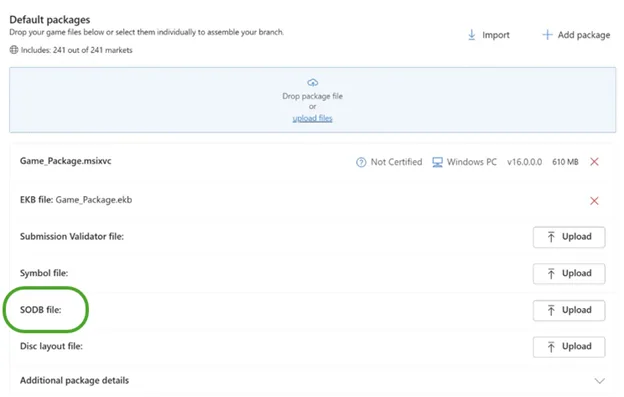
New Xbox Partner Center UI for sharing SODB files
And in the near future, look out for the release of partial programs to more efficiently compile PSOs.
For additional questions, you can reach out to us via Discord.


This is great for the future. A proper way to get rid of this frustrating issue once for all; however, I am kind of worried about the state of legacy tittles, as it is up to the developers to share these files.
I do believe they will gladly integrate this in their next projects, but it would be amazing to find a way not to depend completely on devs in certain scenarios, particularly for legacy games. The amount of games out there, especially Unreal Engine and Unity ones, with huge amounts of stuttering for compiling on the run is insane....