


Java has powered some of the world’s most mission‑critical systems for decades and that’s a big part of why we’re excited to be back with the community at JavaOne 2026 (March 17–19 in Redwood City). At Microsoft, we get to work with Java teams every day: folks shipping at massive scale, running on tight SLAs, modernizing mature codebases, and now, figuring out how to bring AI into production without breaking what already works.
You’ve probably heard some version of “AI will write all the code.” In practice, what we’re seeing is simpler (and more useful): AI helps take the busy work out of your day so you can spend more time on the work that needs a Java engineer. That means architecture decisions, performance tradeoffs, correctness, security, and the kind of operational thinking that keeps systems running.
What we’re bringing to JavaOne
So, what are we going to talk about at JavaOne? We’ll share how Java teams are building real AI features, supported by your favorite AI models that are grounded in the right data, evaluated for quality, and operated with the same discipline you apply to your applications today. And we’ll show what that looks like on Azure, whether you’re modernizing your applications or running the latest code on serverless, containers, Kubernetes, and beyond.
We’ll also spend time on what makes agents trustworthy. Java engineers are right to ask: how do we make sure these systems behave like our best teammates? The answer is guardrails: clear roles, permissions, and policies; strong grounding so responses are tied to the right context; and continuous evaluation so you can define what “good” looks like and enforce it. When agents are treated like software (with testing, monitoring, and security), they become a practical way to ship new AI capabilities that are safe and scale.
Microsoft’s commitment to the Java ecosystem
Microsoft is deeply invested in Java’s success. We partner across the ecosystem and contribute upstream so Java stays open, portable, and production‑ready, including ongoing contributions to projects like LangChain4j and Spring AI (from model integrations and SDK alignment to security fixes, documentation, and reference architectures). We also keep investing in developer productivity across the tools you already use like IntelliJ and Eclipse, so teams can move faster while staying in control, especially when it comes to modernizing existing applications and bringing them forward into modern Java.
If you’re curious what Microsoft’s Java team has been building, check us out at JavaOne, starting with the keynote, then a set of technical sessions, and a fantastic roster of experts and theatre sessions at the Microsoft booth where you’ll have the opportunity to go deeper.
Microsoft sessions at JavaOne
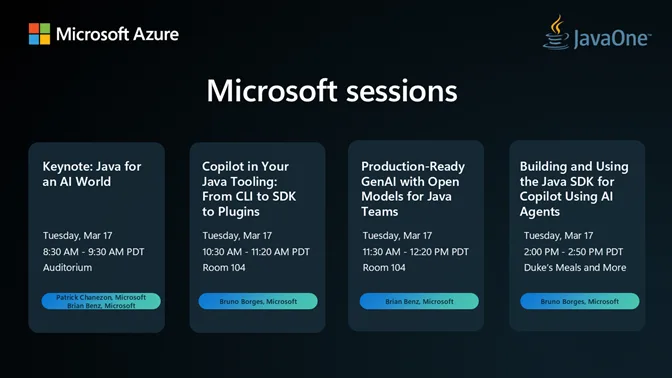
Day 1 Keynote: Java for an AI World
Tuesday, Mar 17 | 8:30 AM – 9:30 AM PDT Auditorium
The keynote streams live on March 17 at 15:30 UTC at youtube.com/java — join us on stage alongside Rod Johnson, Josh Long, and engineering leads from Oracle, NVIDIA, JetBrains, and Uber for what’s shaping up to be one of the most compelling keynotes in JavaOne’s recent history.
Technical Sessions
Copilot in Your Java Tooling: From CLI to SDK to Plugins – Bruno Borges
Tuesday, March 17 | 10:30–11:20 AM PDT Room 104
See how GitHub Copilot CLI and the Copilot Community SDK for Java enable embedding Copilot into custom tools, workflows, and Java-based developer platforms.
Production-Ready GenAI with Open Models for Java Teams – Brian Benz
Tuesday, March 17 | 11:30 AM–12:20 PM PDT Room 104
Learn how Java teams build and operate production GenAI systems using open models with frameworks and tools like LangChain4j and vector search, including tuning, safety, and RAG quality evaluation.
Building and Using the Java SDK for Copilot Using AI Agents – Bruno Borges
Tuesday, March 17 | 2:00–2:50 PM PDT Duke’s Meals
Explore the Java SDK for Copilot, which brings programmatic control of the Copilot CLI and its agents to the Java ecosystem, including conversational AI sessions, custom tools, streaming events, and MCP server integration.
Meet us at the Microsoft booth

You can also connect with Patrick Chanezon, Bruno Borges, Naga Surendran, Beena Moore, Ayan Gupta and myself throughout the event to discuss Java modernization, platform engineering, containers, and AI-powered development.
Visit the Microsoft booth #2 for demos, technical conversations, and a chance to win a Microsoft Store gift card in our sweepstakes. While you’re there, stick around for some fun — we’ll have swag and surprises waiting.
We look forward to seeing you at JavaOne 2026!
That’s not all! The learning continues in a couple of weeks. Join us for JDConf 2026 on April 8-9, a free, global virtual conference for and by Java developers, now in its sixth year! RSVP here for a chance to win exciting prizes
Resources
-
- Java on Azure Build and run Java applications on Azure. https://learn.microsoft.com/azure/developer/java/
- Microsoft Foundry Secure model deployment and management platform. https://azure.microsoft.com/ai/foundry
- GitHub Copilot App Modernization App assessment and modernization with Copilot App Mod. https://learn.microsoft.com/github/copilot/app-modernization
- JavaOne 2026 Demo Code and Samples Demo code from Microsoft’s JavaOne sessions. https://aka.ms/javaonedemo
- Microsoft for Java Developers Java at Microsoft: 2025 Year in Review https://devblogs.microsoft.com/java/java-at-microsoft-2025-year-in-review/
Follow @JavaAtMicrosoft on social media


0 comments