

CppCon 2026 is a wrap! Microsoft returned to Aurora, Colorado, for a week of talks, technical discussions, and conversations with developers from across the C++ community.
Microsoft C++ @ CppCon
At our booth, we met people building games, financial systems, developer tools, embedded software, scientific tools, and other applications. Some were working with the latest language features, and others were maintaining and modernizing systems that have been in production for decades. Many talked to us about debugging, performance, build systems, or modern C++, and a growing number were experimenting with ways AI can help them accomplish their goals in the most effective way possible.
Attendees who completed our annual Microsoft C++ survey were entered for our daily LEGO raffle. This year’s prizes included some great LEGO sets; a retro gaming console, a retro camera, a mini orchid, and a model of the Milky Way galaxy.
Congratulations to our raffle winners and thank you to everyone who took the time to share detailed feedback.

Our Talks
I didn’t get a chance to attend many sessions as I spent most of my time talking with folks at the booth, but I was lucky enough to get to see most of our Microsoft sessions as they were being developed.
The Journey to “/W4 /WX”: How Hard Could It Be?

Keith Stockdale, from Rare, presented another session in his series of talks on dealing with the sometimes massive fallout from making small changes to your build system. After first establishing why someone should increase their warning level and treat warnings as errors, Keith walked through the diagnostics that show up, and how they were resolved.
And there were THOUSANDS of warnings, many of them previously suppressed through #pragmas or on the command line. Notably, the one warning that seemed to be the most pervasive was C4189 (local variable is initialized but not referenced) which they took from nearly 10,000 unique warnings down to zero! Definitely check this talk out if you are interested in generally improving the quality of your codebase and keeping your sanity intact while doing so.
C++ in the Age of AI: How Visual Studio Is Evolving
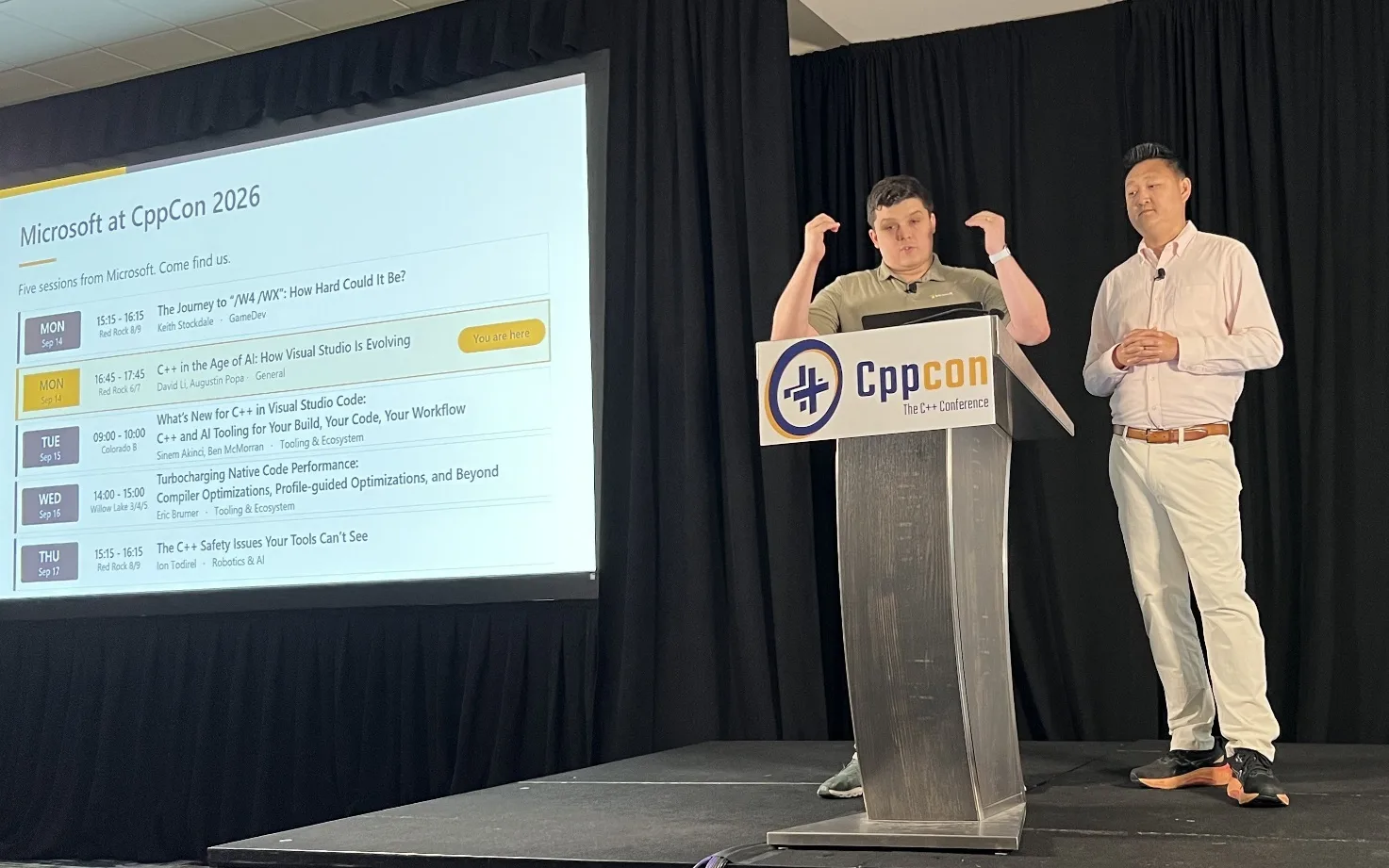
David Li and Augustin Popa presented this year’s version of our “what’s new” session for Visual Studio. GitHub Copilot has become an important part of the modern development toolbox, so much of the session was focused on how those features show up in Visual Studio, including AI workflows to modernize your code, reduce your build times, and debug your projects.
But there were plenty of features and improvements that aren’t specific to AI workflows, as well. Navigating your code in Visual Studio is now much faster with the latest versions, and MSVC Build Tools v14.52 (ships in November, release candidate available now) will ship with all C++23 features implemented and a /std:c++23 switch, which will also be compatible with C++/CLI. The team has also fixed nearly 650 bugs across the compiler, libraries, and IDEs since last year’s conference.
What’s New for C++ in Visual Studio Code: C++ and AI Tooling for Your Build, Your Code, Your Workflow Watch it on YouTube!
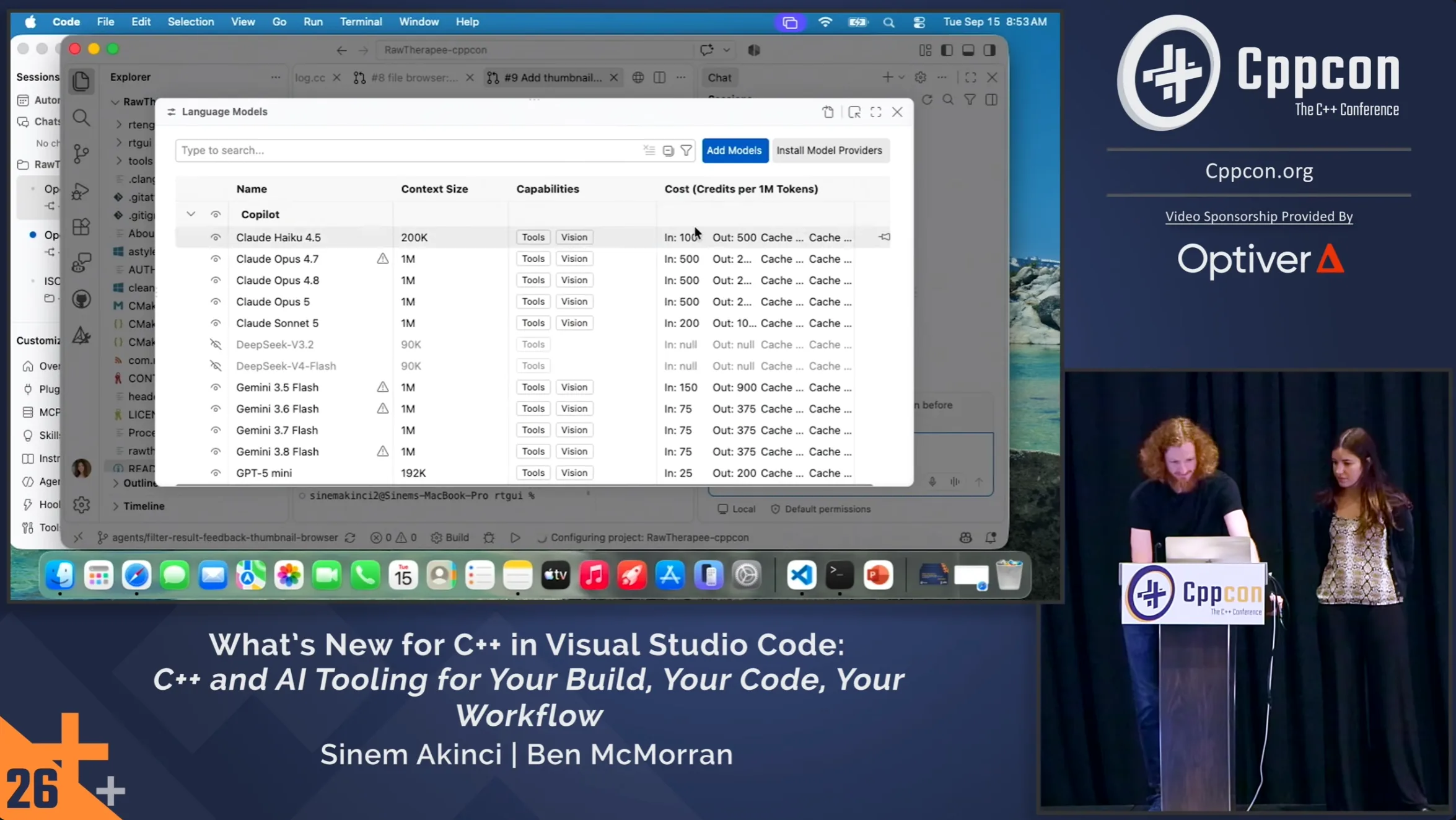
Sinem Akinci and Ben McMorran gave a rundown on the latest and greatest for C++ users of Visual Studio Code. Our Visual Studio Code users are at the forefront of the AI agentic shift, and a lot of this session focused on how you can easily shift between different agentic experiences, depending on the nature of the work, and how you can customize your AI experience with Bring Your Own Key (BYOK), skills, custom agents, and hooks.
I tend to be a Visual Studio guy so a lot of this information wasn’t as useful to me in my day-to-day, but it was nice to see how excited Visual Studio Code users were to talk about their experiences with all of these new features. I for one am looking forward to the day when all AI tools have an easy-to-use BYOK experience that lets you run LLM inference on local hardware.
Turbocharging Native Code Performance: Compiler Optimization, Profile-guided Optimizations, and Beyond
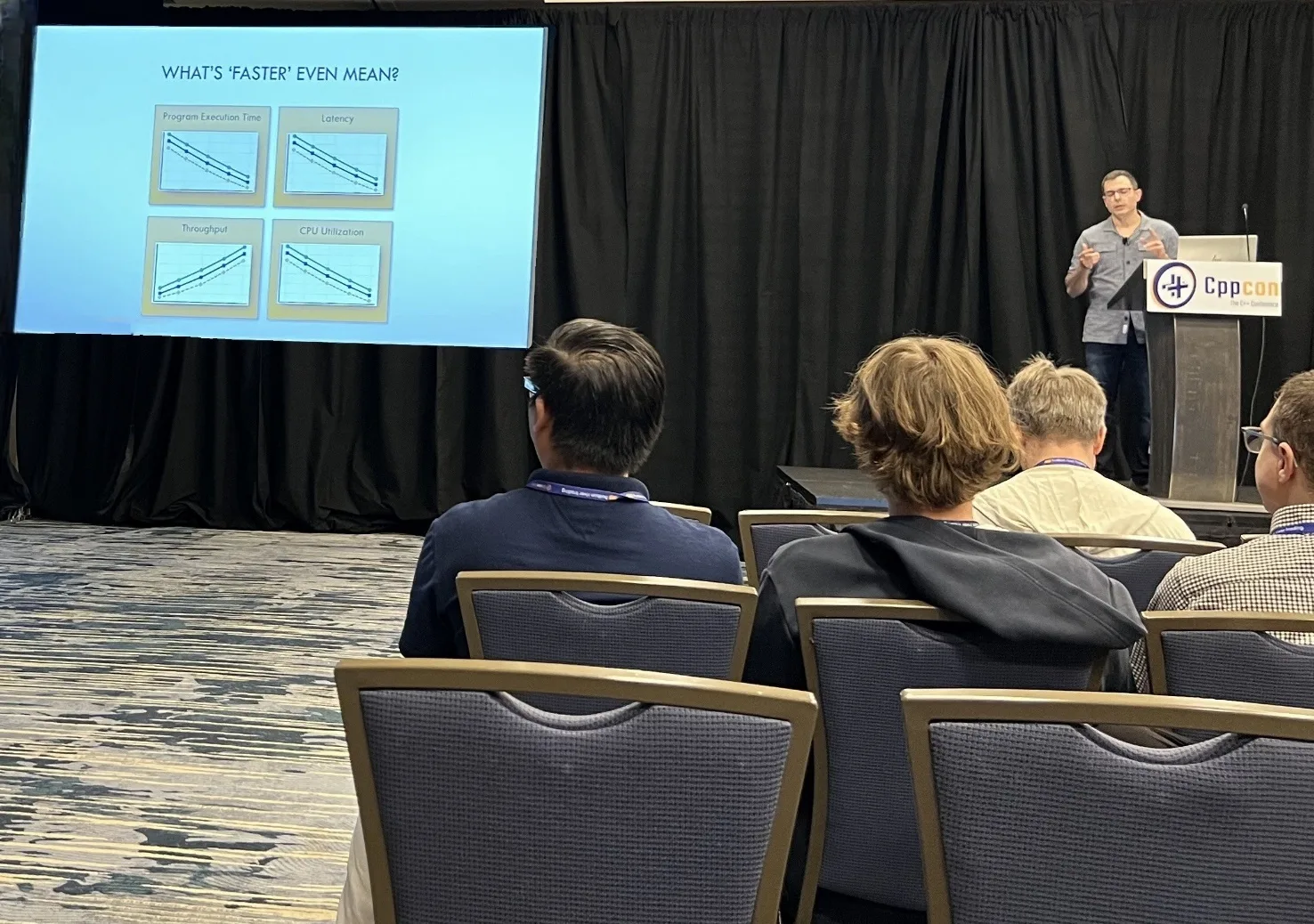
I did get to spend some time in Eric Brumer’s session on how modern CPUs work, how to use profilers, and how those profiles can be used to optimize your products based on behavior of real users. Sample-based Profile Guided Optimizations (SPGO) is a pretty cool evolution of traditional Profile Guided Optimizations (PGO) and it’s already been deployed inside Microsoft to gain non-trivial runtime performance gains.
If you use C++ for the performance it unlocks for your applications, definitely catch this one when it’s available.
The C++ Safety Issues Your Tools Can’t See
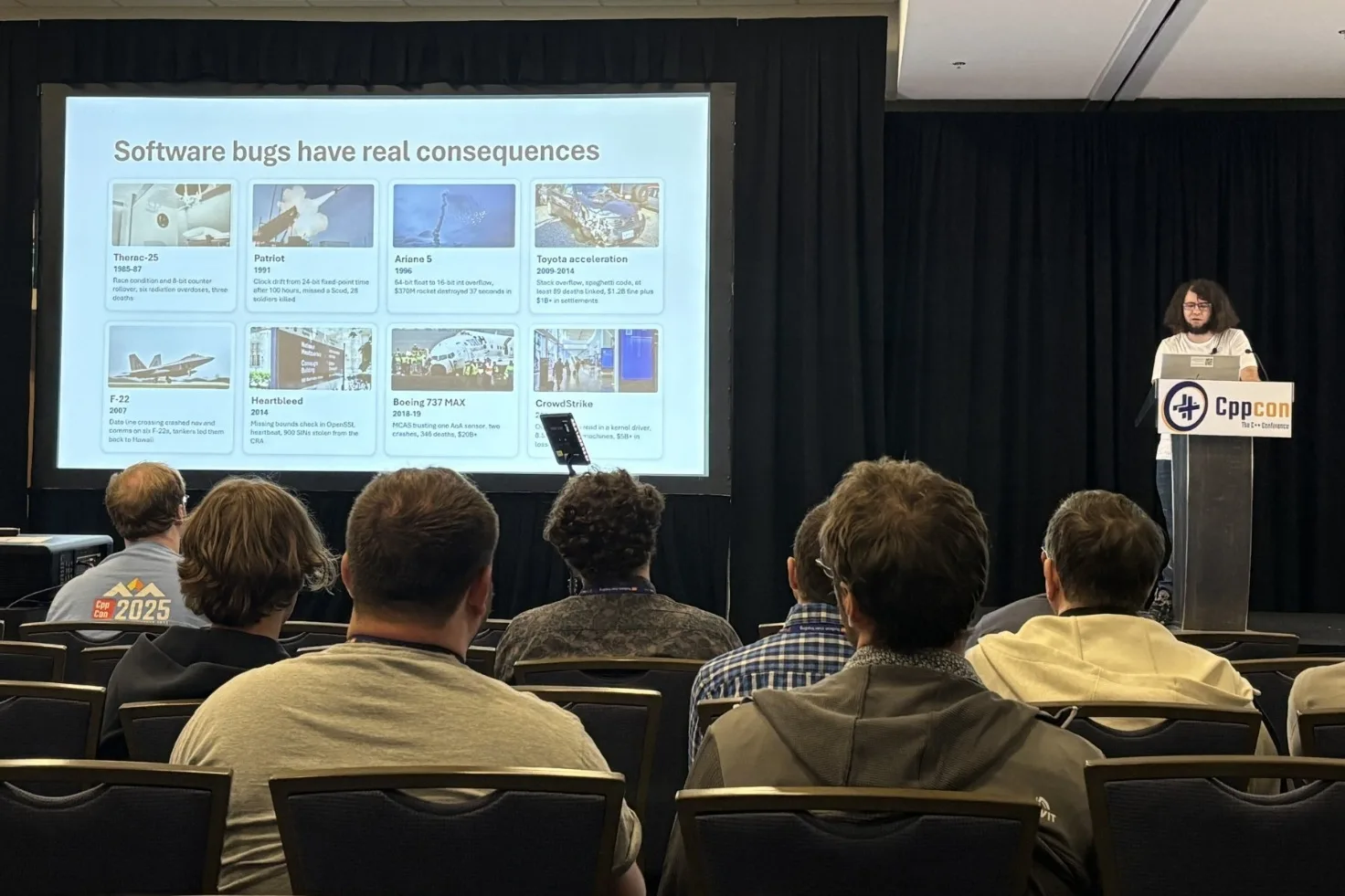
Safety for C++ products has been a hot topic over the past decade, and there have been lots of papers and talks on the topic. Ion Todirel’s session starts by summarizing where we have been and introducing a way to discuss the different meanings of safety and how real issues map to them. One of the biggest points that I love to reinforce any chance I get, is that C++ is not C. Many of the problems that C++ has are things that it gets from its history of C compatibility, but unlike C, C++ has a long history of introducing features that are explicitly meant to avoid many of those problems. The talk closes out with a discussion about the broad solution space available to us and how AI can help us make our software safer.
My Major Takeaways
C++ Language Developments
Folks are really excited for new C++ language features, particularly reflection. There were already a couple of sessions, based on existing reflection implementations, showing really compelling things that can be done with the feature. It has the potential to be as impactful as templates were in how we write C++ code.
Performance is King
When we asked developers what they enjoy about C++, they often started with performance and control. CppCon attendees described building low-latency systems, game engines, embedded software, databases, compilers, infrastructure, scientific applications, and other software where memory use, hardware behavior, and predictable performance matter. They value the ability to choose a zero-cost abstraction when one fits, and to choose writing at a lower level when a problem requires it.
AI Normalization
The past few years have seen LLM-based AI workflows become increasingly common for attendees. It feels like there’s been a significant shift in the past year where people have really started to understand how they can use existing AI tools to complete their work faster and easier. Multiple attendees we talked to had conference badges that said something along the line of, “I haven’t written code in N months.” Folks are exploring new product surfaces, such as agentic CLI experiences and mostly-automated agents. There also seems to be much less friction getting started with AI tools, especially as products introduce BYOK capabilities and AI tools get approved for sensitive environments like restricted and air-gapped networks. I expect more talks on how to effectively use AI tools for C++ users in the coming years.
Thank you, CppCon
CppCon is valuable because it brings together people working on very different software who still share many of the same engineering questions.
How can we understand a large codebase more effectively? How can we improve performance without making code harder to maintain? How can we adopt a new language feature safely? Where can AI remove repetitive work, and where does an experienced developer need to stay closely involved?
Thank you to everyone who attended a Microsoft session, visited the booth, completed the survey, participated in an interview, or shared a project with us. Those conversations help us understand your workflows and pain points, and they help us improve the tools you use to make all those awesome products in C++.
CppCon is adding the 2026 session recordings to its video archive on a rolling basis. You can also follow the CppCon YouTube channel and the Microsoft C++ Team Blog for new videos, companion posts, and product updates.
We look forward to continuing the conversation.


0 comments
Be the first to start the discussion.