

Azure Cosmos DB enables scalable AI-driven document processing, addressing one of the biggest barriers to operational scale in today’s enterprise AI landscape. Organizations continue to manage massive volumes of structured and unstructured content—contracts, regulatory filings, operational records, images, and field documentation—yet many workflows remain fragmented, manual, and slow.
In the March edition of our Scalable AI with Azure Cosmos DB series, we featured Tredence and their production-grade Intelligent Document Processing (IDP) solution—an Azure-native architecture designed to transform document-heavy business processes into scalable, AI-driven systems. The on-demand session showcases how Azure Cosmos DB, Azure Document Intelligence, and agentic AI patterns power enterprise-scale document understanding and decision-making.
This post recaps the architecture presented in the session, including the document pipeline, agentic orchestration layer, and a real-world telecom scenario where the solution helped reduce decision cycles by 80% and unlock multi-million-dollar savings.
Enterprise document processing challenges: moving from legacy systems to AI at scale
Enterprises in industries such as telecom, retail, and media often operate across disconnected systems while handling high volumes of business-critical documents. These may include lease agreements, compliance records, field inspection reports, OSS/BSS data, scanned files, and image-based documentation. Traditional approaches to processing this information are often manual, inconsistent, and difficult to scale.
Common pain points include:
- Contract analysis that takes weeks or even months
- Slow and error-prone revenue mapping across operational systems
- Outdated site documentation during infrastructure transformation programs such as 5G to 6G transitions
- Siloed data estates that prevent unified analysis
- Compliance risk caused by incomplete or inconsistent extraction
Tredence addresses this challenge through its IDP platform, built natively on Azure and designed for enterprise-grade scale, traceability, and automation.
A three-layer architecture for scalable enterprise AI
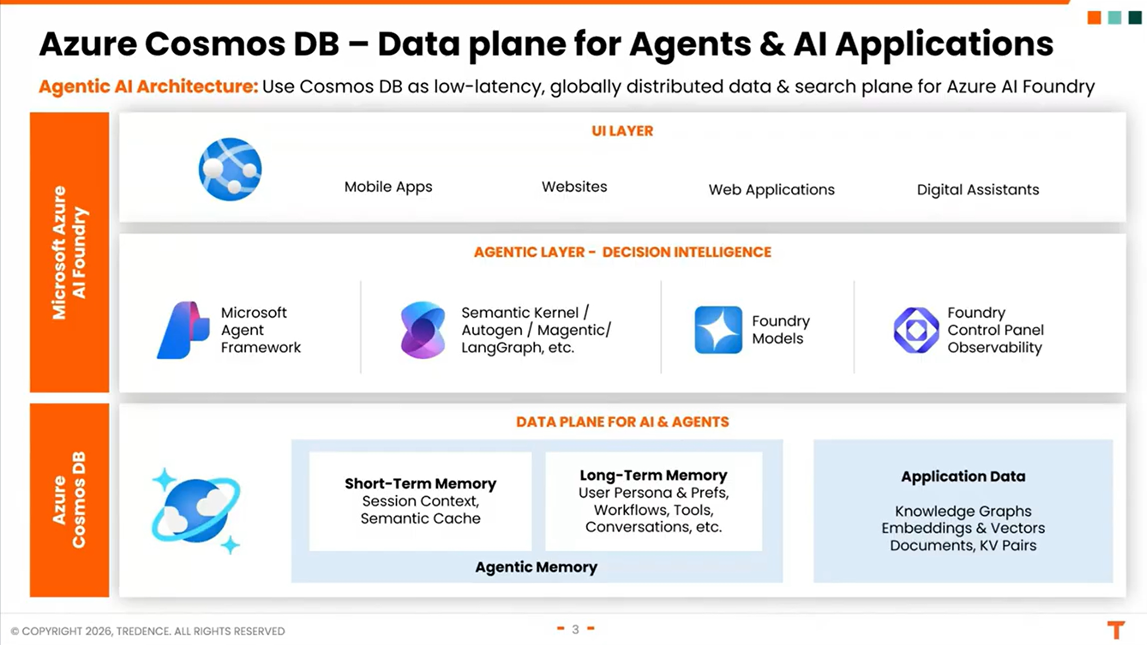
The solution presented follows a clean three-layer architecture:
1. Experience layer
This includes web and mobile user experiences, along with conversational interfaces that allow business users to interact with extracted knowledge and system recommendations in natural language.
2. Agentic intelligence layer
This layer orchestrates multi-agent workflows using modern AI frameworks such as LangChain, Semantic Kernel, and AutoGen. Specialized agents coordinate tasks such as extraction, validation, reasoning, search, and decision support. These agents communicate through agent-to-agent and agent-to-tool patterns, including data access through the Azure Cosmos DB MCP Toolkit.
3. Unified data plane
At the foundation is Azure Cosmos DB, which acts as the unified data and memory layer for the solution. It stores:
- Operational application data
- Structured extraction outputs
- Metadata and document state
- Vector embeddings for semantic retrieval
- Graph relationships for contextual reasoning
- Session memory and interaction context for agents
This unified model allows the system to support both transactional and AI-native workloads without introducing additional data silos.
Why Azure Cosmos DB is the backbone
A key theme from the session was that the value of the solution comes not only from AI models, but from the strength of the underlying data architecture.
Azure Cosmos DB enables this architecture through several capabilities:
- Multi-model flexibility – supporting document-style access, graph relationships, and vector-based retrieval patterns in a single platform
- Low-latency global scale – enabling consistent application responsiveness across regions
- Automatic horizontal scaling – allowing the system to absorb variable ingestion and query workloads
- Support for hybrid workloads – combining transactional operations, metadata filtering, semantic retrieval, and relationship traversal
This is especially important for agentic systems, where AI agents need fast access to both current state and historical context in order to reason effectively and act reliably.
AI-driven document pipeline: precision, auditability, and scale
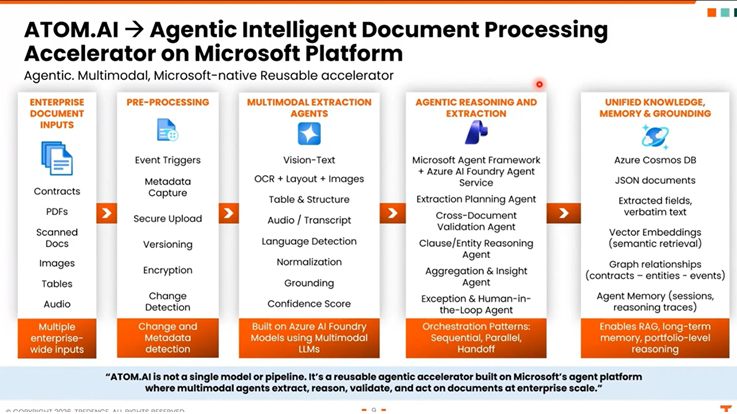
At the core of the solution is a document intelligence pipeline built using Azure AI services, including Azure Document Intelligence and Content Understanding.
The pipeline supports:
- Multimodal ingestion from PDFs, scanned images, operational systems, and visual field inputs such as drone imagery
- OCR and layout understanding for extracting structure from semi-structured and unstructured files
- Table, chart, and content extraction for downstream analytics and reasoning
- Classification and confidence scoring to improve extraction reliability
- Verbatim extraction for legal and compliance-sensitive scenarios where paraphrasing is not acceptable
- Smart backfill capabilities to add or correct fields later without requiring the full document corpus to be reprocessed
- Post-processing and validation across documents and systems
- Human-in-the-loop workflows to continuously improve extraction quality and governance
The output is persisted directly into Azure Cosmos DB as structured fields, metadata, embeddings, and contextual relationships—creating an immediately usable knowledge layer for downstream agents and applications.
From extraction to action: agentic AI for document processing and decision-making
A major differentiator in the Tredence approach is that the system does not stop at extraction. Instead, it uses agentic AI to turn document understanding into business decisions.
In this architecture:
- Orchestrator agents coordinate specialized sub-agents
- Sub-agents handle domain tasks such as contract interpretation, revenue analysis, or document validation
- Persistent memory in Azure Cosmos DB allows the system to maintain context across sessions
- AI models reason over extracted knowledge to identify patterns, anomalies, and opportunities
- Tools integrated through the Cosmos DB MCP Toolkit allow agents to securely perform data access operations, semantic retrieval, and contextual graph exploration
This means agents can do more than extract fields. They can correlate data, validate findings, surface risks, and recommend next-best actions—while maintaining traceability for governance and review.
Real-world telecom scenario: optimizing network rollout and reducing operational cost
The session highlighted a telecom scenario in which the solution was applied to support rollout planning and infrastructure optimization.
The objective was to accelerate network modernization by identifying opportunities to optimize existing infrastructure, reduce redundant sites, and improve decision-making across contract, operations, and revenue data.
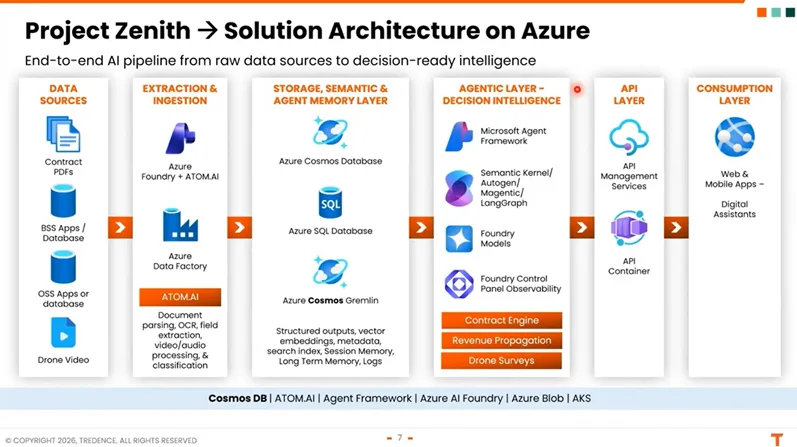
The solution included several core modules:
Strategic cell site contract engine
Contracts were processed to extract key commercial and operational terms such as rent, vendor details, equipment references, renewal timelines, and obligations. This information was then linked with operational metrics stored in Azure Cosmos DB.
Revenue propagation and prioritization
Coverage, utilization, and business impact signals were combined to estimate revenue potential and help prioritize the highest-value sites.
Zero-touch drone surveys
Visual field inputs were used to automate site validation and update documentation more efficiently.
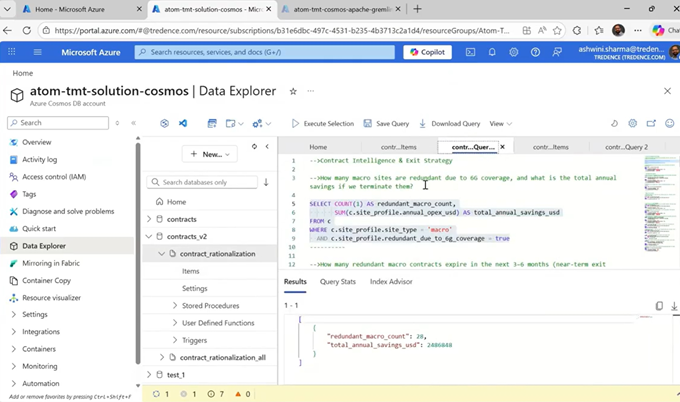
Because contracts, metadata, embeddings, and site relationships were all stored in a common data platform, the system could support rich operational questions such as:
Which sites associated with a specific vendor are nearing expiration and showing low utilization?
This type of multi-dimensional reasoning is difficult to achieve in fragmented architectures, but becomes practical when structured data, unstructured data, semantic context, and graph relationships are all available in one place.

Quantified impact
According to the session, the solution delivered strong business outcomes, including:
- Decision cycles reduced from 2 months to 1–2 weeks
- 80% reduction in processing time
- $2.49M in annual savings in one Dallas market
- Projected national savings of $50M–$100M
- Support for millions of documents with near real-time analytics
These outcomes underscore an important point: scalable AI is not just about model quality. It is about data architecture, operational integration, and system design.
Why AI-driven document processing with Azure Cosmos DB matters
Traditional IDP systems often plateau when they encounter enterprise-scale complexity—multiple systems, multiple content types, compliance constraints, and the need for continuous reasoning.
Tredence’s architecture works because it combines:
- A unified data plane in Azure Cosmos DB
- Enterprise-grade AI extraction services
- Agentic design patterns for reasoning and orchestration
- Azure-native governance, security, and extensibility
This is the shift many enterprises are now making—from isolated AI experiments to integrated production systems that can reason, scale, and drive measurable business value.
Final thoughts
The Tredence session is a strong example of what production-ready agentic AI looks like when paired with the right data foundation. By combining Azure Cosmos DB, Azure Document Intelligence, and modern AI orchestration frameworks, enterprises can move beyond manual document processing and toward intelligent systems that extract, understand, validate, and act.
For organizations working with large volumes of unstructured content, this pattern offers a clear path to reducing compliance risk, accelerating decision-making, and unlocking meaningful operational savings.
You can watch the full session here: https://aka.ms/scalable-ai-mar26 You can also explore the broader series here: Scalable AI with Azure Cosmos DB – Video Series
If you’re building AI solutions that need to operate over massive volumes of unstructured data—with memory, semantic retrieval, full text, highly performant vector search and intelligent orchestration—Azure Cosmos DB is the answer to it.
About Azure Cosmos DB
Azure Cosmos DB is a fully managed and serverless NoSQL and vector database for modern app development, including AI applications. With its SLA-backed speed and availability as well as instant dynamic scalability, it is ideal for real-time NoSQL and MongoDB applications that require high performance and distributed computing over massive volumes of NoSQL and vector data.
To stay in the loop on Azure Cosmos DB updates, follow us on X, YouTube, and LinkedIn. Join the discussion with other developers on the #nosql channel on the Microsoft Open Source Discord.


0 comments
Be the first to start the discussion.