

Follow an AI application from a blank folder to a system built for production
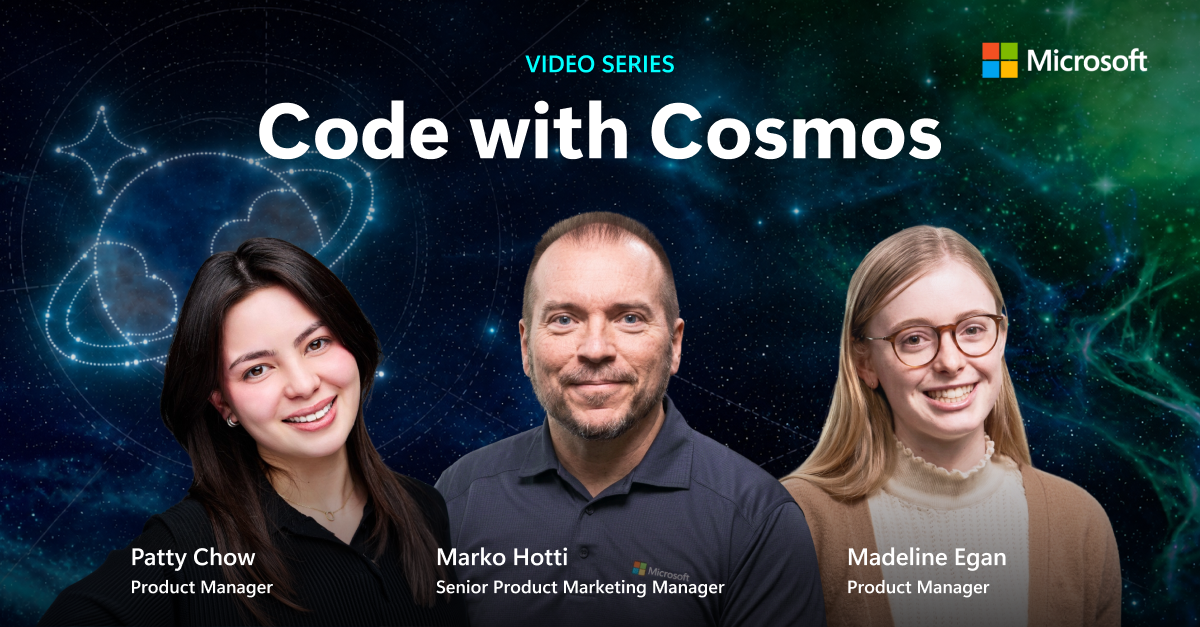
AI application development often starts with a promising prototype. A real application has to do more than produce an answer: it needs current operational data, the ability to take actions and complete transactions, memory that carries across sessions, coordination between specialized agents, and enough visibility for developers to understand and improve how the system behaves.
Today, we’re introducing Code with Cosmos, a new four-part Azure Cosmos DB video series that follows one app – an AI travel planner – from a blank folder and product specification to a production-style, stateful multi-agent application. The planner searches for hotels using meaning and exact criteria, checks live inventory, supports a booking workflow, remembers traveler preferences across sessions, and passes context between research, hotel, and restaurant agents. Watch the full Code with Cosmos playlist to follow the build from beginning to end.
Across four short episodes, the same application evolves step by step.
The journey starts in Episode 1: AI-Assisted Development with Azure Cosmos DB. Marko Hotti and Patty Chow start with a product specification, then use GitHub Copilot in Visual Studio Code, the Azure Cosmos DB Linux emulator, Azure Cosmos DB Agent Kit, and MCP Toolkit to build the first working version locally. By the end, the planner has an application foundation that can evolve without requiring an Azure subscription for the initial build.
In Episode 2: Building AI Applications with Azure Cosmos DB, the planner becomes useful with real application data stored in Azure Cosmos DB. It combines operational data with vector, full-text, and hybrid search, so a traveler can search by meaning and exact criteria, check live inventory, and move from a recommendation into a booking workflow without stitching together separate data systems.
Next, Episode 3: Building Stateful and Multi-Agent Systems adds specialized research, hotel, and restaurant agents with durable shared memory in Azure Cosmos DB. Preferences and trip context carry across sessions and handoffs, allowing each agent to continue the work another started instead of asking the traveler to repeat information.
Finally, Episode 4: Operating AI Agents in Production prepares the system for production. Marko Hotti and Madeline Egan use traces, evaluations, and regression testing to understand how the agents behave and improve retrieval quality, latency, token usage, memory efficiency, and Azure Cosmos DB request unit consumption.
Together, the episodes tell one story: start locally, ground the planner in live operational data, add specialized agents with memory that survives sessions and handoffs, then measure the system so it can be operated and improved in production.
Ready to build along? Explore the GitHub repository and try Azure Cosmos DB for free.
About Azure Cosmos DB
Azure Cosmos DB is a fully managed NoSQL and vector database for modern applications, including AI. Ready to move beyond local testing? Try Azure Cosmos DB for free.
Follow us on X, YouTube and LinkedIn for product updates and developer walkthroughs.


0 comments
Be the first to start the discussion.