

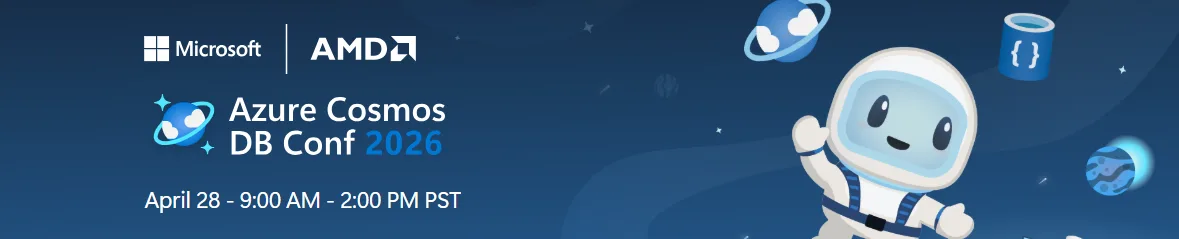
Join us for Azure Cosmos DB Conf 2026, a free global, virtual developer event focused on building modern applications with Azure Cosmos DB.
- Date: April 28, 2026
- Time: 9:00 AM–2:00 PM PT
- Where: Streaming live on the Microsoft Developer YouTube channel, with additional sessions available on demand.
- Free Registration: aka.ms/cosmosconfreg
- Full details: aka.ms/azurecosmosdbconf
- Chat with the community: #nosql on Discord
This year, Azure Cosmos DB Conf will feature 21 speakers from across the globe, bringing together Microsoft engineers, community leaders, architects, and developers to share how they are building modern applications with Azure Cosmos DB. Attendees will hear directly from experts using Azure Cosmos DB to power real systems—from AI agent memory architectures and retrieval-augmented generation pipelines to globally distributed event-driven microservices and cost-efficient high-scale workloads.
You can also expect talks exploring Open Source DocumentDB and Azure DocumentDB (with MongoDB compatibility), demonstrating how developers can build portable architectures that run both on-premises and in the cloud while maintaining full compatibility with the MongoDB developer ecosystem.
Still curious about what you’ll see? Below, you can watch a short recap from Azure Cosmos DB Conf 2025 to get a sense of the technical depth and real‑world focus that shape the conference.
An Expanded Azure Cosmos DB Conf, Powered by AMD

This year’s event is our biggest yet. Thanks to our partnership with AMD, Azure Cosmos DB Conf has expanded from three hours to five hours of live programming, giving us more time for deep technical sessions, product insights, and real‑world engineering stories. That includes a behind‑the‑scenes look at how Azure Cosmos DB runs at planetary scale, with Andrew Liu, Principal GPM, Azure Cosmos DB at Microsoft, walking through the internal architecture that powers request processing, replication, and high availability on AMD‑powered infrastructure across Azure datacenters. From data placement and partitioning to quorum‑based replication and the mechanics behind Request Units and serverless execution, this session trades slides for whiteboards and focuses on how the system actually works under the hood.
Keynote: Azure Cosmos DB Platform Evolution and Real‑World Learnings
 Evolving the Azure Cosmos DB Platform

In the opening keynote, Kirill Gavrylyuk, Vice President of Azure Cosmos DB at Microsoft, will highlight how the platform continues to evolve to support modern production workloads. Over the past year, Azure Cosmos DB has delivered meaningful improvements across AI‑driven applications, retrieval workloads, performance, reliability, and developer productivity—including advances in vector indexing, full‑text and hybrid search, workload control, and security and backup capabilities that help teams build faster and operate with confidence at scale.
From Production Systems to Open Architectures
The keynote will also highlight how developers are applying these capabilities across the broader Azure Cosmos DB ecosystem in real production environments. Kirill will share success stories from teams using Azure Cosmos DB, Azure DocumentDB (with MongoDB compatibility), and the open source DocumentDB project, part of the Linux Foundation, to meet different architectural and operational requirements, including cloud and hybrid deployments, AI applications, real time analytics, and mission critical workloads. These examples reflect how developers choose the right option for their scenario while maintaining consistent performance characteristics, scalability, and operational reliability as systems grow in complexity and scale.
A look at some of the 25 minute sessions at Azure Cosmos DB Conf 2026
Azure Cosmos DB Conf 2026 includes sessions from developers and engineers who are building modern systems with Azure Cosmos DB today. Here are just a few of the talks you’ll see during the event.
AI, agents, and intelligent retrieval
Modern AI applications require more than a vector database—they need persistent memory, coordination between agents, and scalable retrieval systems. Several sessions at Azure Cosmos DB Conf 2026 will explore how developers are using Azure Cosmos DB to power these new AI architectures.
 Farah Abdou, Lead Machine Learning Engineer, SmartServe — Cutting AI Agent Costs with Azure Cosmos DB: The Agent Memory Fabric
In this session, Farah Abdou will demonstrate how Azure Cosmos DB can serve as a unified Agent Memory Fabric for multi-agent AI systems. By combining vector search for semantic caching, Change Feed for event-driven coordination, and optimistic concurrency for conflict prevention, this architecture enables faster agent collaboration while reducing operational complexity.
 Varun Kumar Kotte, Senior Machine Learning Engineer, Adobe — Production RAG on Azure Cosmos DB: Version-Aware Enterprise QA
Varun Kumar Kotte will present a production architecture behind Adobe’s AI Assistant, showing how Azure Cosmos DB supports version-aware retrieval across large enterprise documentation sets. The talk explores how RAG pipelines can maintain semantic accuracy while serving hundreds of thousands of documents with low-latency responses.
Performance, cost, and operating at scale
Running Azure Cosmos DB workloads at scale requires strong visibility into performance, partitioning strategy, and RU consumption. These sessions focus on diagnosing real-world issues and optimizing systems as workloads grow.
 Patrick Oguaju. Software Developer, Next — Designing Cost-Efficient, High-Scale Systems with Azure Cosmos DB
 Anurag Dutt, Multi-Cloud Engineer — From Rising RU Costs to Stable Performance: A Practical Cosmos DB Case Study
Anurag Dutt will examine a real high-volume workload and demonstrate how issues like hot partitions, cross-partition queries, and inefficient indexing were identified and corrected. The session walks through the decision-making process behind each optimization and the resulting improvements in cost and latency.
Distributed systems and event-driven architecture
Azure Cosmos DB often acts as the operational backbone for distributed systems that coordinate work across services and process real-time events.
 Eric Boyd, Founder & CEO, responsiveX — Distributed Locks, Sagas, and Coordination with Cosmos DB
Eric Boyd will explore how Azure Cosmos DB can be used as a coordination layer for distributed workflows. The session covers lock and lease patterns, saga orchestration, and strategies for handling retries, contention, and race conditions across multiple regions. He also shares practical guidance on when to centralize coordination versus when to push responsibility to services themselves. Attendees will leave with concrete patterns they can apply to build more resilient, globally distributed systems without introducing unnecessary coupling or operational overhead.
Tural Suleymani , Engineering Manager, VOE Consulting — Designing High-Scale Event-Driven Microservices with Azure Cosmos DB
Tural Suleymani will share lessons learned from building event-driven microservices using Azure Cosmos DB Change Feed as the backbone for domain events. The session demonstrates patterns for building scalable, loosely coupled systems while maintaining observability and resilience.
Developer productivity and modern development workflows
Developer tooling and workflows play a critical role in building reliable distributed systems. These sessions explore how modern development environments and secure architectures help teams move faster.
 Sajeetharan Sinnathurai, Principal Program Manager, Microsoft — Setting Up Your Azure Cosmos DB Development Environment (and Supercharging It with AI)
Sajeetharan Sinnathurai will show how to configure a complete Azure Cosmos DB development workflow using the emulator, VS Code tooling, testing strategies, and AI coding assistants. The session demonstrates how developers can accelerate development while maintaining best practices for Cosmos DB applications.
 Pamela Fox, Principal Cloud Advocate (Python), Microsoft — Know Your User: Identity-Aware MCP Servers with Cosmos DB
Pamela Fox will demonstrate how to build a Python MCP server that authenticates users with Microsoft Entra ID and securely stores per-user data in Azure Cosmos DB. The session highlights identity-first architectures for AI systems and modern cloud applications.
Migration and hybrid architectures
Modernizing applications often requires bridging existing systems with new cloud-native platforms. Azure Cosmos DB Conf 2026 includes sessions exploring migration strategies and hybrid deployment models.
 Sergiy Smyrnov, Senior Specialist, Data & AI Global Black Belt, Microsoft — From JOINs to JSON: Migrating a Real-World ASP.NET App to Cosmos DB with GitHub Copilot
Sergiy Smyrnov will demonstrate how an AI-assisted workflow can analyze a relational schema, generate a migration plan, and convert an ASP.NET application to run on Azure Cosmos DB for NoSQL. Using the classic AdventureWorks database and a real ASP.NET application, the session walks through the full migration journey—from relational modeling and schema analysis to provisioning Azure Cosmos DB infrastructure and rewriting the application data layer.
 Khelan Modi, Program Manager, Microsoft — One Codebase, Any Cloud: Building a Retail Database with OSS and Azure
Khelan Modi will demonstrate how developers can build applications using MongoDB-compatible APIs that run both on-premises and in the cloud. The session walks through a retail application architecture—including product catalog, inventory, orders, and vector-powered recommendations—built once and deployed using open-source DocumentDB and Azure DocumentDB. Khelan will show how the same drivers, queries, and application code can run across both environments without modification, enabling portable architectures while still benefiting from Azure’s managed capabilities.
Explore the full lineup
These sessions are just a sample of what you’ll find at Azure Cosmos DB Conf 2026. With 21 speakers from around the world, the conference offers a broad look at how developers are using Azure Cosmos DB, open-source DocumentDB, and Azure DocumentDB to build intelligent, distributed, and modern applications.
Visit the Azure Cosmos DB Conf 2026 website for the full speaker list, session details, conference news, and the latest event updates.
Be sure to register now for the live event on April 28, 2026. Registering will help keep you up to speed with email updates from the Azure Cosmos DB team, including speaker announcements, session updates, and other conference news.
We look forward to seeing you there!


0 comments
Be the first to start the discussion.