


Running MongoDB at scale eventually forces a trade-off: invest heavily in managing your own infrastructure or move to a managed service and risk losing the compatibility and portability your team depends on.
Azure DocumentDB is a fully managed, MongoDB-compatible database on Azure, built on an MIT-licensed open-source engine that runs consistently across on-premises, hybrid, and cloud environments. Developers keep the skills and tooling they already have. Infrastructure teams get a pricing model built on compute and storage, with no licensing fees and no throughput unit calculations.
Key Capabilities
MongoDB Compatibility
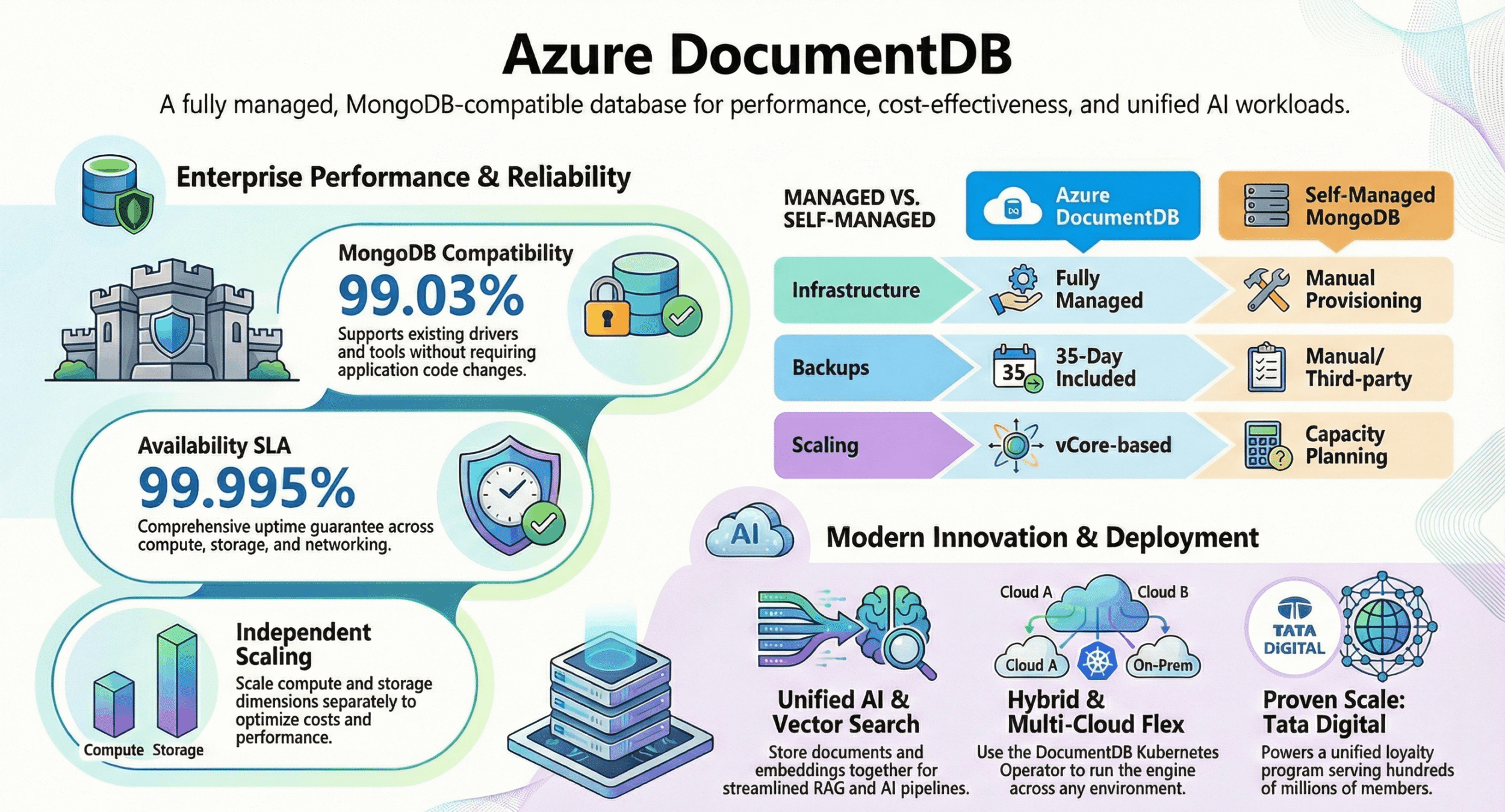
Azure DocumentDB is fully MongoDB-compatible database, so existing drivers, tools, and frameworks connect without modification. MongoDB Shell, LangChain, pymongo, and all major MongoDB drivers are supported out of the box, along with your existing indexes, query patterns, and aggregation pipelines.
DocumentDB delivers 99.03% MongoDB compatibility while keeping the implementation transparent and community-driven
For developers, that means no code changes, no retraining, and no new mental model to adopt. Your team continues working with the tools and patterns they already know. For engineering leads evaluating a migration, it means the scope of the project stays focused on infrastructure, not application code, which significantly reduces both the timeline and the risk of moving a production workload to a managed service.
Predictable Pricing for MongoDB Workloads
Azure DocumentDB uses a straightforward compute and storage pricing model where both dimensions scale independently, with no throughput unit calculations or licensing fees on top. Backups are included at no extra charge for 35 days.
The Price you See is the Price you Pay
| Service | Included |
|---|---|
| Compute | Fixed monthly price |
| Storage | Fixed monthly price |
| Backups (35 days) | Free |
| Metrics and charts | Free |
| Product support | Free |
| Networking | Free |
| Licensing costs | None |
| Additional fees | None |
In practice, that means fewer surprise bills when a query pattern changes, simpler capacity planning conversations with finance, and less time spent modeling cost scenarios before you can commit to a deployment. For teams that have managed throughput-based pricing models before, the operational simplification is significant.
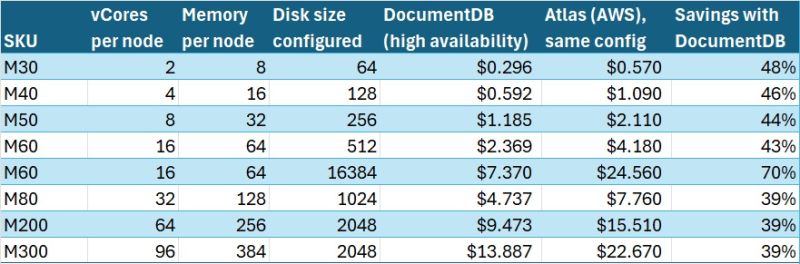
Customers can achieve meaningful cost savings compared to managed MongoDB offerings on AWS, driven by predictable vCore pricing and independent compute and storage scaling
Scaling High-Traffic MongoDB Applications
Azure DocumentDB’s schema-agnostic design means your data model can evolve without migrations or downtime, and its architecture is built to scale with you as traffic grows.
Consider a retail application during a flash sale. Traffic that normally hums along at a steady pace suddenly multiplies within minutes. The database needs to absorb that spike without throttling requests or letting response times creep up. With Azure DocumentDB, you scale up the compute tier to meet the moment, then scale back down once it passes. No over-provisioned cluster sitting idle the rest of the year, and no sharding complexity until your data demands it. The high-throughput, low-latency architecture keeps response times really low through those peaks, which is the difference between a sale that converts and one that doesn’t.
How Tata Neu delivers personalized shopping experiences for millions of users
Tata Digital built exactly this kind of experience on Azure DocumentDB. Their Tata Neu platform serves millions of customers across dozens of brands, with a single sign-on system processing hundreds of authentication requests per second while maintaining millisecond transaction times. NeuPass, their unified loyalty program, consolidates what used to be fragmented programs across brands into one experience for several hundred million members.
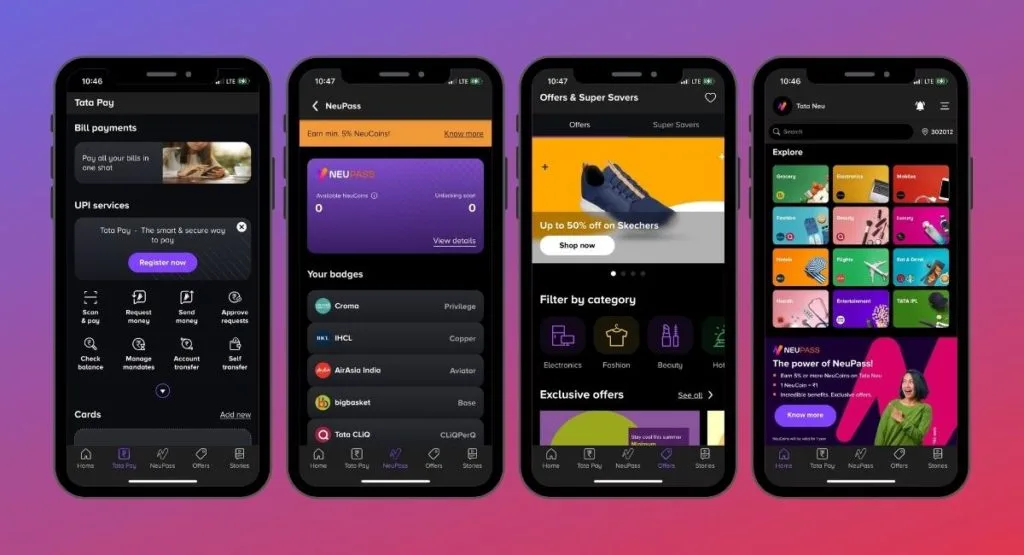
“Azure DocumentDB provides the dependable performance, elasticity, and consistency needed to power Tata Digital’s authentication platform at scale.” — Vinay Vaidya, Chief Technology and Product Officer, Tata Digital
Additionally, the service is backed by a 99.995% availability SLA across the full-service stack, covering compute, storage, and networking. For teams operating at enterprise scale, that end-to-end SLA removes a common gap in availability guarantees that only cover part of the infrastructure.
Hybrid and Multi-Cloud Deployments with DocumentDB
The DocumentDB Kubernetes Operator runs the same open-source engine on-premises, on other clouds, and on Azure. The MongoDB-compatible interface stays consistent across all three environments. For enterprises with data sovereignty requirements or architectural needs that span multiple environments, the same interface can be used across on-premises, cloud, and Azure-managed deployments, enabling hybrid and multi-cloud patterns where required.
A good example is a retailer running point-of-sale systems at the store level alongside a centralized e-commerce and inventory platform. Store databases need to handle transactions locally, even when connectivity is unreliable, while headquarters needs to aggregate that data globally for reporting and fulfillment. Because the same engine runs on both ends, data syncs between on-premises and cloud in real time, often within seconds, and teams avoid the overhead of maintaining separate operational models or wiring together two different database configurations just to keep everything in sync.
Enterprise Integration for MongoDB Workloads
Azure DocumentDB runs as a first-party Azure service, which means it integrates directly with Microsoft Entra ID for authentication and role-based access control, Azure Monitor for metrics and diagnostics, Azure Policy for governance enforcement across your organization, and supports secure networking via Azure Virtual Network (VNet) using Azure Private Link and Private Endpoints.
Vector Search for MongoDB Workloads
Teams building AI applications often end up managing a document store and a separate vector database side by side. Azure DocumentDB includes native vector indexing alongside document data, enabling RAG pipelines and similarity search without introducing a separate vector store. Your documents and your embeddings live in the same collection, queryable together with hybrid search that combines vector similarity, BM25 full-text, and field filters, all over a single connection string.
In independent benchmarking, Azure DocumentDB achieved 11x higher throughput and 14x lower latency against competing solutions.
Start Running MongoDB Workloads on Azure DocumentDB
Create a cluster in the Azure portal, check out the new product page, review pricing, and follow the migration guidance to migrate your MongoDB workloads. Teams can evaluate DocumentDB locally using the open-source project, then move to managed clusters on Azure when ready. We’re excited to see what you build. For teams that need hands-on assistance, several options are available. Teams can nominate for the Cloud Migration Factory program, which provides 100% free migration support with direct Microsoft assistance. The product team is also reachable directly, and the migration support team can be contacted at cdbmigrationsupport@microsoft.com.
About Azure DocumentDB
Azure DocumentDB is a fully managed enterprise-grade MongoDB-compatible database and vector database for modern app development, including AI applications. With its predictable low costs, Open-source project, as well as 99.03% MongoDB compatibility, it is ideal for any MongoDB application running on Azure.


ooo