

Scenario: When Every Millisecond Counts in Gaming
Imagine millions of players logging in at the exact moment a new game season launches. Leaderboards light up, achievements tally, and in-game shops buzz with transactions. In these high-stakes moments, speed and reliability aren’t optional, they’re mission critical. That’s where Azure Cosmos DB with the NoSQL API steps in, powering real-time, global gaming experiences without missing a beat.
Why Gaming Needs a Next-Gen Database
Modern gaming experiences must withstand massive user surges, where game launches and updates can trigger huge spikes in concurrent players much like a virtual stadium filling in seconds. At the same time, players expect seamless play across the globe, demanding smooth, lag‑free gameplay whether they’re in Dublin, Tokyo, or São Paulo. These expectations are compounded by the rise of dynamic game worlds, where modern titles evolve constantly and therefore require databases that can flex and scale on demand to keep every experience responsive and reliable.
Case Study 1: Next Games, Scaling Gaming Experiences
Next Games, acclaimed for its free-to-play mobile successes based on blockbuster franchises such as The Walking Dead and Stranger Things, faced significant challenges as the expectations of the gaming community soared. With increasing player numbers, there was a growing demand for instant updates, precise data tracking, and seamless access to games across the globe. The studio needed a robust and flexible solution capable of supporting nonstop, real-time gameplay while enabling frequent content updates. Their primary challenge was to deliver a platform that could provide reliability, scalability, and security to keep pace with the dynamic world of modern mobile gaming.
To address these complex requirements, Next Games selected Microsoft Azure as the foundation for their cloud infrastructure. By leveraging the advanced capabilities of Azure Cosmos DB, the studio was able to design a bespoke gaming ecosystem precisely suited to the fast-paced nature of their titles. Azure’s suite of features enabled Next Games to meet the needs of modern gamers while streamlining operations for developers.
Game-Changing Results
Agility: Developers had the ability to release new content immediately, delivering fresh episodes and updates to players as soon as they became available.
Scalability: The platform supported multiple games simultaneously, eliminating the need to build new infrastructure for each title.
Global Reach: Expanding into new regions became effortless, with the assurance that game performance would remain robust even under heavy traffic.
Player Experience: Next Games achieved reliable, fair, and engaging gameplay, ensuring that players remained loyal and continually returned for more.
For more information: Next Games meets demands for high performance and scalability with Azure
Case Study 2: Minecraft Earth, Extending Gaming into the Real World

Minecraft Earth set out to transform the renowned Minecraft universe by integrating it with augmented reality (AR), creating a unique experience that seamlessly merged virtual gameplay with players’ real-world surroundings. To achieve this vision, the project demanded real-time geographic data distribution and rapid, low-latency updates for millions of participants worldwide. A critical requirement was a comprehensive, ready-to-use solution capable of managing dynamic, location-based content on a massive scale.
To address these challenges, Minecraft’s team chose Azure Cosmos DB as the foundational platform for Minecraft Earth’s AR experience. This decision enabled the global distribution of game data across multiple regions, ensuring a consistent and engaging gameplay experience for users everywhere. Azure Cosmos DB’s multi-model capabilities supported the storage of varied data types, such as player states, geospatial coordinates, and in-game assets, while also delivering the low-latency performance necessary for real-time interactions and updates.
Performance Highlights
Simplified Global Deployment: The turnkey geo replication and failover mechanisms streamlined the application globally and reduced the complexity of international rollouts.
Azure Cosmos DB’s Millisecond Latency: Delivering Real-time AR experiences and ensuring interactions are seamless whether users are collaborating, gaming, or engaging with dynamic content.
Scalable Architecture: Supporting millions of concurrent players simultaneously, eliminating bottlenecks and ensuring an uninterrupted experience for every participant.
For more information:
Minecraft Earth and Azure Cosmos DB Part 1
Minecraft Earth and Azure Cosmos DB Part 2
Analogy: Think of Azure Cosmos DB as an elastic stadium that instantly adds more seats and entrance gates as fans pour in, ensuring nobody waits in line.
Let’s see how some of the other Azure Cosmos DB’s features seamlessly support building a robust gaming experience.
Leader Board Bucketing: Partitioning Strategies and Player Engagement
Azure Cosmos DB’s NoSQL API mandates partitioning and leveraging this capability strategically adds significant value. For example, in the gaming scenario, implementing leaderboard bucketing distributes player scores across logical partitions such as by region or rank tiers reducing contention and optimizing Request Unit (RU) consumption. By distributing leaderboard entries across logical buckets, the database can scale horizontally and maintain high performance. This approach ensures global leaderboards refresh instantly, even under massive concurrency, delivering a seamless gaming experience. Azure Cosmos DB Partitioning
TTL for Collections: Auto-Expiry for Sessions and Events, Cost Optimisation
Time-to-Live (TTL) in Azure Cosmos DB allows developers to automatically expire data in collections, such as game sessions and event logs. By setting TTL policies, outdated or irrelevant data is removed without manual intervention, reducing storage requirements and optimising Request Unit (RU) costs. This enables gaming applications to maintain lean datasets, improve performance, and control operational expenses efficiently. Azure Cosmos DB Time to Live
Change Feed Feature: Streaming Data for Live Operations
The Change Feed feature in Azure Cosmos DB provides continuous streaming of data changes to downstream consumers. This is invaluable for live operations, such as updating leaderboards, triggering in-game events, or synchronising player progress in real-time. By harnessing Change Feed, developers can build reactive gaming systems that respond instantly to user actions and system events, ensuring dynamic and interactive experiences. Azure Cosmos DB Change Feed
AI Integration and Vector Search: Smarter, More Engaging Games
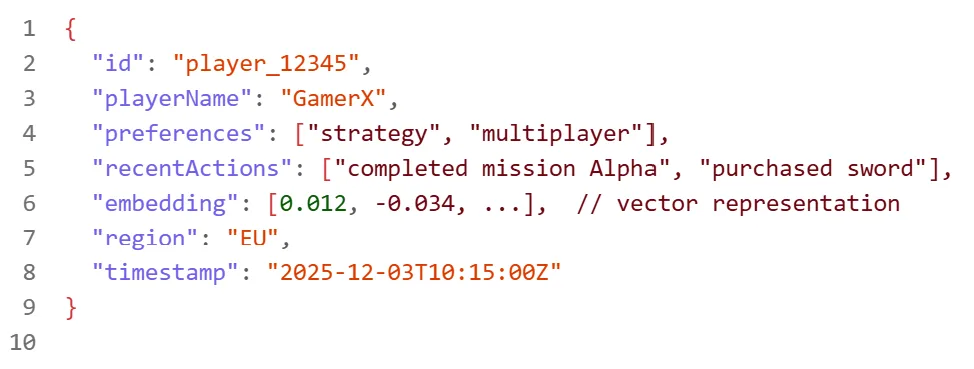
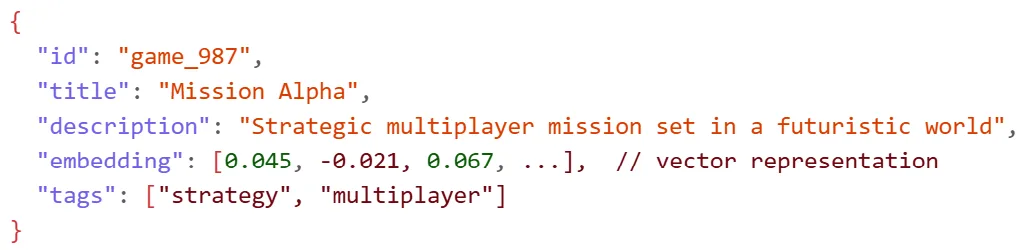
Imagine a live in-game assistant that helps players with tips or troubleshooting instantly. Using Azure Cosmos DB’s vector search, developers can store embeddings of player behaviour and recommend similar games or items. This starts by converting player interaction data such as session history, achievements, and preferences into high-dimensional vectors using embedding models (e.g., OpenAI or Hugging Face). These vectors are then stored in Azure Cosmos DB alongside metadata for fast retrieval. RAG in Azure Cosmos DB.
Examples to Model Data for RAG Search
| Player Profile Data | Game Content Data |
 |
 |
RAG Workflow Scenarios
Live Game Assistant: To create personalized tips for players, first retrieve the player context and embeddings from Azure Cosmos DB. This foundational data is then augmented by querying similar missions using vector search, allowing for relevant comparisons and insights. Finally, a large language model (LLM) is used to generate tailored recommendations, ensuring that each player receives guidance specifically suited to their unique profile and mission history.
| Example Query: |  |
Personalized Recommendations: Fetch similar game embeddings and generate a recommendation narrative: “Players like you enjoyed Mission Alpha for its cooperative challenges.”
Conclusion: Azure Cosmos DB, The Backbone of Modern Gaming
With its unmatched scalability, RAG support, and developer-friendly features, Azure Cosmos DB NoSQL API is the powerhouse behind today’s most ambitious gaming platforms. Whether you’re launching the next global sensation or scaling up your existing hit, Azure Cosmos DB empowers you to deliver experiences that thrill players everywhere, every time. Start small, experiment with the accelerator, and scale globally with Azure Cosmos DB’s NoSQL API.
Next Steps: Let’s Build Together
Are you eager to start building your own gaming app but unsure where to begin? You’re not alone and that’s exactly why we’re thrilled to announce our end-to-end solution accelerator. This powerful tool is designed to kickstart your journey, providing hands-on guidance and practical resources for developing a fully functional gaming application using Azure Cosmos DB.
With this accelerator, you’ll be able to leverage Azure Cosmos DB’s modern capabilities from the ground up. Whether you’re new to gaming development or seeking best practices for scalability and performance, the accelerator walks you through each stage covering everything from data modeling and partitioning for gaming scenarios, leaderboard bucketing and RU tracking, to simulating concurrent gameplay across regions and using Change Feed for live operations and vector search with Retrieval Augmented Generation (RAG).
Let’s dive in and discover how this accelerator can empower you to turn your gaming ideas into reality. A working notebook you can adapt, and extend for building scalable, real-time gaming apps.
- Explore the Azure Cosmos DB documentation for deeper technical guidance.
- Try the Gaming solution accelerator to see capabilities firsthand.
- Connect with Azure experts or join community forums for
- Comprehensive guidance on architecture, core features, and strategies to help you design and optimize gaming solutions.
- Access exclusive programs and offers designed to accelerate your adoption journey.
About Azure Cosmos DB
Azure Cosmos DB is a fully managed and serverless NoSQL and vector database for modern app development, including AI applications. With its SLA-backed speed and availability as well as instant dynamic scalability, it is ideal for real-time NoSQL and MongoDB applications that require high performance and distributed computing over massive volumes of NoSQL and vector data.
To stay in the loop on Azure Cosmos DB updates, follow us on X, YouTube, and LinkedIn.


0 comments
Be the first to start the discussion.