


The MSSQL extension for VS Code v1.41 continues to evolve, delivering features that make SQL development more integrated, more powerful, and more developer-friendly. In this release, we’re introducing the Public Preview of Schema Designer with GitHub Copilot, Data API builder, and SQL Notebooks, along with the General Availability of Data-tier Application, Fabric integration, and SQL Database Projects static code analysis: seven capabilities that bring AI-powered schema design, instant API generation, interactive notebooks, and enterprise-grade tooling directly into your development workflow inside Visual Studio Code.
What’s new in MSSQL extension for VS Code v1.41
Here’s a summary of the key features in this release:
- Schema Designer with GitHub Copilot (Preview): Natural language schema design within the visual Schema Designer
- SQL Notebooks (Preview): Jupyter-based SQL notebooks with rich results and multi-kernel support
- Data API builder (Preview): Create REST, GraphQL, and MCP endpoints for SQL databases
- Edit Data (GA): Browse and modify table data inline with filtering, sorting, and export to JSON, Excel, and CSV
- Data-tier Application (GA): Deploy, extract, import, and export DACPAC and BACPAC files
- Fabric integration (GA): Browse Fabric workspaces and provision SQL databases
- SQL Database Projects static code analysis (GA): Detect T-SQL antipatterns and defects with built-in code analysis rules
Schema Designer with GitHub Copilot (Preview)
The Schema Designer now includes deep GitHub Copilot integration, enabling developers to design and evolve database schemas using natural language: directly within the visual canvas. Instead of manually adding tables, columns, and relationships through the UI, you can describe what you need in plain English and watch the schema materialize in real time.
Key highlights
- Natural language schema creation: Describe your schema in conversational prompts, and GitHub Copilot generates the tables, columns, data types, and relationships automatically, all reflected live in the visual diagram and T-SQL script.
- Schema evolution: Modify existing schemas by asking GitHub Copilot to add columns, rename tables, change data types, or create new relationships. Each change is presented individually with Accept/Undo controls so you stay in full control.
- Change review with diff view: Before applying changes to your database, review a consolidated diff showing all pending modifications. Schema-qualified names (schema.table, schema.column) make it easy to understand exactly what will change.
- Bootstrap from scratch: Start from an empty database and build a complete application schema using only natural language prompts, ideal for rapid prototyping and proof-of-concept work.
- Import external artifacts: Feed JSON files, documents, or even images into the Schema Designer and let GitHub Copilot generate matching schema elements, accelerating migrations and reverse engineering workflows.
- Validation and guardrails: GitHub Copilot flags potential issues like missing primary keys, invalid data types, and normalization concerns, helping you catch design problems early.
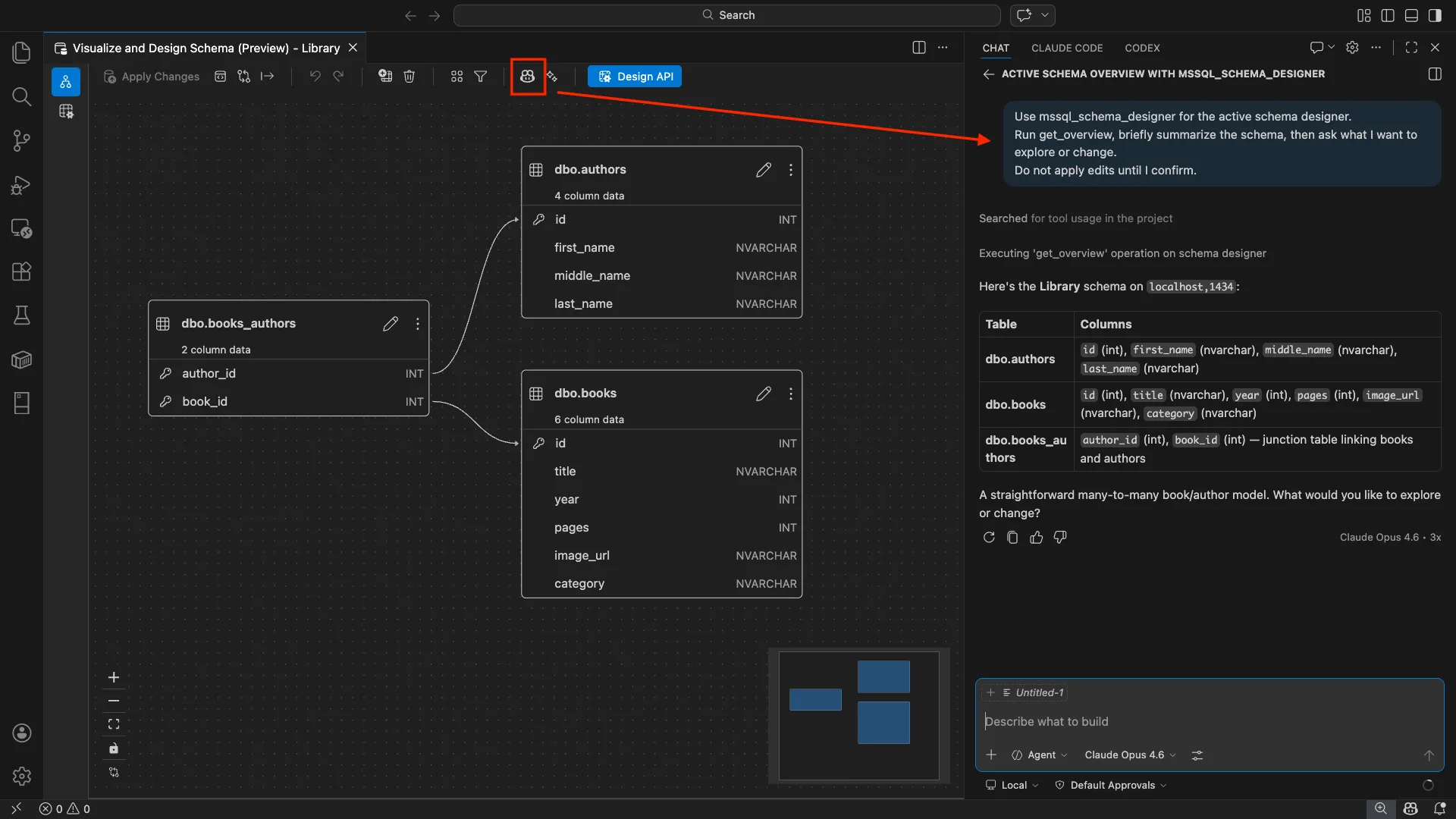
For full documentation, see GitHub Copilot integration in Schema Designer.
SQL Notebooks (Preview)
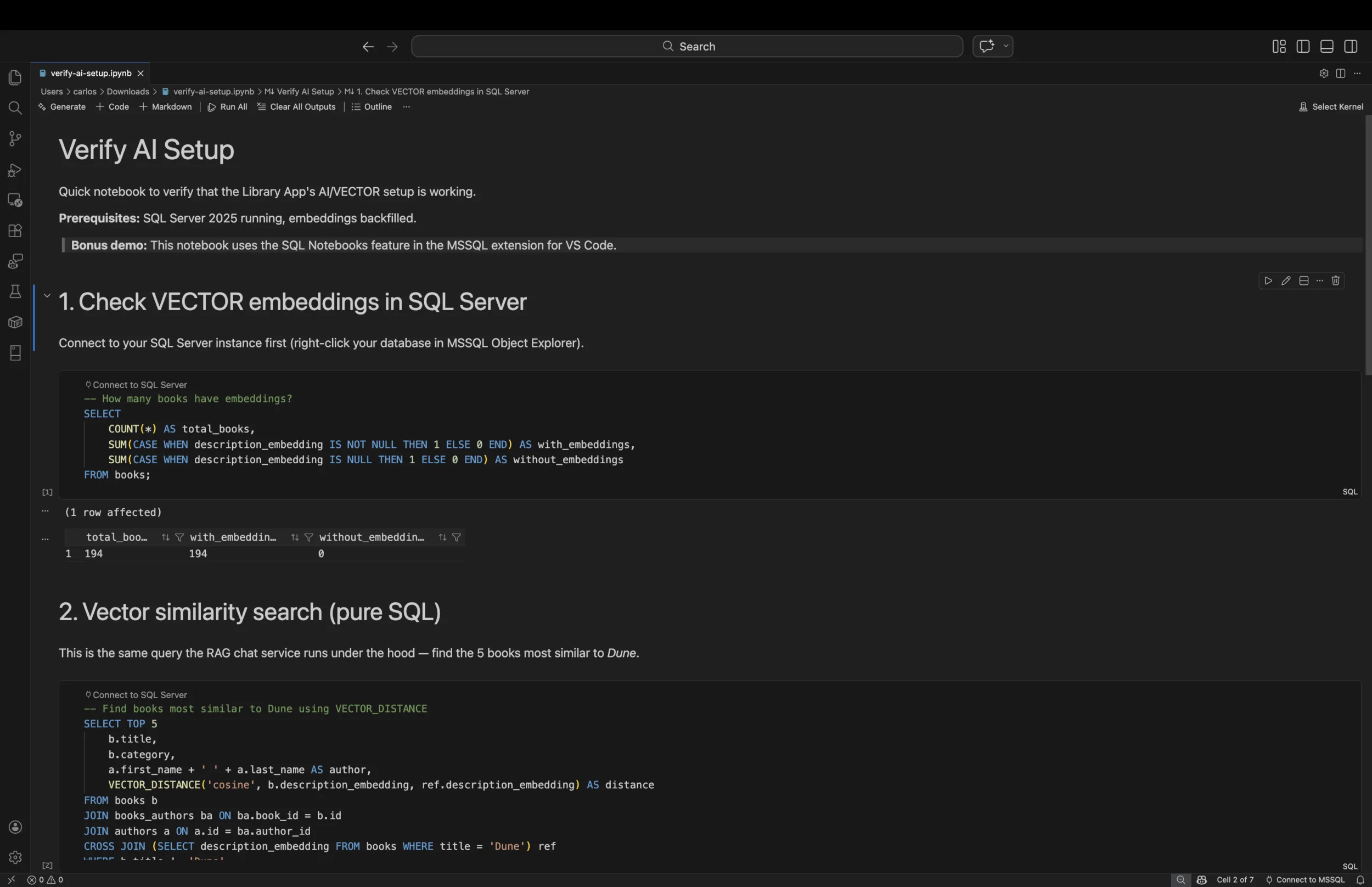
SQL Notebooks bring native Jupyter notebook support to the MSSQL extension for VS Code v1.41, combining interactive SQL query execution with Markdown documentation cells for reproducible analysis, runbook documentation, and educational content.
Key highlights
- Interactive SQL execution: Execute T-SQL queries cell by cell with inline results displayed in a rich data grid that supports sorting, filtering, null highlighting, and copy with headers.
- Native
.ipynbformat: Notebooks use the standard Jupyter.ipynbformat, making them portable and compatible with existing notebook tooling and version control workflows. - Markdown documentation: Combine SQL cells with Markdown cells to create self-documenting query collections, runbooks, and tutorials.
- IntelliSense support: Get table and column suggestions from your active database connection as you write SQL, bringing the same productivity features you expect from the query editor.
- Database context switching: Connect each notebook to a SQL Server instance and switch between databases on the same server without reconnecting.
- Multi-kernel support: Install complementary extensions like the Jupyter extension to unlock additional kernels such as Python, enabling you to combine SQL and Python cells in the same notebook for end-to-end data workflows.
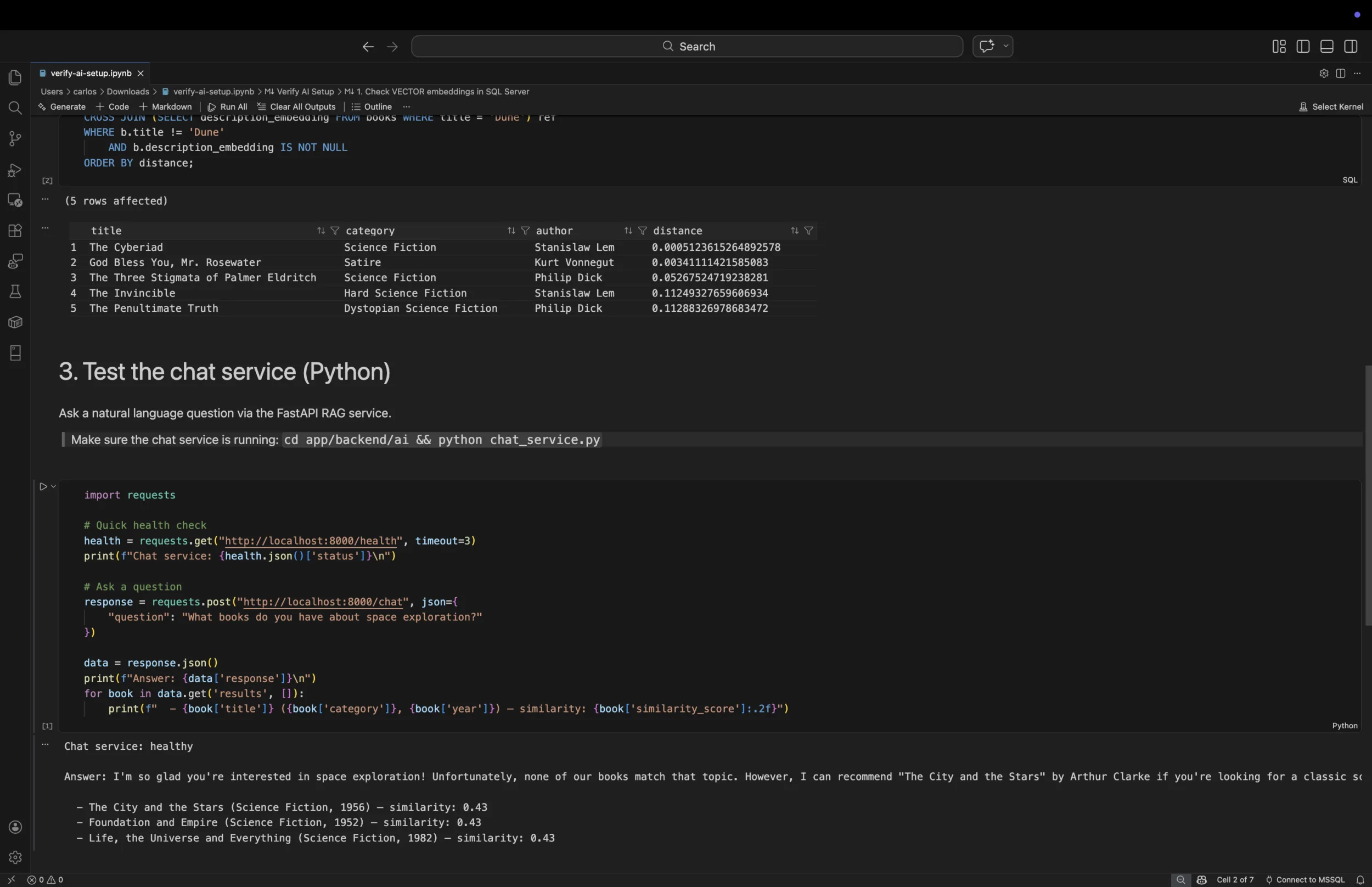
For full documentation, see SQL Notebooks.
Data API builder (Preview)
Data API builder brings a visual, guided experience for creating REST, GraphQL, and MCP endpoints directly from your SQL Server tables: no configuration files required. Combined with built-in GitHub Copilot chat integration, you can go from a database to a fully functional API in minutes.
Key highlights
- Entity selection and configuration: Select tables from your database, organized by schema, and configure CRUD permissions (Create, Read, Update, Delete) independently for each entity with granular role-based access control.
- Multiple API types: Choose REST, GraphQL, MCP, or any combination. Data API builder generates the appropriate endpoints and configuration automatically.
- Configuration preview: Review the generated Data API builder configuration file (JSON) in a read-only Definition panel before deploying, ensuring full transparency into what will be created.
- One-click Docker deployment: Deploy your API as a local Docker container with an automated prerequisite check wizard that validates Docker availability, pulls the Data API builder image, and starts the container.
- Built-in API testing: Once your API is running, open the Swagger UI (REST) or Nitro GraphQL playground endpoints directly in the VS Code Simple Browser, so you can validate your APIs without ever leaving the editor.
- GitHub Copilot chat integration: Use natural language in GitHub Copilot chat to configure entities, set permissions, and generate Data API builder configurations. Ask questions like “Add all HR tables with read-only access” and GitHub Copilot handles the rest.
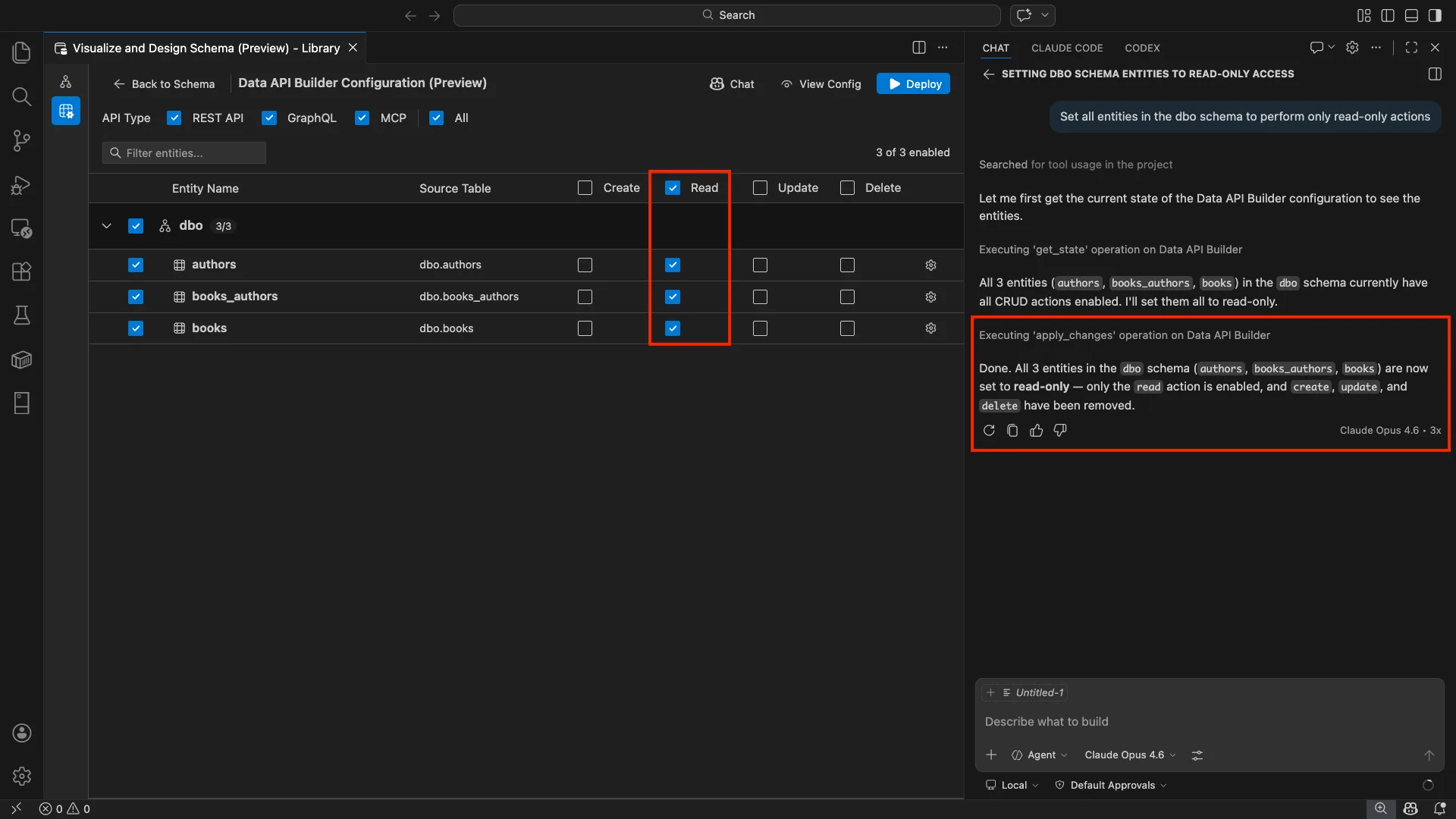
For full documentation, see Data API builder
Edit Data (GA)
Edit Data is now generally available. The feature provides an intuitive, interactive way to browse and modify table data directly within the editor without writing Transact-SQL data manipulation language (DML) statements. Developers can interact with their data in an intuitive interface, simplifying everything from quick edits to in-depth validation. The GA release adds UI improvements, advanced filtering and sorting, and export options to JSON, Excel, and CSV.
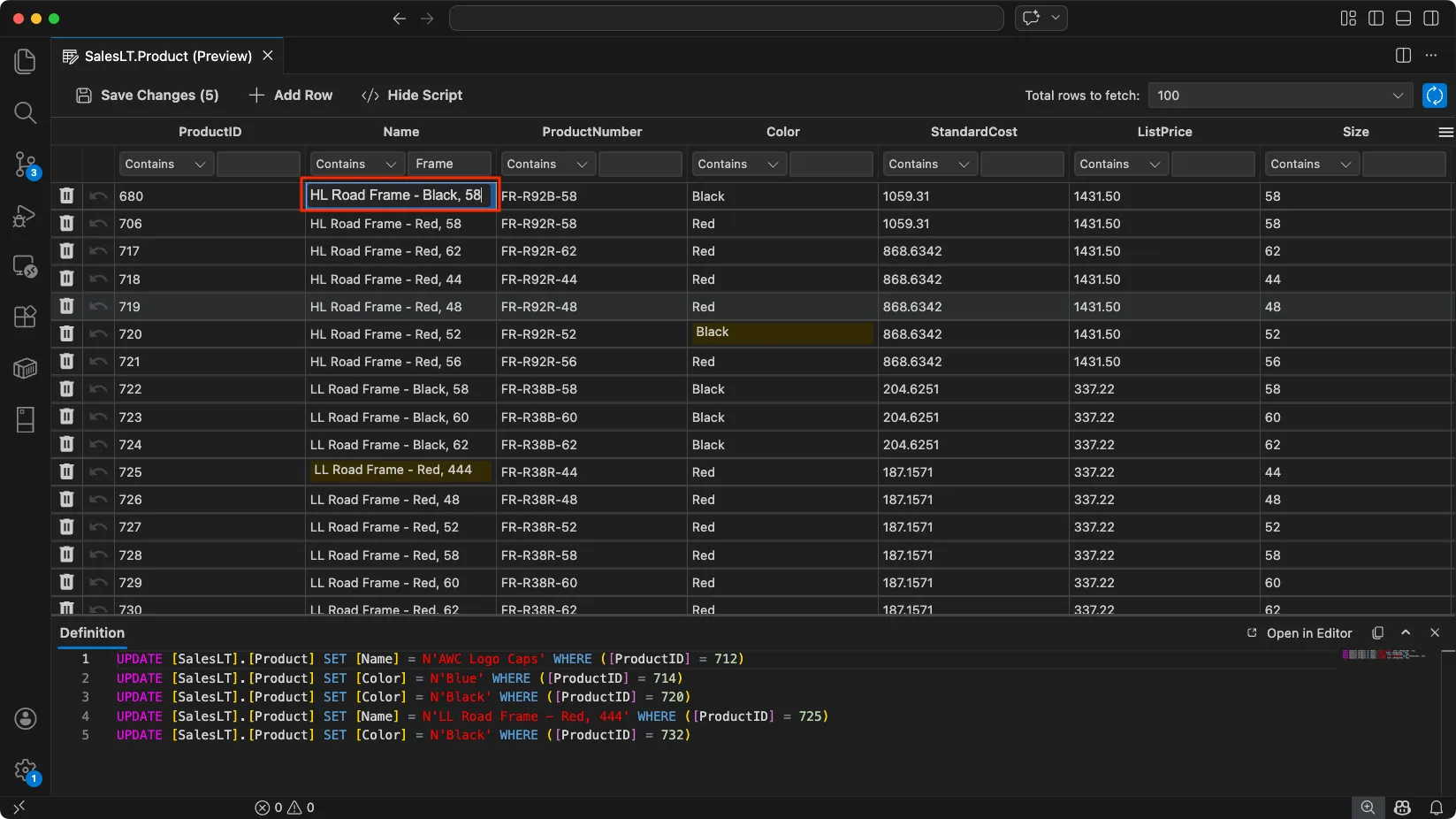
For full documentation, see Edit Data.
Data-tier Application (GA)
The Data-tier Application experience is now generally available. This feature provides an intuitive, wizard-driven UI for working with DACPAC and BACPAC files directly from the Object Explorer: no command-line tools required.
Key highlights
- Publish DACPAC: Deploy
.dacpacfiles to new or existing SQL databases. - Extract DACPAC: Extract the schema from a SQL database into a
.dacpacfile for version control or sharing. - Import BACPAC: Import
.bacpacfiles to create new databases with schema and data. - Export BACPAC: Export schema and data from a SQL database to a
.bacpacfile for migration or archival.
Right-click the Databases node or a specific database in Object Explorer to access all four operations. For full documentation, see Data-tier Application.
Fabric integration (GA)
Fabric integration is now generally available, providing seamless connectivity to Microsoft Fabric SQL databases and SQL analytics endpoints with zero connection strings required, plus integrated SQL database provisioning directly from VS Code.
Key highlights
- Fabric workspace browsing: Browse workspaces, search across databases, and connect to SQL databases or SQL analytics endpoints using Microsoft Entra ID authentication with persistent sign-in and tenant switching.
- SQL database provisioning: Create new Fabric SQL databases directly from the Deployments page with a guided workflow that handles authentication, workspace selection, naming, and auto-connection: typically in under one minute.
- Cross-extension support: Open Fabric databases directly from the Fabric VS Code extension using the Open in MSSQL action.
For full documentation, see Fabric integration.
SQL Database Projects static code analysis (GA)
SQL Database Projects now supports static code analysis in VS Code. Enable it by adding <RunSqlCodeAnalysis>True</RunSqlCodeAnalysis> to your .sqlproj file, and the built-in rules will run automatically on every project build to flag T-SQL design issues, naming convention violations, and performance pitfalls.
Conclusion
The MSSQL extension for VS Code v1.41 introduces Schema Designer with GitHub Copilot, Data API builder, SQL Notebooks, Edit Data (GA), Data-tier Application (GA), Fabric integration (GA), and SQL Database Projects static code analysis (GA): seven major updates that bring AI-powered schema design, instant API generation, interactive notebooks, and enterprise-grade tooling to your SQL development workflow. Together, these capabilities make the MSSQL extension more powerful, more integrated, and more developer-friendly than ever.
If there’s something you’d love to see in a future update, here’s how you can contribute:
- 💬 GitHub discussions – Share your ideas and suggestions to improve the extension
- ✨ New feature requests – Request missing capabilities and help shape future updates
- 🐞 Report bugs – Help us track down and fix issues to make the extension more reliable
Want to see these features in action?
Thanks for being part of the journey—happy coding! 🚀


Excellent for addition in vs code ide.